IAEA Ends First Nuclear Security Review of Pakistan in Karachi
The IAEA's first IPPAS nuclear security review of Pakistan ended in Karachi on 9 October 2026. What it checked, KANUPP's role and why the report stays secret.
The International Atomic Energy Agency (IAEA) finished its first ever nuclear security peer review of Pakistan on 9 October 2026 in Karachi. The Foreign Office said the team reviewed Pakistan's laws and rules on protecting nuclear material and visited the old Karachi nuclear plant, KANUPP-1, which is being taken apart.
The review is called an IPPAS mission. IPPAS stands for International Physical Protection Advisory Service. It is a check that a country asks for itself. Pakistan invited the team, and the Pakistan Nuclear Regulatory Authority (PNRA), the national nuclear regulator, hosted it.
We read the Foreign Office statement, the IAEA's own page on how IPPAS works, and PNRA's pages on the mission and on Pakistan's nuclear plants. Here is what the review is, what was confirmed, and what was not made public.
The IAEA nuclear security review of Pakistan ended on 9 October
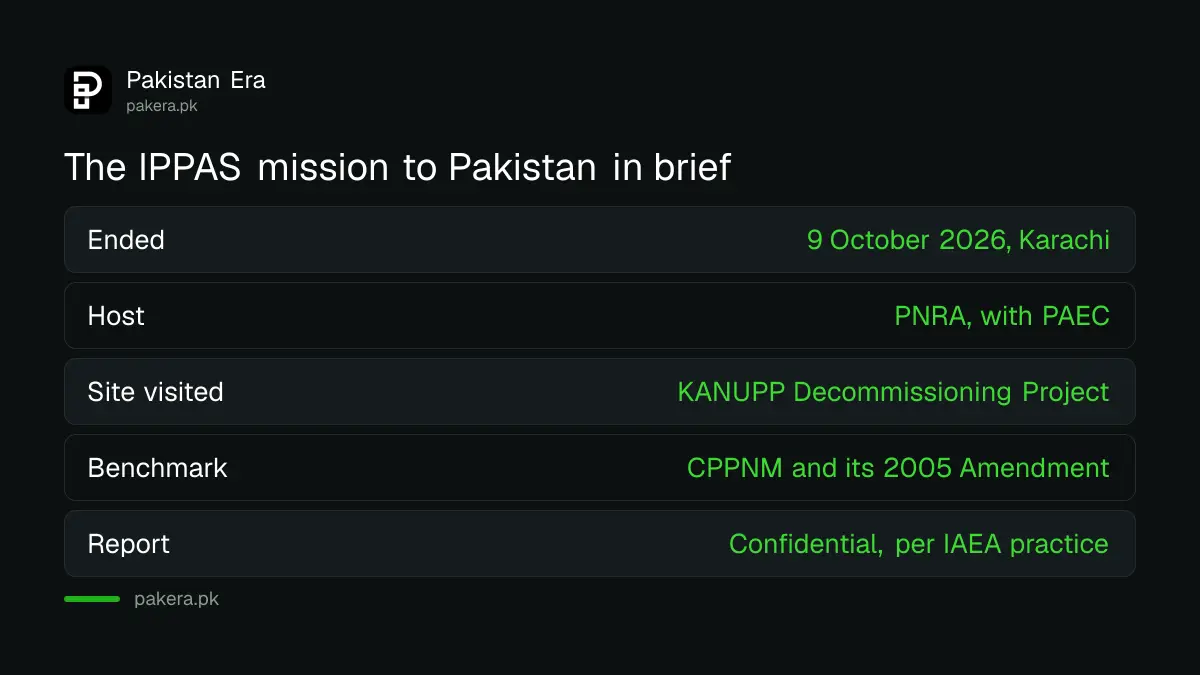
The Ministry of Foreign Affairs said on 9 October 2026 that the IAEA's IPPAS mission to Pakistan "concluded today in Karachi". The review was hosted by PNRA with the Pakistan Atomic Energy Commission (PAEC) and other national bodies. Its stated aim was a transparent review of Pakistan's national nuclear security regime.
The Foreign Office statement says three things happened:
- A team of international experts reviewed the national legal and regulatory framework for nuclear security.
- The team visited the KANUPP Decommissioning Project in Karachi, which covers the former Karachi Nuclear Power Plant Unit-1.
- The IAEA's Deputy Director General for Nuclear Safety and Security called it the first IPPAS mission in Pakistan.
The statement does not give the start date of the mission or the names of the team members. It also does not list any findings, and that is normal for this kind of review, as the next section explains.
IPPAS is a peer review that a country requests
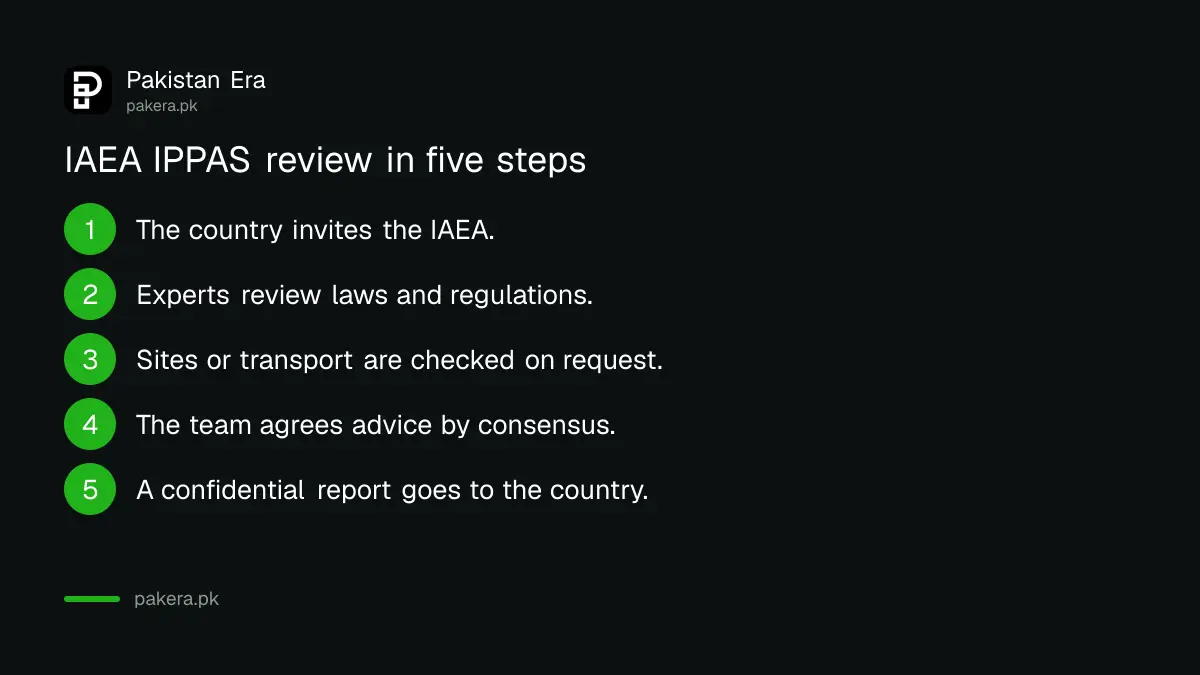
An IPPAS mission is advice, not an inspection with penalties. The IAEA created the service in 1995. A team of nuclear security experts from other countries compares a state's practice with international rules and IAEA guidance, then suggests improvements.
The IAEA's page says a mission always reviews the national legal and regulatory framework. If the country asks, it can also look at security at specific facilities, security during transport of nuclear and radioactive material, and computer security. The team reaches its conclusions by consensus.
The main benchmark is the Convention on the Physical Protection of Nuclear Material, known as the CPPNM, and its 2005 Amendment. The Foreign Office statement names both. In plain words, these are the treaty rules on guarding nuclear material from theft and sabotage.
One detail matters for anyone hoping to read the results. The IAEA says it treats IPPAS mission reports as highly confidential. So the public will likely see statements, as we did on 9 October, but not the report itself.
Pakistan prepared for this review for two years
The mission did not come out of nowhere. PNRA's own page records a National Workshop on IPPAS held at its headquarters in Islamabad from 10 to 12 September 2024. That workshop said the mission was planned for 2025 to 2026.
An IAEA team with experts from Lithuania and the United Kingdom ran the workshop. PNRA says 26 participants attended from PAEC, the Strategic Plans Division, the Ministry of Foreign Affairs and PNRA itself.
- September 2024: PNRA hosts a three-day IPPAS preparation workshop in Islamabad.
- 2025 to 2026: the mission is planned, according to PNRA.
- Early October 2026: the IAEA team reviews the legal framework and visits the KANUPP site.
- 9 October 2026: the mission ends in Karachi, and the Foreign Office announces it.
- Next: a confidential report to Pakistan, and possible follow-up help if Pakistan asks.
KANUPP-1 is Pakistan's first nuclear plant, now being dismantled
The team's site visit was to Karachi Nuclear Power Plant Unit-1, called K-1 or KANUPP-1. PNRA describes it as a 137 megawatt reactor and Pakistan's first nuclear power plant. It ran past its 30-year design life and stopped operating in August 2021.
PNRA issued its decommissioning licence on 27 June 2022. The chosen method is deferred dismantling, which means the plant is taken apart in stages over time rather than all at once. A plant in that stage still holds material that must be guarded, which is one reason a security review would look at it.
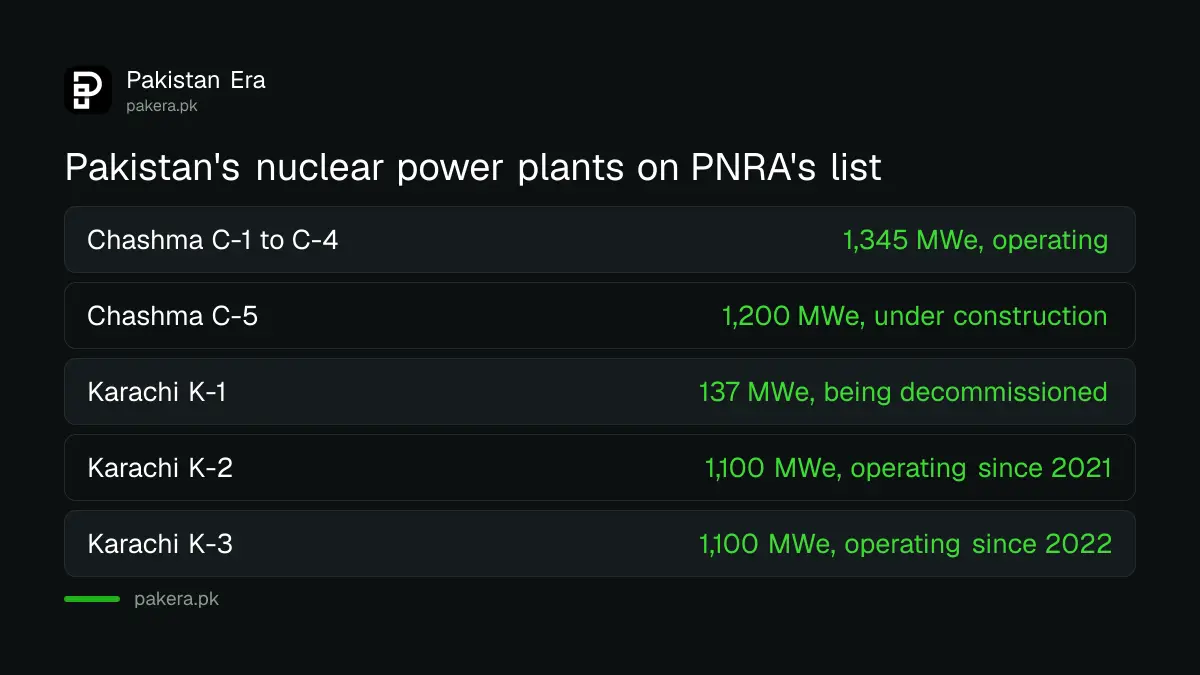
PNRA's page lists the rest of Pakistan's nuclear power fleet. Six of them are operating, one is under construction and one is being decommissioned. All of them fall under PNRA's licensing and inspection.
| Plant | Capacity | Status on PNRA's page |
|---|---|---|
| Chashma Unit-1 (C-1) | 325 MWe | Operating since 2000 |
| Chashma Unit-2 (C-2) | 340 MWe | Operating since 2011 |
| Chashma Unit-3 (C-3) | 340 MWe | Operating since 2016 |
| Chashma Unit-4 (C-4) | 340 MWe | Operating since 2017 |
| Chashma Unit-5 (C-5) | 1,200 MWe | Construction licence issued December 2024 |
| Karachi Unit-1 (K-1) | 137 MWe | Being decommissioned, licence 27 June 2022 |
| Karachi Unit-2 (K-2) | 1,100 MWe | Operating since 2021 |
| Karachi Unit-3 (K-3) | 1,100 MWe | Operating since 2022 |
What the IAEA and PNRA said, and what is still unknown
Both sides spoke warmly, which is usual at the end of a peer review. The Foreign Office says the IAEA team praised the cooperation, transparency and professionalism shown by Pakistan. The IAEA's Deputy Director General said the mission showed Pakistan's commitment to further improving its nuclear security regime.
The PNRA Chairman said Pakistan gives the highest priority to the safety and security of its nuclear sites. He said Pakistan was ready to share its expertise with the global nuclear security system.
Three things are not public. We did not find a list of findings, recommendations or "good practices", because the report is confidential. We did not find a separate IAEA press release on this mission when we checked. And no date has been given for any follow-up mission.
The review also landed in a busy week for Pakistan's diplomacy. The UN Secretary-General's meetings with Pakistan's leaders ended on 8 October, and a senior Holy See diplomat was also in Islamabad, as our report on the Archbishop Gallagher visit sets out.
Common questions
What is an IPPAS mission?
It is a voluntary IAEA peer review of how a country protects nuclear and other radioactive material. International experts compare the country's laws and practice with treaty rules and IAEA guidance, then give advice.
Was this the first IPPAS mission to Pakistan?
Yes. The Foreign Office quoted the IAEA's Deputy Director General as calling it the first IPPAS mission in Pakistan.
Where did the IAEA team go in Pakistan?
The statement names one site visit, the KANUPP Decommissioning Project in Karachi. The team also reviewed the national legal and regulatory framework.
Will the IAEA publish the report?
Unlikely. The IAEA says it treats IPPAS mission reports as highly confidential. Countries sometimes share summaries, but none was public when we checked.
Is KANUPP still producing electricity?
No. PNRA says K-1 operated until August 2021 and received a decommissioning licence on 27 June 2022. K-2 and K-3 at the same Karachi site are operating.
How we verified this
What we checked, where we read it, and what we could not confirm.
Last checked on 10 October 2026 at about 7:30pm PKT. We read the Ministry of Foreign Affairs press release of 9 October 2026 on the conclusion of the IPPAS mission, the IAEA's page describing the International Physical Protection Advisory Service, PNRA's page on the September 2024 IPPAS national workshop, and PNRA's nuclear power plants page. The mission's start date, team list and findings were not published in these sources.
About the author

Global Affairs & Political Economy Writer
Muhammad Hatim is a book lover who started writing because he enjoys it. At Pakistan Era he writes about international relations, geopolitics and the global economy, with a particular interest in South Asia and the forces behind current events.