Pakistan Rejects India's New Political Map Showing Parts of Kashmir
Pakistan's Foreign Office rejected India's new political map of Jammu and Kashmir on 9 October 2026 as legally void. What it said and the other October rows.
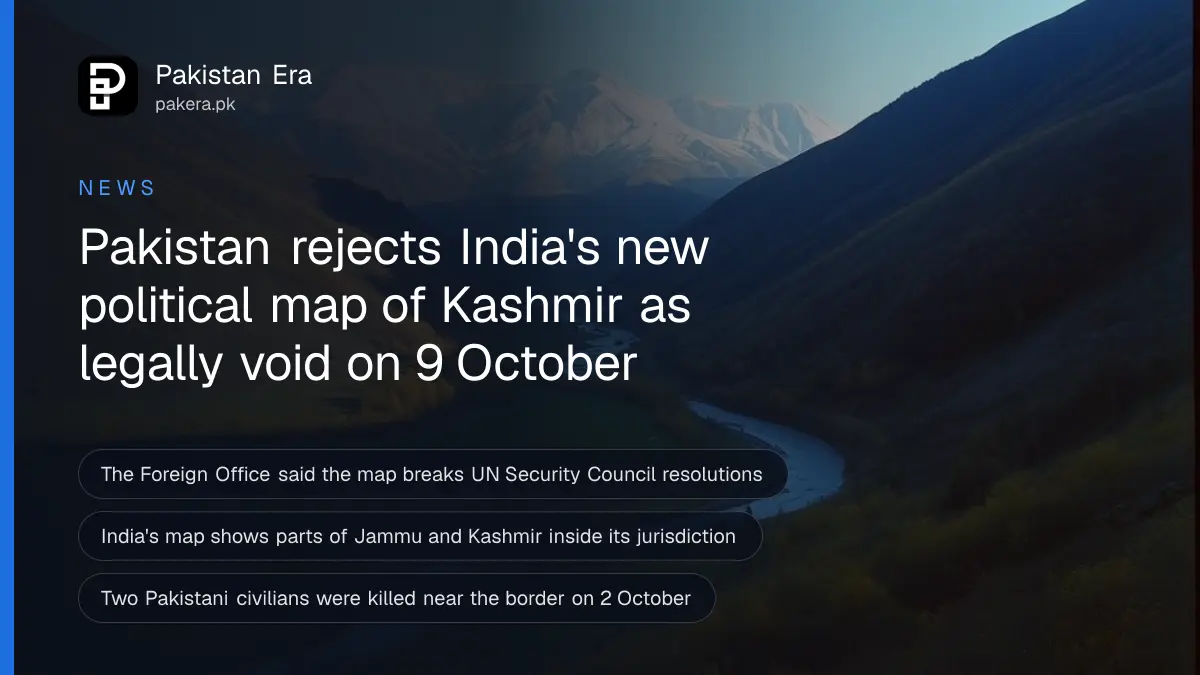
Pakistan has rejected a new Indian political map that shows parts of the disputed region of Jammu and Kashmir inside India and gives some places new standardised names. The Foreign Office spokesperson called it "legally void" at the weekly briefing in Islamabad on 9 October 2026.
The map was raised by a journalist, who said it was dated 2 October 2026. The spokesperson answered that "no unilateral action by India can alter the internationally recognised disputed status of Jammu and Kashmir". It is the latest of several Pakistan and India disputes in the first ten days of October.
Pakistan called India's new map legally void
The Foreign Office said Pakistan "categorically rejects" what it called India's "act of cartographic aggression". Cartographic means map-making. The objection covers two things: marking and renaming places with so-called standardised names, and drawing parts of Jammu and Kashmir as falling within India's territorial jurisdiction.
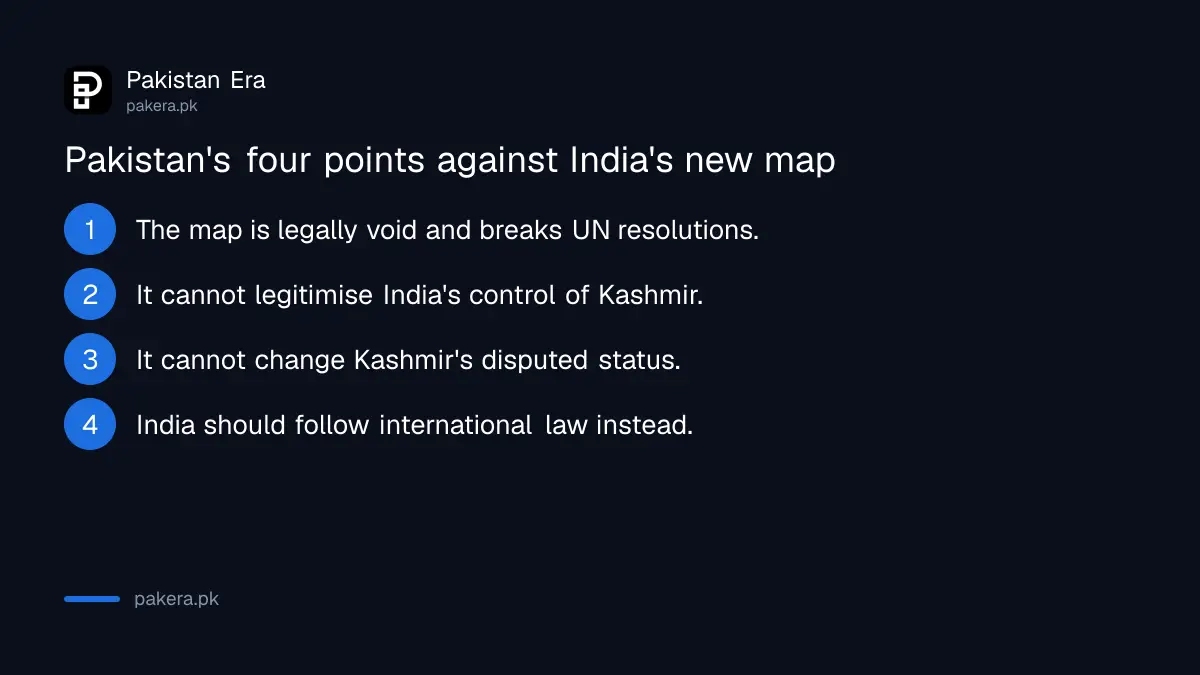
The spokesperson made four points, which we have put in plain words:
- Any one-sided map exercise by India is legally void and breaks United Nations Security Council resolutions.
- Such steps cannot make India's control of large parts of Jammu and Kashmir legitimate.
- No Indian action can change the dispute's internationally recognised status, or the Kashmiri people's right to decide their future through a free and fair vote under UN supervision.
- India should follow international law and the Security Council resolutions instead of "futile cartographic exercises".
We could not find the Indian map on an Indian government page ourselves, so the 2 October date is as the journalist described it. Pakistan's rejection is on the record in the Foreign Office's own transcript.
Why a map matters in the Kashmir dispute
Maps are how states put a claim on paper. The Kashmir dispute has been on the UN Security Council's agenda since 1948. Pakistan's position is that the region's final status must be settled under those resolutions through a plebiscite, a public vote of the people.
A map that draws the whole region inside one country does not change anything on the ground. What it does is restate a claim. That is why Pakistan answers each such map formally, so that silence is never read as acceptance.
Pakistan made the same argument to the UN Secretary-General a few days earlier. During António Guterres's meetings with Pakistani leaders from 6 to 8 October, the Foreign Minister restated Pakistan's position on Kashmir. The Secretary-General also visited the headquarters of the UN Military Observer Group in India and Pakistan (UNMOGIP), the UN team that has watched the ceasefire line since 1949.
Other Pakistan and India disputes in October 2026
The map was one of five India-related items in the 9 October briefing. Taken together, they show how strained relations are.
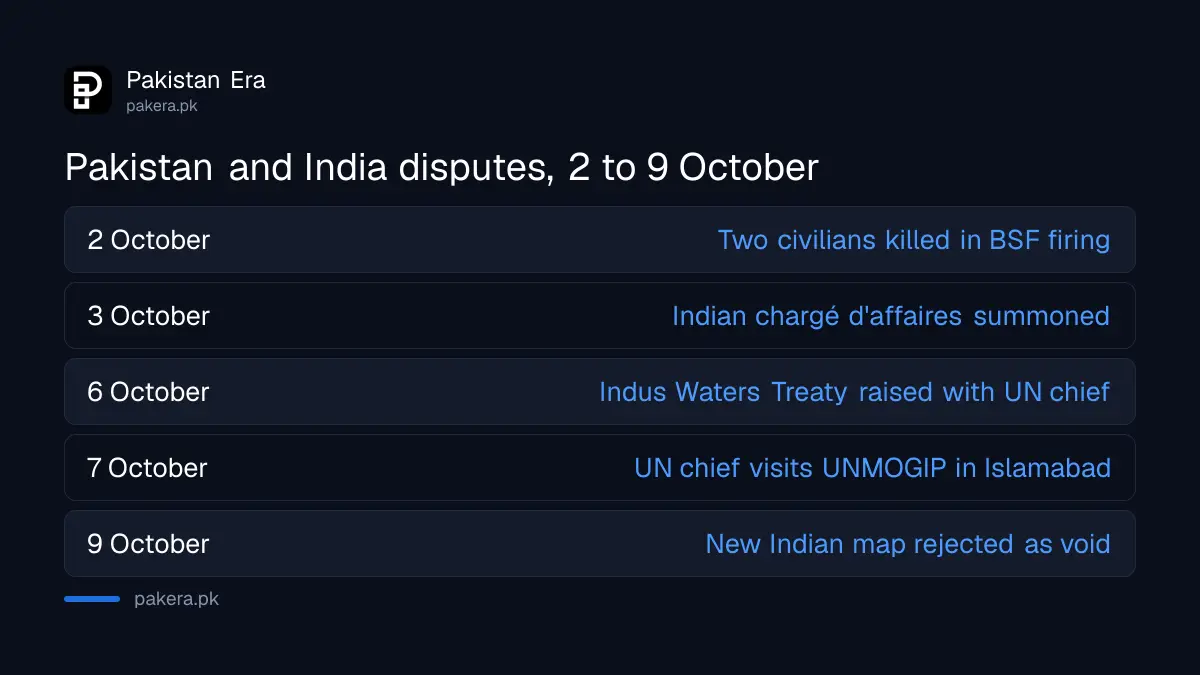
| Date | What happened | Pakistan's response |
|---|---|---|
| 2 October | Two Pakistani civilians killed by India's Border Security Force in the Bedian sector | Indian chargé d'affaires summoned on 3 October |
| 2 October | New Indian political map, as described by a journalist | Rejected as legally void on 9 October |
| 6 October | India still holding the Indus Waters Treaty in abeyance | Raised with the UN Secretary-General |
| 6 October | Water security symposium in Vienna | Foreign Minister said the treaty remains in force |
| 9 October | Pakistani social media accounts and TV channels blocked in India | Spokesperson criticised the blocking |
After the two civilians were killed in BSF firing near the Kasur border, Pakistan asked India for an immediate and transparent investigation and to share its findings.
On water, the Foreign Minister said at the Vienna symposium that a Court of Arbitration award has confirmed that the Indus Waters Treaty remains in force and that its obligations must be respected. Pakistan's airspace remains closed to Indian aircraft too, under the ban extended to 24 October.
What happens next
A rejection like this is a statement, not a legal case. Pakistan has not said it will take the map to the UN or a court. The usual next step is to raise it in UN letters and meetings, as Pakistan does with other Kashmir issues.
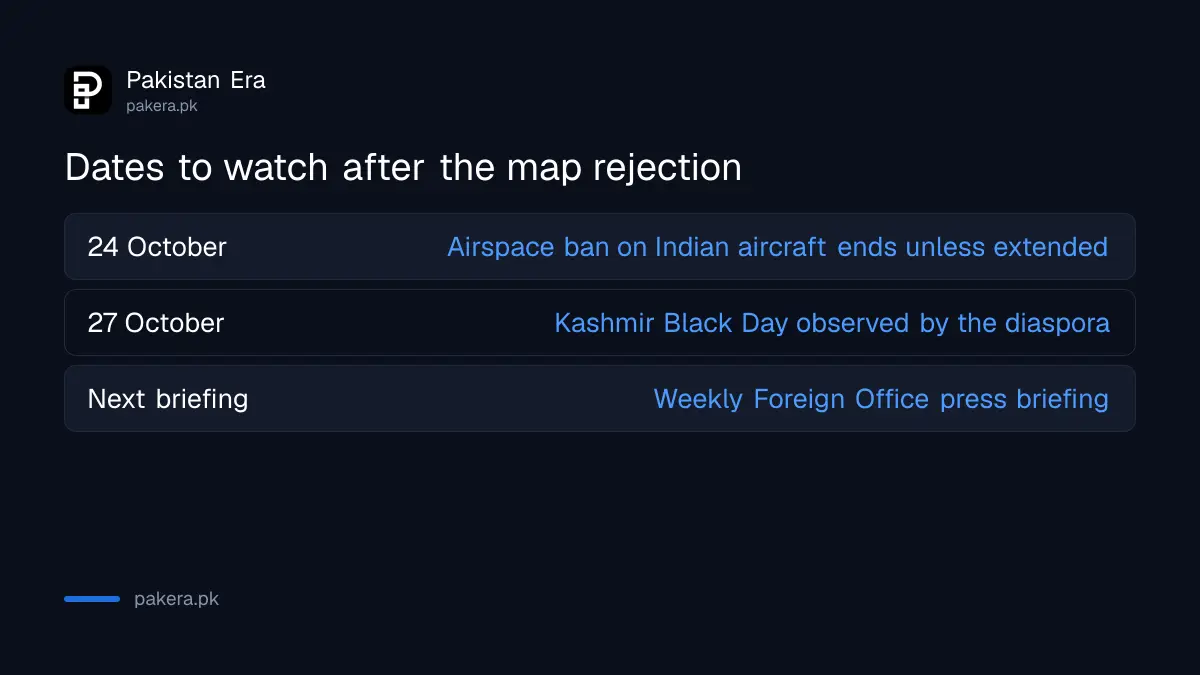
The next dates to watch are close. The spokesperson noted that the Kashmiri diaspora marks 27 October as Black Day each year, the anniversary of Indian troops landing in Srinagar in 1947. The airspace ban on Indian aircraft runs to 24 October unless it is extended again.
For ordinary Pakistanis, the map changes nothing in daily life. Travel, trade and visas between the two countries were already heavily restricted before it appeared.
Common questions
What did Pakistan say about India's new map?
The Foreign Office rejected it on 9 October 2026, calling it legally void and in violation of UN Security Council resolutions.
What does the Indian map show?
As described at the briefing, it shows parts of Jammu and Kashmir inside India's territorial jurisdiction and renames some places with standardised names.
Does the map change the status of Kashmir?
Pakistan says no. Its position is that no unilateral step can change the internationally recognised disputed status of Jammu and Kashmir.
Who announced Pakistan's rejection?
The Foreign Office spokesperson, answering a question at the weekly press briefing in Islamabad on 9 October 2026.
Is Pakistan's airspace still closed to Indian aircraft?
Yes. The ban was extended to 24 October 2026.
How we verified this
What we checked, where we read it, and what we could not confirm.
Last checked 10 October 2026, about 6:45 am PKT. Pakistan's rejection, its wording and the other October items are from the Foreign Office's own transcript of the press briefing of 9 October 2026. The Secretary-General's visit details are from the Foreign Office release of 8 October 2026 and the same briefing. We did not find the Indian map on an Indian government page, so its date is as described by the journalist who asked the question.
About the author

Global Affairs & Political Economy Writer
Muhammad Hatim is a book lover who started writing because he enjoys it. At Pakistan Era he writes about international relations, geopolitics and the global economy, with a particular interest in South Asia and the forces behind current events.