Pakistan Standard Time Is UTC+5 in Law Now: 2026 Act Drops the Old Five and a Half Hours
Act LI of 2026 fixes a 1943 law that put Pakistan Standard Time five and a half hours ahead of GMT. Clocks stay at UTC+5; what it means for deadlines and deals.
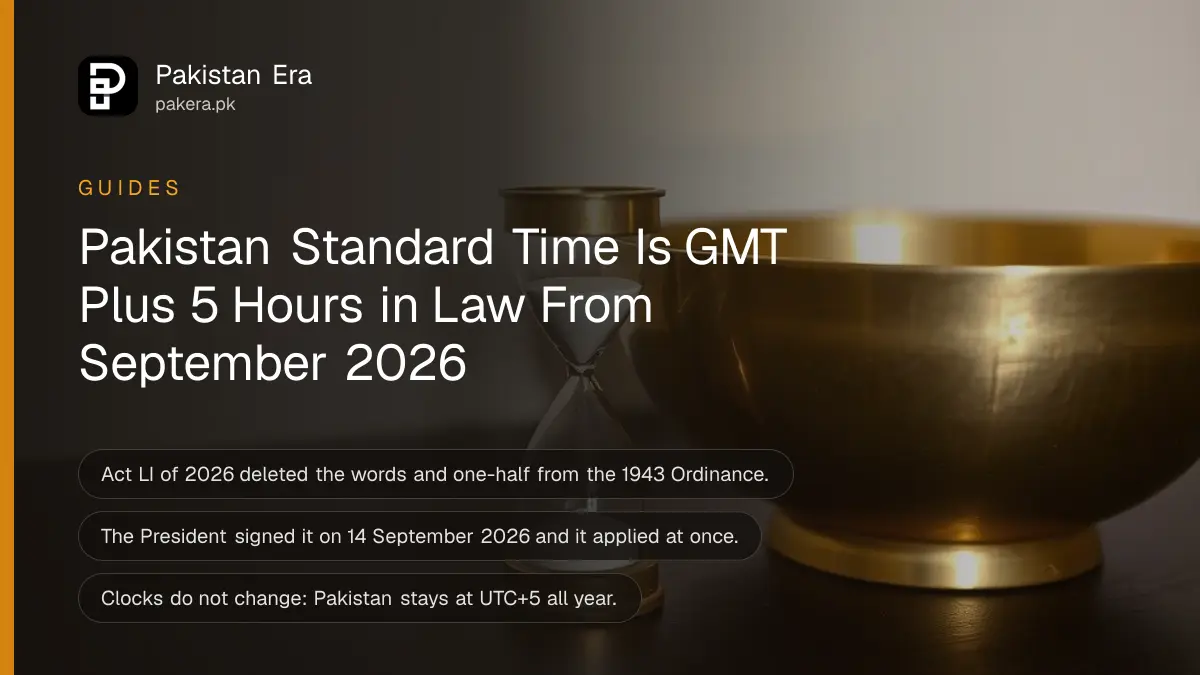
Pakistan Standard Time (PKT) is five hours ahead of Greenwich Mean Time, written as UTC+5 or GMT+5, and since September 2026 the law says so too. Until then, section 2 of the Standard Time (Interpretation of References) Ordinance, 1943 still described standard time as five and one-half hours ahead of GMT, a figure left over from before 1947.
Parliament fixed this with the Standard Time (Interpretation of References) (Amendment) Act, 2026, Act LI of 2026. The President signed it on 14 September 2026, and it came into force at once. Your clock does not change. What changes is the legal text that every contract, notice and law relies on when it says "standard time".
What the Standard Time Act 2026 changed
The 2026 Act makes two edits to the 1943 Ordinance. It deletes the words "and one-half" in the two places they appear in section 2, so the gap with GMT reads five hours. It also inserts the word "Pakistan" in section 1(1) of the Ordinance.
The government's statement of objects and reasons, printed with the bill, puts it plainly. Section 2 set the time at "five and one-half hours" ahead of GMT, "reflecting the pre-partition difference of time interval". That did not match the actual five hour gap between Pakistan Standard Time and GMT, and the bill was meant to remove the mismatch.
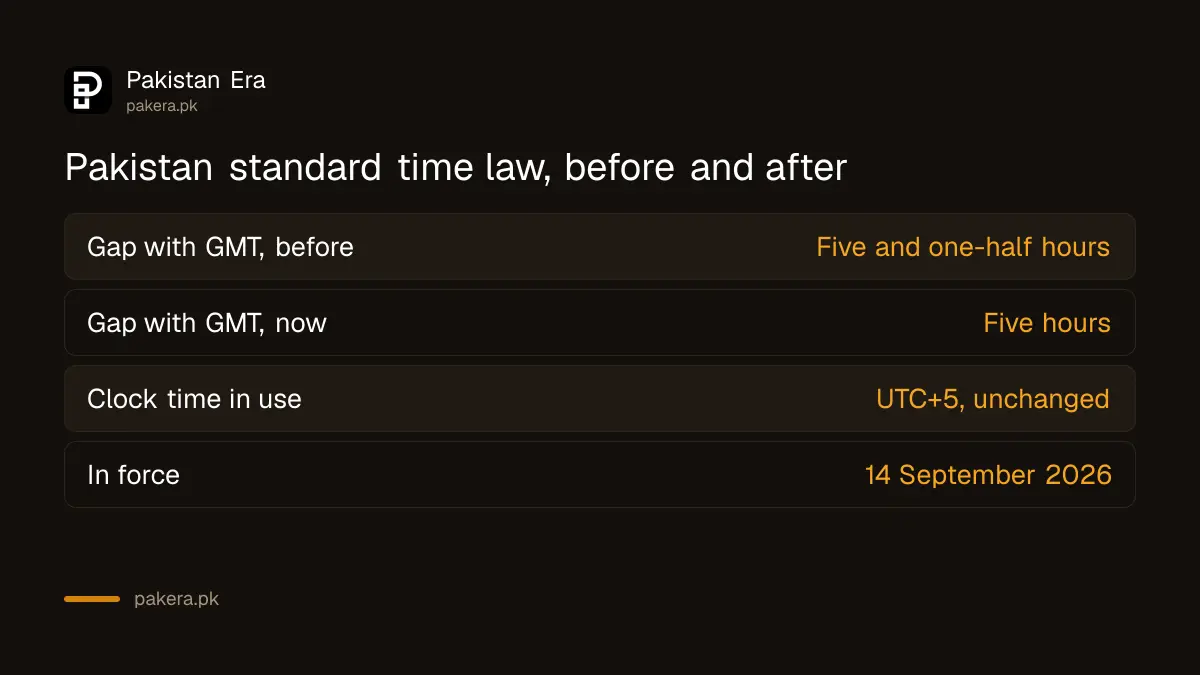
| Point | Before | After Act LI of 2026 |
|---|---|---|
| Gap with GMT in section 2 | Five and one-half hours | Five hours |
| Wording in section 1(1) | No mention of Pakistan | "Pakistan" inserted |
| Clock time in daily use | UTC+5 | UTC+5, unchanged |
| In force | Old text since 1943 | At once, from 14 September 2026 |
Why a 1943 law still set the time
The 1943 Ordinance is an interpretation law. It tells courts and officials how to read any reference to "standard time" in a law, contract or official document. It was made before partition, when the official time of the region was five and a half hours ahead of GMT.
Pakistan kept the Ordinance after 1947, and its clocks have long run at five hours ahead of GMT. The text was never updated. So for decades the statute book said one thing and every clock in the country said another. The 2026 Act brings the words in line with the time people actually use.
Laws often survive like this. Many pre-1947 Acts are still in force, and each needs a separate amendment to change it. To read a law with all its later changes, use the method in checking the latest text of a federal law.
What it means for contracts, deadlines and notices
Any document that says a deadline falls at a time "Pakistan Standard Time" or "standard time" now has a clear legal meaning: GMT plus five hours. A tender closing at 11:00 PST closes at 06:00 GMT. Nothing in daily life moves.
The practical value is in disputes. A contract, a bank cut-off, an exam portal or a court filing deadline that falls near midnight could, in theory, have been argued against the old half-hour wording. The 2026 text removes that argument.
- Courts and offices read "standard time" as UTC+5.
- Government notices that give a time, such as a petrol price taking effect at midnight, use that same clock.
- Private contracts that use "PST" or "PKT" match the statute.
Pakistan time compared with other countries
Pakistan is five hours ahead of GMT all year, because it does not use daylight saving time now. So the gap with the UK, Europe and North America changes by one hour when those countries change their clocks, while the gap with the Gulf stays fixed.
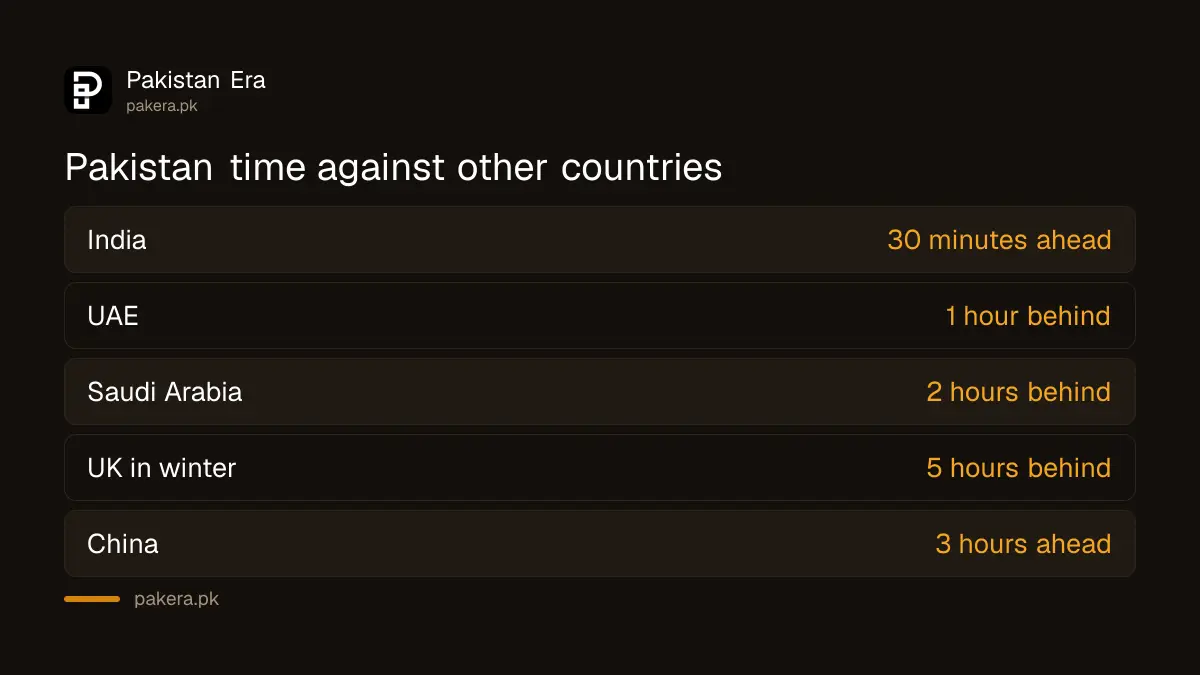
| Place | Offset from GMT | Difference from Pakistan |
|---|---|---|
| Pakistan (PKT) | +5 | Same |
| India | +5:30 | 30 minutes ahead |
| UAE | +4 | 1 hour behind |
| Saudi Arabia, Qatar | +3 | 2 hours behind |
| UK in winter (GMT) | 0 | 5 hours behind |
| UK in summer (BST) | +1 | 4 hours behind |
| China | +8 | 3 hours ahead |
India's half hour is the same half hour the 1943 text carried. That is the clearest sign of where the old wording came from. Match times for sport are listed in PKT, as in this week's sports schedule in Pakistan time.
How the bill became law
The bill passed the National Assembly, then the Senate, and the President assented on 14 September 2026. The Senate Secretariat published it in the Gazette of Pakistan on 28 September 2026. It is numbered LI, the 51st Act of 2026.
- The minister in charge moved the bill with its statement of objects and reasons.
- The National Assembly passed it. Its "as passed" copy still carried the title "Amendment Act, 2025".
- The Senate passed it.
- The President assented on 14 September 2026.
- It was published in the Gazette on 28 September 2026 as the Amendment Act, 2026.
Each stage is explained in how a bill becomes law in Pakistan.
Common questions
What is Pakistan Standard Time?
Pakistan Standard Time, also written PKT or PST, is five hours ahead of Greenwich Mean Time, or UTC+5. It is used across the whole country, with no regional time zones.
Did the 2026 Act change the time on my phone?
No. Clocks stay where they were. The Act only corrected the old legal text, which said five and a half hours ahead of GMT, so that the law matches the UTC+5 time already in use.
Does Pakistan use daylight saving time?
No. Pakistan keeps UTC+5 all year. The 2026 Act sets no summer time rule, so the clock does not move forward or back.
What is the Act number of the Standard Time amendment?
It is Act LI of 2026, the Standard Time (Interpretation of References) (Amendment) Act, 2026. It amends Ordinance VI of 1943.
Why was it called a 2025 Act at first?
The bill was drafted in 2025, so the National Assembly's "as passed" copy uses that year in its short title. The published Act is titled 2026, the year it was passed and signed.
How we verified this
What we checked and where we read it.
Checked on 15 November 2026. We read the Standard Time (Interpretation of References) (Amendment) Act, 2026 as published in the Gazette of Pakistan, Extraordinary, Part I, 28 September 2026, and the National Assembly's "as passed" copy of the bill with its statement of objects and reasons, both on the National Assembly's Acts of Parliament page. The "as passed" copy titles it the 2025 Act; the Gazette text titles it the 2026 Act. Time offsets for other countries are their standard published offsets.
About the author

Global Affairs & Political Economy Writer
Muhammad Hatim is a book lover who started writing because he enjoys it. At Pakistan Era he writes about international relations, geopolitics and the global economy, with a particular interest in South Asia and the forces behind current events.