Pakistani Citizenship Through Your Mother: 2026 Act Covers Children Born Abroad Before 2000
The Citizenship (Amendment) Act 2026 lets Pakistani mothers pass on citizenship to children born abroad before April 2000. Who qualifies and how to claim it.
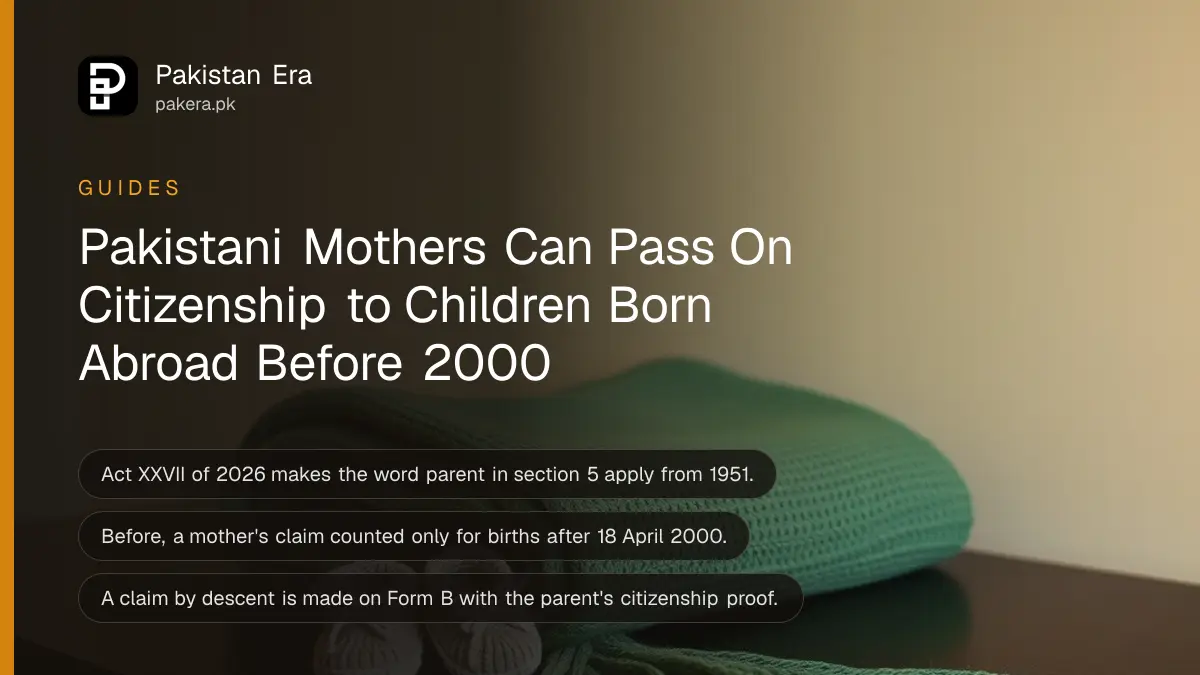
A child born abroad to a Pakistani mother is a citizen of Pakistan by descent, and since March 2026 the law says this has always been so, back to 1951. The Pakistan Citizenship (Amendment) Act, 2026 (Act XXVII of 2026) makes the word "parent" in section 5 apply from the start of the 1951 Act. Before this, the change from "father" to "parent" dated only from 18 April 2000.
That matters most to adults born outside Pakistan before April 2000 whose mother was Pakistani and whose father was not. The President signed the Act on 14 March 2026 and it came into force at once. Below is what changed, who gains, and how a claim is made.
What the 2026 Citizenship Act changed
The 2026 Act adds one sub-section to section 5 of the Pakistan Citizenship Act, 1951. It says the 2000 swap of "father" for "parent" is deemed to have been made from the commencement of the Act. In plain words, mothers could always pass on citizenship by descent.
Section 5 is the citizenship by descent rule. It says a person born after the 1951 Act began is a citizen by descent if their parent was a citizen of Pakistan at the time of the birth. Until 2000 the word was "father". Ordinance XIII of 2000, dated 18 April 2000, replaced it with "parent".
The 2000 change did not say it worked backwards. So a child born abroad in, say, 1985 to a Pakistani mother and a foreign father had no claim under section 5. The 2026 Act closes that gap.
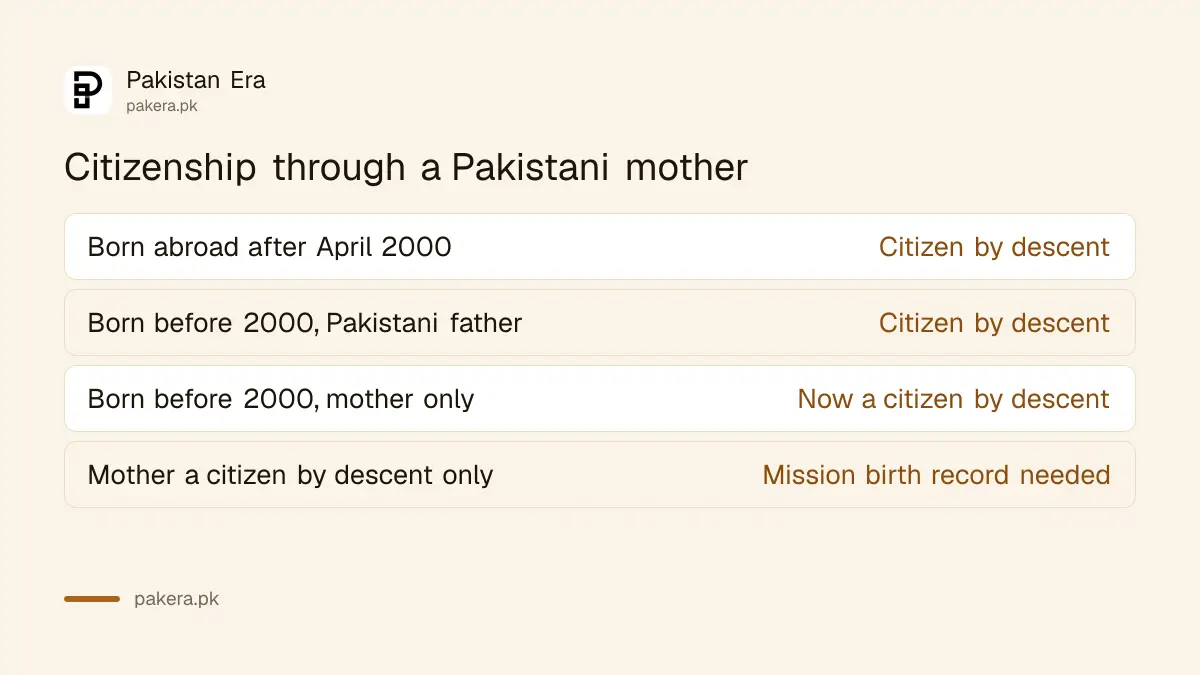
| Born abroad | Pakistani parent | Before March 2026 | After the 2026 Act |
|---|---|---|---|
| After 18 April 2000 | Mother or father | Citizen by descent | Citizen by descent |
| Before 18 April 2000 | Father | Citizen by descent | Citizen by descent |
| Before 18 April 2000 | Mother only | No claim under section 5 | Citizen by descent |
Who can now claim citizenship through a Pakistani mother
A person born outside Pakistan after the 1951 Act began, whose mother was a Pakistani citizen at the time of the birth, now meets section 5. The father's nationality no longer matters. The mother must have been a citizen on the birth date itself.
Three groups gain most:
- Adults born in the Gulf, the UK, Europe or North America before April 2000 to a Pakistani mother and a foreign father.
- Children of those adults, who can now trace descent through a parent whose own status is clearer.
- Families who were told in the past that a mother could not pass on citizenship for a birth before 2000.
The mother's own status matters too. If she was a citizen by birth in Pakistan, the claim is simple. If she was a citizen by descent only, extra conditions apply, set out in the next section.
The extra rule when the mother is a citizen by descent only
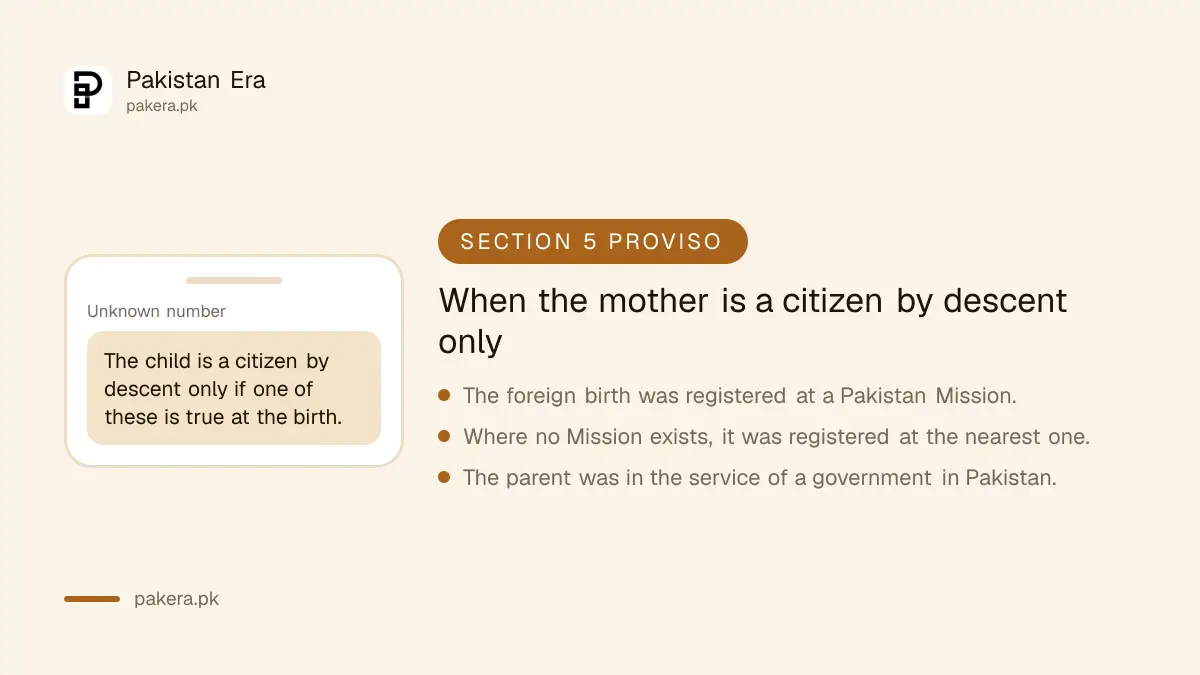
When the Pakistani parent is a citizen by descent only, section 5 adds a condition. The child's foreign birth must have been registered at a Pakistan Mission or Consulate, or the parent must have been in the service of a government in Pakistan at the time of the birth.
The registration can be at the Mission in the country of birth. Where Pakistan has no Mission there, the law allows a prescribed Mission or the one in the nearest country. Birth registration abroad is done on Form S, covered in registering a child's birth at a Pakistan Mission.
So a grandchild born abroad two generations down needs this record. Without a registered birth or proof of government service, section 5 does not cover them, even after the 2026 Act.
How to apply for citizenship by descent
The Pakistan Citizenship Rules route a claim under section 5 through Form B. The application goes to the Provincial Government where the applicant has a domicile of origin, in triplicate, with the parent's citizenship certificate and proof of the relationship. The Federal Government decides cases needing extra papers.
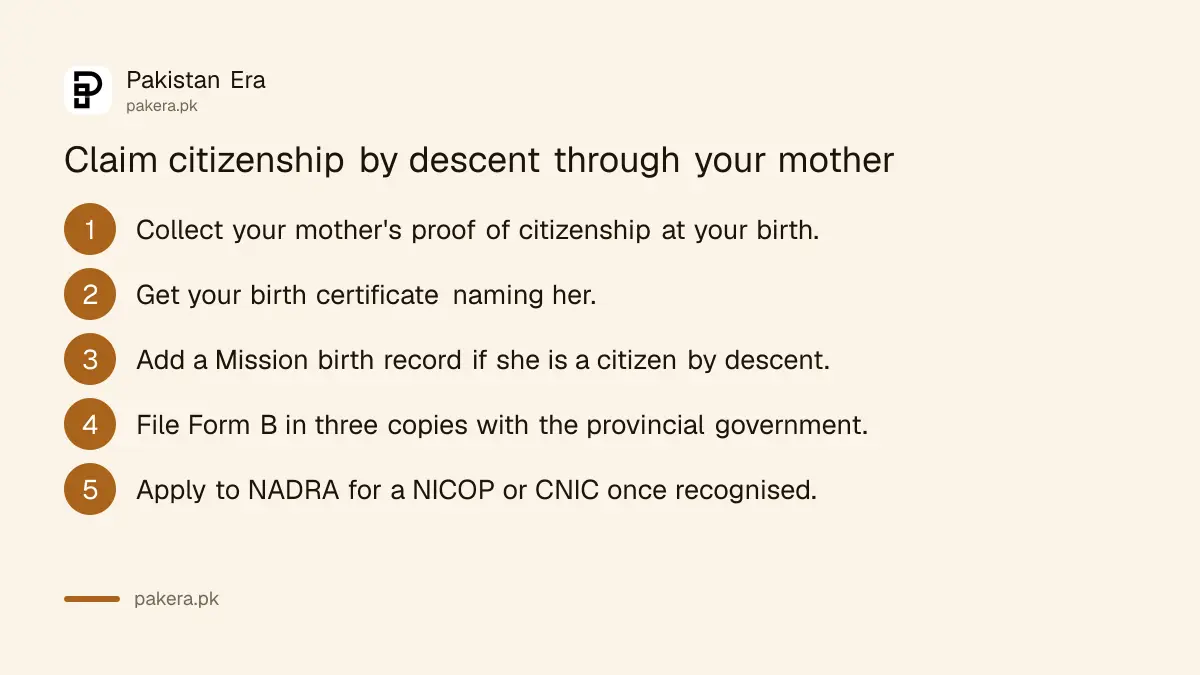
- Collect your mother's proof of citizenship at your birth date, such as her old passport, CNIC or a citizenship certificate.
- Get your own birth certificate showing her as your mother.
- If she is a citizen by descent only, add your Mission birth registration or proof she was in government service when you were born.
- Fill in Form B, in three copies.
- Send it to the Provincial Government of your domicile of origin. It forwards cases that need the extra papers to the Federal Government.
- Once recognised, apply to NADRA for a NICOP or CNIC, and then for a Pakistani passport.
We checked Form B on the Directorate General of Immigration and Passports (DGIP) site. Its section 8 still reads "his father", wording from before 2000. Cross out the paragraphs that do not apply, as the form's own note says, and attach a copy of the 2026 Act with your claim.
Dual nationality and the age 21 rule
A citizen of Pakistan who also holds another nationality loses Pakistani citizenship under section 14, unless that other country is one Pakistan has a dual nationality arrangement with. Section 14 does not apply to a person under 21.
Most diaspora countries, including the UK, the US and Canada, are on Pakistan's list of dual nationality countries. For a British citizen, travelling as a British Pakistani dual national explains the passport side.
Children of a citizen can also be registered as minors under section 11, a separate route. It is covered in registering a minor child on Form M.
Common questions
When did the Pakistan Citizenship (Amendment) Act, 2026 come into force?
At once on assent. The President assented on 14 March 2026, and the Act was published in the Gazette of Pakistan on 25 March 2026 as Act XXVII of 2026.
I was born in Dubai in 1990 to a Pakistani mother and an Indian father. Am I now a citizen?
Under section 5 as amended, yes, if your mother was a Pakistani citizen when you were born. If she was a citizen by descent only, your birth must also have been registered at a Pakistan Mission, or she must have been in government service then.
Does this help my children too?
It can. Once you are a citizen by descent, your children born abroad are citizens by descent only through you. Register their births at a Pakistan Mission so the section 5 condition is met.
Do I need to give up my other nationality?
Only if Pakistan has no dual nationality arrangement with that country and you are 21 or older. Section 14 sets this rule. Most major diaspora countries have an arrangement with Pakistan.
Did the 2000 change already cover births before 2000?
No. Ordinance XIII of 2000 replaced "father" with "parent" from 18 April 2000. The 2026 Act is what makes the word apply back to the start of the 1951 Act.
Does the Act change citizenship for a foreign husband of a Pakistani woman?
No. It covers children by descent only. A foreign husband is a separate matter, explained in why a foreign husband does not get citizenship by marriage.
How we verified this
What we checked and where we read it.
Checked on 15 November 2026. We read the Pakistan Citizenship (Amendment) Act, 2026, as published in the Gazette of Pakistan, Extraordinary, Part I, on the National Assembly's Acts of Parliament page. The Gazette notice prints the assent year as "2016" though it is dated 24 March 2026 and numbers the Act for 2026; we use 14 March 2026. We read section 5, section 14 and rule 9 in the consolidated Pakistan Citizenship Act and Rules on the DGIP Acts and Rules file, and the DGIP's Form B, which still uses "father" in its descent paragraph.
About the author

Global Affairs & Political Economy Writer
Muhammad Hatim is a book lover who started writing because he enjoys it. At Pakistan Era he writes about international relations, geopolitics and the global economy, with a particular interest in South Asia and the forces behind current events.