Plane Crash Compensation in Pakistan: Rs 20 Million per Passenger on Domestic Flights Under the 2026 Law
Under the Carriage by Air Amendment Act 2026, airlines owe up to Rs 20 million per passenger for domestic deaths or injuries. Limits, advances and how to claim.
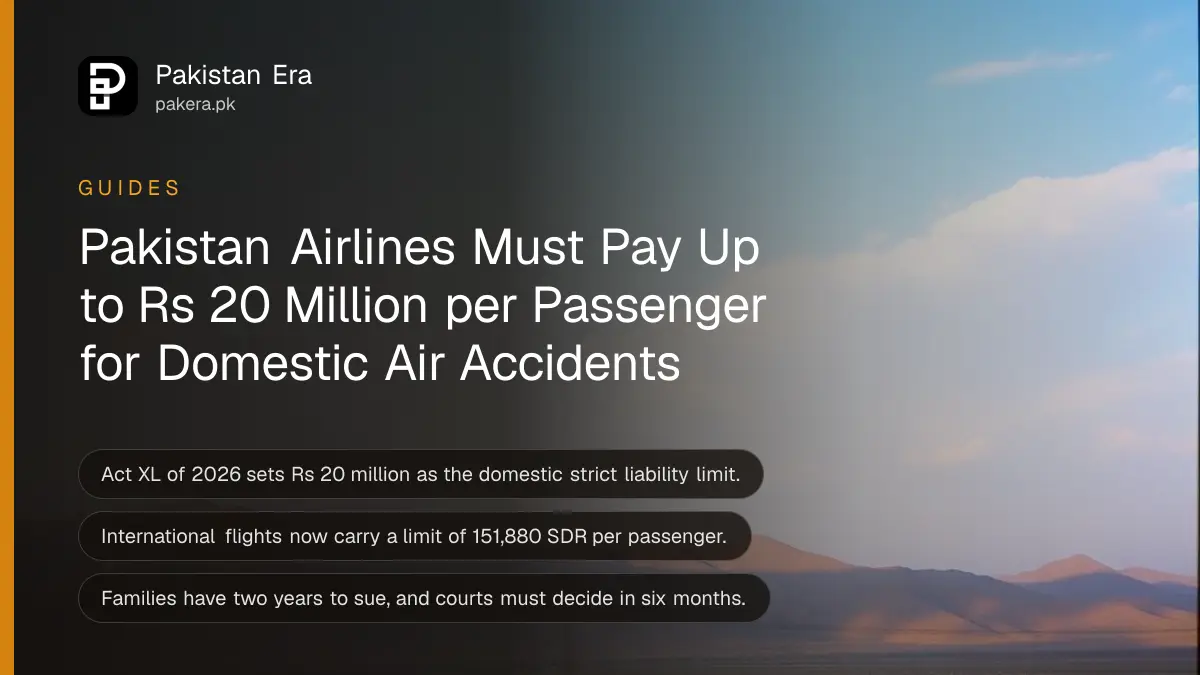
If a passenger dies or is injured on a domestic flight in Pakistan, the airline must pay up to Rs 20 million (Rs 2 crore) per passenger without being able to limit or escape that liability. Above Rs 20 million, the airline can avoid paying only if it proves the harm was not caused by its own negligence, or was caused solely by a third party. This is the rule under the Carriage by Air (Amendment) Act, 2026.
On international flights the strict limit is now 151,880 Special Drawing Rights (SDR) per passenger. The Act, Act XL of 2026, came into force on 29 May 2026. It also gives families a two year deadline to sue, sends claims to consumer courts, and orders a decision within six months.
What the Carriage by Air Amendment Act 2026 changed
The 2026 Act amends the Carriage by Air Act, 2012. It sets Rs 20 million as the domestic death and injury limit, raises the international limits to the latest Montreal Convention figures, sends cases to consumer courts with a six month target, and adds a two year time limit for claims.
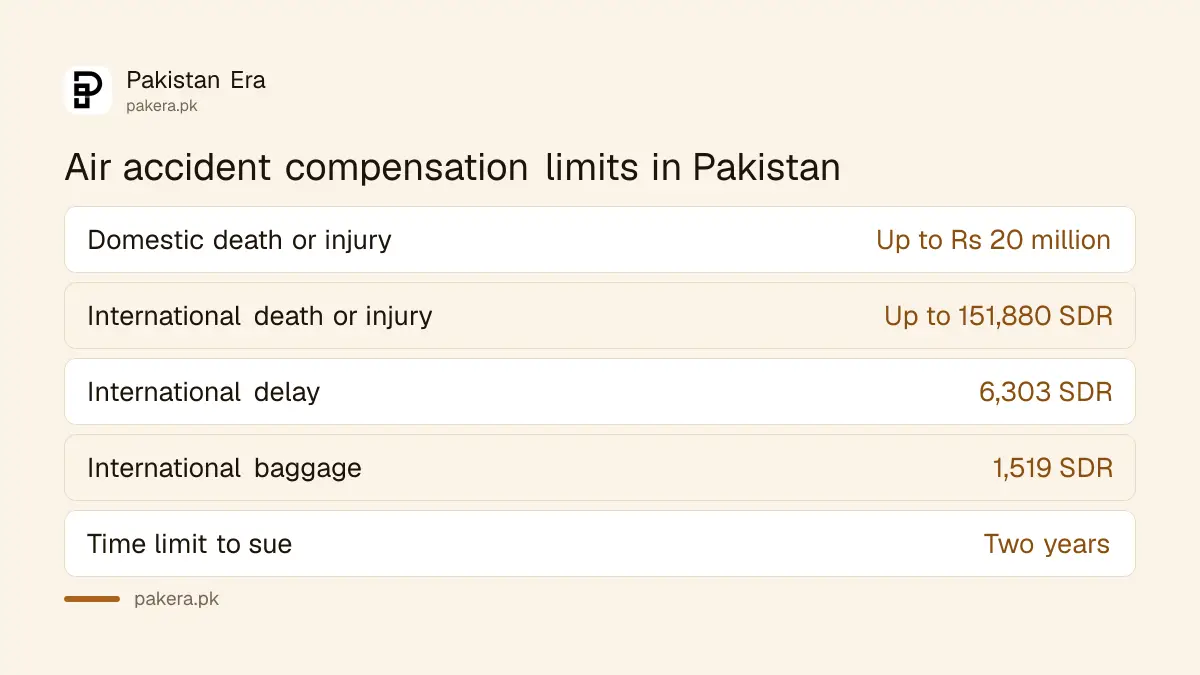
| Rule | Domestic flights (Fifth Schedule) | International flights (Fourth Schedule) |
|---|---|---|
| Death or injury, strict liability | Up to Rs 20,000,000 per passenger | Up to 151,880 SDR (was 100,000) |
| Delay and baggage limits | Rule 22 figures raised from 1,000 to 5,000 | Delay 6,303 SDR (was 4,150), baggage 1,519 SDR (was 1,000) |
| Cargo per kg | Not part of this change | 26 SDR (was 17) |
| Advance payment after a crash | Yes, to the family | Yes, to the family |
An SDR is a unit set by the International Monetary Fund from a basket of major currencies. Its rupee value moves daily, so a claim is worked out at the rate on the relevant date.
How the Rs 20 million rule works on domestic flights
For damages up to Rs 20 million per passenger for death or bodily injury, the airline cannot exclude or limit its liability. It pays proven damages up to that figure even if it was not at fault. Above Rs 20 million, it must prove it was not negligent to avoid paying more.
In plain terms, there are two layers:
- Up to Rs 20 million: the family does not have to prove the airline was at fault. The airline cannot use a ticket clause to reduce this.
- Above Rs 20 million: the family can claim more. The airline escapes the extra only by proving the harm was not due to its negligence or wrongful act, or was due solely to a third party.
The Federal Government can raise domestic limits once every three years by notification, based on average official inflation over that period. International limits can be revised by notification to match Pakistan's treaty commitments.
Advance payment to families after an air crash
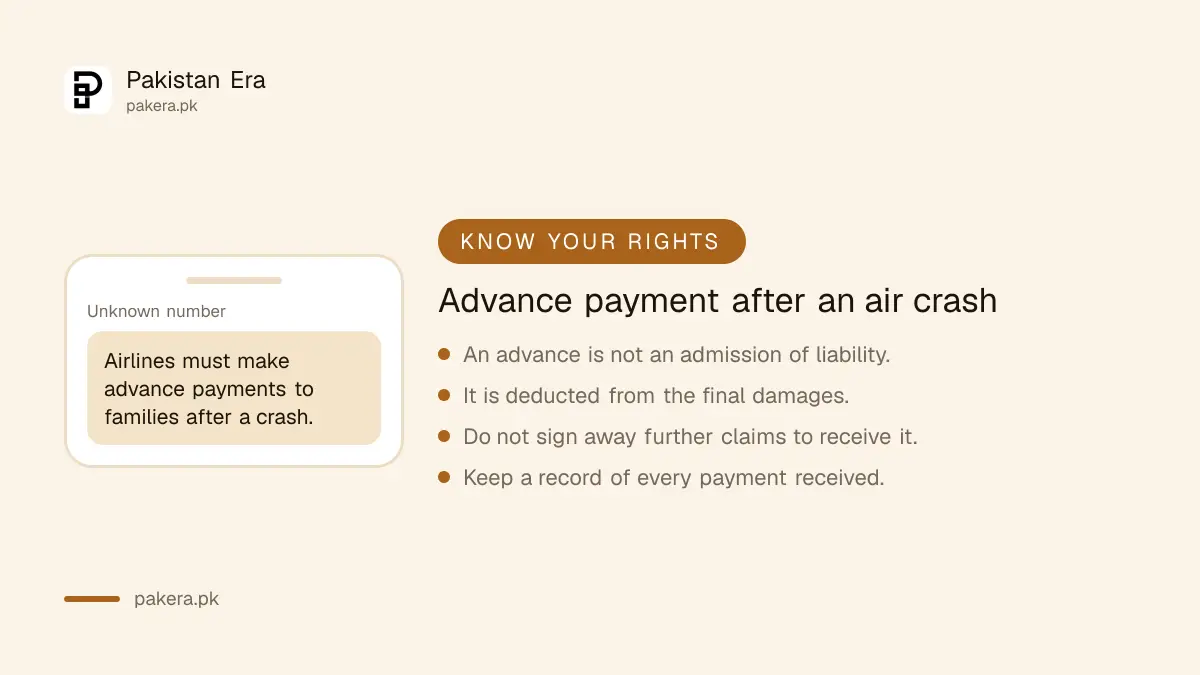
After an aircraft accident that kills a passenger, the airline must make an advance payment to the person or people entitled to claim compensation. For injuries, it pays advances without delay under the Pakistan Civil Aviation Authority's directions, to meet urgent needs.
Two points protect both sides. An advance payment is not an admission that the airline is liable. And it can be deducted from whatever the airline later pays as damages. So a family should accept an advance without signing away any further claim, and keep records of every payment.
How a family claims compensation
The family first gets a succession certificate naming the members entitled to the money and each one's share. The claim then goes to a consumer court, or a court the Federal Government notifies where none exists. It must be filed within two years, and the court must decide within six months.
- Collect the ticket or booking record, the death certificate or medical records, and proof of income lost.
- Apply for a succession certificate under the Succession Act, 1925 that names the family members for whose benefit the claim is made, and the share of each.
- Agree the shares among the family if you can. If not, the certificate sets them.
- File the claim against the airline in the consumer court within two years of the date of arrival, or the date the flight should have arrived.
- Submit documents. The court can decide on papers or allow oral evidence.
- Expect a final order within six months. If the court runs late, it must hear the case day to day and report the delay to the High Court.
Succession certificates are now issued through NADRA in most provinces, set out in getting a succession certificate online. How consumer courts work is covered in filing a consumer court complaint in Pakistan.
When the limits do not protect the airline
Except for cargo, the limits stop applying if the damage came from an act or omission by the airline's staff or agents done with intent to cause damage, or recklessly and with knowledge that damage would probably result. Then the airline's liability is not capped.
For everyday problems, such as a delayed flight or lost bag, the same law applies at the lower limits. Those cases, and what the regulator can order, are covered in flight delay and cancellation compensation in Pakistan.
Common questions
How much compensation is paid for a plane crash death in Pakistan?
On a domestic flight, the airline is strictly liable for proven damages up to Rs 20 million per passenger. Families can claim more, unless the airline proves it was not negligent or a third party alone was to blame.
Is Rs 20 million paid automatically?
No. Rs 20 million is the level up to which the airline cannot limit its liability. The actual award depends on proven damages decided by the court or agreed in a settlement.
What is the time limit to sue an airline in Pakistan?
Two years from the date of arrival at the destination, the date the aircraft should have arrived, or the date the carriage stopped. This applies to actions under the carriage by air conventions.
Which court hears an air accident claim?
The consumer court set up under any law. Where there is none, it is the court the Federal Government notifies.
When did the Carriage by Air (Amendment) Act, 2026 start?
At once on assent, on 29 May 2026. It was published in the Gazette of Pakistan on 18 June 2026 as Act XL of 2026.
Does an advance payment end my claim?
No. The Act says an advance is not a recognition of liability and is offset against the final damages, so you can still claim the rest.
How we verified this
What we checked and where we read it.
Checked on 15 November 2026. We read the Carriage by Air (Amendment) Act, 2026, Act XL of 2026, as published in the Gazette of Pakistan, Extraordinary, Part I, on 18 June 2026, from the National Assembly's Acts of Parliament page. The notice records assent on 29 May 2026. Parts of the scanned schedules are blurred: the time limit for the advance payment after a death is not legible, so no number of days is given. The domestic rule 22 figures rise from 1,000 to 5,000; the units are those of the 2012 Act's Fifth Schedule. The base Act is on Pakistan Code.
About the author

Global Affairs & Political Economy Writer
Muhammad Hatim is a book lover who started writing because he enjoys it. At Pakistan Era he writes about international relations, geopolitics and the global economy, with a particular interest in South Asia and the forces behind current events.