Polio Campaign 2 to 8 November 2026: Nearly 24 Million Children in 97 Districts of Pakistan
Pakistan's next polio campaign runs 2 to 8 November 2026 in 97 districts for nearly 24 million children, all of Karachi included. See the split and what to do.
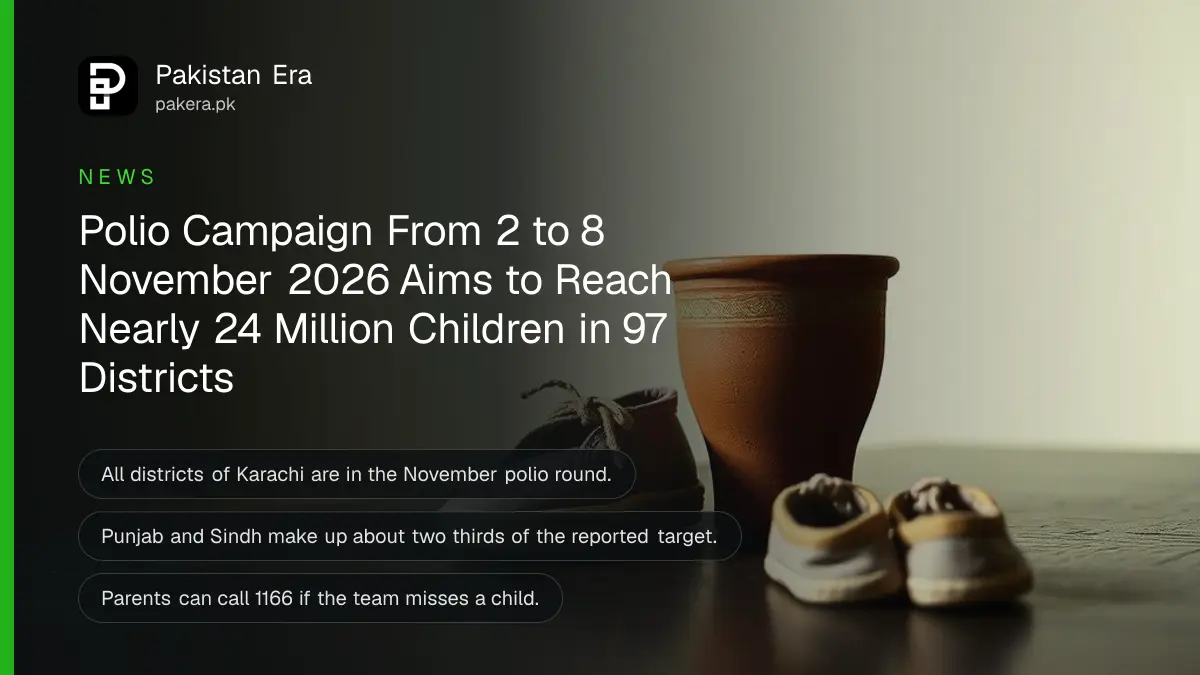
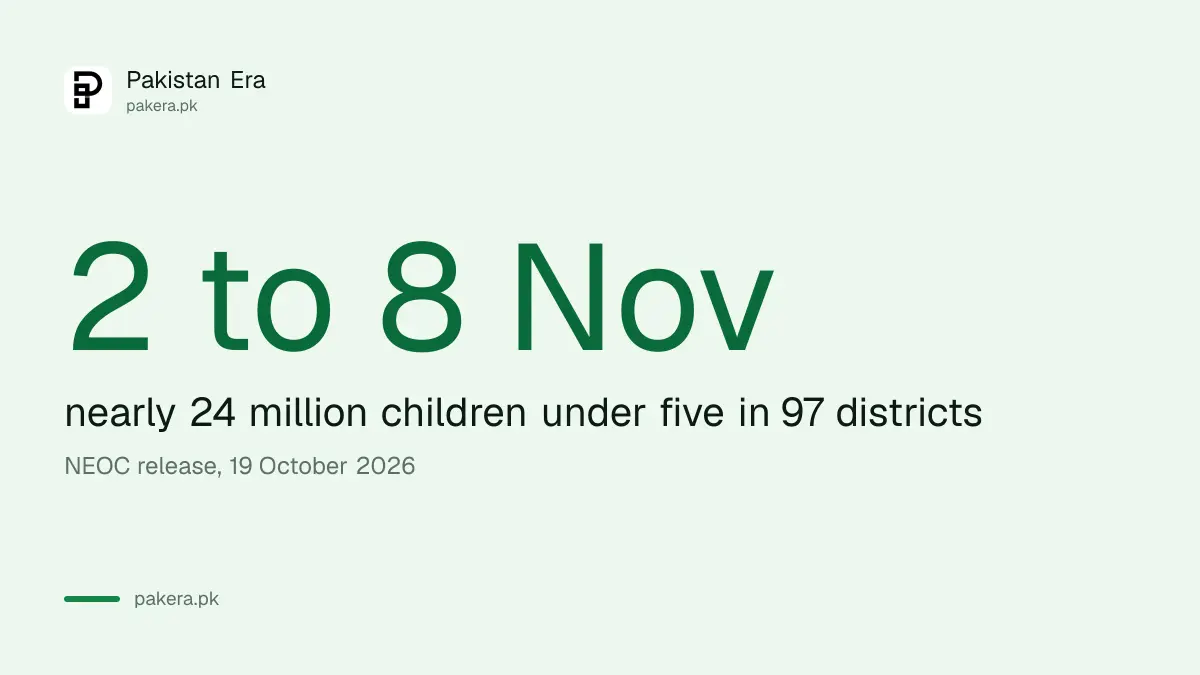
Short answer: Pakistan's next polio campaign runs from 2 to 8 November 2026 in 97 districts. The National Emergency Operations Centre (NEOC) says it aims to vaccinate nearly 24 million children under five, including every district of Karachi. Teams go door to door with two drops.
This is a sub-national round. That means selected high-risk districts, not the whole country. If you live in one of them, a team should knock on your door during that week. If you live elsewhere, your child's protection comes from routine doses at a vaccination centre.
We read the NEOC's 19 October 2026 release on poliofreepakistan.gov.pk on 20 October. It gives the dates, the 97 districts and the figure of nearly 24 million. The province-by-province split below was reported the same day, attributed to the NEOC, but we could not find it on the programme's own site yet.
The round covers nearly 24 million children from 2 to 8 November
The NEOC's release of 19 October says the next round is scheduled from 2 to 8 November 2026 to protect nearly 24 million children in 97 districts. It names all districts of Karachi as included. The release came with news of Pakistan's seventh polio case of 2026.
That case, a six-month-old boy in Karachi East, is in our report on the seventh polio case of 2026. The timing is not a coincidence. A case in a city that already had positive sewage samples makes the next round more urgent there.
Two drops, every child under five, every round. That is the rule the programme repeats, and it holds even if your child had drops in September.
Punjab and Sindh account for two thirds of the target, as reported
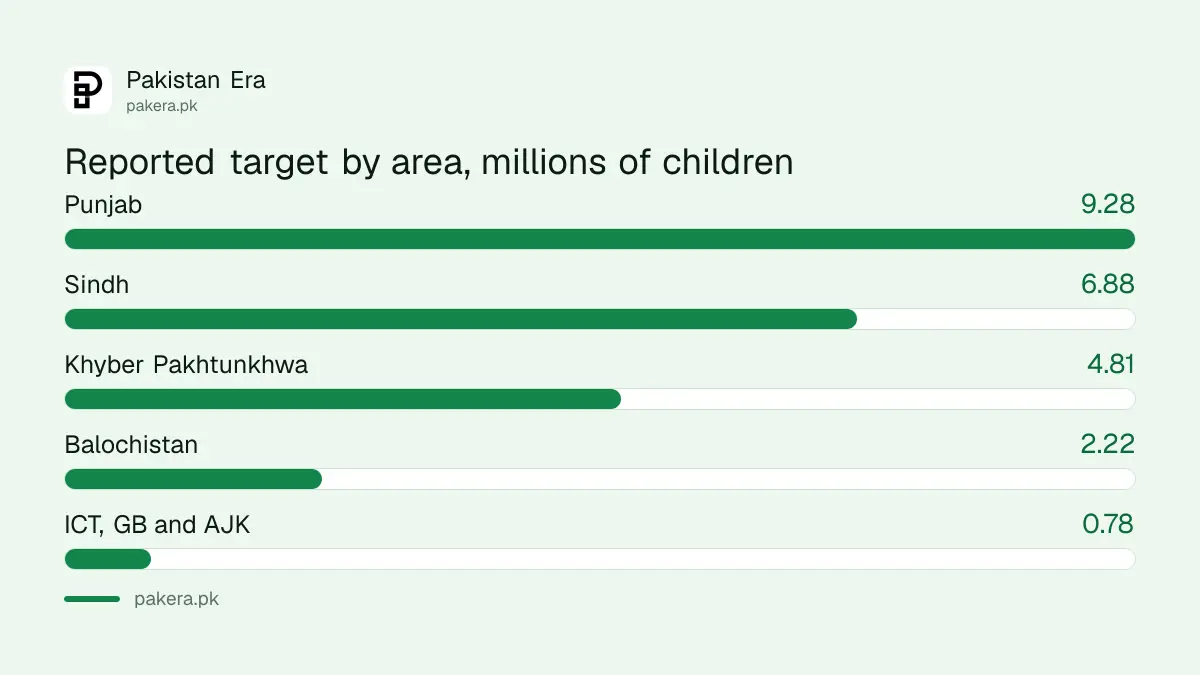
The reported split gives Punjab about 9.28 million children in 13 districts and Sindh about 6.88 million in 20 districts. Together that is about 16.2 million, or two thirds of the target. These figures are reported and not yet on the programme's site.
| Area | Districts | Children under five, reported |
|---|---|---|
| Punjab | 13 | 9,278,000+ |
| Sindh | 20 | 6,883,000+ |
| Khyber Pakhtunkhwa | 27 | 4,808,000+ |
| Balochistan | 31 | 2,217,000+ |
| Islamabad | 1 | 447,000+ |
| Gilgit-Baltistan | 3 | 153,000+ |
| Azad Jammu and Kashmir | 2 | 183,000+ |
| Total | 97 | about 23.97 million |
We added the rows ourselves, counting Islamabad as one district. The districts come to 97, which matches the NEOC's figure, and the children come to about 23.97 million, which matches "nearly 24 million". So the split is consistent with the official total, even though the split itself is not yet published by the programme.
The list of the 97 district names has not been published. Shikarpur in Sindh is one, from a district meeting reported earlier this month, covered in our note on Shikarpur's 310,414 children.
November is smaller than September's round
September's sub-national round aimed for more than 31 million children and, by the NEOC's count, protected over 29.3 million. November aims for nearly 24 million, about 7 million fewer. The programme has not said why the district list is shorter this time.
The September result also left children out. Our report on the September campaign result covers the 627,776 children who were still missed. Those missed children are one reason the programme keeps running rounds a few weeks apart.
The NEOC says Pakistan has run four large campaigns in 2026, protecting more than 45 million children several times, plus smaller oral and injectable rounds in high-risk areas. November would be the fifth large round of the year.
Parents should be home for the team and call 1166 if missed
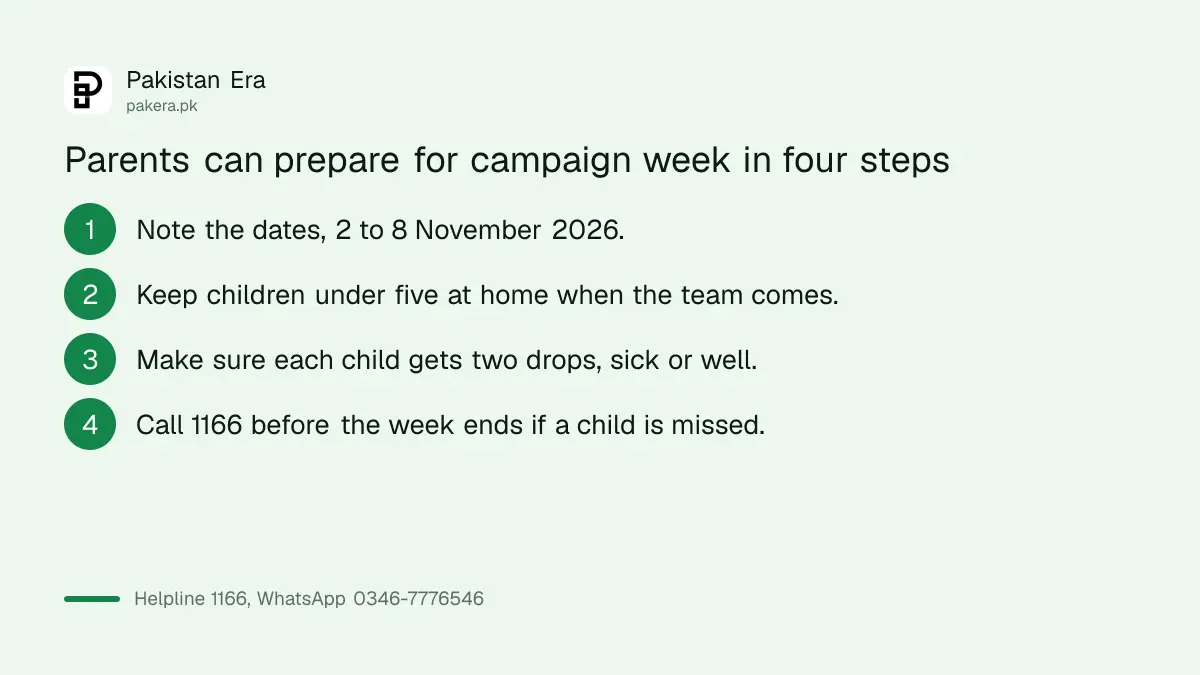
When the team visits, every child under five should get two drops, including newborns and children who are unwell. If nobody comes by 8 November, or a child was away, call the polio helpline 1166 or send a WhatsApp message to 0346-7776546.
- Note the dates, 2 to 8 November 2026, and tell anyone who looks after your children.
- Keep every child under five at home, or with a neighbour you trust, when the team comes.
- Make sure each child gets two drops, including newborns and children who are unwell.
- Keep a note of which children got drops and on which day, so nobody is missed by mistake.
- If a child is missed, call 1166 or message 0346-7776546 before the week ends.
The programme's advice is that sick children and newborns should still get the drops. Its reasons are in our page on giving polio drops to a sick child.
Common questions
When is the next polio campaign in Pakistan?
From 2 to 8 November 2026, in 97 selected districts. It is a sub-national round, not a nationwide one.
How many children will the November 2026 polio campaign cover?
Nearly 24 million children under five, according to the NEOC. The reported provincial figures add up to about 23.97 million.
Is Karachi included in the November polio campaign?
Yes. The NEOC says all districts of Karachi are included.
Is my district in the November round?
The NEOC has not published the list of 97 districts. Ask your local health office, or call the helpline 1166.
My child had drops in September. Should they have them again?
Yes. The programme says every child under five should get drops in every round, because each dose adds protection.
What if the team does not come to my house?
Call 1166 or send a WhatsApp message to 0346-7776546 during the campaign week. Give your address and the number of children.
How we verified this
What we checked, where we read it, and what we could not confirm.
We read the NEOC's 19 October 2026 release and the programme's contact page on 20 October 2026. The dates, the 97 districts and "nearly 24 million" are official. The province split was reported on 19 October and attributed to the NEOC, but no release on poliofreepakistan.gov.pk carried it when we checked, so we mark it as reported.
About the author
Public Services and Education Journalist
Fajr Riaz is a journalist and content writer at Pakistan Era, based in Lahore. She covers the questions people meet in everyday life in Pakistan: how a public service works, what a change in the rules means, and where to find a reliable answer.