PTA Draft Radio Licence Rules in Pakistan: Amateur Licence Rs 2,000 for 10 Years, Minimum Age 18
PTA's draft radio rules for 2026 would charge Rs 2,000 for a 10 year amateur licence, set the age at 18 and move applications online. See what would change.
PTA has put out draft Radio Based Services (RBS) Licensing Regulations, 2026 for public comment, and the draft would raise the amateur radio licence to Rs 2,000 for 10 years, set the minimum age at 18 and move every application online. The draft was reported on 19 October 2026. It is a proposal, not a rule in force, and nothing changes for a current licence holder until PTA notifies a final version.
We tried to open the draft on PTA's own website on 20 October 2026, and the site did not load for us, either directly or through a rendering service. So every figure below is reported, from published accounts of the draft, and not read by us in PTA's text. We compare it with PTA's current 2019 amateur radio procedure, which we read at source on 13 October 2026.
PTA's draft covers four kinds of radio licence
The draft sets one licensing process for four groups: private radio networks, aircraft mobile stations, maritime mobile stations and amateur radio operators, with a separate junior category for young amateurs. Most licences would last 10 years, according to reports of the draft.
A private radio network is a radio system a company runs for itself. The draft reportedly lists wireless networks, trunking systems (shared two-way radio, the kind security firms and factories use), microwave links, telemetry, weather radars and SCADA systems. SCADA is the remote control equipment that runs pipelines, grids and water works.
Aircraft and maritime stations are the radios fitted to planes and ships. Amateur radio is the licensed hobby of talking to other operators over radio, often called ham radio. If you already hold an amateur radio licence from PTA, this draft is the part that matters most to you.
The amateur licence would cost Rs 2,000 for 10 years
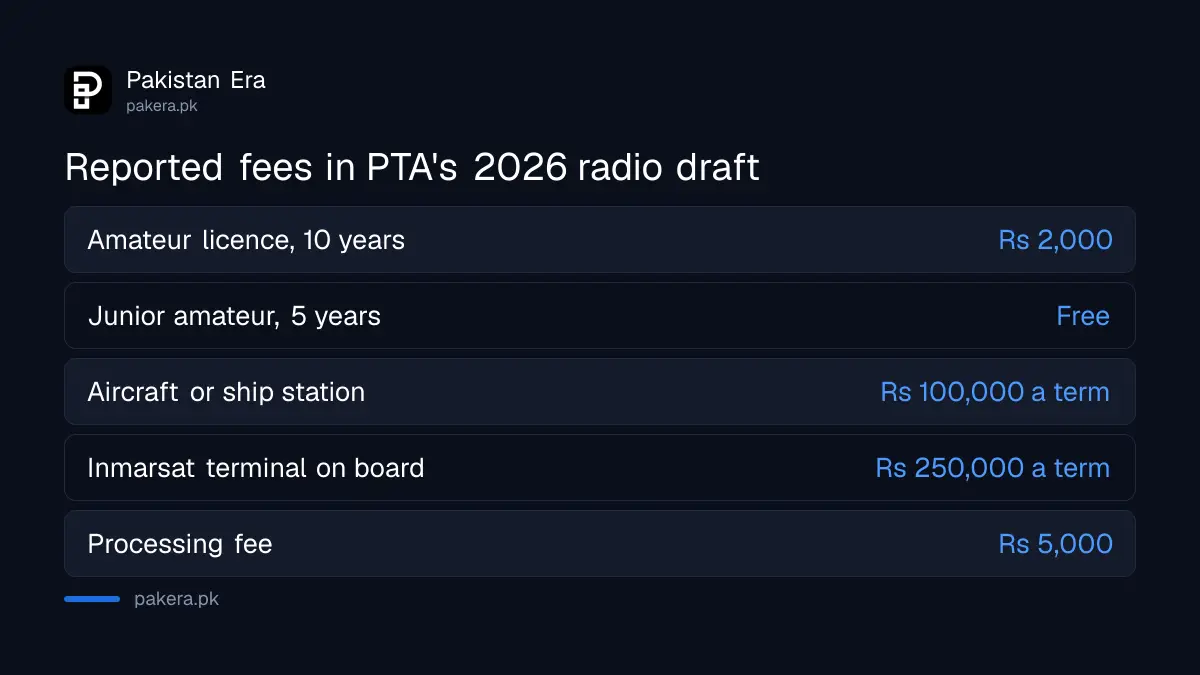
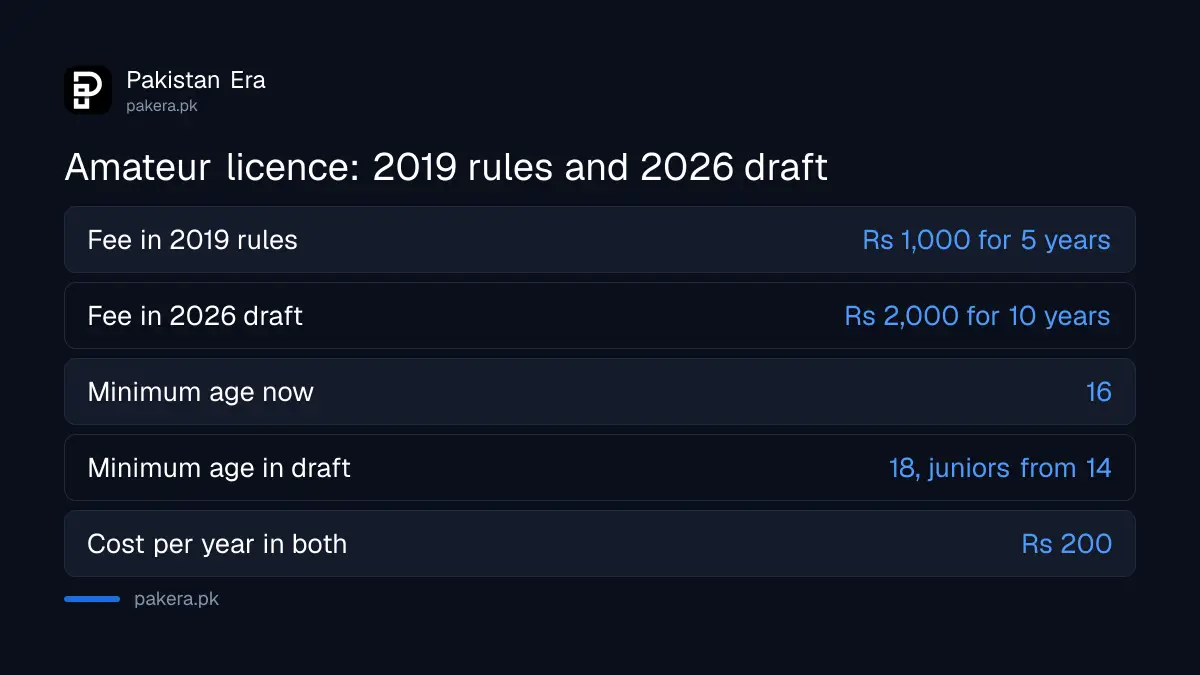
Reports of the draft put the amateur radio licence at Rs 2,000 for 10 years. Today PTA's 2019 procedure charges Rs 1,000 for five years plus a Rs 100 test fee. So the yearly cost stays at Rs 200, but you pay for twice as long upfront.
The junior amateur licence would be free and last five years, as reported. The draft also lists a non-refundable application processing fee of Rs 5,000 and an initial licence fee of Rs 10,000 "where applicable". Reports do not make clear whether those two charges apply to amateurs or only to commercial licences. That is a question to put to PTA in the comment period.
| Item | PTA 2019 procedure (read at source) | Draft 2026 (reported) |
|---|---|---|
| Amateur licence fee | Rs 1,000 for 5 years | Rs 2,000 for 10 years |
| Minimum age, full licence | 16, with limits until 18 | 18 |
| Junior licence | Provisional permission at 16 or 17 | Age 14 to under 18, free, 5 years |
| Police clearance | Police character certificate on the form | Mandatory |
| Club membership | Listener with PARS or an accepted club | Valid PARS membership |
| How you apply | Two paper sets to PTA headquarters | Online through PTA's system |
PARS is the Pakistan Amateur Radio Society. The yearly cost comparison is our arithmetic: Rs 1,000 over five years and Rs 2,000 over ten years both come to Rs 200 a year.
Applicants under 18 would move to a junior licence
The draft reportedly sets 18 as the minimum age for a full amateur licence. Young people aged 14 to under 18 could get a junior licence if a sponsor backs them and a parent or institution gives consent. Today's procedure starts at 16.
That is a real change for schools and families. Under the 2019 procedure, a 16 or 17 year old gets a provisional permission capped at 10 watts, with a licensed supervisor at the same address. The draft would open the hobby two years earlier, at 14, but keep under-18s in a separate, supervised class.
PTA would decide a complete application in 15 working days
Under the draft, PTA would check a new application for missing papers within seven working days. Applicants get 15 days to fix each gap, and a file can go back at most three times. A complete file gets a decision within 15 working days, as reported.
Private radio networks have one extra step. They would first need a frequency from the Frequency Allocation Board (FAB) through its own portal, and PTA's 15-day clock would depend on FAB assigning that spectrum. Renewals would need an application at least three months before expiry, or six months where spectrum must be revalidated.
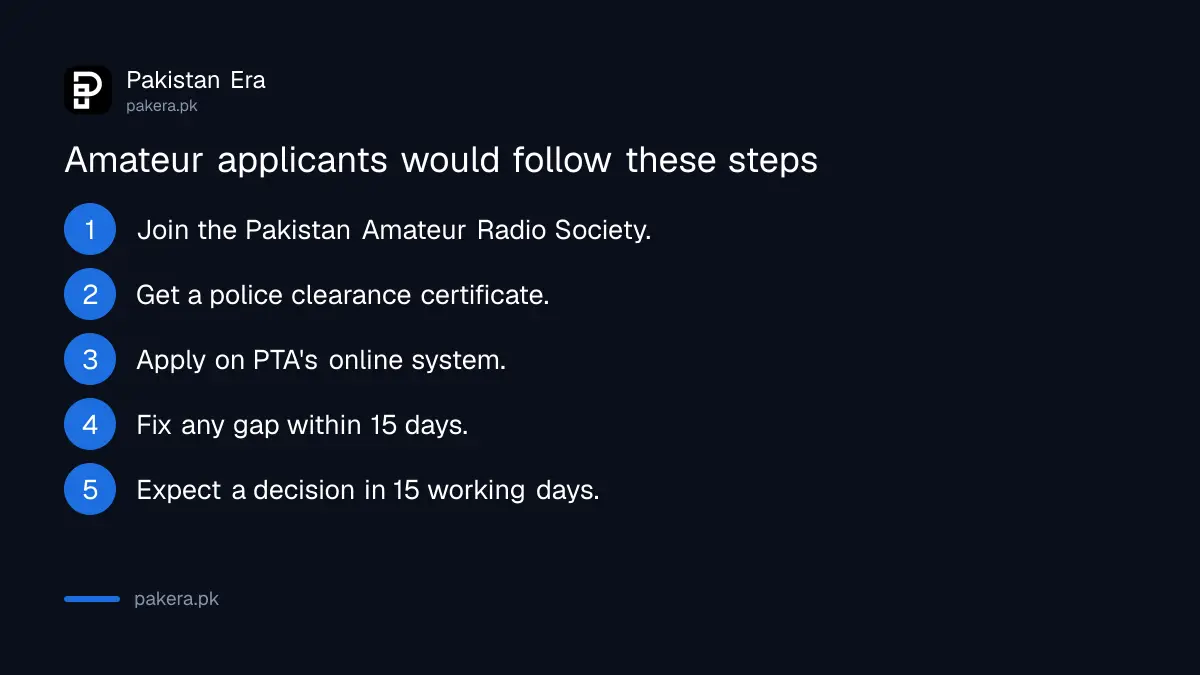
- Join PARS, the club the draft names, if you are not already a member.
- Get a police clearance certificate ready, since the draft makes it mandatory.
- Apply through PTA's online system once the final rules are notified.
- Answer any deficiency notice within 15 days.
- Pay the demand note and keep the receipt with your licence.
Aircraft and ship radios would pay Rs 100,000 a term
Reports of the draft list Rs 100,000 for an aircraft mobile station licence and Rs 100,000 for a maritime mobile station licence, each for the full licence term. An Inmarsat satellite terminal on board would add Rs 250,000 for the term.
Private radio networks would pay a yearly charge worked out by formula. The reported inputs are the base price, the frequency band, the number of frequencies, the bandwidth, the transmitter power and a location factor. Urban sites would carry a higher location factor than suburban or rural ones, so the same network costs more in a big city.
Radio equipment would also need type approval, with an exemption for gear on aircraft or ships certified by the aviation or maritime authority. Type approval is PTA's check that a device meets its technical standards; the steps are the same ones used to get PTA type approval for radios and trackers today.
Existing licences stay valid until they expire
Current licence holders would keep their licences on present terms until expiry, as reported. They would have to enter their licence details on PTA's online system within six months of the new rules taking effect, with no registration fee.
The draft would also let PTA refuse a licence on national security grounds and inspect licensed equipment with notice. Inspections without notice would be allowed where PTA suspects harmful interference, unauthorised spectrum use or a security threat. None of this applies yet. It all waits on a final notification.
Reports did not give a deadline for comments. If you want to comment, PTA's consumer helpline is 0800-55055, and the PTA website is where consultation drafts are usually posted.
Common questions
Has the amateur radio fee already gone up?
No. The Rs 2,000 for 10 years is in a draft for public comment. Until PTA notifies final rules, its 2019 procedure of Rs 1,000 for five years is the one we can confirm.
Do I need to reapply if I hold a licence now?
Not under the draft as reported. Existing licences stay valid until expiry, but holders would register their details online within six months of the rules taking effect.
Can a 14 year old get a radio licence?
Not yet. The draft would allow a free junior licence from 14 with a sponsor and parental or institutional consent. Today the youngest applicant is 16.
Is a walkie-talkie covered by these rules?
A business two-way radio system counts as a private radio network under the draft. A licence-free consumer device is a separate matter we have not checked, and the same caution applies to mobile signal repeaters, so ask PTA before you buy.
Where can I read the draft myself?
PTA normally posts consultation drafts on pta.gov.pk. The site did not load for us on 20 October 2026, so try again or call 0800-55055.
How we verified this
What we checked, where we read it, and what we could not confirm.
Last checked on 20 October 2026, Pakistan time. We could not open the draft Radio Based Services Licensing Regulations, 2026 on PTA's website: the site refused our connection and timed out through a rendering service. Every figure from the draft is therefore reported, from published accounts dated 19 October 2026, and we have not seen the text. The comparison column comes from PTA's amateur radio SOP of 5 November 2019 and Form AW-01, which we read at source on 13 October 2026. We could not confirm the comment deadline or whether the Rs 5,000 and Rs 10,000 charges apply to amateurs.
About the author

Technology Journalist & Multimedia Producer
Ahmad Ali is a technology journalist and multimedia producer at Pakistan Era, joining the team in October 2026. He covers consumer technology and digital life for Pakistani readers, combining research with hands-on product testing.