Gratuity Calculation in Punjab 2026: 30 Days' Pay a Year Under the Labour Code, Notice Rules and How to Claim
Punjab Labour Code 2026 gratuity: 30 days' pay per year after one year, the new salary caps, 30 days' notice, final pay in 2 working days and how to claim it.
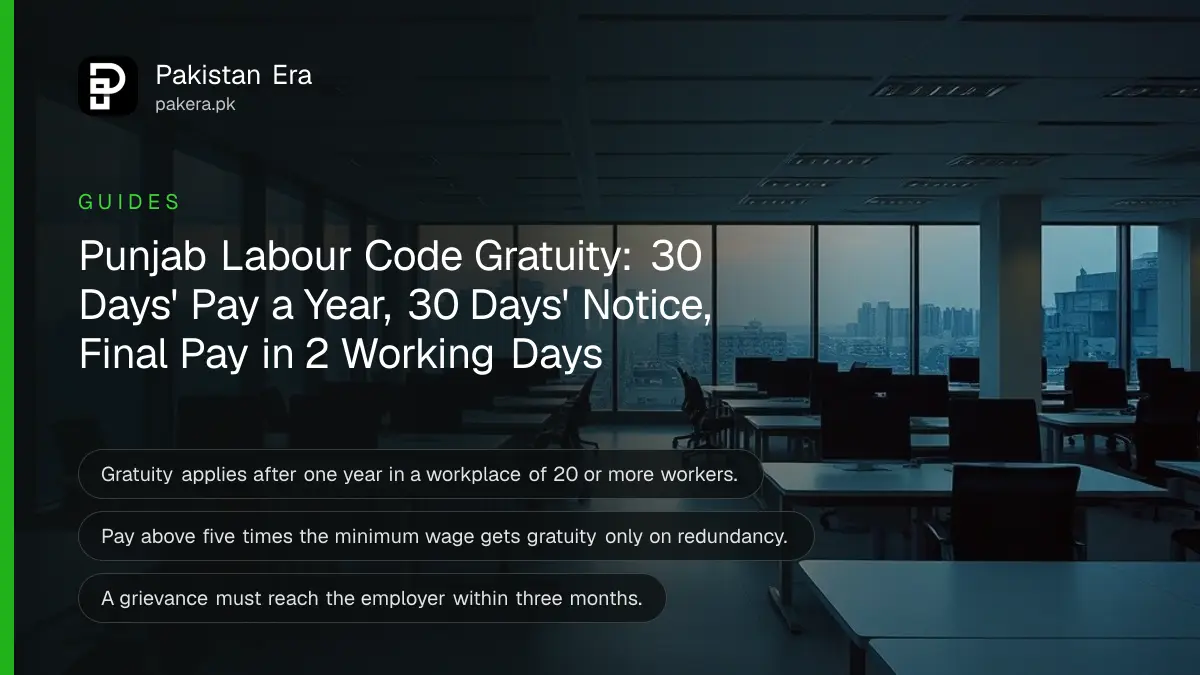
Under the Punjab Labour Code 2026, gratuity is 30 days' remuneration for every year of service, payable after one year in any establishment with 20 or more workers, whether you resign or are let go, unless you are dismissed for gross misconduct. The same Code gives you 30 days' written notice, or 30 days' pay instead, and says your final pay is due within two working days.
Most gratuity calculators online still follow the 1968 Standing Orders, which the Code repeals in Punjab. The Code also adds something new: a cap on gratuity for higher earners. We read the Code on the Punjab Government's Punjab Code page for the Labour Code 2026 on 28 October 2026.
Gratuity is 30 days' pay for each year after the first year
Section 159 gives gratuity equal to 30 days' remuneration for every year of service once you finish one year of continuous service. After the first year, any part year longer than six months counts as a full year. It applies to establishments with 20 or more workers.
The pay used is your last month's remuneration if you are on a fixed salary. For piece-rate workers, it is the highest pay drawn in the last twelve months. If a worker dies, the heirs get the gratuity, but the employer must deposit it with the Employees Compensation Commissioner, who divides it.
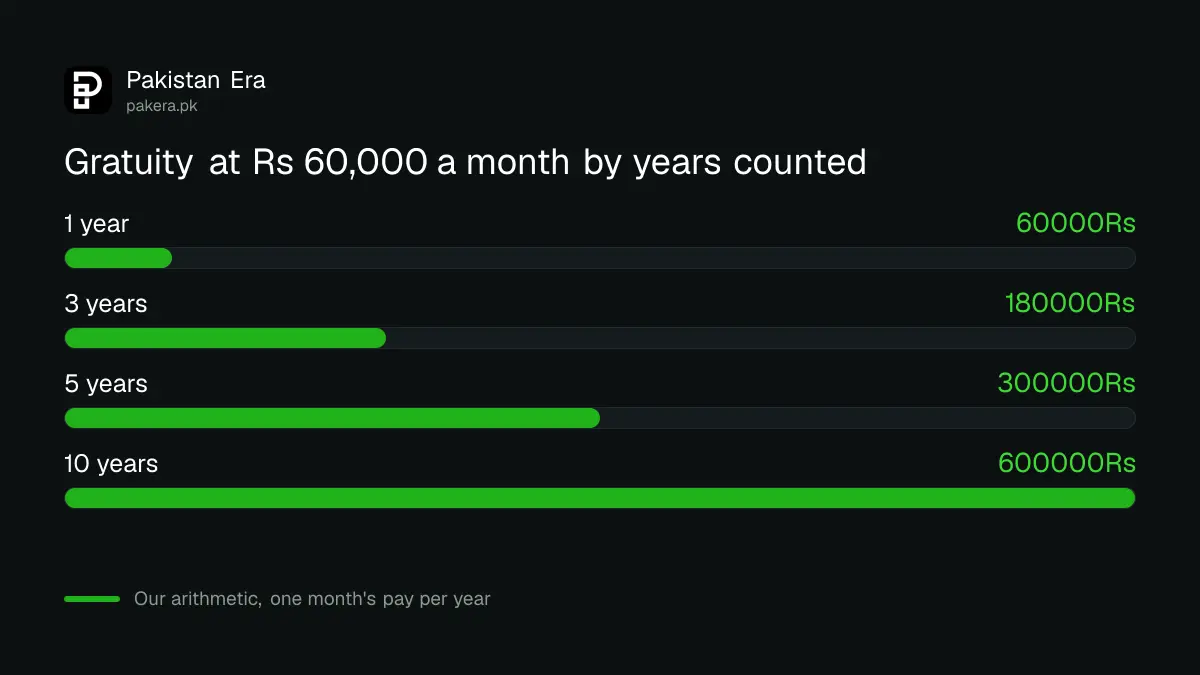
Here is how the arithmetic works for a worker on Rs 60,000 a month. For a monthly salaried worker, 30 days' remuneration is close to one month's pay, so we use one month in this example.
| Service | Years counted | Gratuity at Rs 60,000 a month |
|---|---|---|
| 11 months | 0, first year not complete | Nil |
| 3 years 4 months | 3 | Rs 180,000 |
| 4 years 7 months | 5 | Rs 300,000 |
| 10 years 2 months | 10 | Rs 600,000 |
Higher earners get gratuity only on redundancy, and it is capped
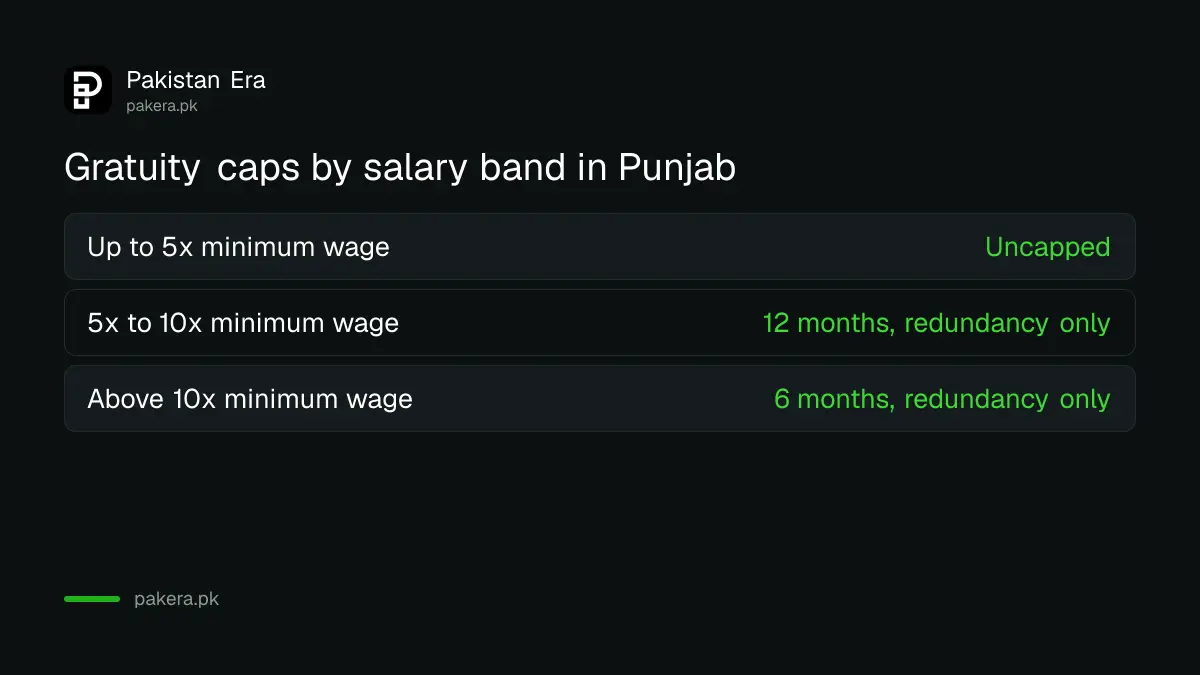
Section 160 limits gratuity by salary. Workers earning up to five times the monthly minimum wage get it, uncapped, on any termination except gross misconduct. Those earning more get it only when let go for redundancy or retrenchment, capped at twelve or six months' pay.
| Average monthly pay | When gratuity is paid | Maximum |
|---|---|---|
| Up to 5 times the minimum wage | Any termination except gross misconduct | Uncapped |
| Above 5 and up to 10 times | Redundancy or retrenchment only | 12 months' pay |
| Above 10 times | Redundancy or retrenchment only | 6 months' pay |
At Punjab's notified minimum wage of Rs 40,000 a month, five times is Rs 200,000 and ten times is Rs 400,000. Check the current figure on the Punjab minimum wage for 2026-27, because a new notification moves both lines. Section 160(3) protects gratuity you had already earned under the old law before the Code.
One more exception. If your employer runs a provident fund and puts in at least as much as you do, section 161 says no gratuity is due for the years the fund existed. The employer's share must still be no less than the gratuity would have been.
Either side must give 30 days' notice or 30 days' pay
Section 150 says a worker being let go gets 30 days' written notice or 30 days' pay in lieu, unless guilty of gross misconduct. A worker resigning must also give 30 days' notice or pay. In a micro-enterprise, with fewer than ten workers, it is 14 days.
During the notice period you keep full pay and benefits. You also get one paid day off each week, on top of the weekly rest day, to look for another job.
The Code also controls how a job can end. Under section 146, a termination must be a written order that states the reason. You must get a chance to answer the allegations first. Poor performance needs written instructions and a warning before it can be used as a reason.
Gross misconduct is a closed list in section 151. It includes theft, fraud, bribes, wilful damage, being drunk at work, and absence without leave for more than ten days in total. Joining a union, filing a complaint, or taking maternity, iddat or sick leave can never be a reason to sack you.
Final pay is due in 2 working days, the certificate in 10
Section 146(6) says pay you have earned and other dues, including unused annual leave, must be paid before the end of the second working day after the job ends. Section 158 requires an employment certificate within ten working days.
The certificate must show the employer's name and address, the nature of the business, how long you worked, your job, and the reason the job ended. It must not judge your work unless you ask for that. Wages under the Code have their own deadline, and the Punjab Labour Code wage rules set pay by the 7th of the month.
How to claim unpaid gratuity in Punjab
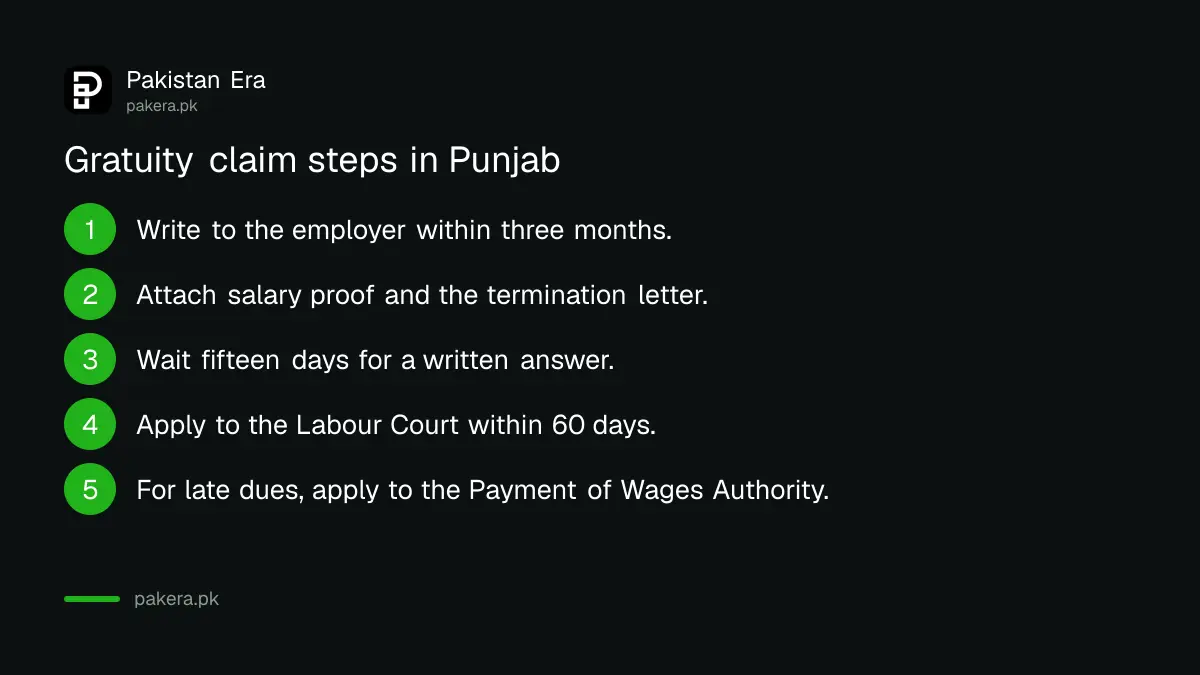
Start with a written grievance to the employer within three months of the termination. The employer has fifteen days to answer in writing. If it refuses or stays silent, you can go to the Labour Court within 60 days, and the court must decide within 90.
- Write to the employer, by hand with a receipt or by registered post, asking for the gratuity, notice pay and final dues. Keep a copy.
- Attach your appointment letter, salary slips or bank statements, and the termination or resignation letter.
- Wait fifteen days for the written answer under section 335(2).
- If the answer is no, or there is none, apply to the Labour Court within 60 days under section 335(6). For a termination, the grievance and the court application must both come within three months of the termination.
- For gratuity or wages that are only late, section 338 also lets you apply to the Payment of Wages Authority for a recovery direction.
A lawyer, a union official or a labour inspector can file the section 338 application for you. Older disputes in the courts follow the route for unpaid wages in a Punjab labour court.
Common questions
How is gratuity calculated in Punjab?
30 days' remuneration for each year of service, using your last month's pay. After the first year, a part year over six months counts as a full year.
Do I get gratuity if I resign?
Yes. Section 159 pays gratuity on termination by either party, so resignation counts, after one year of service. The salary cap in section 160 can limit this for higher earners.
Is gratuity paid in a small shop or office?
Not under section 159, which does not apply to establishments with fewer than 20 workers. Your contract may still promise it.
How much notice must my employer give in Punjab?
30 days' written notice or 30 days' pay, or 14 days in a business with fewer than ten workers. No notice is due for gross misconduct.
Is the Punjab Labour Code in force?
It was published in the Punjab Gazette on 10 February 2026 and comes into force on a date the Punjab Government notifies. We could not open that notification, so confirm with the Labour Department.
What if my employer has a provident fund?
If the employer contributes at least as much as you, no gratuity is due for those years. You still get the whole fund balance, including the employer's share.
How we verified this
What we checked, where we read it, and what we could not confirm.
We read the Punjab Labour Code 2026 (Act IX of 2026) on the Punjab Code portal of the Law and Parliamentary Affairs Department on 28 October 2026, including sections 146 to 161, 335, 338 and 435. It was passed on 4 February 2026, assented on 10 February 2026 and published in the Gazette the same day. The Code takes effect on a notified date, and the Punjab Labour Department website would not open from our connection, so we could not confirm the commencement notification. The Rs 40,000 minimum wage comes from the September 2025 notification recorded on our Punjab minimum wage page. The salary examples are our arithmetic.
About the author

Tax, Bills and Technology Writer
Ali Akhtar is a young and curious voice here at Pakistan Era. He is currently pursuing his A-Levels and has a growing interest in Pakistan’s changing industrial landscape and educational trends. Ali likes to write in a way that helps him explain and explore the world around him. His writing reflects the perspective of the new generation navigating the evolving trends of Pakistan where technology, youth innovation, and shifting opportunities are reshaping the country’s future.