Remittances of $7.29 Billion Beat Pakistan's Goods and Services Deficit in July and August 2026
Pakistan got $7.29 billion in remittances in July and August 2026, above the $6.75 billion goods and services deficit. See the numbers and the risks involved.
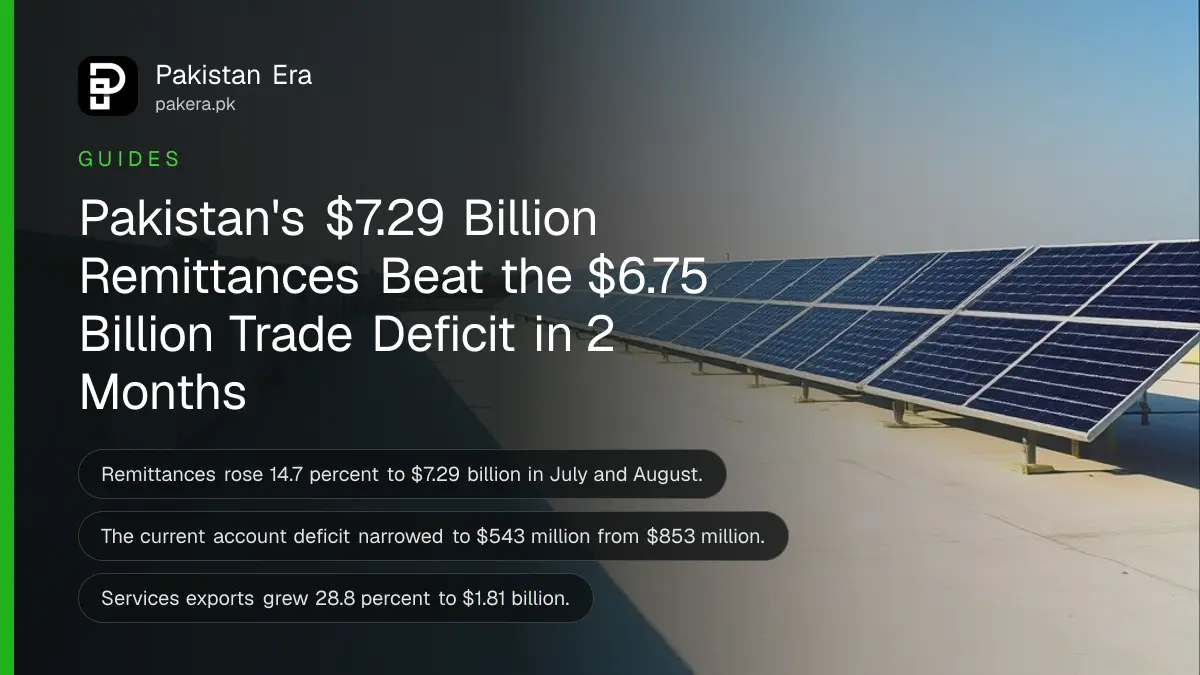
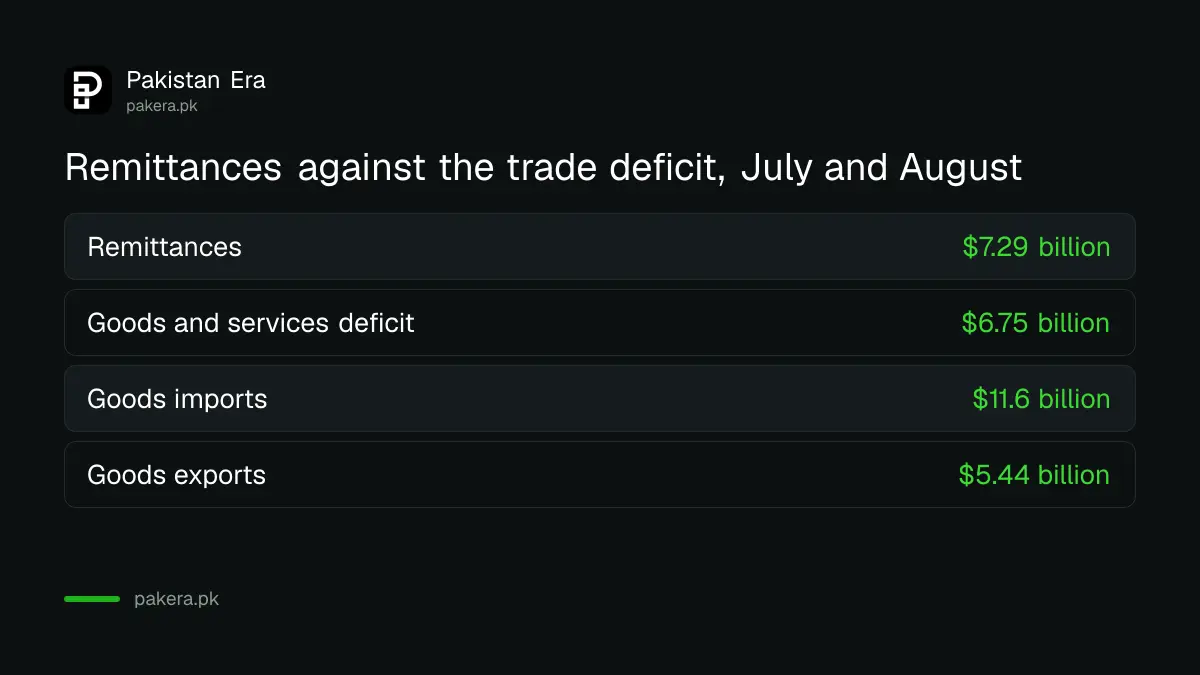
Pakistan received $7.29 billion in workers' remittances in July and August 2026, more than the whole goods and services deficit of $6.75 billion, according to the Finance Division. Money sent home by overseas Pakistanis now covers the gap between what the country buys and sells abroad.
Remittances are the money overseas workers send to families in Pakistan. We read the Finance Division's September 2026 economic update and two State Bank of Pakistan (SBP) press releases on 21 October 2026. The figures cover the first two months of the 2026-27 fiscal year.
Remittances rose 14.7 percent to $7.29 billion
The Finance Division reports workers' remittances of $7.29 billion for July and August 2026, up 14.7 percent from a year earlier. The same two months cost Pakistan $6.75 billion more on goods and services imports than it earned on exports, so remittances covered it with room to spare.
Our arithmetic: 7.29 divided by 6.75 is 108 percent. Remittances paid for the entire deficit and left about $0.54 billion over.
The trade gap widened but the current account narrowed
Goods imports rose 11.4 percent to $11.6 billion, because oil costs more and domestic demand is recovering. Goods exports rose only 4.0 percent to $5.44 billion. That leaves a goods gap of about $6.16 billion, our subtraction from the update's table.
| July and August | 2025 | 2026 |
|---|---|---|
| Workers' remittances | $6.3 billion | $7.29 billion |
| Goods exports | $5.24 billion | $5.44 billion |
| Goods imports | $10.4 billion | $11.6 billion |
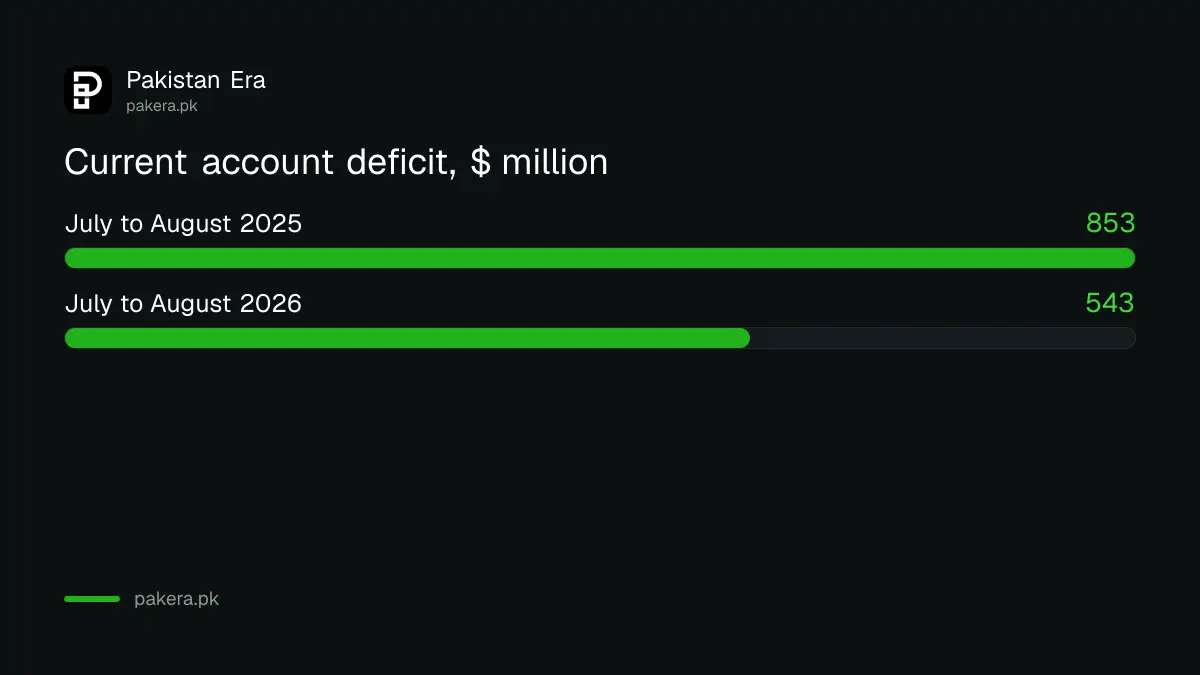
| Current account balance | minus $853 million | minus $543 million |
Even so, the current account deficit narrowed from $853 million to $543 million. The Finance Division says two sources of strength absorbed the pressure: remittances and services exports.
Services exports grew 28.8 percent to $1.81 billion
Services exports, such as IT work, rose 28.8 percent to $1.81 billion. The update says this narrowed the services deficit by about a quarter. It also says these non-trade inflows are now the main factor holding the current account deficit down as the import bill rises.
Foreign investment helped too. Foreign direct investment was $494.5 million, up about a quarter, and portfolio flows turned positive. Our report on the July and August current account has the SBP's own table.
Saudi Arabia and the UAE lead the corridors
SBP says September remittances were $3.6 billion, up 12.7 percent on a year earlier and down 1.9 percent on August. For the first quarter, July to September, they were $10.9 billion, up 14.0 percent from $9.5 billion.
The biggest sources in September were Saudi Arabia with $899.1 million, the UAE with $748.5 million, the UK with $515.1 million and the United States with $305.9 million. The full September breakdown is in our September remittances report.
The Gulf share shows why Gulf worker rules matter to the whole economy. A job loss or a visa change in Riyadh or Dubai shows up quickly in Pakistan's external accounts.
Why one strong source of dollars is also a risk
When remittances cover the whole trade gap, the external accounts lean heavily on workers abroad. That is good while jobs and wages hold. But a downturn in a Gulf economy, a change in visa rules or a fall in overseas hiring would show up fast at home.
The Finance Division lists overseas employment as an important source of foreign exchange and economic mobility. Its update says the Bureau of Emigration and Overseas Employment registered 27,656 Pakistani workers for overseas jobs in August 2026. Our report on workers who went abroad from January to September 2026 has the longer count.
Exports are the second leg. Goods exports grew only 4.0 percent while imports grew 11.4 percent, so the goods gap widened. Remittances and services are plugging it, and the update calls them the main factor containing the deficit. That is a strength this year and a dependency over time.
What families and exporters can do with this
The numbers are macro, but they lead to simple choices. Banks and the SBP want remittances to come through formal channels, and a scheme now rewards it. Check how your family can qualify in our guide to the Pasban remittance reward.
- Send money through a bank, exchange company or app that is licensed by SBP.
- Keep the transfer receipt and reference number until the money arrives.
- Compare the rate offered with the SBP interbank rate that day.
- If money does not arrive, complain first to the sending provider and then to the receiving bank.
Common questions
How much were remittances in July and August 2026?
The Finance Division reports $7.29 billion, up 14.7 percent from a year earlier.
What was the goods and services deficit?
It was $6.75 billion for the same two months, so remittances were larger than the deficit.
What was the current account deficit?
The current account deficit was $543 million in July and August, against $853 million a year earlier.
Which country sends the most money?
In September 2026 it was Saudi Arabia with $899.1 million, followed by the UAE with $748.5 million, per SBP.
Will remittances keep growing?
We do not forecast it. The Finance Division expects remittances to keep supporting household incomes, but it gives no figure.
How we verified this
What we checked, where we read it, and what we could not confirm.
On 21 October 2026 we read the Finance Division's Monthly Economic Update and Outlook for September 2026, and SBP's 9 October press release on September remittances, listed on the SBP press page. We could not verify October data, which is not yet published.
About the author

Global Affairs & Political Economy Writer
Muhammad Hatim is a book lover who started writing because he enjoys it. At Pakistan Era he writes about international relations, geopolitics and the global economy, with a particular interest in South Asia and the forces behind current events.