Sales Tax Withholding Rates in Pakistan 2026-27: 1/5th, 1/10th, 5% and 80% Under the Eleventh Schedule
Sales tax withholding in Pakistan 2026-27: 1/5th or 1/10th from Active Taxpayers, whole tax or 5% from others, 80% on coal and scrap. Exclusions and deadlines.
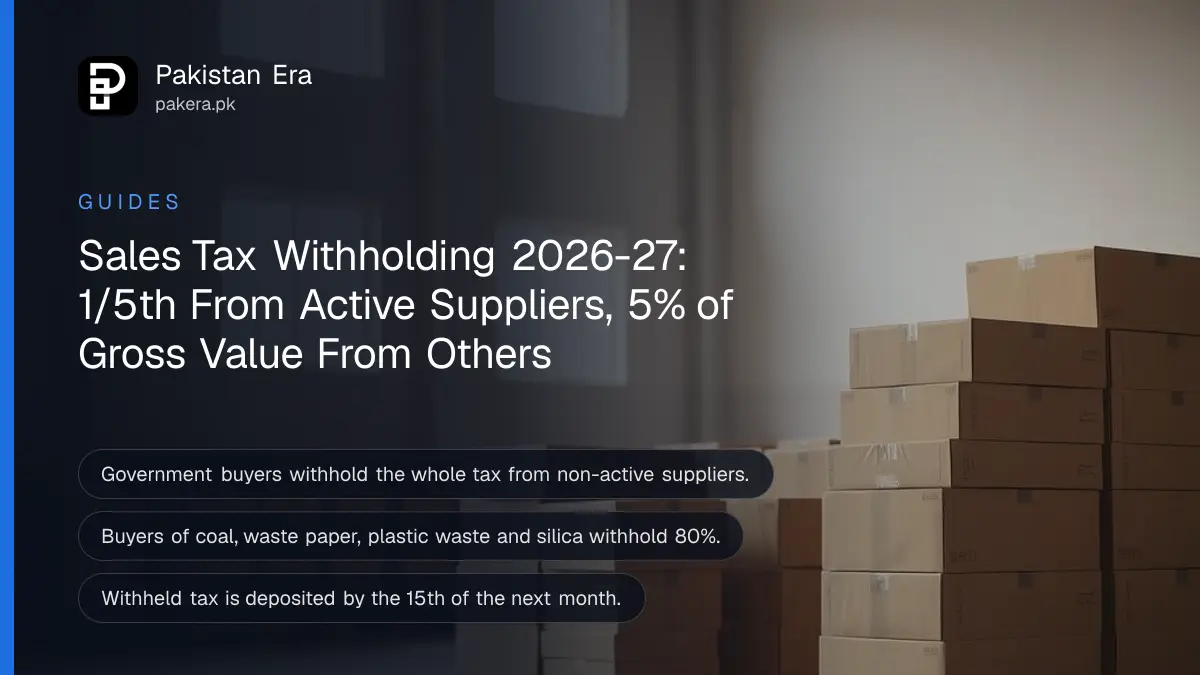
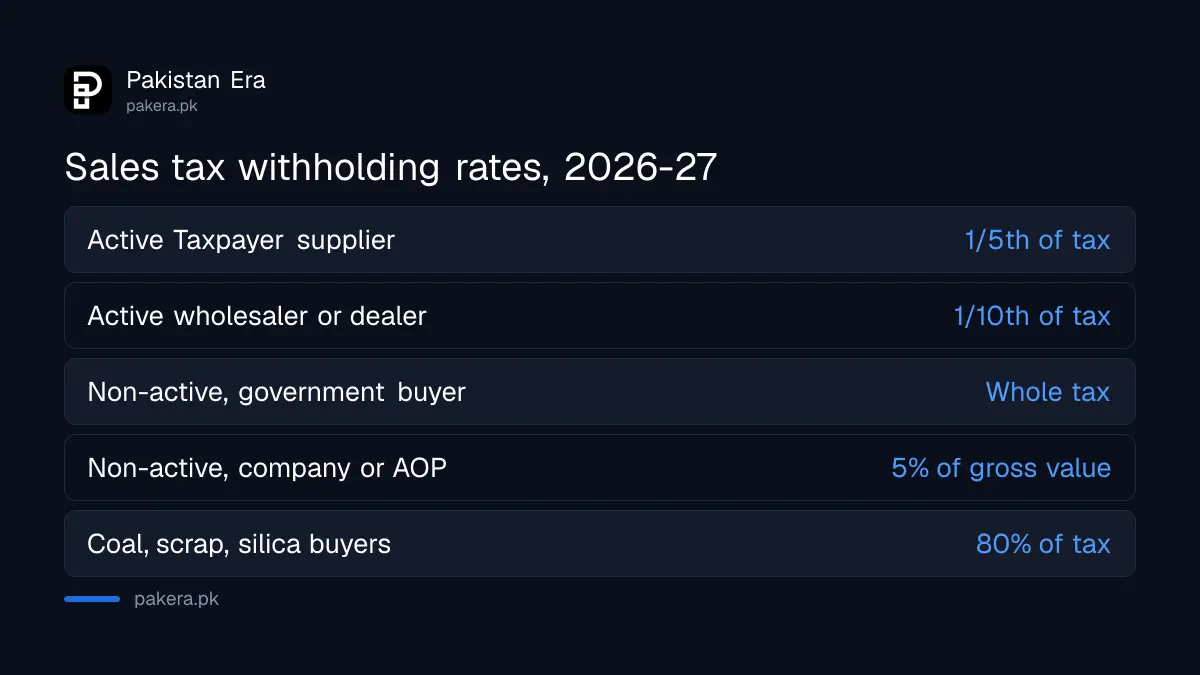
Under the Eleventh Schedule to the Sales Tax Act, 1990, government departments and companies withhold 1/5th of the sales tax on an invoice from an Active Taxpayer supplier, or 1/10th if the supplier is a registered wholesaler, dealer or distributor. From a supplier who is not an Active Taxpayer, government withholds the whole tax, and companies, AOPs and individuals withhold 5% of the gross value. Buyers of coal, gypsum, waste paper, plastic waste, crush stone and silica withhold 80% of the tax.
Suppliers feel this as a smaller cheque than the invoice. Buyers who are withholding agents must deduct, deposit and issue a certificate by the 15th of the next month. Here is the 2026-27 table, the goods left out, and what each side must do.
Sales tax withholding rates for 2026-27
The rate depends on who buys and who sells. Government bodies and companies take a fraction of the invoiced tax from Active Taxpayers, and much more from suppliers who are not on the Active Taxpayers List. The Finance Act, 2026 added associations of persons and individuals to the 5% row.
| Withholding agent (buyer) | Supplier | Amount withheld |
|---|---|---|
| Federal and provincial government departments, autonomous bodies, public sector organisations, and companies | Active Taxpayer | 1/5th of the sales tax on the invoice |
| Same buyers | Active Taxpayer registered as a wholesaler, dealer or distributor | 1/10th of the sales tax on the invoice |
| Government departments, autonomous bodies, public sector organisations | Not an Active Taxpayer | Whole of the tax on the gross value |
| Companies, associations of persons and individuals (except companies exporting surgical instruments) | Not an Active Taxpayer | 5% of the gross value of supplies |
| Registered persons buying coal, waste paper and paperboard, plastic waste, crush stone and silica | Any supplier of those goods | 80% of the sales tax |
| Registered cement makers buying gypsum or limestone flux | Any supplier of those goods | 80% of the sales tax |
| Registered toll manufacturers | Person other than a registered person | Four times the tax charged on conversion charges |
The table also has rows for advertisement services, cane molasses, lead and scrap batteries, and digitally ordered goods sold online, each with its own rule. The toll manufacturing row was added by the Finance Act, 2026. Check whether a supplier is active on the sales tax Active Taxpayers List before you pay.
Supplies left out of withholding
Nine kinds of supply are excluded after the table. They include electricity, gas, petroleum products, ghee and cooking oil, telecom services, and goods taxed at retail price. Most important for businesses, an Active Taxpayer selling to another registered person is excluded, except in the 80% rows.
- Electrical energy.
- Natural gas.
- Petroleum products supplied by exploration and production companies, refineries, oil marketing companies and petrol and diesel dealers.
- Vegetable ghee and cooking oil.
- Telecommunication services.
- Goods in the Third Schedule, which are taxed at the printed retail price.
- Supplies by importers who paid value addition tax at import.
- Supplies by an Active Taxpayer to another registered person, except for advertisement services, lead and scrap batteries, gypsum, coal, waste paper, plastic waste, crush stone and silica.
- Sand, stone, gravel, crush and clay supplied to low cost housing schemes sponsored or approved by the Naya Pakistan Housing and Development Authority.
Exclusion 8 changes how the 1/5th and 1/10th rows work in practice. A registered company buying from an Active Taxpayer usually withholds nothing. The fractions bite mainly on government departments and on companies that are not registered for sales tax. For the price-printed goods in exclusion 6, see the Third Schedule retail price goods list.
A worked example of withholding
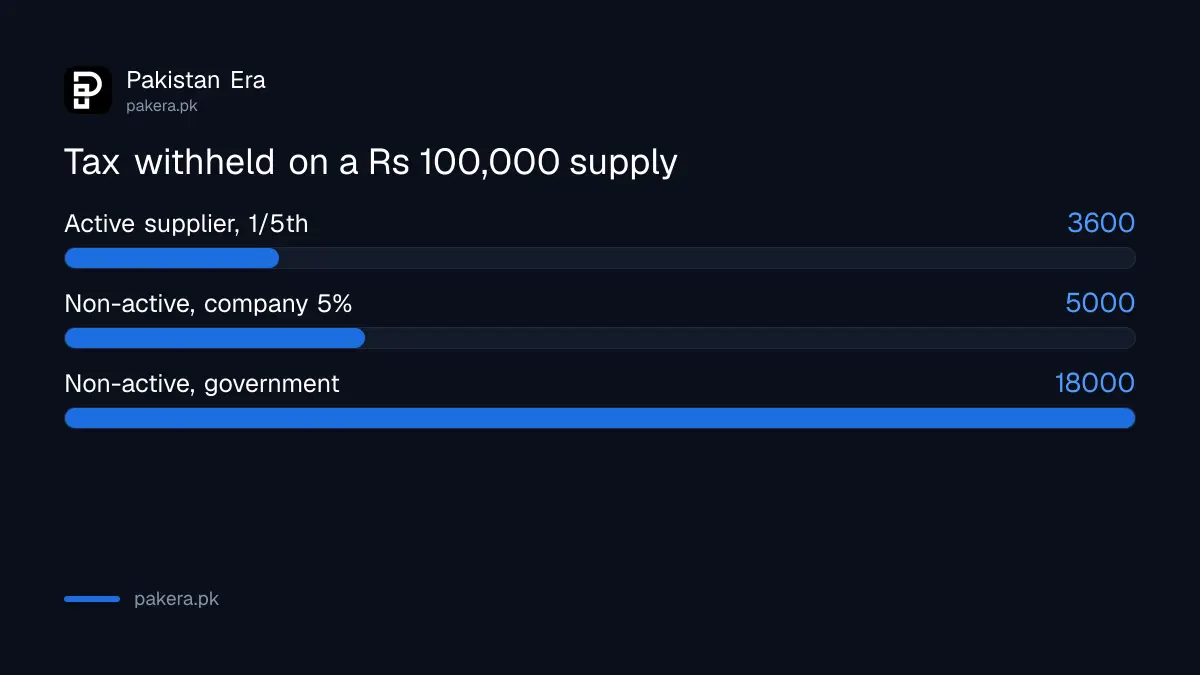
An Active Taxpayer sells goods worth Rs 100,000 to a government department. Sales tax at 18% is Rs 18,000. The department withholds 1/5th, Rs 3,600, pays the supplier Rs 114,400, and deposits the Rs 3,600 itself. The supplier pays the other Rs 14,400 through its return.
If the same supplier were not an Active Taxpayer, the department would withhold the whole Rs 18,000. A private company buying from a non-active supplier, with a gross value of Rs 100,000, withholds 5%, which is Rs 5,000.
Rule 150ZZI(2) of the Sales Tax Rules, 2006 sets out this method. Its proviso adds that the buyer cannot claim the amount it withheld as its own input tax.
What the buyer must do as withholding agent
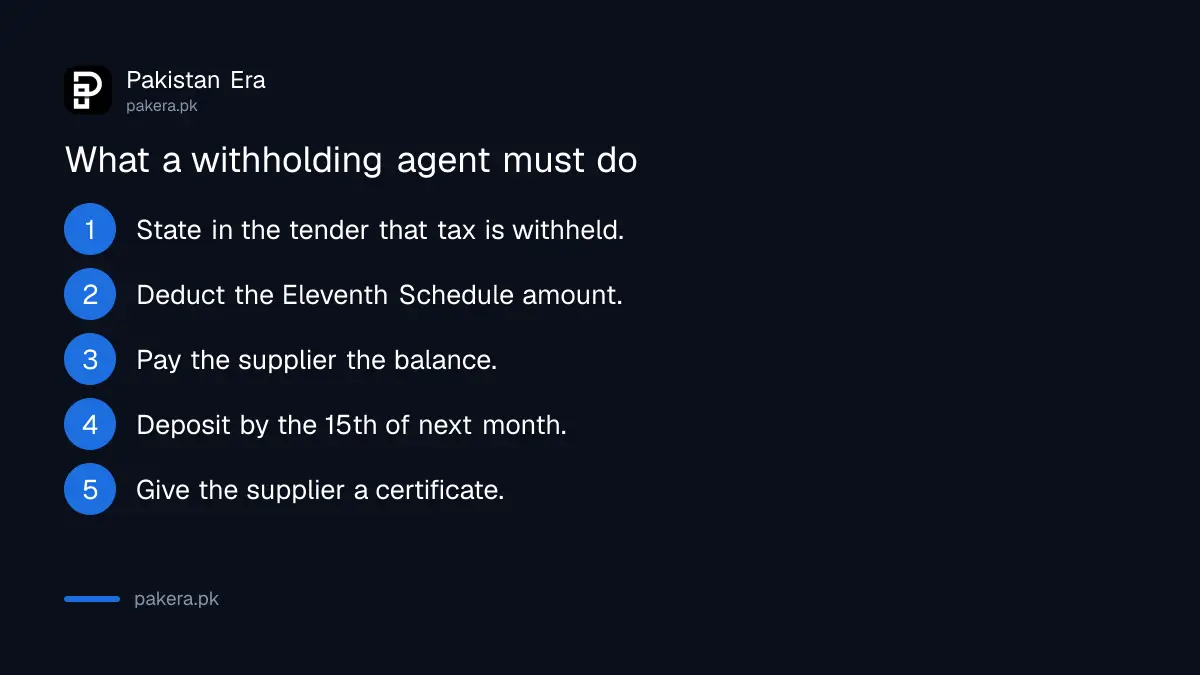
Chapter XIV-D of the Sales Tax Rules sets the duties. The buyer says in its tender or notice that tax will be withheld, deducts the amount, deposits it by the 15th of the next month, and gives the supplier a certificate of the deduction.
- Registered buyers deposit the withheld tax with their own monthly sales tax return, under rule 150ZZI(6).
- Buyers with an NTN but no sales tax registration file the STR-28 return online and pay electronically.
- Government departments deposit through their accounting office. The Drawing and Disbursing Officer files an STR-28 return for each month by the 15th.
- Every withholding agent issues a certificate showing the supplier's name and registration number, the goods and the tax deducted, under rule 150ZZI(8).
The Commissioner keeps a list of withholding agents and checks their deposits against suppliers' returns, under rule 150ZZK. Late payment of sales tax attracts default surcharge, set out in the late sales tax return penalty guide.
What the supplier must do
The supplier issues a proper sales tax invoice for every taxable supply to a withholding agent, then files its monthly return and takes credit for the tax withheld. Keep each withholding certificate, because the credit claimed in the return must match the buyer's deposit.
Where the supplier is on FBR's digital invoicing system, the invoice should carry FBR's invoice number. The sales tax invoice rules list what it must show. A supplier who stays on the Active Taxpayers List faces far lower withholding than one who drops off it.
Common questions
How much sales tax does a government department withhold?
1/5th of the invoiced tax from an Active Taxpayer, 1/10th from an active wholesaler or distributor, and the whole tax from a non-active supplier.
What do companies withhold from a non-active supplier?
5% of the gross value of supplies. The Finance Act, 2026 added associations of persons and individuals to this row.
Does a registered company withhold from an Active Taxpayer?
Usually not. Supplies by an Active Taxpayer to another registered person are excluded, except in the 80% and a few other rows.
Is sales tax withheld on electricity or gas bills?
No. Electrical energy, natural gas, petroleum products and telecom services are excluded from withholding.
When must withheld sales tax be deposited?
By the 15th of the month after the purchase, or with the buyer's own monthly return if it is registered.
Can the buyer claim withheld tax as input tax?
No. Rule 150ZZI(2) bars the withholding agent from claiming the withheld amount as input tax.
How we verified this
What we checked and where we read it.
We checked the Eleventh Schedule and section 3(7) in the Sales Tax Act, 1990 amended up to 30 June 2026, and Chapter XIV-D (rules 150ZZH to 150ZZK) in the Sales Tax Rules, 2006 updated to 31 July 2026, both on FBR's download server, on 15 November 2026. The illustration printed in rule 150ZZI still uses the old 17% rate; our example uses the current 18% standard rate.
About the author

Tax, Bills and Technology Writer
Ali Akhtar is a young and curious voice here at Pakistan Era. He is currently pursuing his A-Levels and has a growing interest in Pakistan’s changing industrial landscape and educational trends. Ali likes to write in a way that helps him explain and explore the world around him. His writing reflects the perspective of the new generation navigating the evolving trends of Pakistan where technology, youth innovation, and shifting opportunities are reshaping the country’s future.