Sales Tax on Retail Price Now Covers 20 More Goods in Pakistan, From Noodles to Footwear
The Finance Act 2026 put 20 more goods groups on the Third Schedule, so sales tax is charged on retail price. See the full list and what to check on the pack.
The Finance Act 2026 added 20 groups of goods to the Third Schedule of the Sales Tax Act, from cooking oil and noodles to footwear, crockery and shampoo. Sales tax on these goods is charged at 18 per cent of the retail price printed on the pack. The Act came into force on 1 July 2026 unless it says otherwise.
You will see the effect at the shop shelf, not in a tax return. The price on the pack is now the base for the tax, and the tax amount has to be printed with it. We read the Act in the Gazette of 26 June 2026 on FBR's own download site, and the older Sales Tax Act text to check what the Third Schedule means.
The Third Schedule taxes goods on the price printed on the pack
The Third Schedule is a list of goods that are taxed on retail price. The Sales Tax Act says the tax is 18 per cent of that price, and that the price and the tax must be printed or embossed on each pack. It is not charged on the factory price.
The Act defines the retail price as the price fixed by the manufacturer, or by the importer for imported goods. It includes duties and charges, but not sales tax. If a maker fixes more than one price for the same brand, the highest one counts. For imported Third Schedule goods, the retail price cannot be less than 130 per cent of the customs value.
The Finance Act 2026 also carries a note. If the Federal Government has already notified a sales tax rate higher than 18 per cent for any of these goods, that higher rate continues after they join the Third Schedule.
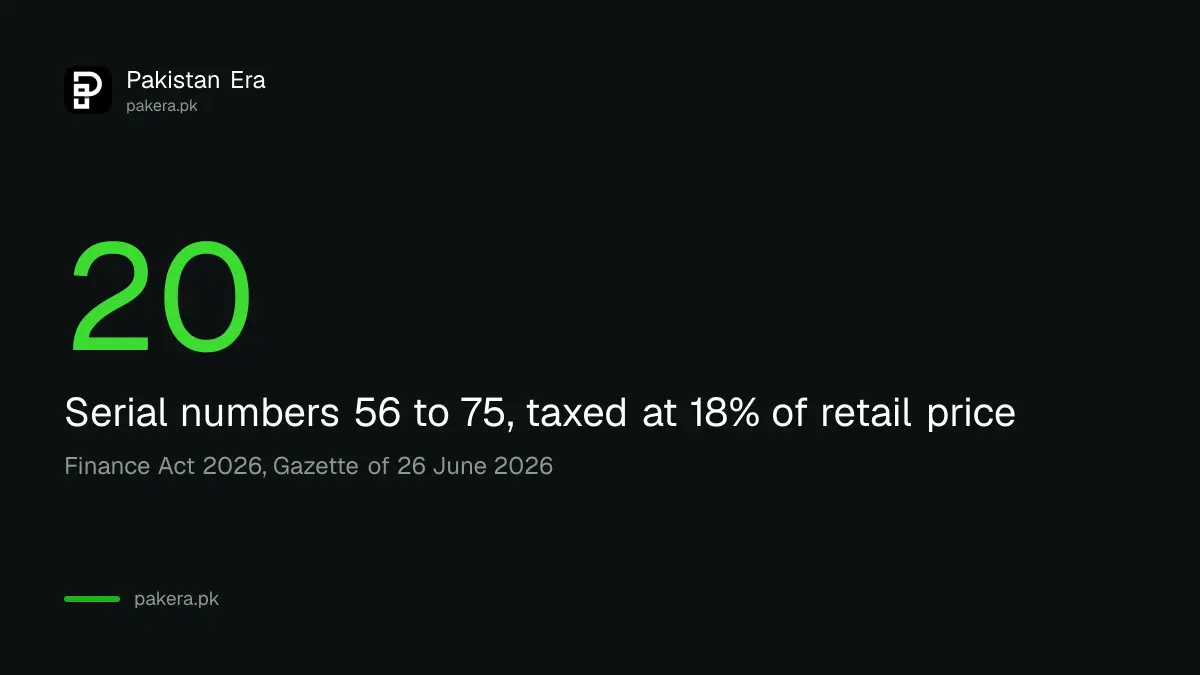
Twenty groups of goods were added as serial numbers 56 to 75
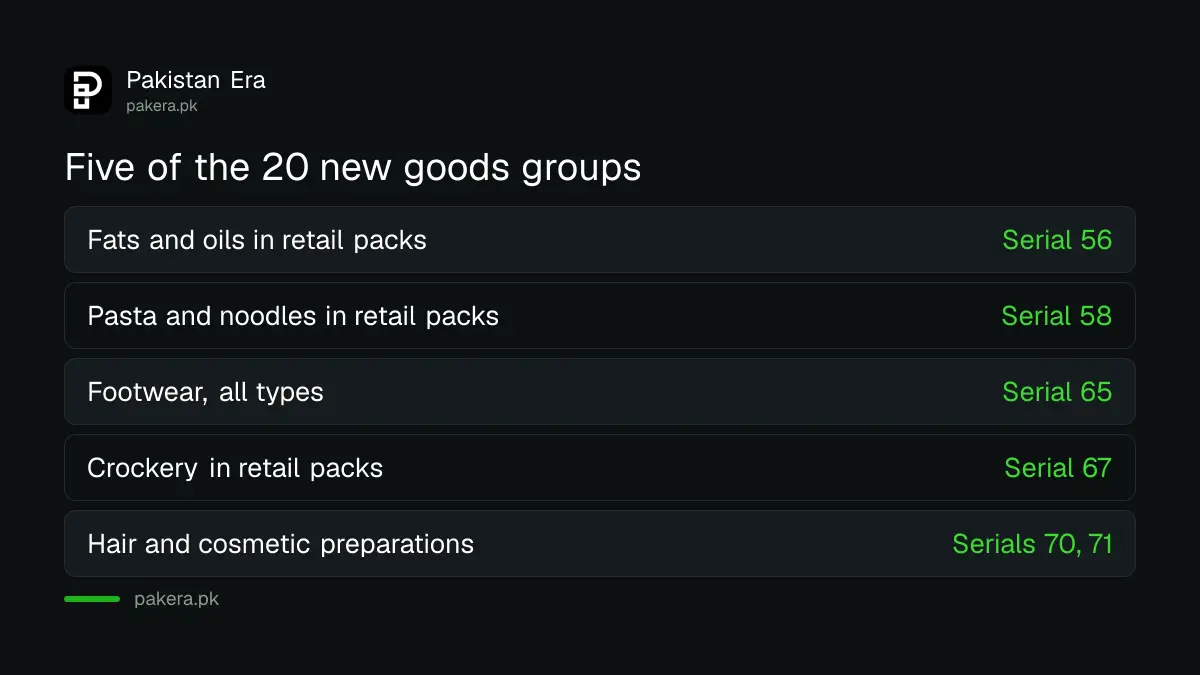
The Act adds serial numbers 56 to 75 to the Table of the Third Schedule. Most entries say "sold in retail packing", so loose goods may fall outside. The table below shortens the Act's wording. Read the Act for the exact tariff headings.
| Serial no. | Goods (shortened) | Condition in the Act |
|---|---|---|
| 56 | Vegetable and animal fats and oils | Sold in retail packing |
| 57 | Sugar confectionery | Sold in retail packing |
| 58 | Pasta, noodles, macaroni, couscous | Sold in retail packing |
| 59 | Sauces, ketchup, mixed seasonings, mustard | Sold in retail packing |
| 60 | Fermented beverages | Sold in retail packing |
| 61 | Petroleum jelly and mineral waxes | Sold in retail packing |
| 62 | Plastic plates, sheets, film, foil, tape | Sold in retail packing |
| 63 | Plastic tableware, kitchenware, furniture, storage items | Sold in retail packing |
| 64 | Suitcases, handbags, school satchels, wallets, travel bags | Put up for retail sale |
| 65 | Footwear, all types | Except where the maker sells only through digitally integrated, POS compliant outlets |
| 66 | Bathroom accessories, taps, showerheads, sanitaryware fittings | Sold in retail packing |
| 67 | Crockery | Sold in retail packing |
| 68 | Car and automobile accessories | Sold in retail packing |
| 69 | Milk, fat-filled milk, infant preparations, other milk products | Sold in retail packing |
| 70 | Hair preparations | Sold in retail packing |
| 71 | Shaving products, deodorants, bath preparations, cosmetics | Sold in retail packing |
| 72 | Toilet and facial tissue, napkin and towel paper | Put up for retail sale |
| 73 | Jams, jellies, fruit and nut pastes, fruit preparations | Sold in retail packing |
| 74 | Household utensils, steel, aluminium, melamine | Put up for retail sale |
| 75 | Ceramic basins, commodes, tiles, sanitary ceramics | Put up for retail sale |
Look at serial 69. It lists milk, fat-filled milk and infant milk preparations, all "sold in retail packing". We read that wording in the Gazette text. We have not read an FBR circular on how it applies to a particular product, so check with a registered seller if a price matters to you.
Shoppers should look for the retail price and tax on the pack
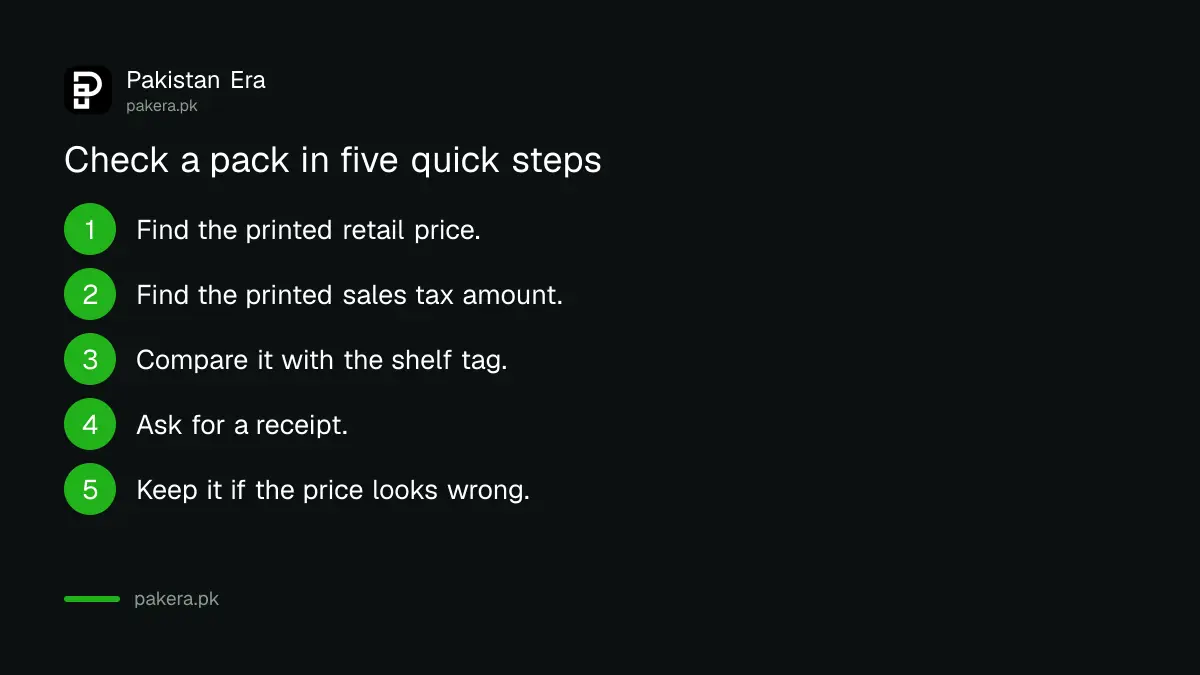
For goods in this list, the law requires the retail price and the amount of sales tax to be printed or embossed on the pack. A pack that shows neither is a warning sign. It may be old stock or a product that skipped the rule.
- Pick up the pack and find the printed retail price.
- Look for the sales tax amount printed or embossed beside it.
- Compare the price on the shelf tag with the price on the pack.
- Ask for a receipt that shows the sale. An FBR linked shop can give you a POS invoice, and you can check it with the steps in verify an FBR POS invoice.
- Keep the receipt if the price looks wrong, so you can raise it with the seller.
We did not survey shelves, so we cannot say how many packs already carry the printed tax. We read the law, not the market.
Makers and importers face a penalty if they skip the printing rule
The Sales Tax Act sets a penalty for a manufacturer or importer who does not print the retail price as required. It is Rs 10,000 or 5 per cent of the tax involved, whichever is higher. The goods can also be confiscated.
In the penalty table we read, the adjudicating authority may let the owner redeem confiscated goods by paying a fine. The fine cannot be less than 20 per cent of the total retail price of the goods. That text comes from the Act as updated to 2025-26, so check the current version if you face a case.
Small sellers who only resell packed goods are not the printer of the price. They still need to know what FBR can ask for at registration if their turnover brings them into the system.
Cooking oil already has a separate FBR rule
Ghee and cooking oil sit in serial 56. FBR has also set a minimum sales tax value for them by a separate order, so the two rules sit side by side. Read both before you work out a price for oil.
Our note on the minimum sales tax value for ghee and cooking oil explains that order. Our guide to filing a monthly sales tax return helps a registered seller who now sells goods from this list.
Common questions about the new Third Schedule goods
What is the Third Schedule?
It is a list in the Sales Tax Act of goods taxed on retail price instead of the factory price. The rate in section 3 is 18 per cent of that price.
How many goods did the Finance Act 2026 add?
Twenty entries, serial numbers 56 to 75, were added to the Table of the Third Schedule. Each entry covers a group of goods.
When do the new entries start?
The Finance Act 2026 says it comes into force on 1 July 2026 unless it says otherwise. We found no separate later date on these entries.
Is footwear taxed on retail price?
Yes, but with an exception for makers who sell only through digitally integrated, POS compliant retail outlets. The detail is in the footwear sales tax rule and its POS exception.
Will prices go up?
We cannot say. The Act changes the tax base, not the price a maker chooses. Watch the printed price and compare it with what you paid before.
How we verified this
What we checked, where we read it, and what we could not confirm.
Last checked 14 October 2026. The list of goods, the 1 July 2026 start and the note on higher rates come from the Finance Act 2026, published in the Gazette of 26 June 2026 at download1.fbr.gov.pk. The retail price definition, the 18 per cent rate, the printing rule and the penalty come from the Sales Tax Act as updated to 2025-26 on the same site. We did not read an FBR circular on how the new entries are applied, and we did not check shop prices.
About the author

Senior Writer, Public Services and Technology
Shahid joined us in 2024 as an author. He is a senior contributor to Pakistan's leading technology websites. He writes detailed articles, mostly covering his expertise in the latest tech, mobiles, apps, gadgets, and step-by-step guides. His ideology is to help people understand the latest trends and explain complex methods through very easy-to-understand guides.