FBR Sets a Minimum Sales Tax Value for Ghee and Cooking Oil in Pakistan: PBS Price Minus Rs 25
FBR's S.R.O. 1632(I)/2026 sets a minimum sales tax value for ghee and cooking oil: the PBS average price less Rs 25, with 93% and 85% shares for other brands.
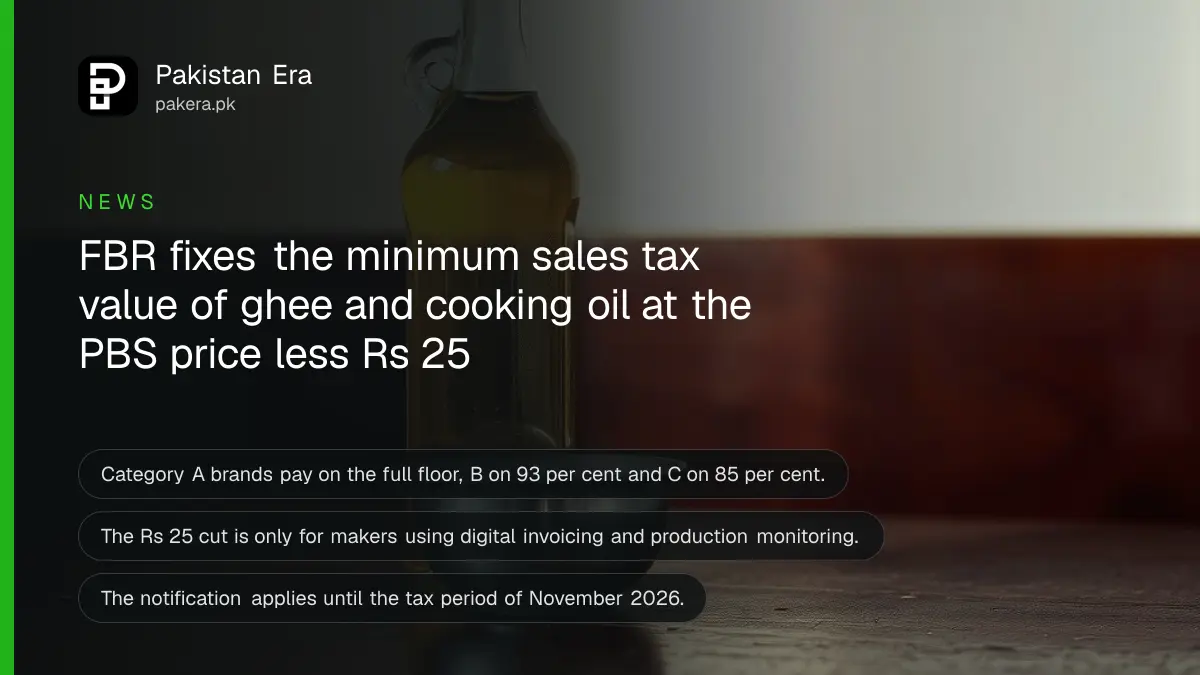
FBR has fixed a minimum sales tax value for ghee and cooking oil made in Pakistan. The floor is the average national retail price from the Pakistan Bureau of Statistics (PBS) weekly price survey, minus Rs 25 a kilo for compliant makers. Lower-ranked brands pay on 93 or 85 per cent of that figure.
The rule is S.R.O. 1632(I)/2026, dated 18 September 2026. We read the notification and its companion, S.R.O. 1631(I)/2026, on the FBR website on 13 October 2026. Both apply until the tax period of November 2026.
Sales tax is charged on the value of a supply. A minimum value stops a seller from declaring a low price to pay less tax. Shoppers do not pay this tax separately, because it is already inside the price on the pack.
The minimum value follows the PBS retail price
Under S.R.O. 1632(I)/2026, the minimum value of domestic ghee and cooking oil, including sales tax, is the average national retail price shown on the PBS website for the last week of the previous month, less Rs 25. The reduction is only for makers using digital invoicing and FBR's production monitoring.
The notification uses the weekly Sensitive Price Indicator, the same survey we cover each week. Our latest note on it is in the weekly inflation report for 8 October 2026.
The Board used the power in the first proviso to clause (46) of section 2 of the Sales Tax Act, 1990. If a seller's actual price is higher than the floor, tax is charged on the higher price.
Three brand categories pay on different shares
The notification sorts brands into categories A, B and C. Category A pays on 100 per cent of the floor, category B on 93 per cent and category C, which is every other brand, on 85 per cent.
| Category | Brands named | Share of the floor | Example price a kilo |
|---|---|---|---|
| A | Dalda, Habib, Sufi, Mezan, Soya Supreme, EVA | 100% | Rs 588 |
| B | Manpasand, Habib Handi, Seasons, Kashmir, Kausar, Shah Taj, Kisan, Shafaq, Sultan | 93% | Rs 547 |
| C | All other brands | 85% | Rs 500 |
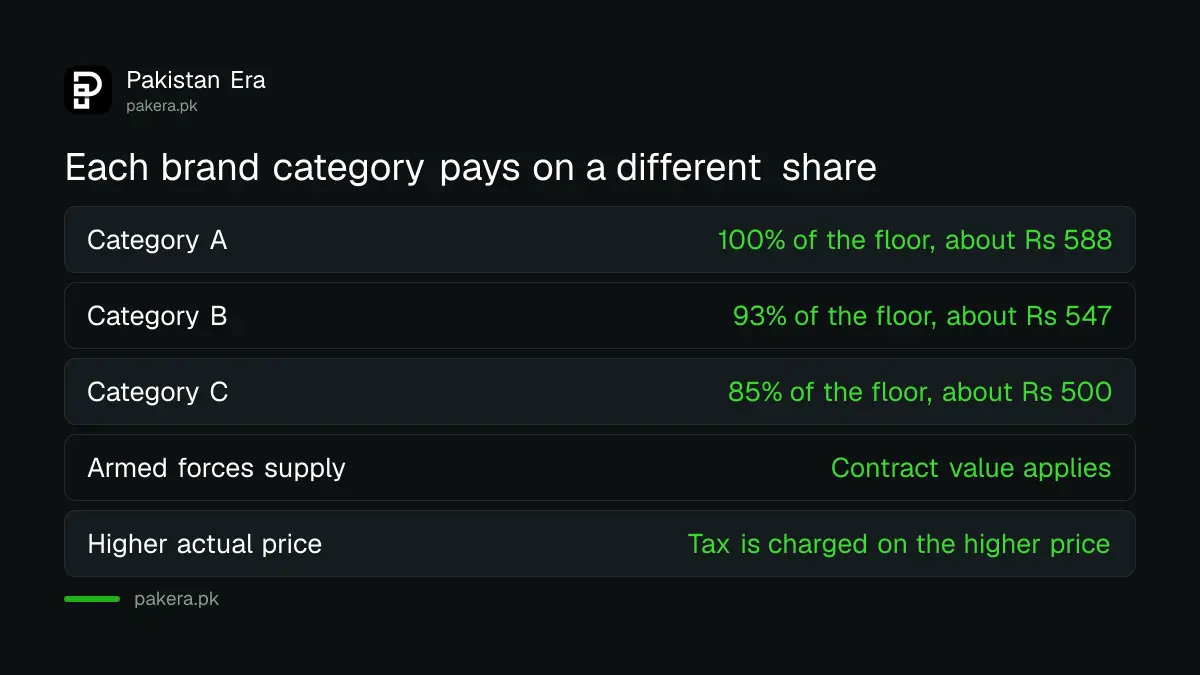
The example prices come from the worked example inside the notification. They are not today's prices. They show how the sum works when the PBS average is Rs 613.
How the Rs 588 example is worked out
The notification shows one sum. The per litre or kilo prices of the 5 litre, 2.5 litre and one litre packs are Rs 613, Rs 620 and Rs 606. Their average is Rs 613. Rs 25 comes off, which leaves Rs 588 for category A, and the shares for B and C follow from that.
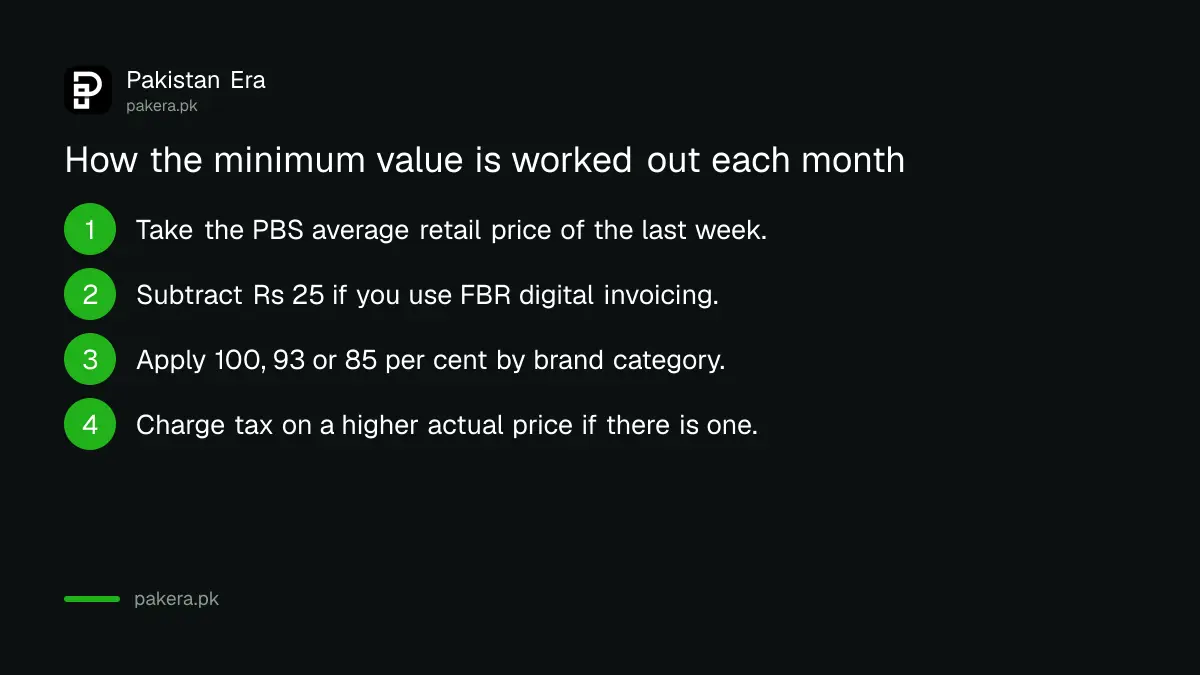
- Take the PBS average retail price of ghee or oil for the last week of the previous month.
- Subtract Rs 25 a kilo, if you are registered and use digital invoicing and production monitoring.
- Apply 100, 93 or 85 per cent for your brand category.
- Charge sales tax on the actual price if it is higher than this floor.
Supplies to the armed forces are exempt from this floor. They stay at the value in the contract.
The Rs 25 relief depends on being in FBR's systems
The Rs 25 cut is not automatic. It is only for registered persons that comply with digital invoicing and production monitoring. A maker outside those systems works from the full PBS average, which gives a higher floor.
Edible oil and ghee are also in FBR's camera order, which gave makers until 15 October 2026 to install video systems. Read the details in the guide to the FBR video camera order.
The companion S.R.O. 1631(I)/2026 adds a new entry to an older notification, S.R.O. 1190(I)/2019, for registered persons in oil and ghee that comply with digital invoicing and production monitoring. It lets them pay sales tax at the retail price under serial 56 of the Third Schedule, until 30 November 2026.
What buyers and shopkeepers should know
The notification does not set a shelf price. It sets the value on which the maker or importer pays tax. A shopper sees no new tax line, and a shop does not collect anything extra because of this rule.
If a shop sells below the PBS price, nothing in this notification punishes the shop. The rule applies to the registered maker who is supplying, not to the retail counter. We read no document that says prices will rise or fall because of it.
Common questions
Does the minimum value raise the price of ghee for shoppers?
The notification does not say so. It sets a floor on the value used to charge sales tax at the maker. We found no official statement on shelf prices.
How long does S.R.O. 1632(I)/2026 last?
It applies until the tax period of November 2026. After that, FBR must renew or replace it.
Who gets the Rs 25 reduction?
Registered persons that comply with FBR's digital invoicing and production monitoring systems. Others do not get the reduction.
Which brands are in category A?
Dalda, Habib, Sufi, Mezan, Soya Supreme and EVA. They pay on 100 per cent of the floor.
Where is the PBS price published?
On the PBS website, in the weekly Sensitive Price Indicator report. The notification names the last week of the previous month as the base week.
How we verified this
What we checked, where we read it, and what we could not confirm.
Last checked on 13 October 2026, Pakistan time. We read S.R.O. 1632(I)/2026 and S.R.O. 1631(I)/2026 in the FBR sales tax SRO list, and the PBS site for the price survey. We could not check what retail prices of each brand are this week, so the example figures are those printed in the notification.
About the author

Global Affairs & Political Economy Writer
Muhammad Hatim is a book lover who started writing because he enjoys it. At Pakistan Era he writes about international relations, geopolitics and the global economy, with a particular interest in South Asia and the forces behind current events.