Weekly Inflation in Pakistan Rises 0.57% as Flour Jumps 5.69%
Pakistan's SPI rose 0.57% in the week to 8 October 2026 and 11.97% on the year. Flour jumped 5.69% and chicken 4.93%. See prices, trend and income groups.
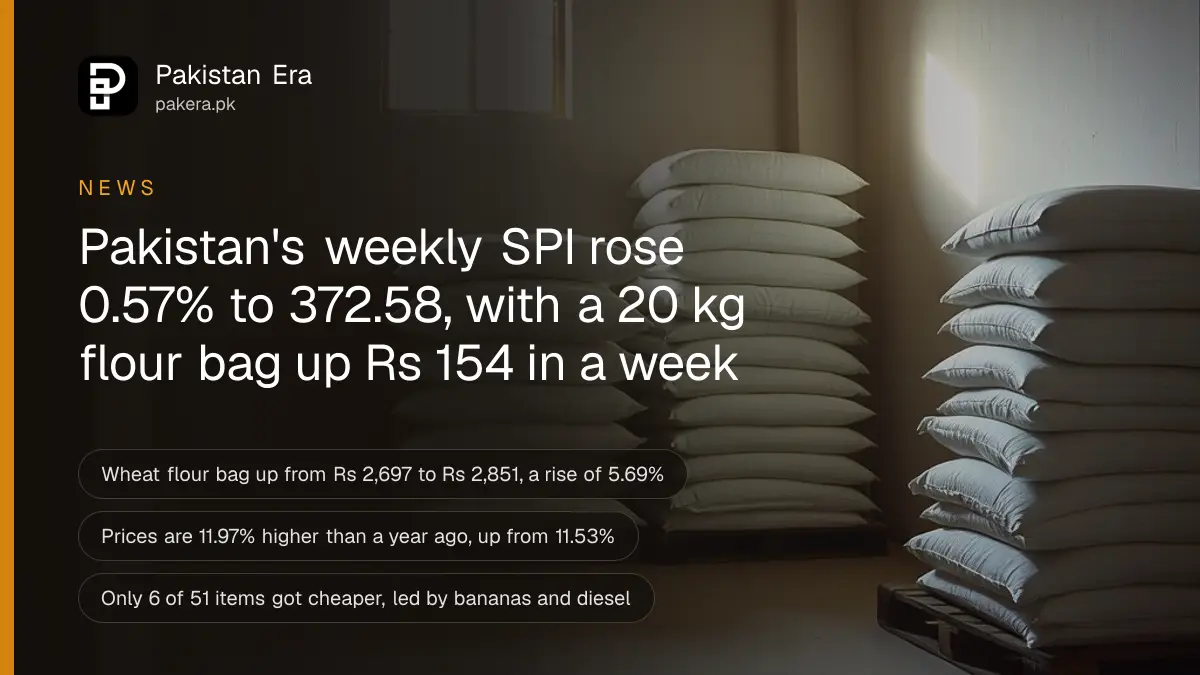
Weekly inflation in Pakistan rose 0.57% in the week ended 8 October 2026, almost three times last week's 0.21%. The Pakistan Bureau of Statistics (PBS) put its Sensitive Price Indicator (SPI) at 372.58 in a release published on 9 October. Prices were 11.97% higher than a year earlier.
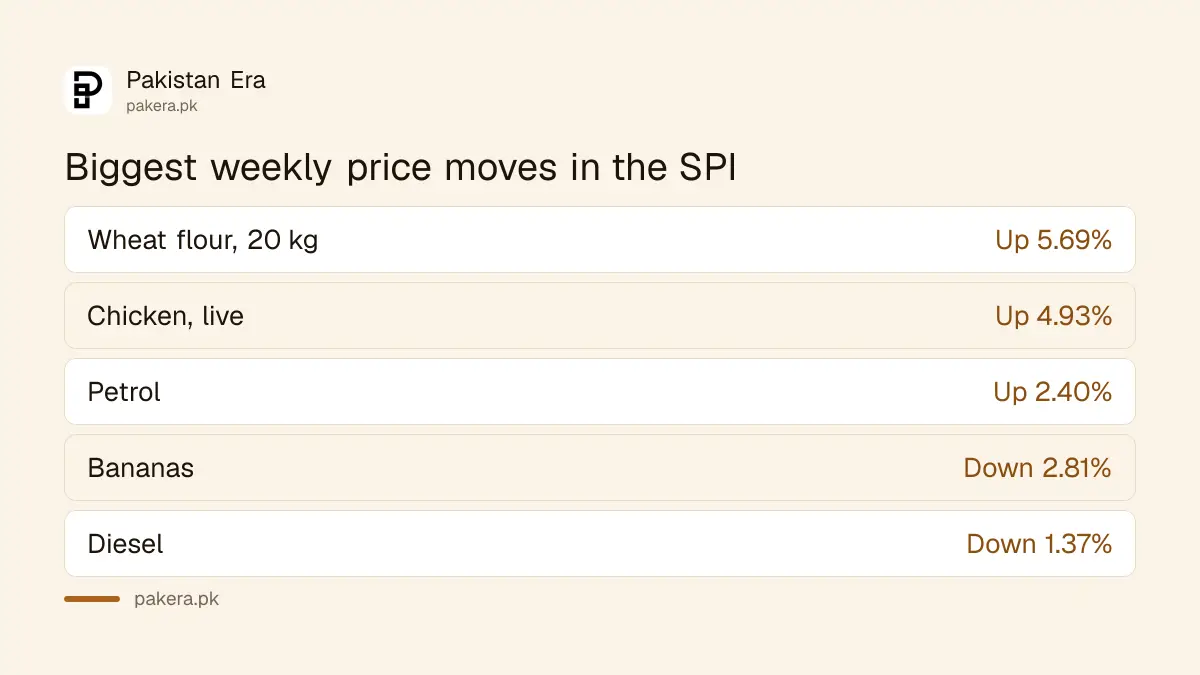
Flour and petrol did most of the damage. A 20 kg bag of wheat flour jumped 5.69% in one week. Chicken rose for the second week running, up 4.93%. Only six of the 51 items got cheaper.
We read the PBS release page, its executive summary and the city annex on 9 October 2026. Every figure below comes from those documents.
Weekly inflation rose to 0.57% and the SPI reached 372.58
The SPI for the week ended 8 October 2026 was 372.58, up 0.57% from 370.46 a week earlier. That is the third biggest weekly rise in the last ten weeks, behind the 0.99% electricity jump in late September and 0.65% in early September.
Of the 51 items PBS tracks, 20 went up, 6 went down and 25 did not move. Last week 10 items fell. So fewer things got cheaper, and the things that went up are ones every household buys.
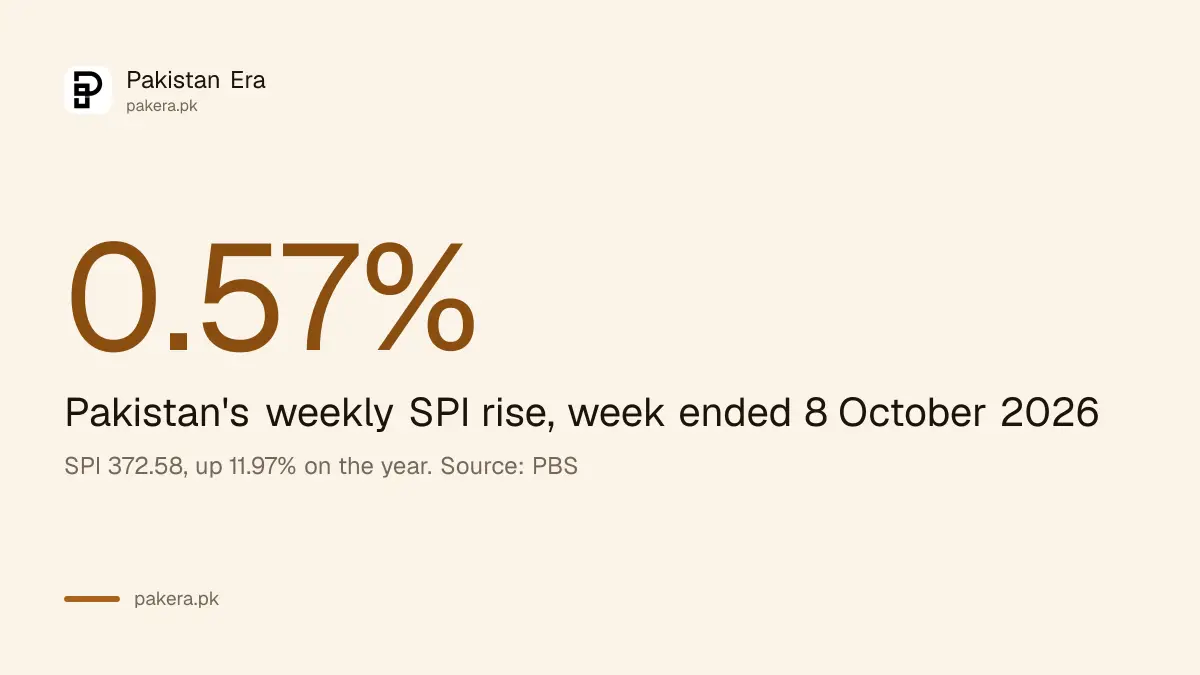
The yearly rate went back up, from 11.53% to 11.97%. A basket that cost Rs 1,000 in the second week of October 2025 now costs about Rs 1,120. That is our own arithmetic on the PBS figure.
Flour rose 5.69% and petrol added the most to the index
The average 20 kg flour bag went from Rs 2,697.45 to Rs 2,851.04, up Rs 154 in a week. Petrol rose 2.40% to an average of Rs 398.87 a litre. PBS lists how much each item added to the index, and petrol and flour together added about 0.38 of the 0.57 points.
Chicken also kept climbing. These are the biggest weekly increases, as average prices across 17 cities:
| Item | 1 October | 8 October | Change |
|---|---|---|---|
| Wheat flour (20 kg bag) | Rs 2,697.45 | Rs 2,851.04 | Up 5.69% |
| Chicken, live broiler (1 kg) | Rs 365.31 | Rs 383.31 | Up 4.93% |
| Pulse gram (1 kg) | Rs 275.08 | Rs 286.06 | Up 3.99% |
| Petrol super (1 litre) | Rs 389.51 | Rs 398.87 | Up 2.40% |
| Tomatoes (1 kg) | Rs 151.57 | Rs 155.21 | Up 2.40% |
| Pulse masoor (1 kg) | Rs 262.60 | Rs 265.99 | Up 1.29% |
| LPG 11.67 kg cylinder | Rs 5,103.37 | Rs 5,132.47 | Up 0.57% |
The flour rise was not even across the country. Lahore and Faisalabad did not move at all, while Islamabad, Bannu and Sukkur rose by Rs 300 or more a bag. The city by city numbers are in our report on the flour price in Pakistan this week.
PBS does not say why flour or chicken went up. It only records the price. The petrol rise matches the pump price changes of early October, which pushed petrol to Rs 398.96 on the petrol price for 9 October.
Bananas, diesel and sugar got cheaper this week
Six items fell in price. Bananas dropped the most, down 2.81% to Rs 134.75 a dozen. Diesel fell 1.37% and sugar fell again, though only slightly. Electricity for the lowest spending group stayed at Rs 7.66 a unit.
- Bananas: Rs 138.65 to Rs 134.75 a dozen, down 2.81%
- Diesel: Rs 402.53 to Rs 397.02 a litre, down 1.37%
- Potatoes: Rs 50.60 to Rs 50.15 a kilo, down 0.89%
- Sugar: Rs 143.52 to Rs 142.99 a kilo, down 0.37%
- Gur: Rs 228.87 to Rs 228.44 a kilo, down 0.19%
- Pulse moong: Rs 354.14 to Rs 354.02 a kilo, down 0.03%
These falls are small. Together they took less than 0.02 points off the index, against almost 0.6 points added by the rises.
Onions and LPG still lead the year-on-year rises
Compared with the week ended 9 October 2025, onions cost 100.24% more, roughly double. LPG is up 68.55%, electricity for the lowest group 58.59%, petrol 47.52% and diesel 42.52%. Wheat flour is up 32.60% on the year.
A 20 kg bag of flour now averages Rs 2,851.04, against Rs 2,150.09 a year ago. That is Rs 701 more for the same bag. For a family using two bags a month, it is about Rs 1,400 extra every month, on our arithmetic.
Some staples are cheaper than last year. Potatoes are down 39.51%, tomatoes 37.07%, sugar 22.44% and eggs 18.88%. That helps, but flour, fuel and power take a far bigger share of most budgets than potatoes do.
Five weeks show the weekly rise picking up again
The weekly rise had cooled to 0.21% last week. Now it is back above half a per cent. The yearly rate is at 11.97%, the highest in this five week run and well above the 8.62% recorded on 10 September.
| Week ended | SPI | Weekly change | Year on year |
|---|---|---|---|
| 10 September 2026 | 364.26 | Up 0.23% | 8.62% |
| 17 September 2026 | 366.05 | Up 0.49% | 10.64% |
| 24 September 2026 | 369.69 | Up 0.99% | 11.92% |
| 1 October 2026 | 370.46 | Up 0.21% | 11.53% |
| 8 October 2026 | 372.58 | Up 0.57% | 11.97% |
Last week's driver was chicken alone, as we reported in the SPI for the week ended 1 October. This week several staples moved together, which is harder on a household budget.
The monthly picture is measured differently. The official inflation rate for September 2026 was 10.3%, measured by the Consumer Price Index (CPI). The SPI covers fewer items and moves faster, so the two rarely match.
The richest group saw the biggest rise this week
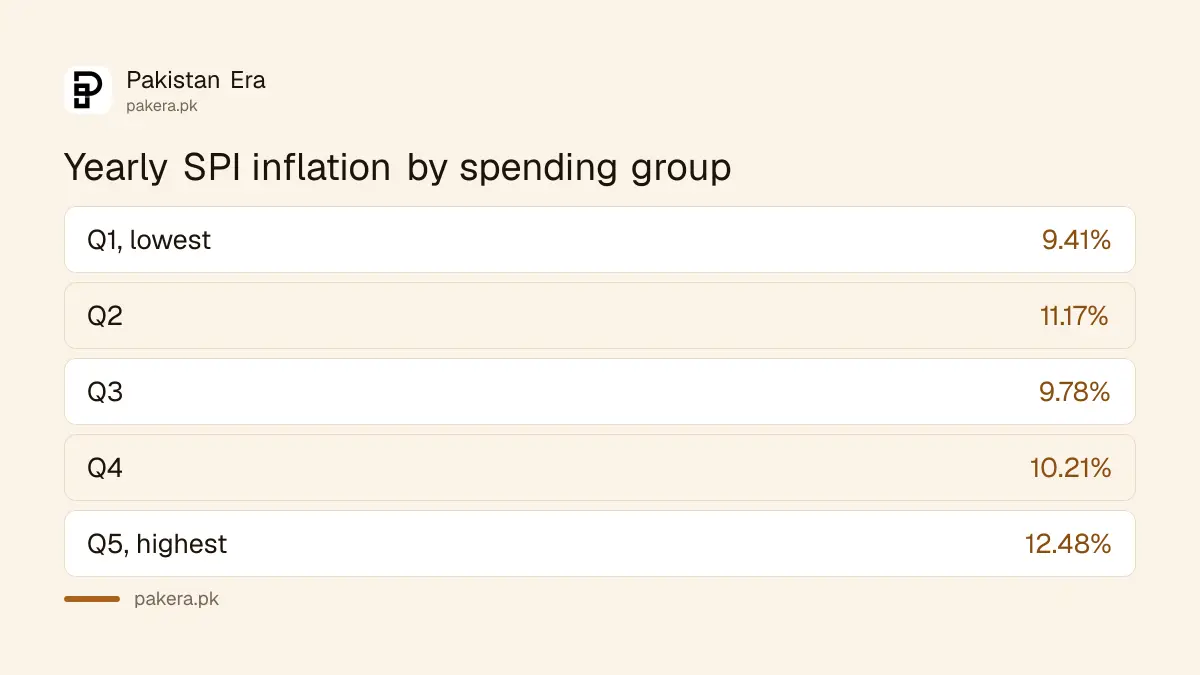
PBS splits the SPI into five spending groups, called quintiles. Q1 is the lowest spending group, with monthly spending up to Rs 17,732. Q5 spends above Rs 44,175. This week Q5 rose the most, 0.60%, and Q1 the least, 0.52%.
Flour matters most to the poorest. For Q1, flour alone added about 0.25 points, nearly half of that group's weekly rise. Petrol hits richer households harder. PBS gives petrol a weight of 1.47% in the Q1 basket and 6.70% in the combined basket.
Over the year, Q5 is up 12.48% and Q1 is up 9.41%. PBS does not break that gap down, but petrol, up 47.52% on the year, carries far more weight in the richer baskets.
What you can do when a price rises
The SPI cannot lower a price, but it does give you a fair benchmark. If a shop charges well above the PBS average for your city, you can compare and complain.
- Open the PBS SPI release for the latest week and download the city annex.
- Find your city's column for the item, such as flour or chicken.
- Compare the shop's price with the city average and maximum.
- Check the district's official price list, where one exists, before you complain.
- In Punjab, report overcharging on the provincial helpline. The steps are in our page on reporting overcharging in Punjab.
The PBS figures are averages from 50 markets. A shop can legally charge more than the average where no notified price exists, so a complaint works best for items with an official rate.
Common questions
What was Pakistan's weekly inflation for the week ended 8 October 2026?
The SPI rose 0.57% in the week ended 8 October 2026, to 372.58. Year on year it was up 11.97%. PBS published the figures on 9 October.
Why did weekly inflation rise this week?
Wheat flour rose 5.69%, chicken 4.93% and petrol 2.40%. Petrol and flour together added about 0.38 of the 0.57 points, according to the PBS impact table.
How much is a 20 kg flour bag now?
The national average was Rs 2,851.04 in the week ended 8 October 2026. City averages ranged from Rs 2,200 in Faisalabad to Rs 3,364.33 in Islamabad.
What got cheaper this week?
Bananas fell 2.81%, diesel 1.37%, potatoes 0.89% and sugar 0.37%. Gur and moong pulse fell by tiny amounts. Only six items fell in total.
When is the next SPI released?
PBS publishes the SPI every week, usually on Friday. The next release should cover the week ending 15 October 2026.
How we verified this
What we checked, where we read it, and what we could not confirm.
We read these PBS documents on 9 October 2026, after the release went up that afternoon.
- PBS, SPI for the week ended 8 October 2026
- PBS executive summary, SPI 8 October 2026 (PDF)
- PBS city annex, SPI 8 October 2026 (PDF)
The Rs 1,000 basket, the two bag monthly cost and the combined petrol and flour share are our own arithmetic on PBS figures.
About the author

Tax, Bills and Technology Writer
Ali Akhtar is a young and curious voice here at Pakistan Era. He is currently pursuing his A-Levels and has a growing interest in Pakistan’s changing industrial landscape and educational trends. Ali likes to write in a way that helps him explain and explore the world around him. His writing reflects the perspective of the new generation navigating the evolving trends of Pakistan where technology, youth innovation, and shifting opportunities are reshaping the country’s future.