DAP Price in Pakistan Hits Rs 17,128 a Bag at Wheat Sowing, Urea Rs 4,780
DAP averaged Rs 17,128 a bag and Sona urea Rs 4,780 in Pakistan in the week to 8 October 2026. See prices in 13 cities and the extra cost per acre of wheat.
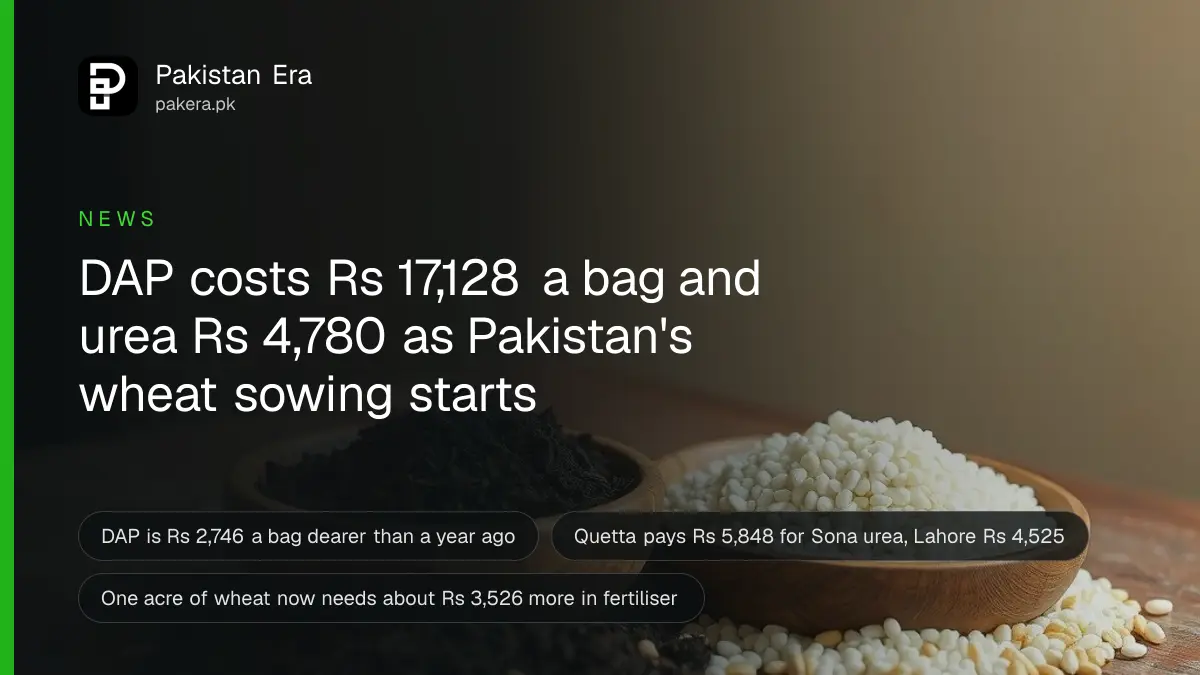
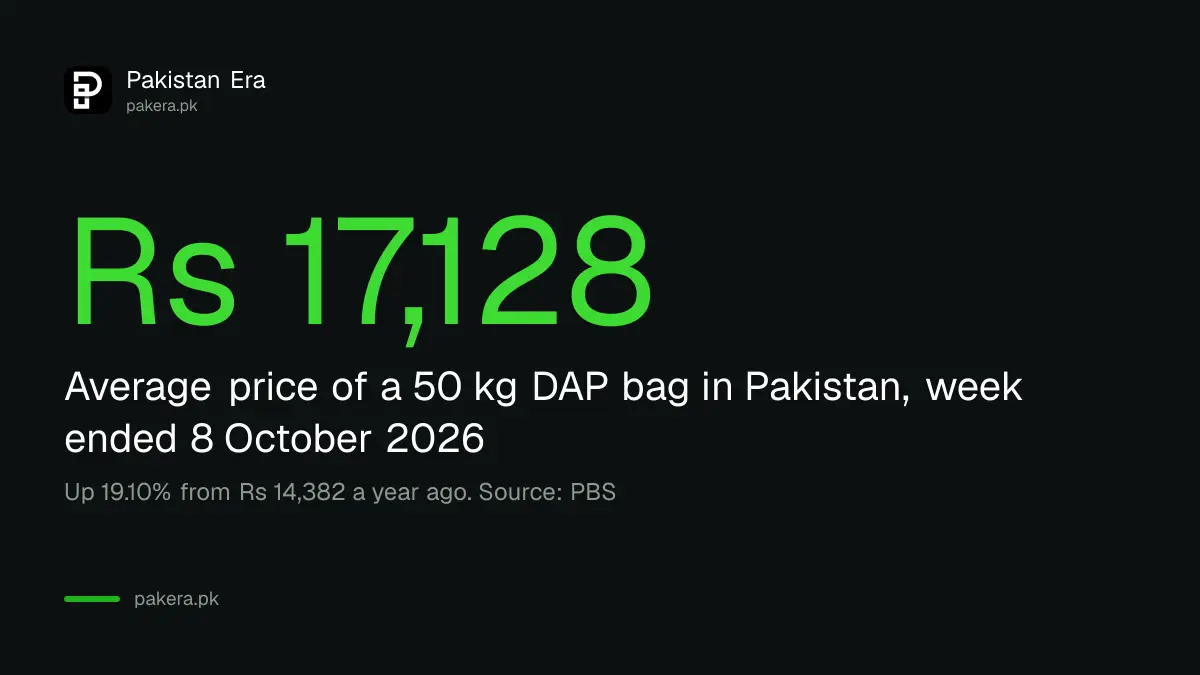
A 50 kg bag of DAP fertiliser cost an average of Rs 17,128 across Pakistan in the week ended 8 October 2026. A bag of Sona urea cost Rs 4,780. Both are higher than a year ago, DAP by 19.10% and urea by 8.88%, according to the Pakistan Bureau of Statistics (PBS).
The timing hurts. Wheat sowing for the Rabi season is starting now, and DAP is the fertiliser most farmers put down at sowing. A farmer using one bag of DAP and two of urea on an acre pays about Rs 3,500 more than last October, on our arithmetic.
We read the fertiliser table PBS publishes with its weekly price report, for 8 October, 1 October and earlier weeks. Every price below is the average PBS recorded in that city, not a price fixed by the government.
DAP costs Rs 2,746 a bag more than last year
The national average for DAP was Rs 17,127.78 a bag this week, against Rs 14,381.53 in the week ended 9 October 2025. It barely moved from last week's Rs 17,125.42, so the rise happened over the summer rather than in the past few days.
In July 2026, the federal food ministry's monthly fertiliser review put DAP at Rs 16,055 a bag, as our report on July's DAP and urea prices found. So DAP has added about Rs 1,073 a bag since then. On 10 September it was Rs 16,883.
Supply is part of the story. The Federal Committee on Agriculture said on 7 October that Pakistan has 766,000 tonnes of DAP for a Rabi need of 838,000 tonnes, with private imports expected to fill the gap. Our page on the Rabi 2026-27 fertiliser and water plan sets out those figures.
Urea is Rs 390 a bag dearer than last October
Sona urea averaged Rs 4,779.51 a bag, up 0.45% in a week and 8.88% in a year. Other urea brands averaged Rs 4,588.55, up 0.27% in a week and 7.96% in a year.
The committee said urea supply is comfortable, with 3.95 million tonnes available against expected sales of about 3.6 million tonnes. Even so, the price has crept up every few weeks, from Rs 4,700.71 on 10 September to Rs 4,779.51 now.
| Fertiliser (50 kg bag) | 8 October | Week change | Year change |
|---|---|---|---|
| DAP | Rs 17,127.78 | Up 0.01% | Up 19.10% |
| Sona urea | Rs 4,779.51 | Up 0.45% | Up 8.88% |
| Other urea brands | Rs 4,588.55 | Up 0.27% | Up 7.96% |
| Calcium ammonium nitrate (CAN) | Rs 4,334.34 | No change | Up 7.94% |
| Single super phosphate (SSP) | Rs 4,605.20 | Up 1.92% | Up 42.73% |
| Nitrophos (NP) | Rs 10,617.65 | Up 0.33% | Up 18.67% |
| NPK | Rs 11,117.30 | Down 0.17% | Up 19.66% |
| Sulphate of potash (SOP) | Rs 15,422.22 | No change | Up 23.10% |
Single super phosphate, a cheaper phosphorus fertiliser, has risen the most over the year, by 42.73%. PBS does not say why.
Quetta and Rawalpindi pay the most for urea
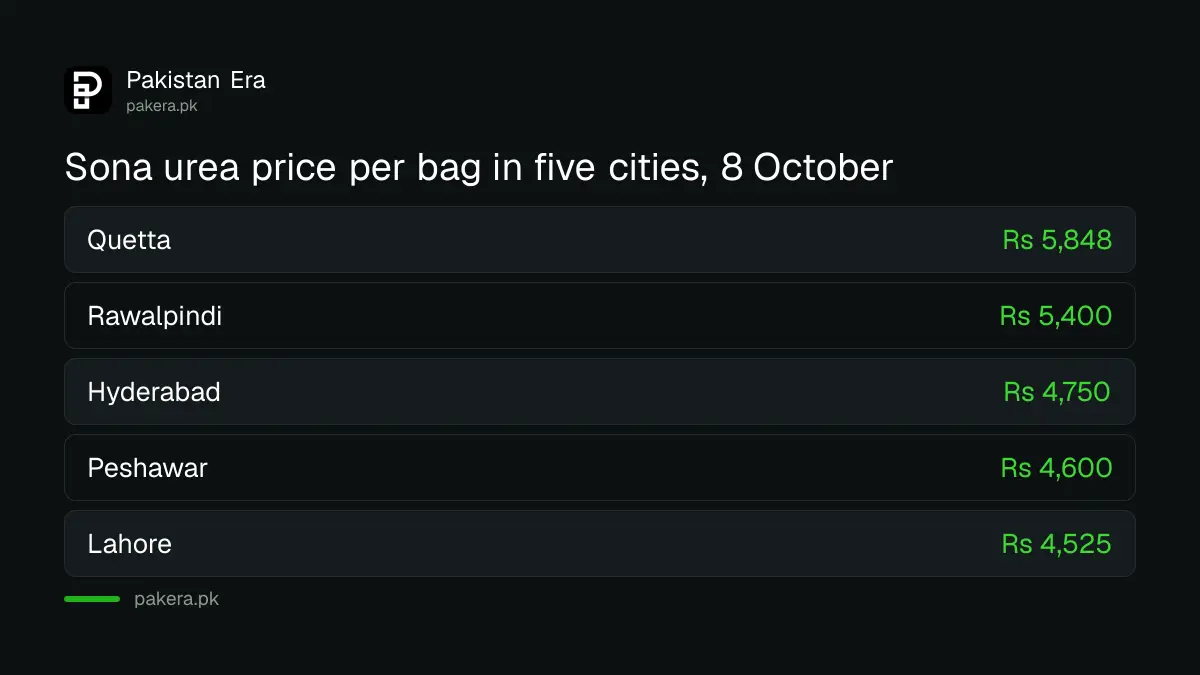
PBS checks fertiliser in 13 cities. Most charge between Rs 4,525 and Rs 4,750 for Sona urea. Two do not.
| City | Sona urea | DAP |
|---|---|---|
| Quetta | Rs 5,848.35 | Rs 17,743.54 |
| Rawalpindi | Rs 5,400.00 | Rs 17,000.00 |
| Hyderabad | Rs 4,749.74 | Rs 17,149.93 |
| Gujranwala | Rs 4,700.00 | Rs 17,200.00 |
| Larkana | Rs 4,669.98 | Rs 17,168.27 |
| Sukkur | Rs 4,650.00 | Rs 17,100.00 |
| Bannu | Rs 4,650.00 | Rs 17,500.00 |
| Bahawalpur | Rs 4,649.82 | Rs 16,999.80 |
| Sargodha | Rs 4,633.27 | Rs 17,300.00 |
| Multan | Rs 4,624.93 | Rs 16,099.69 |
| Faisalabad | Rs 4,600.00 | Rs 17,200.00 |
| Peshawar | Rs 4,600.00 | Rs 17,000.00 |
| Lahore | Rs 4,525.00 | Rs 17,250.00 |
A Quetta farmer pays Rs 1,323 more for a bag of Sona urea than a Lahore farmer. Rawalpindi rose Rs 100 a bag this week, to Rs 5,400 for urea, and Rs 300 for DAP.
Multan is the cheapest place for DAP this week, at Rs 16,099.69. It fell by Rs 1,000 a bag from Rs 17,099.71. Larkana went the other way, up Rs 791 to Rs 17,168.27. PBS does not explain single-city swings like these, so treat one week's figure with care.
What the higher prices mean for a wheat farmer
Take one acre of wheat with one bag of DAP at sowing and two bags of urea later. At this week's averages, that is about Rs 26,687, against about Rs 23,161 a year ago. The difference is about Rs 3,526 an acre, on our arithmetic.
On a 12.5 acre farm, the extra cost is about Rs 44,000 for a single season. That is before seed, diesel and water.
Two things can soften it. Punjab farmers can spend an interest-free Punjab Kissan Card loan on fertiliser and seed. And soil testing at a government lab can show whether a field needs the full bag of DAP at all. The Punjab wheat sowing dates and seed rates are worth checking at the same time.
How to avoid paying too much or buying fake fertiliser
- Compare the dealer's price with the PBS average for your nearest city, published every Friday with the weekly price report.
- Check that the bag is sealed, carries the company name and batch number, and weighs 50 kg.
- Ask for a written receipt with the dealer's name, the brand and the price.
- Buy from a registered dealer. Cheap bags from roadside sellers are where fake fertiliser turns up.
- If you suspect a fake or overpriced bag in Punjab, use the steps for reporting fake fertiliser on 0800-17000.
If dealers in your area all say they are out of DAP while prices rise, report it to the district agriculture office rather than paying a premium.
Common questions
What is the DAP price in Pakistan today?
The PBS average was Rs 17,127.78 for a 50 kg bag in the week ended 8 October 2026. City averages ranged from Rs 16,099.69 in Multan to Rs 17,743.54 in Quetta.
What is the urea price in Pakistan today?
Sona urea averaged Rs 4,779.51 a bag and other urea brands Rs 4,588.55. Lahore was the cheapest city for Sona urea at Rs 4,525.
How much has DAP gone up in a year?
By Rs 2,746.25 a bag, or 19.10%, from Rs 14,381.53 in the week ended 9 October 2025.
Is there a shortage of DAP for Rabi 2026-27?
The Federal Committee on Agriculture expects a gap of about 72,000 tonnes, to be filled by private imports. It says urea supply is sufficient.
Where does the PBS fertiliser price come from?
PBS staff record retail prices from dealers in 13 cities every week. The table is published with the weekly price indicator, usually on Friday.
How we verified this
What we checked, where we read it, and what we could not confirm.
We read these documents on 9 October 2026.
- PBS, SPI for the week ended 8 October 2026, with fertiliser prices in Appendix B
- PBS annex workbook, 8 October 2026
- Press Information Department, Federal Committee on Agriculture, 7 October 2026
Per acre costs and rupee changes are our own arithmetic on PBS figures.
About the author

Tax, Bills and Technology Writer
Ali Akhtar is a young and curious voice here at Pakistan Era. He is currently pursuing his A-Levels and has a growing interest in Pakistan’s changing industrial landscape and educational trends. Ali likes to write in a way that helps him explain and explore the world around him. His writing reflects the perspective of the new generation navigating the evolving trends of Pakistan where technology, youth innovation, and shifting opportunities are reshaping the country’s future.