Pakistan Rabi 2026-27 Plan: Urea Enough, DAP 72,000 Tonnes Short, Water Down 22%
The 7 October Federal Committee on Agriculture expects enough urea and seed, a DAP gap for private imports and 22% less water in Punjab and Sindh this Rabi.
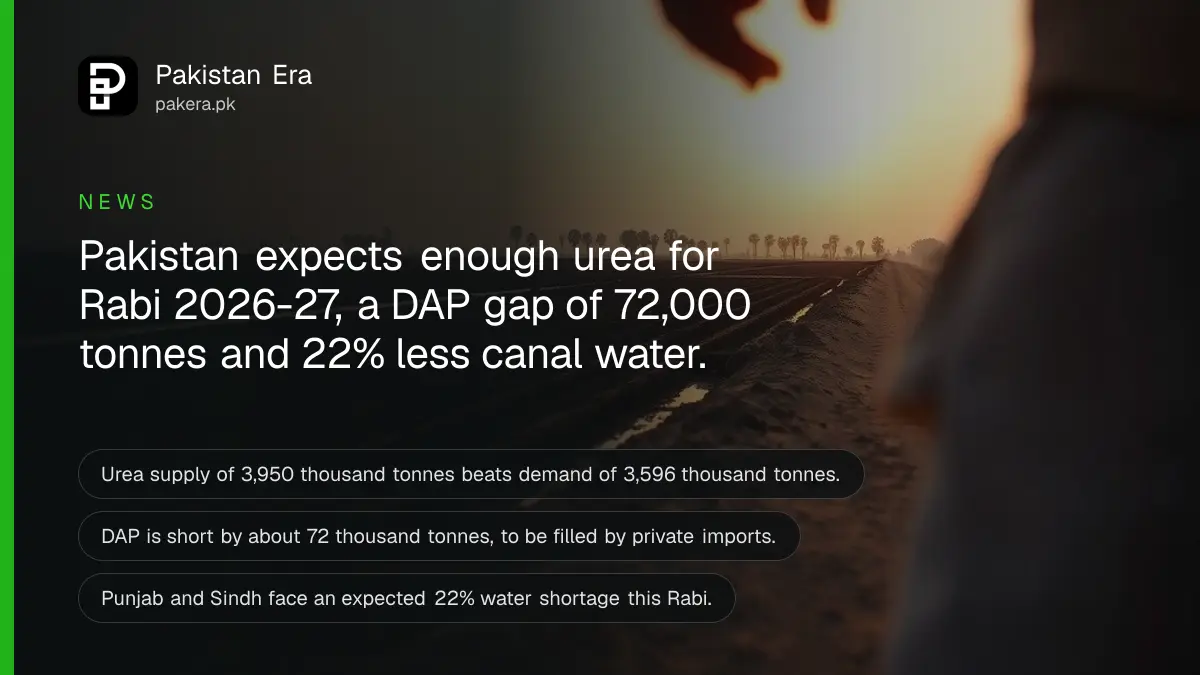
Pakistan's Federal Committee on Agriculture met on 7 October 2026 to plan the Rabi (winter) season for 2026-27. It expects enough urea and certified seed, a DAP gap that private importers must fill, and a 22% water shortage for Punjab and Sindh. Cotton was the weak crop of the last season, with production 4.8% lower.
The Rabi season is when wheat, the country's main food crop, goes into the ground, mostly from late October to December. So what the committee said on Wednesday matters to every farmer and, later, to every household that buys flour. We read the official release from the Ministry of National Food Security and Research. Here is what it says, and what it leaves out.
The minister said farmers face rising costs for inputs, energy and transport. He also said the government is working on "an appropriate wheat illustrative price". No figure was given. We are not guessing one.
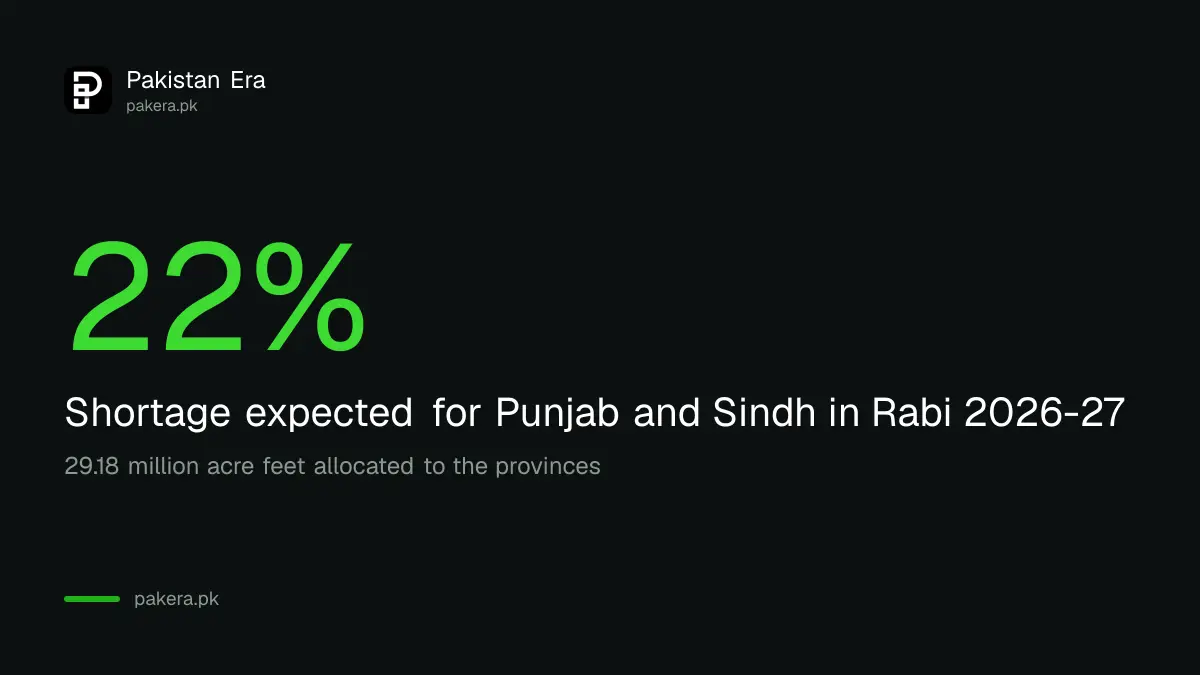
Water for Rabi is short by 22% in Punjab and Sindh
The Indus River System Authority advisory committee expects a 22% shortage for Punjab and Sindh this Rabi season. It based this on expected river inflows of 21.268 million acre feet at the rim stations and has allocated 29.18 million acre feet to the provinces.
A million acre foot is the water that covers one million acres a foot deep. You do not need that detail to read the headline: there will be less canal water than farmers would like. The Met Office told the committee that soil moisture is under stress from September to November, after below normal rain in the last three months, including the monsoon. It expects mostly above normal rain in October and November, which should help.
The practical advice in the release is to use stored water carefully, especially in the lower half of the country. For Punjab growers planning wheat dates and varieties, see wheat sowing in Punjab 2026.
Urea looks sufficient and DAP is short by about 72,000 tonnes
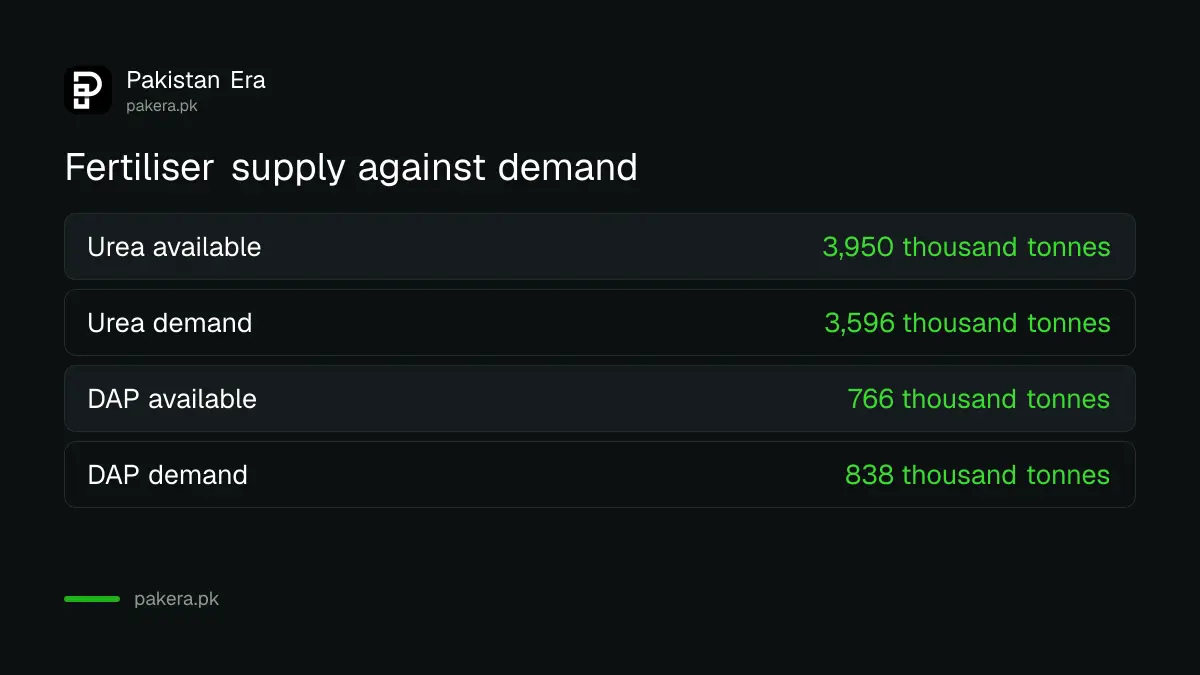
The committee estimates 3,950 thousand tonnes of urea for 2026-27 against an expected demand of 3,596 thousand tonnes. DAP supply is 766 thousand tonnes against demand of 838 thousand tonnes, and the gap is to be filled by private sector imports.
The urea figure includes 765 thousand tonnes carried over from the previous year and 3,185 thousand tonnes of local production. By our arithmetic, that leaves a cushion of about 354 thousand tonnes. The DAP gap is about 72 thousand tonnes. The release does not give a retail price for either fertiliser. For price levels, see DAP and urea prices in Pakistan. And if a dealer offers a bag far below the market rate, report fake fertiliser in Punjab before you spread it.
| Fertiliser | Available 2026-27 | Expected demand | Position |
|---|---|---|---|
| Urea | 3,950 thousand tonnes | 3,596 thousand tonnes | About 354 thousand tonnes spare |
| DAP | 766 thousand tonnes | 838 thousand tonnes | About 72 thousand tonnes short, private imports to fill |
Five of seven Kharif crops grew, and cotton fell
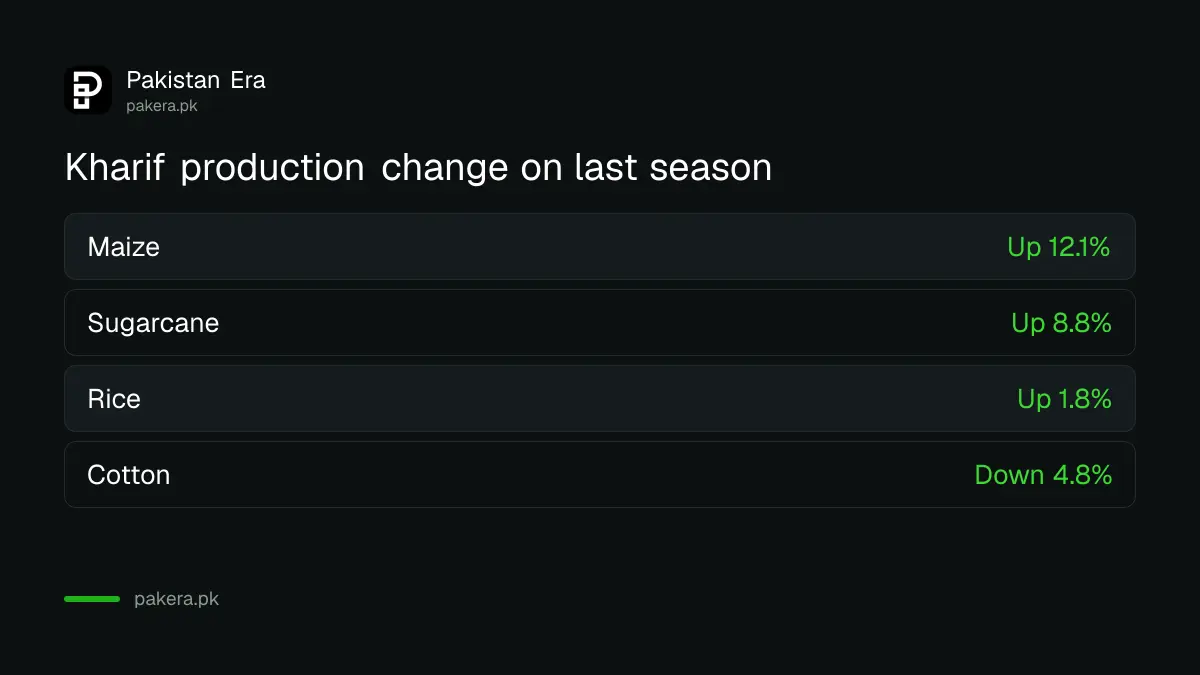
Sugarcane, rice, maize, mung bean and chillies all produced more than the season before. Cotton fell to 6.714 million bales, down 4.8%, and its area shrank 12.6%. Mash bean also fell. Cotton came in 30.4% below the committee's own target of 9.643 million bales.
The release has a confusing label. Its text calls the latest figures "2025-26", while its tables call the same figures "2026-27". We use "previous season" and "latest estimate" and show the numbers exactly as the tables give them.
| Crop | Previous season | Latest estimate | Change |
|---|---|---|---|
| Sugarcane (thousand tonnes) | 89,450 | 97,293 | Up 8.8% |
| Rice (thousand tonnes) | 9,998 | 10,183 | Up 1.8% |
| Maize (thousand tonnes) | 8,900 | 9,977 | Up 12.1% |
| Cotton (thousand bales) | 7,052 | 6,714 | Down 4.8% |
The Punjab number is the one to watch. Punjab's cotton area fell 16.4% and its production 3.0%. Its sugarcane area rose 15.9%. Land moved from one crop to another, and the release does not say why, so we do not claim a cause.
Farm credit disbursed Rs 3,231.6 billion in FY26, above its Rs 3,062 billion target
The State Bank set an agriculture credit target of Rs 3,062 billion for FY26, 19% above the year before. Lenders paid out Rs 3,231.6 billion. The committee also noted 47 formal institutions now give farm loans, from commercial banks to microfinance banks.
That is useful for a farmer shopping for credit, because there are many doors. The Kisan Card and the interest-free options are explained in the six Punjab schemes for farmers. The release also says certified seed for Rabi 2026-27 will remain satisfactory. The disbursement percentage printed in the release does not match its own figures, so we left that number out.
What a farmer can do this week
Book your fertiliser early, ask for a receipt, and plan for less canal water. Nothing in the release changes a price, a subsidy or a sowing date. The wheat price is still to be announced.
- Check your seed is certified and buy from a registered dealer.
- Buy DAP early, because it is the tighter fertiliser.
- Keep every receipt and the bag batch number.
- Plan watering turns with your canal or tubewell, since the shortage hits the lower reaches hardest.
- Watch for the wheat support price, which is not yet announced.
Common questions
When was the Rabi 2026-27 Federal Committee on Agriculture meeting?
On 7 October 2026 in Islamabad, chaired by the Federal Minister for National Food Security and Research. It was the 27th meeting for the Rabi season.
Will there be enough urea for wheat?
The committee estimates 3,950 thousand tonnes available against demand of 3,596 thousand tonnes, so supply is expected to be enough.
Will DAP be short?
Yes, by about 72 thousand tonnes on the committee's numbers. Private sector imports are expected to fill the gap.
How much water shortage is expected?
The advisory committee anticipates 22% for Punjab and Sindh in Rabi 2026-27.
Has the wheat price been announced?
No. The minister spoke of an appropriate wheat illustrative price but gave no figure in the release.
Which crop did badly last season?
Cotton. Production was 6.714 million bales, down 4.8% on the previous season and 30.4% below target.
How we verified this
What we checked, where we read it, and what we could not confirm.
Last checked on 8 October 2026. We read the Press Information Department release PR No. 76, dated 7 October 2026, on pid.gov.pk, which carries the committee's text and tables. The urea surplus (about 354 thousand tonnes) and DAP gap (about 72 thousand tonnes) are our subtraction of its figures. We did not see the wheat target or the wheat price, because neither is in the release. The release labels its crop years inconsistently, so we describe columns as previous and latest.
About the author

Public Services and Education Journalist
Fajr Riaz is a journalist and content writer at Pakistan Era, based in Lahore. She covers the questions people meet in everyday life in Pakistan: how a public service works, what a change in the rules means, and where to find a reliable answer.