Footwear Sales Tax in Pakistan: 18% on Retail Price, With One POS Exception
Footwear joined the Sales Tax Act's Third Schedule on 1 July 2026, so tax is 18% of retail price. See the POS exception and what to check on the box today.
From 1 July 2026, the Finance Act 2026 puts footwear of all types in the Third Schedule of the Sales Tax Act, so sales tax is charged at 18 per cent of the retail price. One exception applies: a maker that sells its shoes only through digitally integrated, POS compliant retail outlets is left out.
That exception is the part buyers and shop owners need to understand. The Act gives the rule in one line. It does not explain how a shop proves it qualifies. We read the Act in the Gazette of 26 June 2026 on FBR's download site, and the Sales Tax Act text for the rule on retail price.
The Finance Act 2026 adds footwear as serial number 65
Serial number 65 of the Third Schedule reads "Footwear (all types)", with an exception for makers who sell only through digitally integrated and POS compliant outlets. The Act applies from 1 July 2026 unless it says otherwise. We found no later date on this entry.
The entry sits in a block of 20 new serial numbers, 56 to 75, that also covers bags, crockery and cosmetics. Footwear is the only one with a POS exception written into it. The others say "sold in retail packing" or "put up for retail sale". Our note on the 20 goods added to the Third Schedule has the full list.
Retail price means the highest price the maker fixes
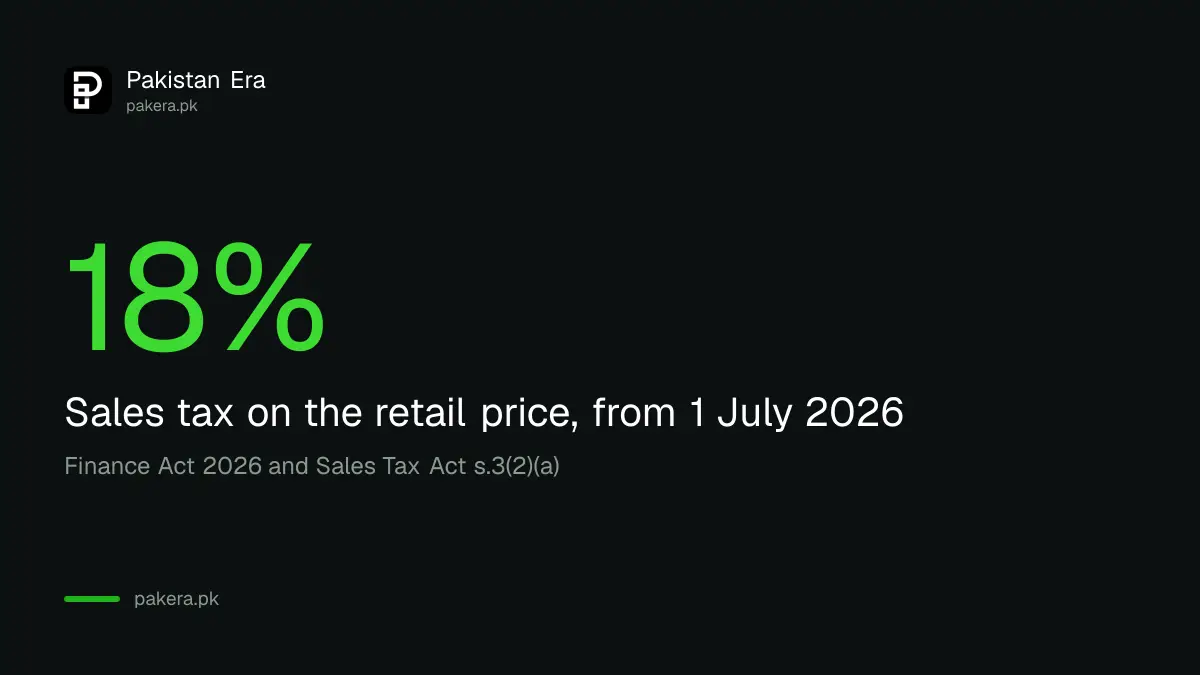
The Sales Tax Act defines retail price as the price the manufacturer fixes, including duties and charges but not sales tax. If a maker fixes more than one price for the same brand or variety, the highest one counts. For imported goods, the importer fixes it.
This matters for footwear because one design often sells at different prices in different shops. The law looks at the price fixed by the maker for the general body of consumers. It does not look at a discount a shop gives you on the day.
For imported goods in the Third Schedule, the retail price cannot be less than 130 per cent of the customs value. That value includes customs duties and any federal excise duty. So an importer cannot declare a low price to cut the tax.
The price and the tax must be printed on each pair's pack
The Act says the retail price and the sales tax amount must be legibly, prominently and indelibly printed or embossed on each article, packet, container, package, cover or label. For shoes, that points to the box or the label.
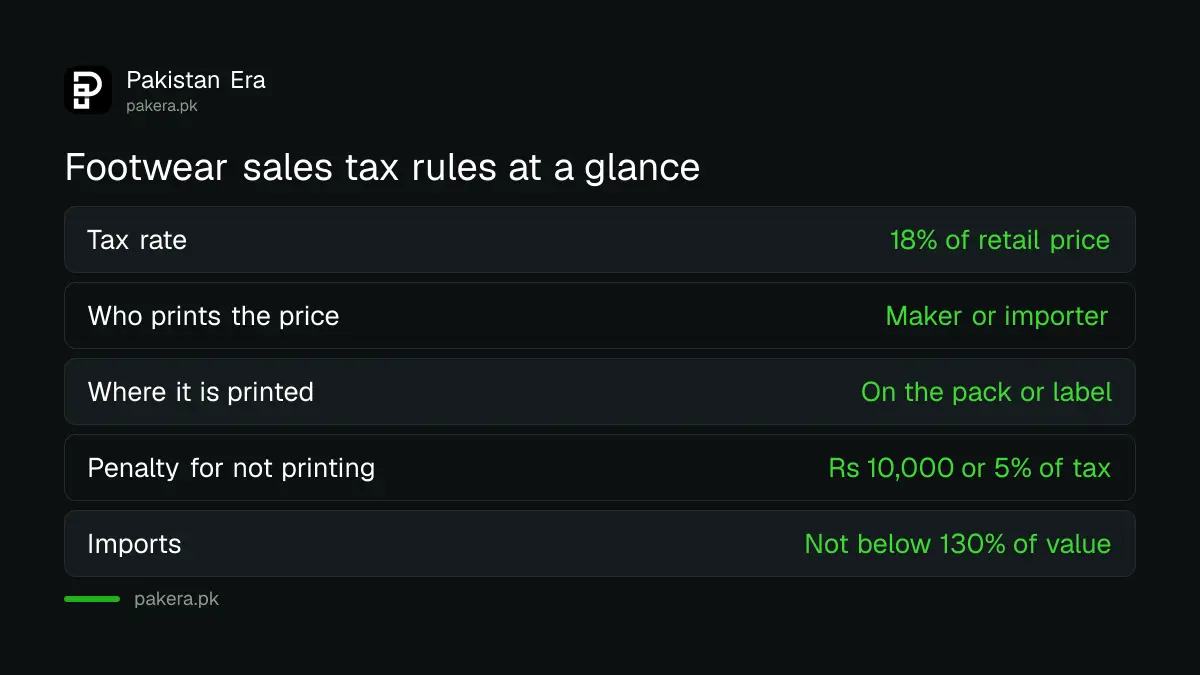
| Question | What the law says |
|---|---|
| Tax rate | 18 per cent of the retail price, under section 3(2)(a) |
| Who prints the price | The manufacturer, or the importer for imported goods |
| Where it is printed | On each article, packet, container, package, cover or label |
| Penalty for not printing | Rs 10,000 or 5 per cent of the tax involved, whichever is higher |
| Other consequence | The goods can be confiscated and redeemed by paying a fine |
The penalty and the printing rule come from the Sales Tax Act as updated to 2025-26. We did not check whether any later amendment changed the penalty figures.
The POS exception depends on how the maker sells
The exception covers a manufacturer that sells its products only through digitally integrated and POS compliant retail outlets. POS means point of sale, the billing system a shop connects to FBR so each sale is recorded. The word "exclusively" is the key.
A maker that sells through both integrated outlets and ordinary shops does not match the wording. Based on the text we read, that maker is not covered by the exception. This is our reading of the Act. We did not find an FBR circular that explains the test.
FBR publishes a list of POS integrated retailers on its site. We covered the latest count in FBR's list of POS integrated retailers. The list shows the sectors, including textile and leather, but it is not a test of whether a given shoe brand qualifies.
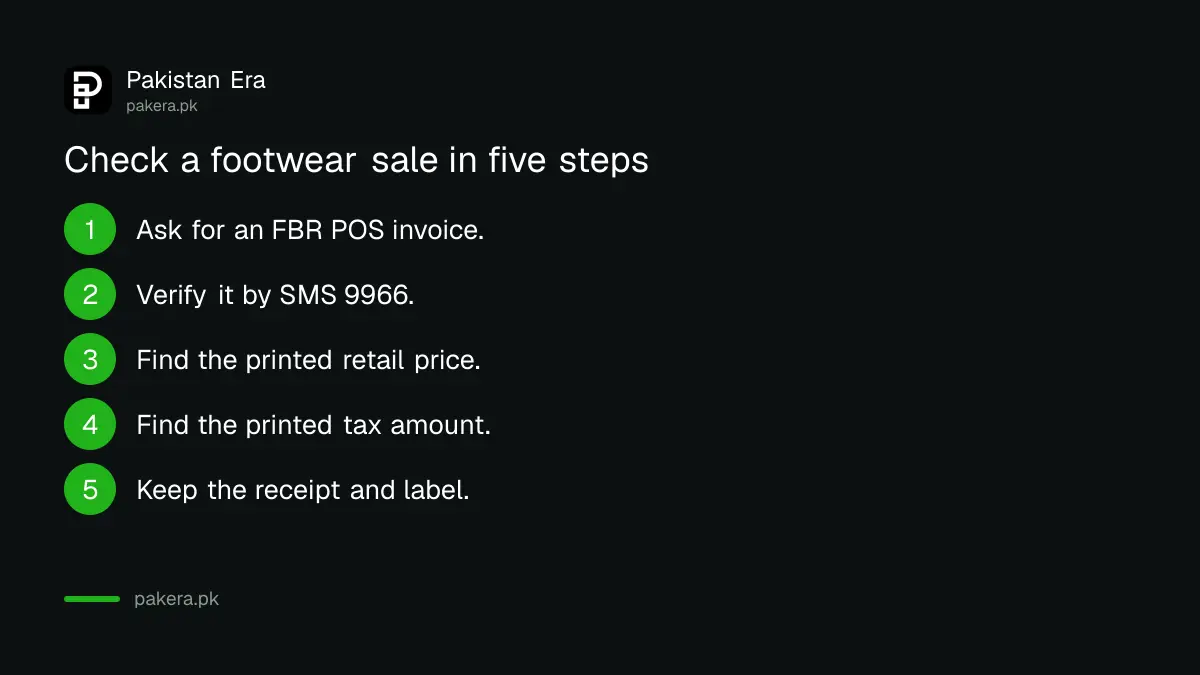
- Ask the shop whether it issues an FBR POS invoice.
- Check the invoice with the Tax Asaan app or SMS 9966, as in checking an FBR POS invoice.
- Look at the box for a printed retail price and a printed tax amount.
- Compare the price on the box with the price you were asked to pay.
- Keep the receipt and the box label until you are sure the sale is right.
Shop owners should check which side of the line they are on
If you run a shoe shop, ask your supplier whether it sells only through integrated outlets. Ask for the answer in writing. If your supplier is a maker without the exception, the printed retail price and tax on the box matter to you, because you resell what it printed.
A seller who also needs to understand small shop penalties can read the guide to small business FBR penalties. It covers NTN display and cash memo fines, which are separate from the retail price rule.
Common questions about footwear and sales tax
Is footwear taxed at 18 per cent in Pakistan?
Goods in the Third Schedule are taxed at 18 per cent of retail price under section 3(2)(a) of the Sales Tax Act. Footwear was added to that list by the Finance Act 2026.
When did the footwear rule start?
The Finance Act 2026 came into force on 1 July 2026 unless it says otherwise. We found no separate date on the footwear entry.
Who is exempt from the footwear rule?
A manufacturer that sells its products exclusively through digitally integrated and POS compliant retail outlets is left out, according to serial number 65.
Does a discount at the shop change the tax?
Not by itself. The tax is based on the retail price the maker fixes, which is the highest price if several are fixed. We did not read a rule on shop discounts.
What if the box has no printed price?
The law requires the price and tax to be printed. A maker who skips this faces a penalty of Rs 10,000 or 5 per cent of the tax, whichever is higher. Keep the receipt and ask the shop.
How we verified this
What we checked, where we read it, and what we could not confirm.
Last checked 14 October 2026. The footwear entry and the start date come from the Finance Act 2026, published in the Gazette of 26 June 2026 at download1.fbr.gov.pk. The retail price definition, the 18 per cent rate, the printing rule and the penalty come from the Sales Tax Act as updated to 2025-26. We did not find an FBR circular on the POS exception, and we did not test any shop.
About the author

Senior Writer, Public Services and Technology
Shahid joined us in 2024 as an author. He is a senior contributor to Pakistan's leading technology websites. He writes detailed articles, mostly covering his expertise in the latest tech, mobiles, apps, gadgets, and step-by-step guides. His ideology is to help people understand the latest trends and explain complex methods through very easy-to-understand guides.