Small Business FBR Penalties in Pakistan: NTN Display, Profile Update and Cash Memo Fines
FBR's penalty table fines shops for not displaying the NTN, skipping receipts or not updating the profile. See each amount, the section and how to avoid them.
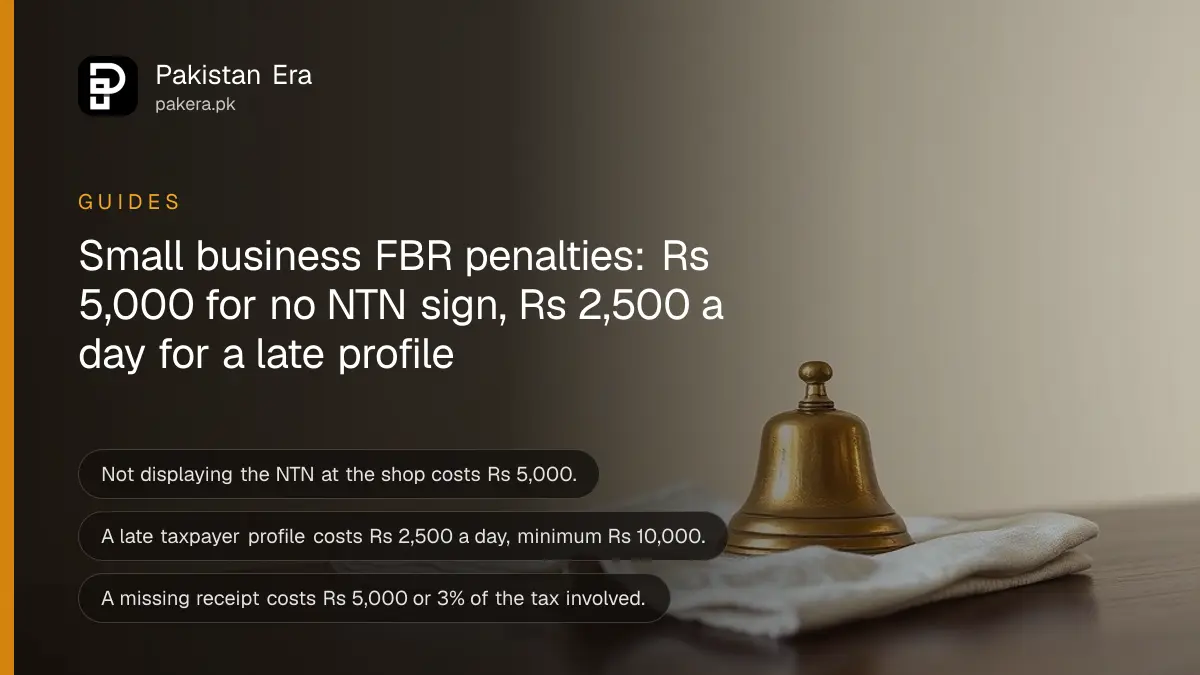
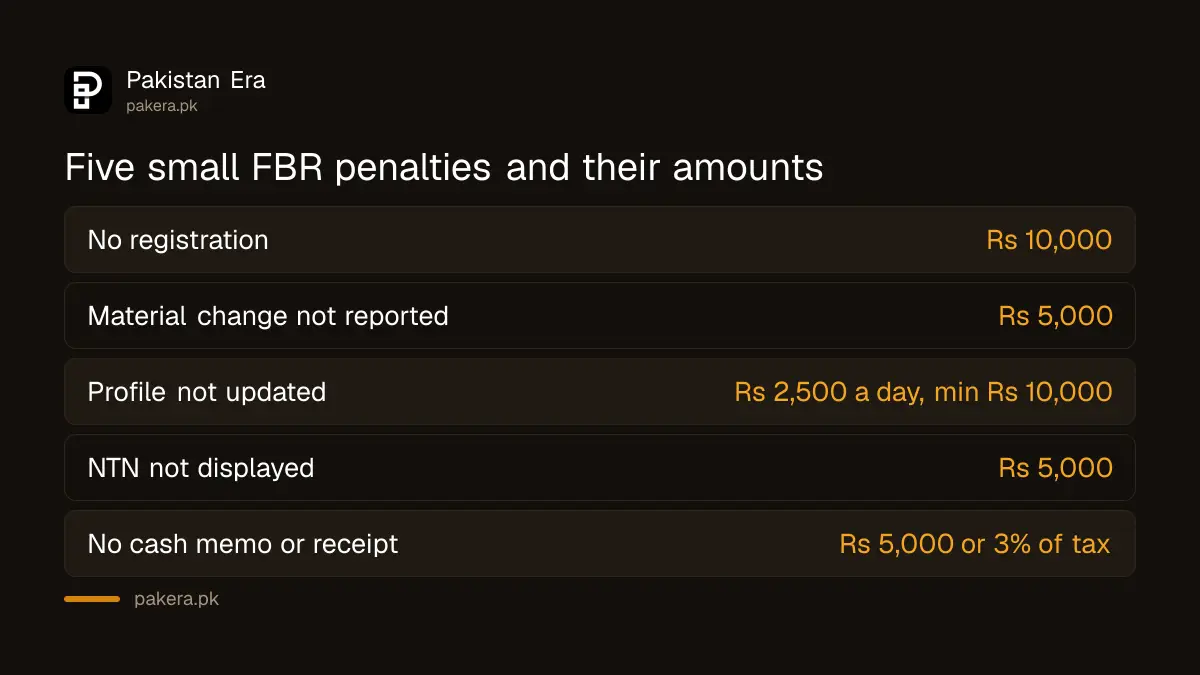
Short answer: A shop or small business can be fined by FBR for five small things: not registering (Rs 10,000), not reporting a material change (Rs 5,000), not updating the taxpayer profile (Rs 2,500 a day, minimum Rs 10,000), not displaying the NTN (Rs 5,000) and not issuing a cash memo (Rs 5,000 or 3% of the tax). A written order must come first.
Most owners worry about the big tax bill. The small penalties catch people out because nobody tells them. An old NTN number, a new shop address or a missing sign can each cost money.
All figures below come from the penalty table in section 182 of the Income Tax Ordinance on FBR's website.
The five small penalties at a glance
The table lists each offence, the penalty and the section it refers to. The amounts below are as shown on FBR's page. A penalty is not automatic. Under section 182(2), a written order after a hearing must come first.
| What goes wrong | Penalty on FBR's table | Section |
|---|---|---|
| Required to register but do not apply | Rs 10,000 | 181 |
| Do not report a material change in registration details | Rs 5,000 | 181 |
| Do not furnish or update the taxpayer profile by the due date | Rs 2,500 for each day, minimum Rs 10,000 | 114A |
| Do not display the NTN at the place of business | Rs 5,000 | 181C |
| Do not issue a cash memo, invoice or receipt when required | Rs 5,000 or 3% of the tax involved, whichever is higher | 174 and Income Tax Rules |
The profile penalty grows every day
The taxpayer profile penalty is the one that grows. It is Rs 2,500 for each day after the due date, and the minimum is Rs 10,000. After four days of delay you are already at the minimum. After forty days, the daily figure would reach Rs 100,000 on its own arithmetic.
The profile holds your address, contact numbers and bank details. Keep them current in IRIS. The steps for changing a mobile number or address are in the guide to changing your mobile, address or bank account in IRIS.
Look at the notice or the IRIS reminder for your date.
Display your NTN and issue a receipt
Item 16 covers a failure to display the NTN at the place of business. The fine is Rs 5,000. A neat printed NTN certificate by the counter is enough in plain terms, but check the rule for your sector.
Item 2 covers a failure to issue a cash memo, invoice or receipt when the law or rules require one. The fine is Rs 5,000 or 3% of the tax involved, whichever is higher. Shops linked to FBR's point of sale system can read how invoices are checked in the guide to verifying an FBR POS invoice.
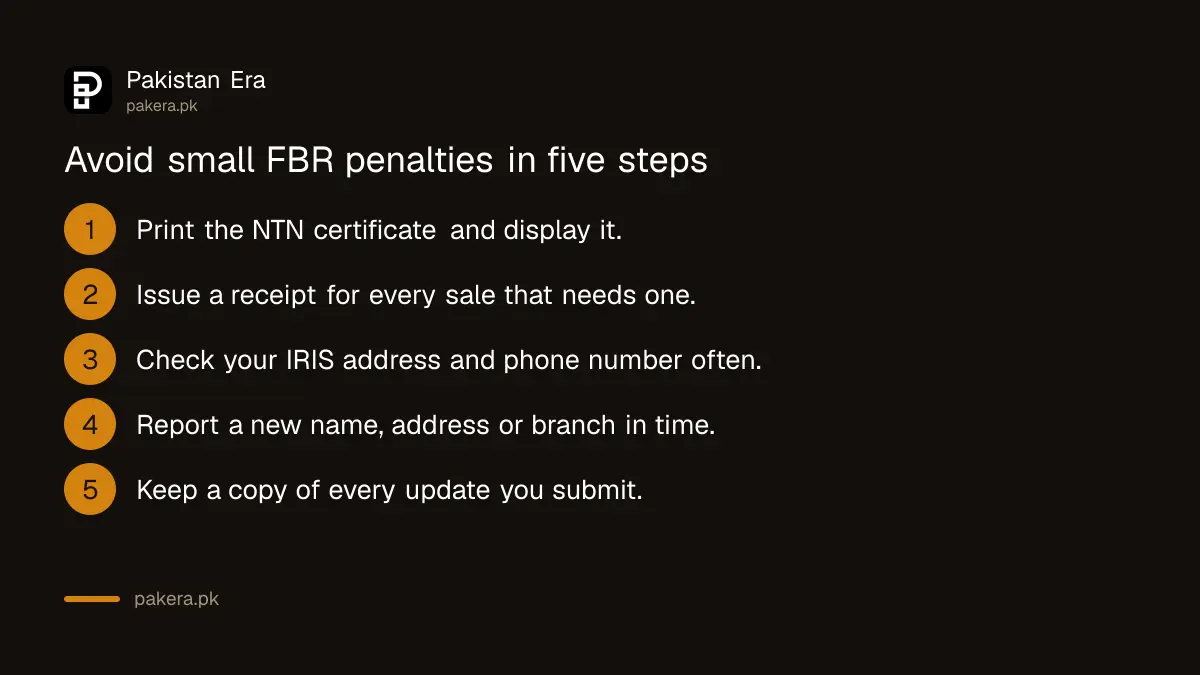
- Print your NTN certificate and place it where customers can see it.
- Give a printed or electronic receipt for every sale you are required to document.
- Check your registered address and phone number in IRIS every few months.
- Tell FBR within the allowed time when you move, change the business name or add a branch.
- Keep a copy of every update you submit.
Register on time and verify your NTN
Item 3 applies when you are required to register and do not apply. A sole trader who has not yet registered can follow the steps in the guide to registering as a sole proprietor with FBR. You can confirm that a number is active using the page on NTN verification online.
Item 4 applies to material changes. Treat a new address, name, owner or business line as a reason to update.
Here is how two small slips add up. A shop moves to a new address and does not tell FBR. It also has no NTN on display at the new counter. On FBR's table, that is Rs 5,000 for the material change and Rs 5,000 for the NTN display, so Rs 10,000 in all. Each penalty still needs a written order after a hearing.
What to do if a penalty notice arrives
Read the section number and the date. Check whether it is a proposal or a written penalty order. Under section 182(2), a penalty needs a written order after you have been heard, and you can pay voluntarily if you accept the default.
If you disagree, reply in writing before the date and attach proof, such as the IRIS update receipt. If an order is passed, the appeal route is in the guide to appealing to the Commissioner (Appeals).
Common questions
What is the penalty for not displaying an NTN at a shop?
Rs 5,000, under item 16 of the section 182 table, which refers to section 181C.
How much is the fine for not updating the taxpayer profile?
Rs 2,500 for each day of default from the due date, with a minimum of Rs 10,000, under item 4A.
What if I do not give a receipt?
The fine is Rs 5,000 or 3% of the tax involved, whichever is higher, when a cash memo, invoice or receipt is required.
What is the penalty for not registering with FBR?
Rs 10,000 for a person who is required to apply for registration and does not, under item 3.
What is the fine for not reporting a change of address?
Rs 5,000 for not reporting a material change in registration details, under item 4, which refers to section 181.
Can the penalty be charged without a hearing?
No. Section 182(2) needs a written order after the person has been given a chance to be heard.
How we verified this
What we checked and where we read it.
Last checked on 13 October 2026, Pakistan time. The source is FBR's page for section 182 of the Income Tax Ordinance. The copy is stamped 23 June 2026. This page is general information, not legal advice.
Free on WhatsApp
Get last dates and rule changes on WhatsApp
We post new last dates, fee changes and fixes for common problems, a few short posts a day.
Follow Pakera on WhatsAppOther followers cannot see your number.
Pakera Solves It
Which online process wasted your time this week?
A portal that will not load, a form nobody explains, a complaint that went nowhere. Tell us. Every week we pick one, solve it step by step and publish the answer.
About the author

Public Services and Education Journalist
Fajr Riaz is a journalist and content writer at Pakistan Era, based in Lahore. She covers the questions people meet in everyday life in Pakistan: how a public service works, what a change in the rules means, and where to find a reliable answer.