Saudi Employer Must Pay Your Iqama, Work Permit and Exit Re-entry Fees: Article 40 for Pakistani Workers
Saudi Labor Law Article 40: the employer pays iqama, work permit, late fines, exit re-entry visa and your ticket home. How Pakistani workers get a refund.
Under Saudi Arabia's Labor Law, your employer, not you, must pay the recruitment fees, the iqama and work permit fees and their renewals, any fines for late renewal, the exit and re-entry visa fees, and your ticket home when the job ends. That is Article 40 of the law. You pay your own way home only if you are unfit for work or leave without a legitimate reason.
Many Pakistani workers in the Kingdom still have iqama renewal money cut from their salary, or are told to pay for their own exit and re-entry visa before Eid leave. We read the English text of the Saudi Labor Law, Royal Decree M/51 of 27 September 2005, published on the website of the Ministry of Human Resources and Social Development, on 20 October 2026.
Article 40 puts the iqama and work permit fees on the employer
Article 40 says the employer bears the fees for recruiting non-Saudi workers, for issuing and renewing the residence permit, or iqama, and the work permit, and the fines caused by any delay. It also covers fees for a change of profession, exit and re-entry visas, and the return ticket.
| Cost | Who pays under Article 40 |
|---|---|
| Recruitment fees for a non-Saudi worker | Employer |
| Iqama issue and renewal | Employer |
| Work permit issue and renewal | Employer |
| Fines for late iqama or permit renewal | Employer |
| Exit and re-entry visa, change of profession | Employer |
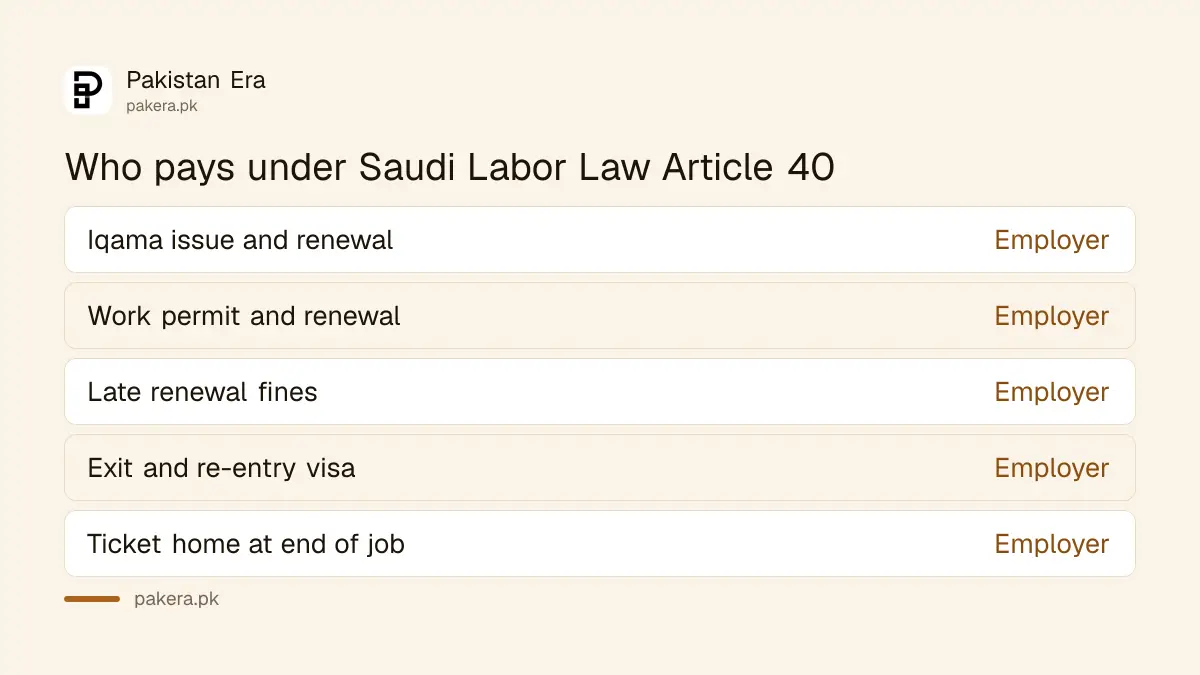
The fines point is the one workers most often get wrong. If your employer renews your iqama late, the late fine is the employer's cost under this article. It should not come out of your wages.
Your ticket home is the employer's cost when the job ends
Article 40 also makes the employer pay the worker's return ticket to their home country at the end of the working relationship. The worker pays only in two cases: if they are unfit for work, or if they choose to go home without a legitimate reason.
So a worker whose contract ends normally, or who is let go, should get the ticket to Pakistan paid. A worker who walks out of a valid contract with no good reason may have to buy their own. Keep proof of why you left, such as unpaid salary records, in case the reason is disputed.
The ticket sits alongside the rest of what you are owed when you leave. Your end-of-service award is a separate amount, and you can work it out in calculate your Saudi end-of-service award.
A new employer pays the transfer fee, not you
When you move your service to a new employer, Article 40 says the employer who takes you on bears the fees of the transfer. It is not a cost for the worker. If a new company asks you to pay the transfer charge yourself, that conflicts with the text of the law.
Article 40 also covers the worst case. If a worker dies, the employer is responsible for preparing the body and sending it to the place where the contract was signed or the worker was recruited, unless the family agrees to burial in the Kingdom. The employer is relieved if the General Organization for Social Insurance, GOSI, takes this on.
Families in Pakistan dealing with a death abroad can also get help through the steps to bring a body home with OPF help.
Ask for your experience certificate and documents back when you leave
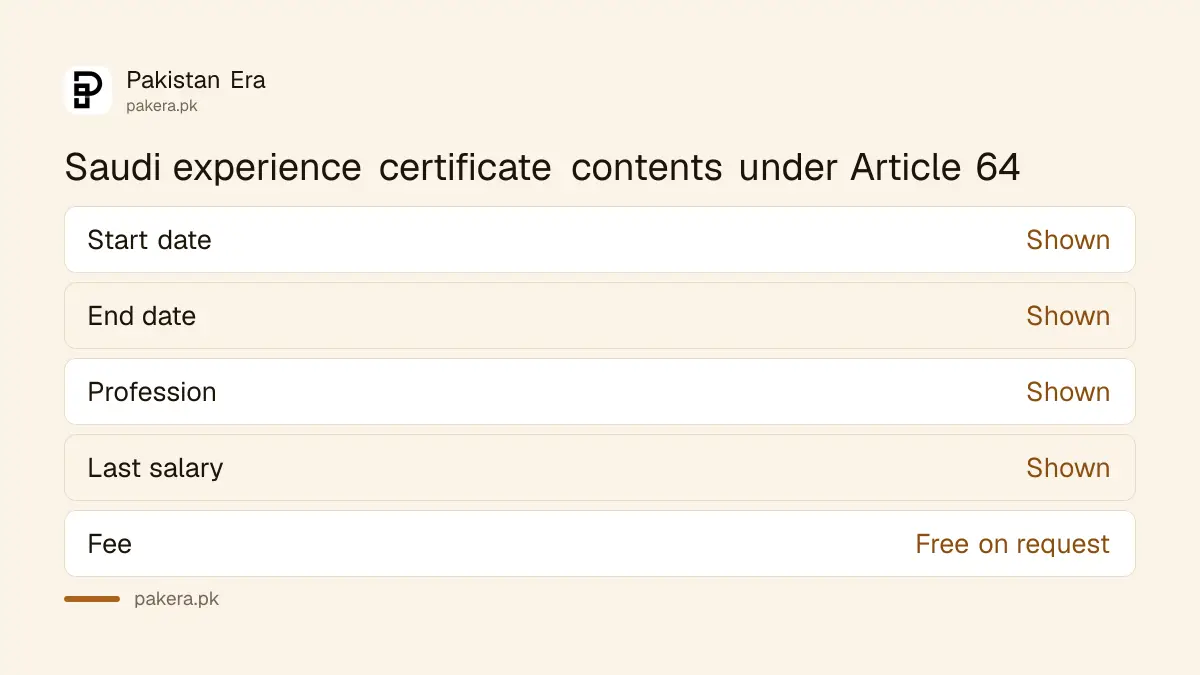
Article 64 says that when a contract ends, the employer must give you, on request, a free certificate of work experience. It shows your start date, end date, profession and last salary, and it cannot carry remarks that harm your reputation. The employer must also return every certificate or document you deposited.
That certificate matters for your next job, in the Gulf or in Pakistan. Ask for it in writing before your final day, and check the salary figure on it against your last payslip.
The duty to return documents covers degrees, diplomas and any papers you handed over when you joined. Make a list of what you gave in, with dates, so you can show what is missing if the employer holds anything back.
How to challenge a fee cut from your salary
If an iqama, work permit or exit and re-entry fee was taken from your wages, first raise it in writing with your employer and quote Article 40. If that fails, a labour dispute goes to the Ministry's friendly settlement stage, which is free, before it can reach the labour courts.
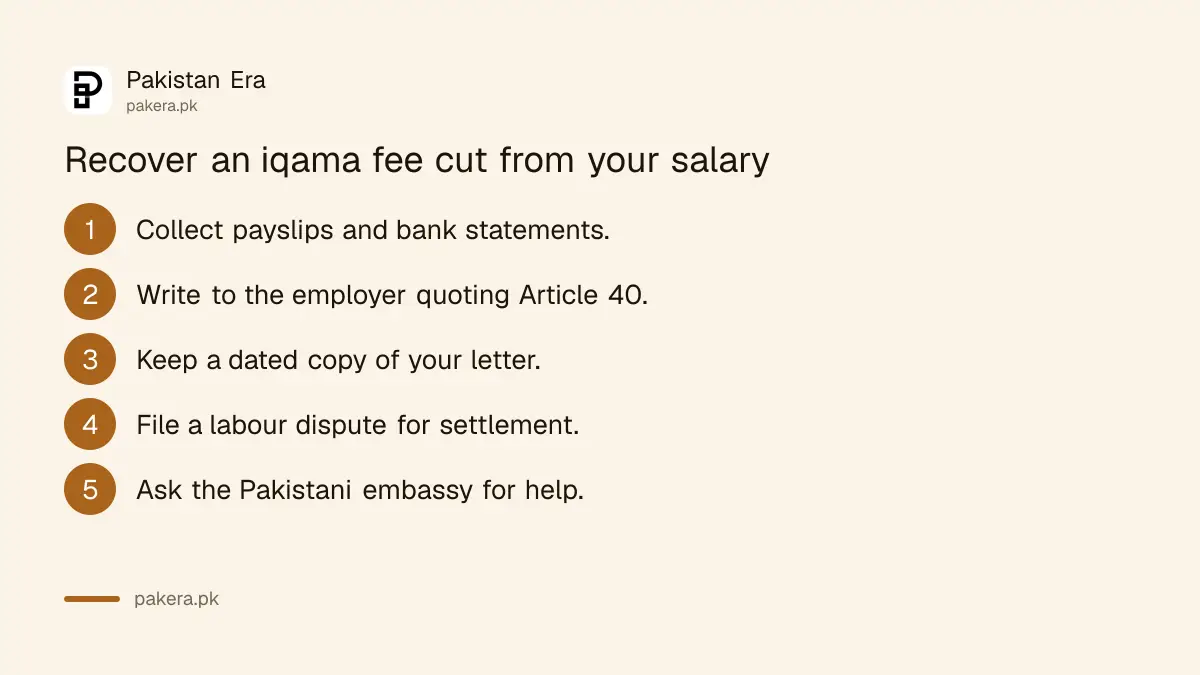
- Collect proof: payslips, bank statements and any message asking you to pay the fee.
- Write to your employer, name the fee and the amount, and quote Article 40 of the Labor Law.
- Keep a copy of your letter and the date you sent it.
- If nothing changes, file a labour dispute for friendly settlement with the Ministry.
- Ask the Pakistani embassy in Riyadh or the consulate in Jeddah for help with the case.
The full dispute process, from filing to settlement, is in filing a Saudi labour dispute for friendly settlement. Fee deductions are also limited by the wage rules in Saudi salary deduction limits.
Be careful with one thing. Saudi Arabia has amended parts of the Labor Law since 2005, including changes reported to take effect in 2025. The text we read is the 2005 law as published in English by the Ministry. Check the current wording of Article 40 with the Ministry or the Pakistani mission before relying on it in a dispute.
Common questions
Who pays the iqama renewal fee in Saudi Arabia?
The employer. Article 40 of the Labor Law puts the iqama and work permit fees, and their renewals, on the employer.
Who pays the fine if my iqama is renewed late?
The employer. Article 40 says the employer bears fines caused by delay in renewing the iqama and work permit.
Do I pay for my own exit and re-entry visa?
No. Article 40 lists exit and re-entry visa fees as an employer cost.
Does my employer have to pay my ticket back to Pakistan?
Yes, at the end of the work relationship, unless you are unfit for work or leave without a legitimate reason.
Who pays the fee when I transfer to a new employer?
The new employer who takes on your service, under Article 40.
Can my employer refuse to give me an experience certificate?
No. Article 64 says the employer must give one free of charge on request when the contract ends.
How we verified this
What we checked, where we read it, and what we could not confirm.
We read the English text of the Saudi Labor Law, Royal Decree M/51 of 27 September 2005, in the PDF published on the Ministry of Human Resources and Social Development website, on 20 October 2026, focusing on Articles 40 and 64. We could not read a consolidated English version with later amendments, so we do not know whether Article 40 has been reworded since. We did not check current fee amounts for the iqama, work permit or exit and re-entry visa.
About the author

Global Affairs & Political Economy Writer
Muhammad Hatim is a book lover who started writing because he enjoys it. At Pakistan Era he writes about international relations, geopolitics and the global economy, with a particular interest in South Asia and the forces behind current events.