Saudi Arabia Salary Rules: Paid Into Your Bank, Deductions Capped at Half, for Pakistani Workers
Saudi Labor Law says wages go into your bank account and deductions stop at half your wage. See loan, damage and court limits and how to claim unpaid salary.
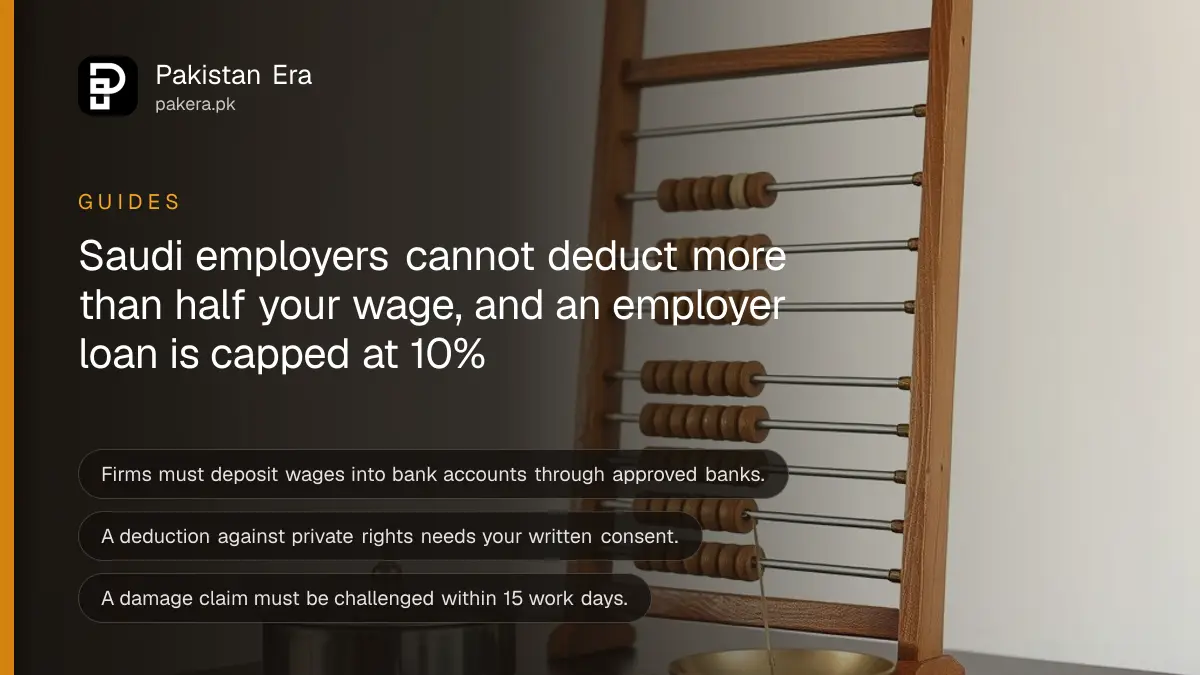
Short answer: In the Saudi Labor Law text on the HRSD website, monthly wages must be paid once a month, and firms must deposit wages into workers' bank accounts through approved banks. Deductions are capped: 10% for an employer loan, and half of your wage in total. A worker may ask the labour court to order unpaid wages.
A Pakistani worker in Saudi Arabia often asks the same three questions. When must I be paid? What can my employer cut from my salary? And what can I do if the money does not come? We read Articles 88 to 94 of the Labor Law on the website of the Ministry of Human Resources and Social Development (HRSD) and set out the answers.
A warning on the text. The English file on HRSD's site is the 2005 version, Royal Decree M/51. The law was reported to be amended in February 2025, and we could not open an official amended text. Check your contract and your records before you act on a figure.
Wages are paid in local currency, into a bank account
Article 90 says wages and all other dues are paid in local currency. A monthly paid worker is paid once a month. A daily paid worker is paid at least once a week. Firms must deposit wages into workers' bank accounts through approved banks in the Kingdom.
The same article lets the Minister exempt some firms from the bank deposit rule. So a small employer may have an exemption. If you are paid in cash, ask which rule applies and keep a signed receipt each month.
| Type of worker | Payment rule in Article 90 |
|---|---|
| Paid monthly | Once a month |
| Paid daily | At least once a week |
| Piece work longer than two weeks | Weekly part payment, balance in the week after delivery |
| All firms | Deposit into a bank account through an approved bank, unless exempted |
Deductions need your written consent, with a few exceptions
Article 92 says no amount may be deducted from a worker's wages against private rights without his written consent, except in listed cases. The list includes loan repayment, social insurance, thrift fund contributions, home ownership instalments, fines and damages, and court judgments.
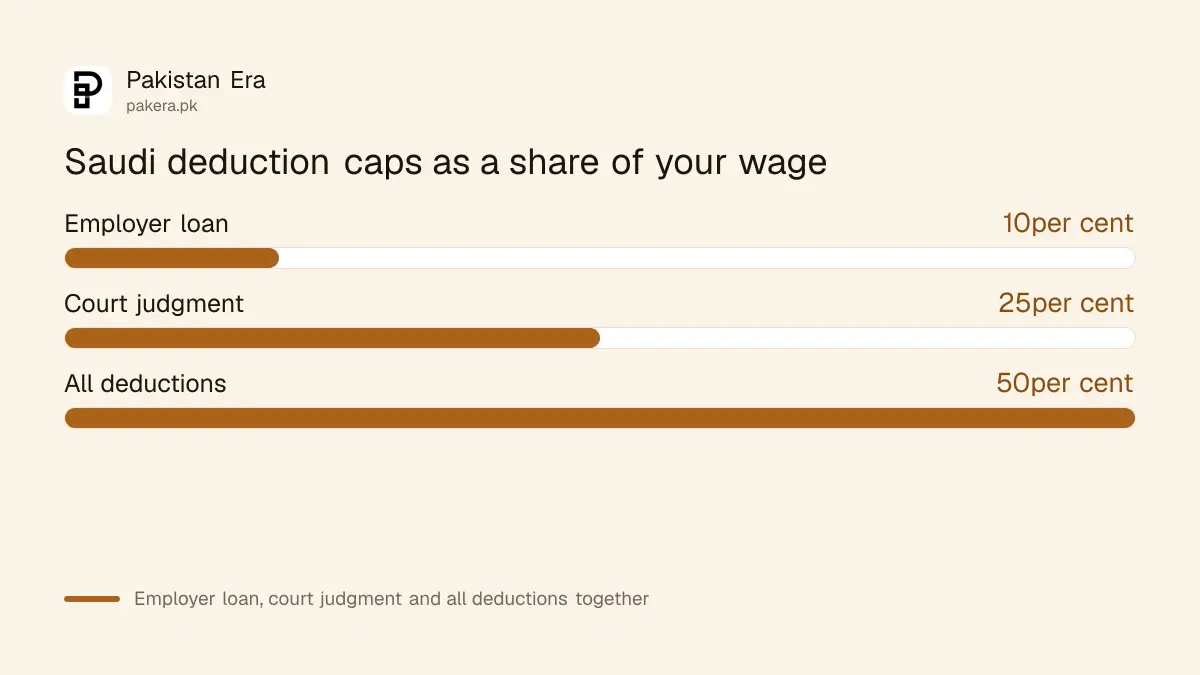
Each case has a limit. An employer's loan can be deducted at no more than 10% of your wage. A court judgment can take no more than one quarter of the monthly wage, unless the judgment says otherwise. Alimony is collected first.
| Deduction | Limit in the text we read |
|---|---|
| Employer's loan | Not more than 10% of wage |
| Damage to employer's machinery or products | Not more than five days' wage a month |
| Court judgment | Not more than one quarter of the monthly wage, unless the judgment says otherwise |
| All deductions together | Not more than half the due wage, unless the labour court allows more |
Article 93 caps all deductions at half the due wage. The labour court may allow more, but the worker may not be left with less than a quarter of his wage in that case.
Damage claims have a strict 15 day window
Article 91 lets an employer deduct the cost of repair if a worker, through his own fault or by breaking instructions, damages machinery or products in his custody. The deduction may not exceed five days' wage a month. Either side must file a grievance within 15 work days or lose that right.
For the worker, the 15 days run from the date the employer notifies him of the damage claim. If the court rules the deduction was not due, the employer must return the amount within seven days of the award. So never sign a paper accepting blame without reading it.
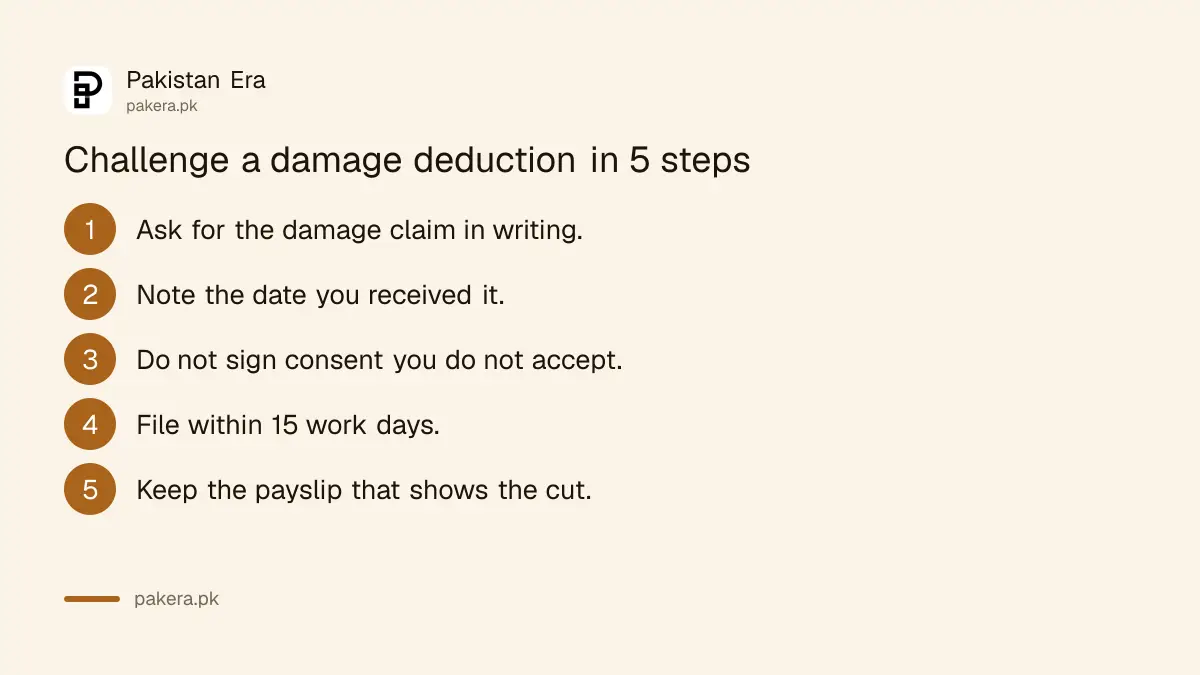
- Ask for the damage claim and the amount in writing.
- Note the date you received it, because the 15 work days start then.
- Do not sign consent to a deduction you do not accept.
- File your grievance with the labour court within the 15 work days.
- Keep the payslip showing the deduction.
Unpaid or wrongly cut wages can go to the labour court
Article 94 says that if an amount is deducted without your written consent, or if the employer delays wages without a valid reason, you, your representative, or the head of the competent labour office may ask the labour court to order the money returned or paid.
The court may also fine the employer up to twice the amount deducted or twice the outstanding wages. That is what the text says. Whether a fine is imposed is the court's decision.
When your job ends, Article 88 sets the settlement deadline. If the employer ends the contract, wages and entitlements are due within one week. If the worker ends it, entitlements are due within two weeks. The employer may deduct a work-related debt from them.
Keep records and use the embassy when payment stops
Keep every payslip and bank statement. Photograph your attendance sheets. These are your proof. If wages stop, write to HR first, then go to the labour office, and tell your embassy's community welfare section.
Our page on recovering unpaid dues abroad through OPF explains the Pakistani side, and Pakistan embassy contacts in Saudi Arabia lists the numbers. To work out what is due at the end of a job, use our end-of-service award guide. If your wage is paid and you send it home, see what to do if a remittance does not arrive.
Common questions
When must a Saudi employer pay my salary?
Monthly paid workers must be paid once a month, and daily paid workers at least once a week, under Article 90 of the Labor Law text on HRSD's site.
Must my salary go into a bank account?
Article 90 requires firms to deposit wages into workers' bank accounts through approved banks. The Minister may exempt some firms, so ask your employer which rule applies to you.
How much can my employer deduct for a loan?
No more than 10% of your wage under Article 92, and all deductions together may not exceed half your due wage under Article 93, unless the labour court allows more.
Can my employer cut my pay without my consent?
Not against private rights. Article 92 requires written consent, except for listed cases such as insurance contributions, fines, damages and court judgments.
What if my employer delays my wages?
You may ask the labour court to order payment, and the court may fine the employer up to twice the outstanding wages. Keep your payslips and bank statements as proof.
Does the Wage Protection programme change this?
We did not read the rules of HRSD's wage monitoring system, so this page does not cover it. Check HRSD or your embassy for how it applies to your employer.
How we verified this
What we checked, where we read it, and what we could not confirm.
Checked on 11 October 2026. We read Articles 88 to 94 of the Saudi Labor Law English text on the HRSD website (hrsd.gov.sa, file dated February 2023, Royal Decree M/51 of 2005). We did not open an amended text, the Regulations or HRSD's wage monitoring pages.
About the author

Global Affairs & Political Economy Writer
Muhammad Hatim is a book lover who started writing because he enjoys it. At Pakistan Era he writes about international relations, geopolitics and the global economy, with a particular interest in South Asia and the forces behind current events.