Fired in Saudi Arabia: Notice, Compensation and Your Rights Under Labor Law
Told to leave a Saudi job? Labor Law needs a written reason and 60 days' notice, or pay for them. See the nine no-notice cases and what to do before you sign.
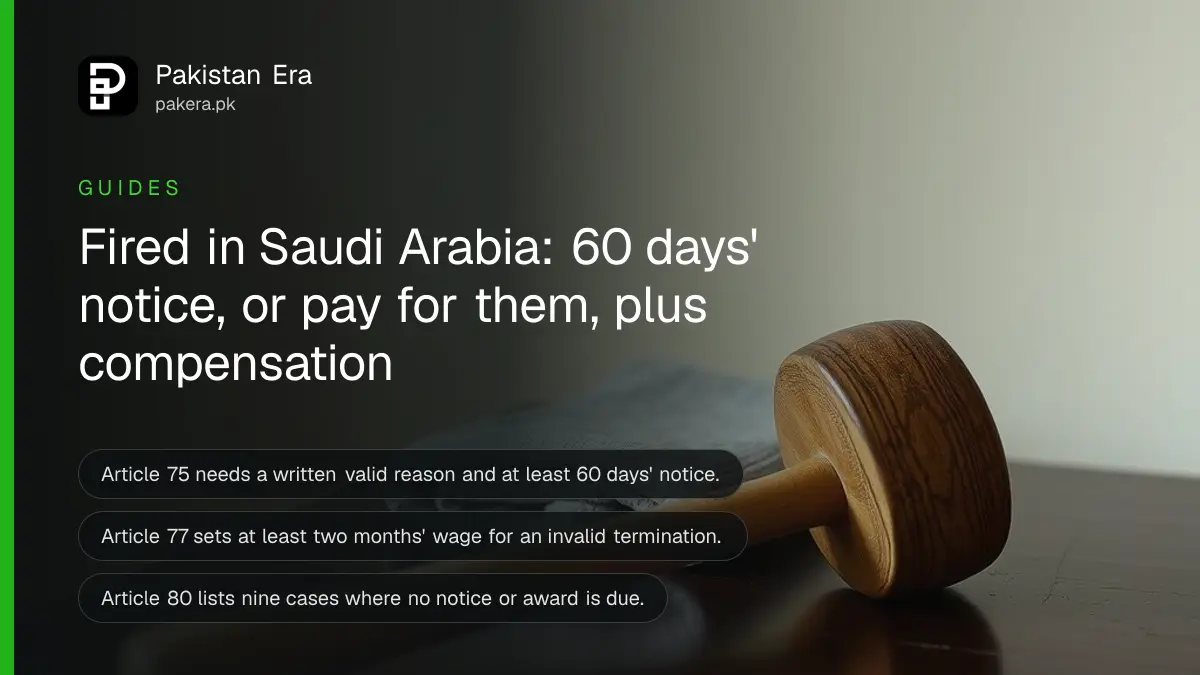
Short answer: Under Saudi Labor Law, an employer who ends an open-ended contract must give a valid reason in writing and at least 60 days' notice if you are paid monthly. If it skips the notice, it owes you the wage for that period. If the reason is not valid, compensation is due. Only nine listed cases allow dismissal with no notice and no award.
Update, 11 October 2026: The Labor Law also limits the probation period.
A termination letter can arrive without warning, and the law sets what the employer must give you first. We read Articles 53 to 54 and 74 to 88 of the Saudi Labor Law on the website of the Ministry of Human Resources and Social Development (HRSD) and set out the rules that matter most to a worker who is told to go.
An open-ended contract needs a valid reason and 60 days' written notice
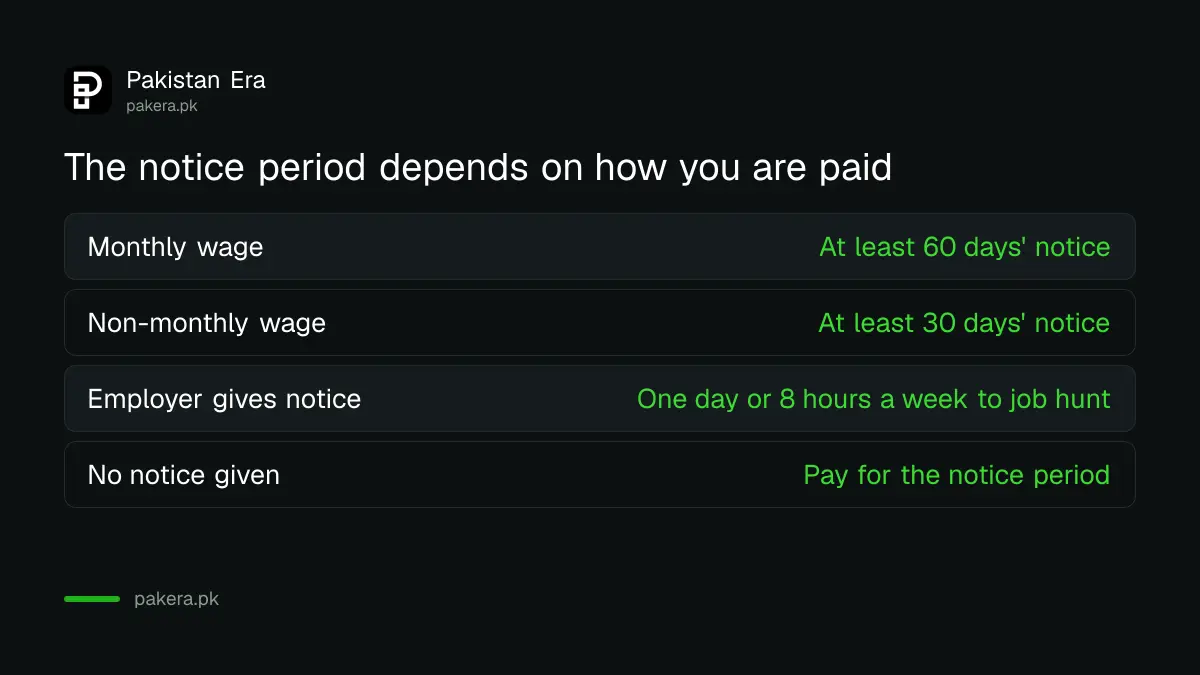
Article 75 says that either side may end an open-ended contract for a valid reason, stated in a written notice served before the termination date. The notice period must be at least 60 days if the wage is paid monthly, and at least 30 days if it is not paid monthly.
Two points follow. The reason must be written down, so a verbal "you are finished" is not the notice the law describes. And the notice period is a minimum, so your contract may give you more.
Article 78 adds a right for the worker. When the employer gives notice, you are entitled to paid time off of a full day or eight hours each week to look for another job. You choose the time and tell the employer one day ahead.
Skipping the notice means paying the notice period in cash
Under Article 76, a party that ends an open-ended contract without the notice owes the other party compensation equal to the worker's pay for the notice period. The two sides may agree on a higher sum in the contract. The same rule applies to a worker who quits without notice.
So if the employer hands you a letter on Sunday and asks you to leave on Monday, ask for the pay for the 60 days. Wage here means your actual wage, which includes the allowances written in your contract.
Dismissal without a valid reason earns compensation
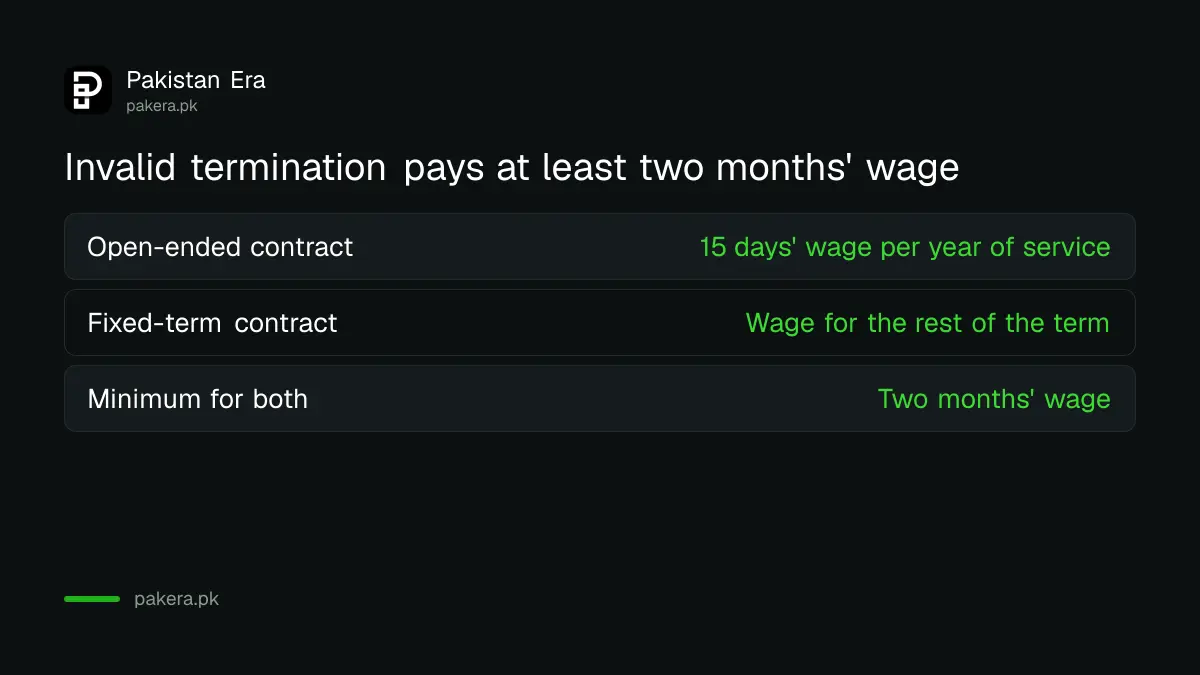
Article 77 sets the minimum. For an open-ended contract it is fifteen days' wage for each year of service. For a fixed-term contract it is the wage for the rest of the term. In both cases the total cannot be less than two months' wage, unless your contract states a specific compensation.
This compensation is separate from your end-of-service award. To work that out, use the Article 84 formula for the Saudi end-of-service award, then add notice pay or compensation on top where they apply.
| Type of contract | Compensation for an invalid termination |
|---|---|
| Open-ended | 15 days' wage for each year of service |
| Fixed-term | Wage for the rest of the term |
| Either type | Never less than two months' wage |
An employer may dismiss without notice or award in nine listed cases
Article 80 lists nine cases in which an employer may end the contract without an award, notice or compensation, as long as it first gives you a chance to state your objection. Outside that list, a dismissal without notice is open to challenge.
The cases include assault on the employer or a superior, failing main duties or ignoring safety warnings in spite of written warnings, dishonesty, deliberate harm to the employer, forgery to obtain the job, dismissal during probation, disclosing trade secrets and using the job for personal gain.
Absence has a strict test. The ground applies only for absence of more than 30 days in a contractual year or more than 15 consecutive days, and only after a written warning, given at 20 days in the first case and 10 days in the second. If the employer reports you absent on Qiwa, read the 60 day period that follows an absence report at once.
Probation has its own rule. It cannot exceed 90 days, excluding Eid holidays and sick leave, and may be extended by written agreement up to 180 days. If the contract ends in probation, neither side owes compensation, and there is no end-of-service award.
You may leave without notice in seven cases
Article 81 lets a worker leave without notice and still keep statutory rights in seven cases. They include the employer failing its essential obligations, fraud about the job conditions, being assigned very different work without consent, violence or an immoral act, cruelty or insult, and serious unaddressed hazards.
The seventh is a case where the employer's conduct, such as unjust treatment or breaking contract terms, makes you look like the one who ended the contract. In practice that is the most useful clause for a worker whose wages are not paid.
Article 82 also bars an employer from ending your service because of illness before you have been given the sick leave the law sets.
Take five steps before you sign a termination letter
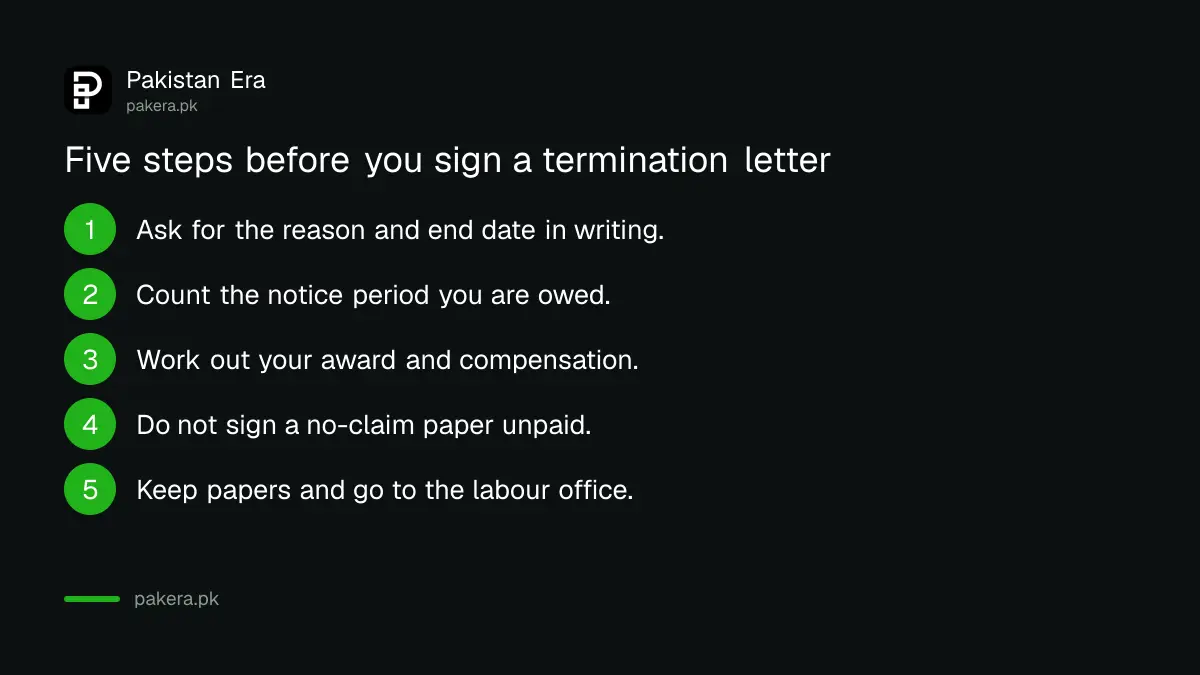
Do not sign a quittance until you have checked what is owed. Ask for the written reason and the date, count the notice period, and work out the award. If the employer does not agree, take the matter to the labour office and the embassy.
- Ask for the termination in writing, with the reason and the end date.
- Count the notice. Monthly paid workers are owed at least 60 days.
- Work out the end-of-service award and any compensation using the table above.
- Do not sign a clearance or a "no claim" paper until you are paid in full.
- Keep your contract, payslips and the letter, and go to the labour office. For unpaid dues, see how OPF helps recover unpaid salary from abroad.
Article 88 gives the employer one week to settle wages and entitlements when it ends the contract, and two weeks when the worker ends it.
Common questions
How much notice must a Saudi employer give?
At least 60 days for a monthly paid worker on an open-ended contract, and at least 30 days for other pay periods, under Article 75.
Can an employer fire me without a reason?
The law requires a valid reason, stated in the written notice. Without one, you may be owed compensation of at least two months' wage.
Do I get compensation on a fixed-term contract?
Yes, if the termination is without a valid reason. It is the wage for the rest of the term, and not less than two months' wage.
Can I resign without notice?
Only in the seven cases of Article 81. Otherwise a worker who skips the notice owes the notice period's pay.
What if I am fired during probation?
Neither side owes compensation, and there is no award. Probation is limited to 90 days, extendable in writing up to 180 days.
Is this the latest version of the law?
HRSD hosts the 2005 English text, so later amendments may differ. Confirm with HRSD, Qiwa or the embassy before you file.
How we verified this
What we checked, where we read it, and what we could not confirm.
Last checked on 11 October 2026. We read Articles 53, 54, 74 to 82 and 88 of the Saudi Labor Law, Royal Decree M/51, in the English copy on the HRSD website. This is the 2005 text, so check for later amendments. This is general information, not legal advice.
About the author

Global Affairs & Political Economy Writer
Muhammad Hatim is a book lover who started writing because he enjoys it. At Pakistan Era he writes about international relations, geopolitics and the global economy, with a particular interest in South Asia and the forces behind current events.