How to Settle a PRA Tax Dispute Through a Dispute Committee in Punjab: Section 69
Disputing a PRA order in Punjab? Section 69 lets PRA form a committee in 30 days, with recommendations in 90 days. See who can apply and who is refused.
A registered person in Punjab can ask the Punjab Revenue Authority (PRA) to set up a dispute committee under section 69 of the Punjab Sales Tax on Services Act, 2012. PRA must name a committee of at least three people within 30 days of the application, and the committee has 90 days to make its recommendations.
Going through two appeals can take a year or more. Section 69 is a shorter path for some disputes: a tax liability you contest, a request to waive default surcharge and penalty, or a missed time limit that was a technical slip. It is not an appeal, and it does not suit every case.
We read sections 63 to 69 of the Act on 21 October 2026, together with the PRA home page at pra.punjab.gov.pk. We did not see a PRA circular or form for this process, so the steps below come from the Act itself. The same idea in another province is explained in the guide to a KPRA dispute committee.
Only a registered person with a tax dispute can apply
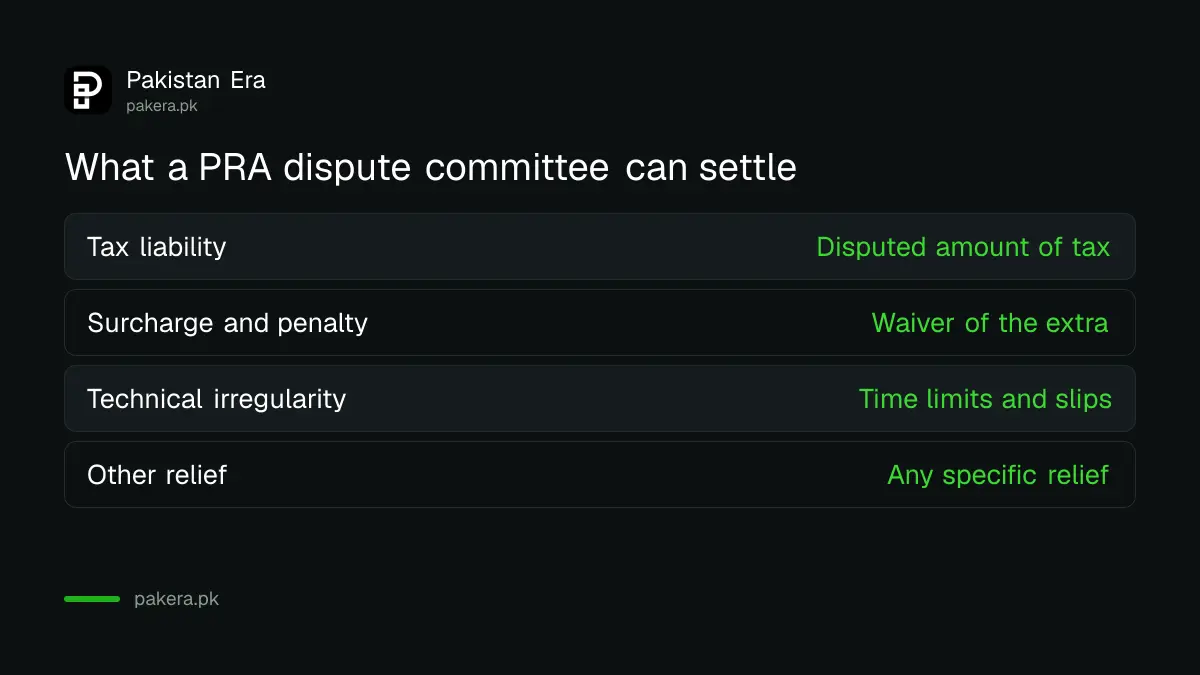
The applicant must be a registered person aggrieved by a dispute on one of four matters: the liability of tax, how much default surcharge and penalty is waived, relaxation of procedural or technical irregularities and condonation of a time limit, or any other specific relief. The application must describe the dispute in detail.
| Matter you can raise | Example |
|---|---|
| Liability of tax | An order adds tax on a service you say is exempt |
| Waiver of default surcharge and penalty | You paid the tax late and ask for relief on the extra |
| Procedural irregularity or time limit | A return was a day late because of a portal fault |
| Other specific relief | A relief the dispute needs that the first three do not name |
PRA will refuse if there is a criminal case or a wide question of law
Section 69(2) says PRA shall not accept an application where criminal proceedings have been initiated. It also refuses when it believes a question of law with a larger impact on revenue, or on a number of similar cases, is involved. A fraud allegation, for example, takes the case out.
The section also does not stop your appeal clock. The Commissioner (Appeals) time limit of 30 days under section 63 still runs. Where an appeal is pending, section 65(6) says time spent in these proceedings is not counted toward the appeal decision deadline, but we did not find a rule that pauses your own deadline to file. File the appeal first if the 30 days are near.
PRA appoints the committee within 30 days and it reports in 90
After examining the application, PRA may appoint a committee of at least three persons within 30 days. It includes an officer not below Additional Commissioner and nominees from a notified panel. The panel can include chartered or cost accountants, advocates, trade body representatives, retired officers of BS-20 or above, and retired judges.
The committee may inquire, seek expert opinion, and direct an audit. It must give its recommendations to PRA within 90 days of being constituted.
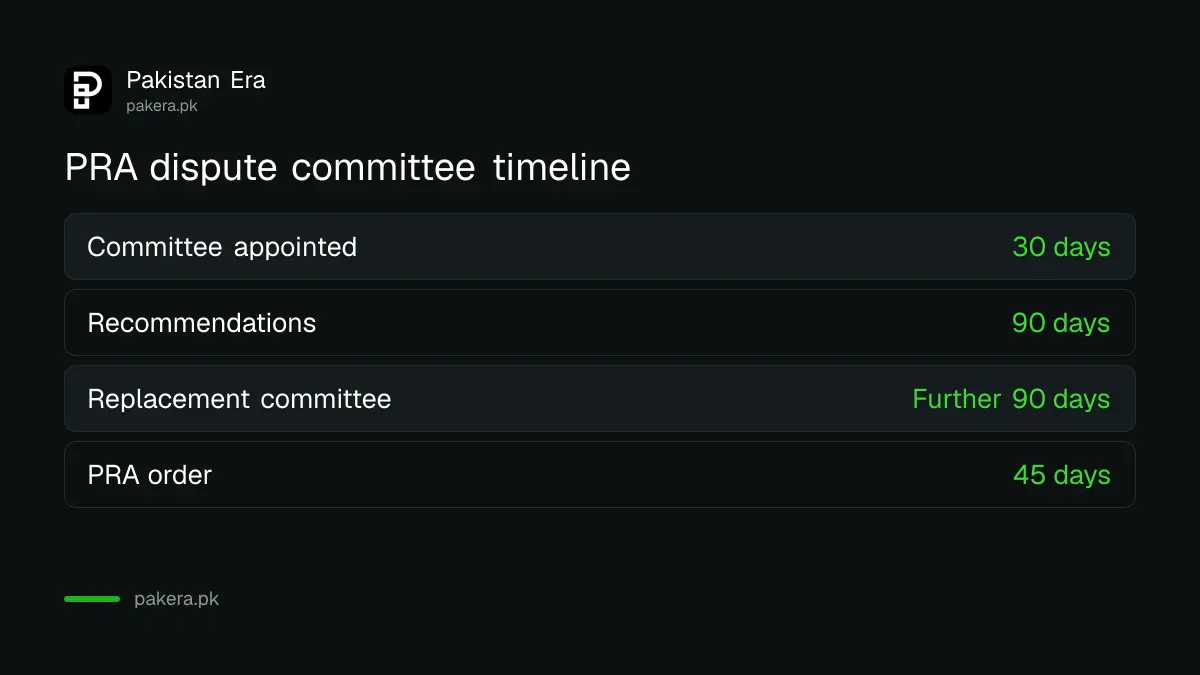
| Step | Time in the Act |
|---|---|
| Committee appointed after application | Within 30 days |
| Committee recommendations | Within 90 days of constitution |
| New committee if the first fails | A further 90 days |
| PRA order on the recommendations | Within 45 days of receiving them |
If the committee fails, the case goes back to the normal appeal forum
Section 69(5) lets PRA dissolve a committee that misses its 90 days and form a new one with a further 90 days. If the dispute is still not resolved after that, the matter goes before the appropriate forum under the Act. So the worst case is a delay of about six months, not a loss of rights, but only if you kept your appeal in time.
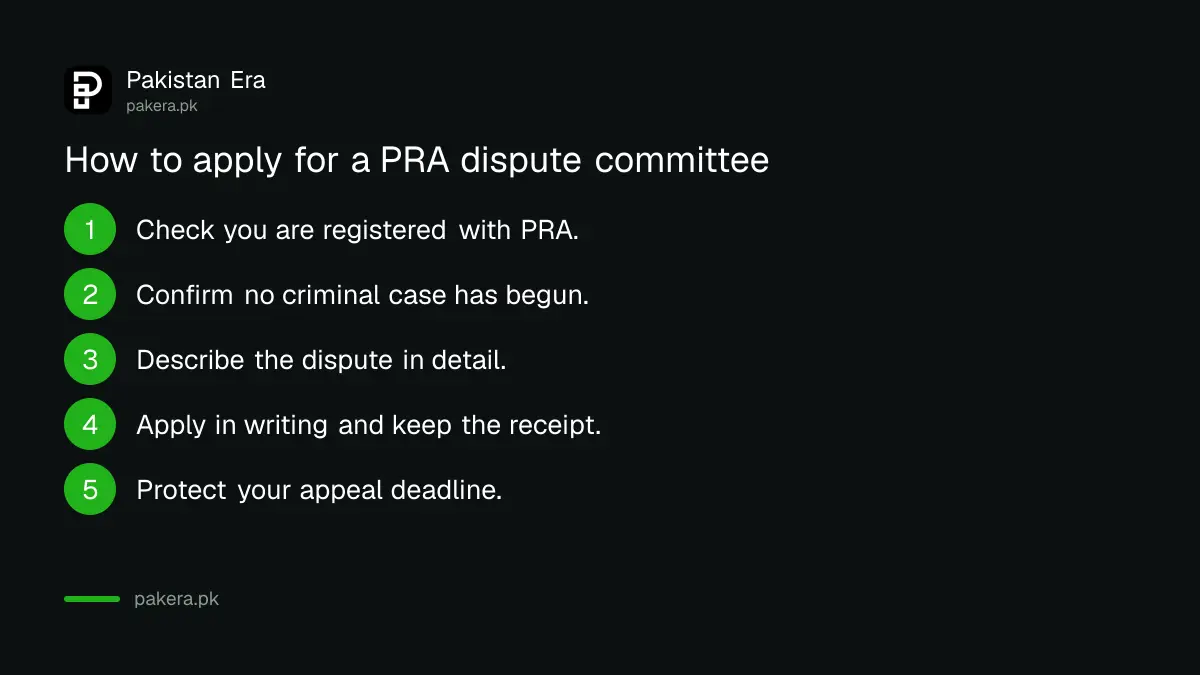
- Check that you are registered and that no criminal proceeding has started.
- Write the dispute in detail: the order, the amount, and the relief you want.
- Apply in writing to PRA, and keep the receipt.
- If your appeal deadline is close, file the appeal separately first.
- Prepare records for the committee: invoices, returns, challans and the order.
- Pay the tax PRA determines, and tell the forum where your case is pending.
You pay the tax PRA decides and the order goes to the pending forum
Section 69(6) lets PRA pass an order on the committee's recommendations within 45 days. Under sub-section (7), you may pay the tax as set in that order, and the order is submitted to the Appellate Tribunal or court where the case is pending, for appropriate orders. The same Act's appeal routes are in the guide to a PRA appeal to the Commissioner (Appeals).
Common questions about a PRA dispute committee
Who can ask PRA for a dispute committee?
A registered person aggrieved in a dispute about tax liability, waiver of surcharge and penalty, procedural or time-limit relief, or another specific relief.
How long does the committee take?
PRA appoints it within 30 days, and it must recommend within 90 days of constitution. A replacement committee gets another 90 days.
Does it cost anything to apply?
We did not find a fee in the Act for the application. Ask PRA if a prescribed form or fee exists.
Can PRA refuse my application?
Yes, if criminal proceedings have begun or a question of law with a larger impact on revenue is involved.
Does it replace an appeal?
No. It is an extra route. Keep the appeal time limits in view while you wait.
What happens after the committee recommends?
PRA may pass an order within 45 days. You can then pay the tax it sets and put the order before the forum where your case is pending.
How we verified this
What we checked, where we read it, and what we could not confirm.
Last checked 21 October 2026. We read sections 63 to 69 of the Punjab Sales Tax on Services Act, 2012 and the PRA home page on that date. We could not verify whether PRA has published an application form, a fee or rules for the committee, or whether later amendments changed these limits. We did not apply to a committee. Check with PRA before relying on the timings.
About the author

Senior Writer, Public Services and Technology
Shahid joined us in 2024 as an author. He is a senior contributor to Pakistan's leading technology websites. He writes detailed articles, mostly covering his expertise in the latest tech, mobiles, apps, gadgets, and step-by-step guides. His ideology is to help people understand the latest trends and explain complex methods through very easy-to-understand guides.