Short Term Savings Certificate Profit Rate History in Pakistan: Every 3, 6 and 12 Month Rate From 2021 to 21 October 2026
Short Term Savings Certificates pay 11.12% to 11.72% from 21 October 2026, Rs 11,720 a year per lakh. See every 3, 6 and 12 month rate change since 2021.
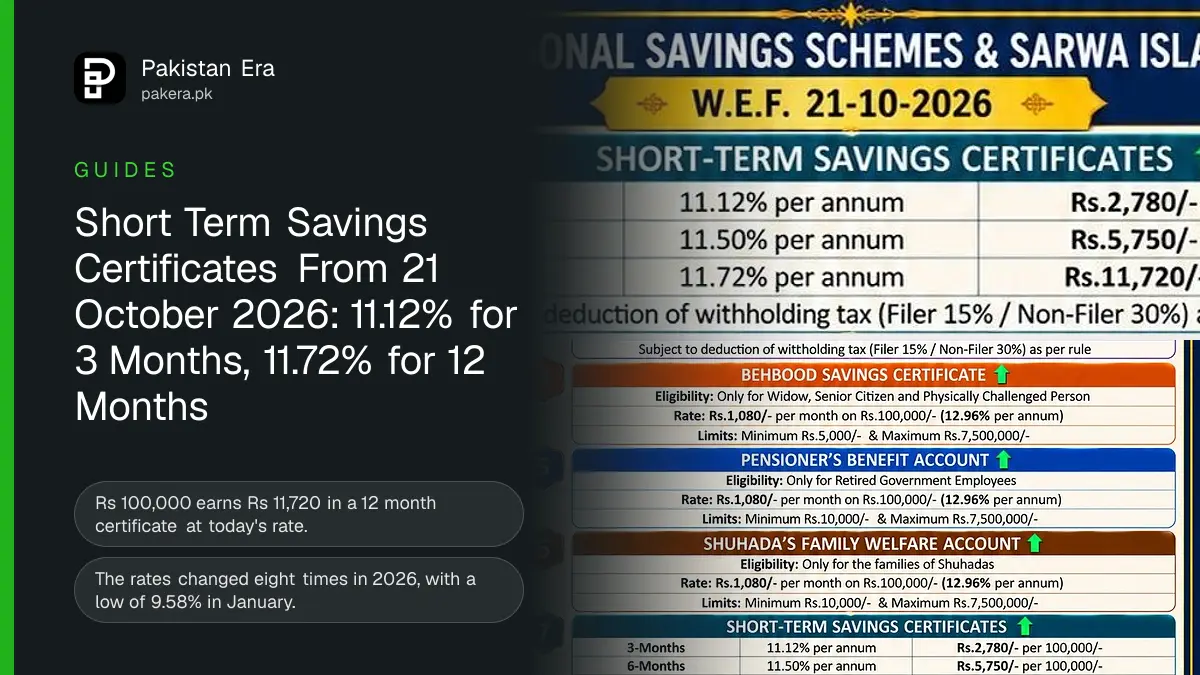
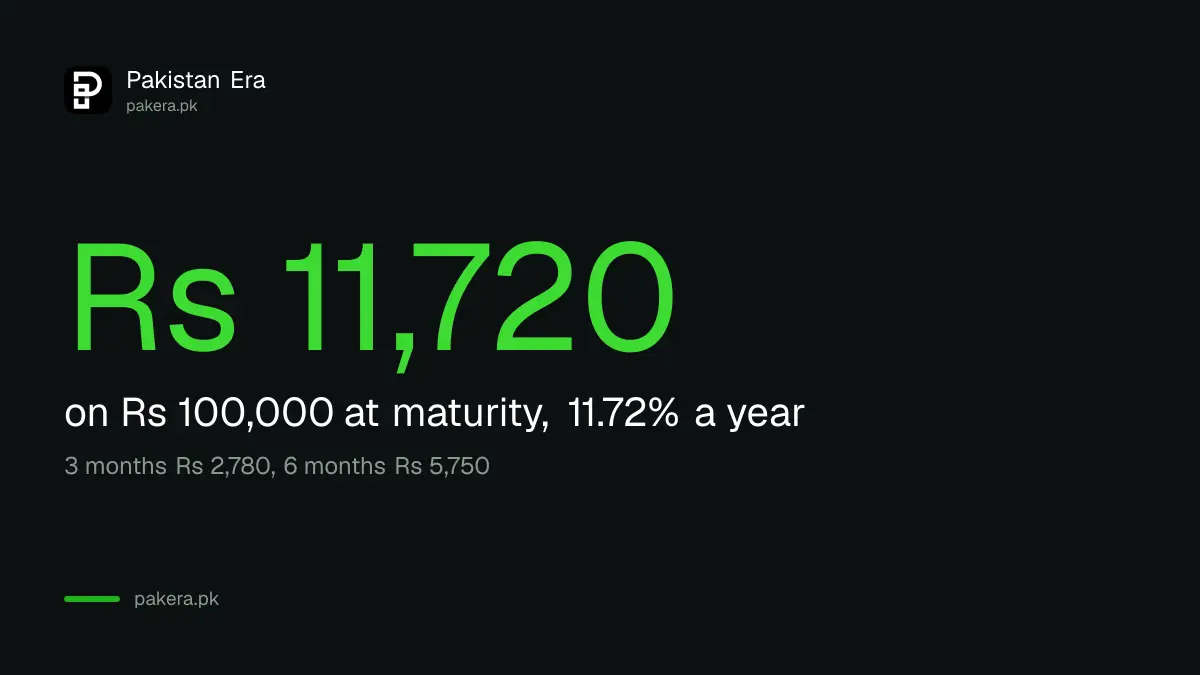
Short Term Savings Certificates pay 11.12% for 3 months, 11.50% for 6 months and 11.72% for 12 months from 21 October 2026. On Rs 100,000 that is Rs 2,780, Rs 5,750 and Rs 11,720. Below is every rate change since May 2021, the 2023 record, and what each change meant in rupees.
We downloaded National Savings' own Short Term Savings Certificate (STSC) history file from savings.gov.pk on 12 November 2026. It lists 46 rate periods from 19 May 2021 to date, with the rate and the rupee profit on Rs 100,000 for all three terms.
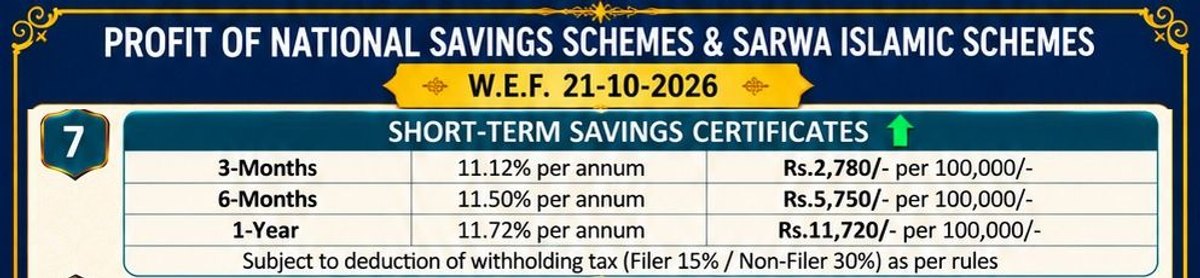
The STSC rates are 11.12% to 11.72% from 21 October 2026
From 21 October 2026, a 3 month certificate pays 11.12% a year, a 6 month one 11.50% and a 12 month one 11.72%. On Rs 100,000, you get Rs 2,780, Rs 5,750 or Rs 11,720 when it matures.
Before that, from 1 to 20 October, the rates were 10.80%, 11.08% and 11.31%. So every term went up, the 6 month one most, by 0.42 points. Profit is paid once, at maturity, not in instalments.
Every STSC rate change since March 2024: the full list
The table shows each period in the file from March 2024, newest first. Each cell is the yearly rate, with the rupee profit on Rs 100,000 at maturity in brackets.
| From | To | 3 months | 6 months | 12 months |
|---|---|---|---|---|
| 21 Oct 2026 | Till date | 11.12% (Rs 2,780) | 11.50% (Rs 5,750) | 11.72% (Rs 11,720) |
| 1 Oct 2026 | 20 Oct 2026 | 10.80% (Rs 2,700) | 11.08% (Rs 5,540) | 11.31% (Rs 11,310) |
| 4 Sep 2026 | 30 Sep 2026 | 10.86% (Rs 2,715) | 10.86% (Rs 5,430) | 11.28% (Rs 11,280) |
| 18 Jul 2026 | 3 Sep 2026 | 11.12% (Rs 2,780) | 11.14% (Rs 5,570) | 11.17% (Rs 11,170) |
| 10 Jun 2026 | 17 Jul 2026 | 11.40% (Rs 2,850) | 11.66% (Rs 5,830) | 11.70% (Rs 11,770) |
| 26 May 2026 | 9 Jun 2026 | 10.84% (Rs 2,710) | 10.58% (Rs 5,290) | 11.23% (Rs 11,230) |
| 23 Jan 2026 | 25 May 2026 | 9.64% (Rs 2,410) | 9.58% (Rs 4,790) | 9.58% (Rs 9,580) |
| 5 Jan 2026 | 22 Jan 2026 | 10.32% (Rs 2,580) | 10.36% (Rs 5,180) | 10.68% (Rs 10,680) |
| 4 Nov 2025 | 4 Jan 2026 | 10.44% (Rs 2,610) | 10.30% (Rs 5,150) | 10.64% (Rs 10,640) |
| 17 Sep 2025 | 3 Nov 2025 | 10.28% (Rs 2,570) | 10.30% (Rs 5,150) | 10.42% (Rs 10,420) |
| 21 Aug 2025 | 16 Sep 2025 | 10.28% (Rs 2,570) | 10.26% (Rs 5,130) | 10.36% (Rs 10,360) |
| 28 Jul 2025 | 20 Aug 2025 | 10.32% (Rs 2,580) | 10.20% (Rs 5,100) | 10.14% (Rs 10,140) |
| 27 Jun 2025 | 27 Jul 2025 | 10.36% (Rs 2,590) | 10.38% (Rs 5,190) | 10.40% (Rs 10,400) |
| 19 May 2025 | 26 Jun 2025 | 11.36% (Rs 2,840) | 11.36% (Rs 5,680) | 11.38% (Rs 11,380) |
| 22 Apr 2025 | 18 May 2025 | 11.24% (Rs 2,810) | 11.32% (Rs 5,660) | 11.30% (Rs 11,300) |
| 20 Mar 2025 | 21 Apr 2025 | 11.12% (Rs 2,780) | 11.08% (Rs 5,540) | 10.96% (Rs 10,960) |
| 25 Feb 2025 | 19 Mar 2025 | 11.08% (Rs 2,770) | 10.84% (Rs 5,420) | 10.81% (Rs 10,810) |
| 14 Feb 2025 | 24 Feb 2025 | 11.08% (Rs 2,770) | 11.14% (Rs 5,570) | 11.14% (Rs 11,140) |
| 31 Jan 2025 | 13 Feb 2025 | 11.24% (Rs 2,810) | 11.32% (Rs 5,660) | 11.38% (Rs 11,380) |
| 10 Dec 2024 | 30 Jan 2025 | 12.76% (Rs 3,190) | 12.74% (Rs 6,370) | 12.38% (Rs 12,380) |
| 4 Nov 2024 | 9 Dec 2024 | 14.32% (Rs 3,580) | 13.46% (Rs 6,730) | 12.96% (Rs 12,960) |
| 12 Sep 2024 | 3 Nov 2024 | 18.52% (Rs 4,630) | 18.22% (Rs 9,110) | 17.22% (Rs 17,220) |
| 19 Aug 2024 | 11 Sep 2024 | 19.00% (Rs 4,750) | 18.92% (Rs 9,460) | 17.56% (Rs 17,560) |
| 7 Aug 2024 | 18 Aug 2024 | 19.00% (Rs 4,750) | 18.92% (Rs 9,460) | 17.90% (Rs 17,900) |
| 14 May 2024 | 6 Aug 2024 | 20.20% (Rs 5,050) | 19.38% (Rs 9,690) | 19.24% (Rs 19,240) |
| 19 Mar 2024 | 13 May 2024 | 19.40% (Rs 4,850) | 19.38% (Rs 9,690) | 19.00% (Rs 19,000) |
The rates changed eight times in 2026. In 2024 the 3 month certificate often paid more than the 12 month one. In 2026 it has usually been the other way round, with 12 months paying the most.
The highest STSC rate was 21.80% in late 2023
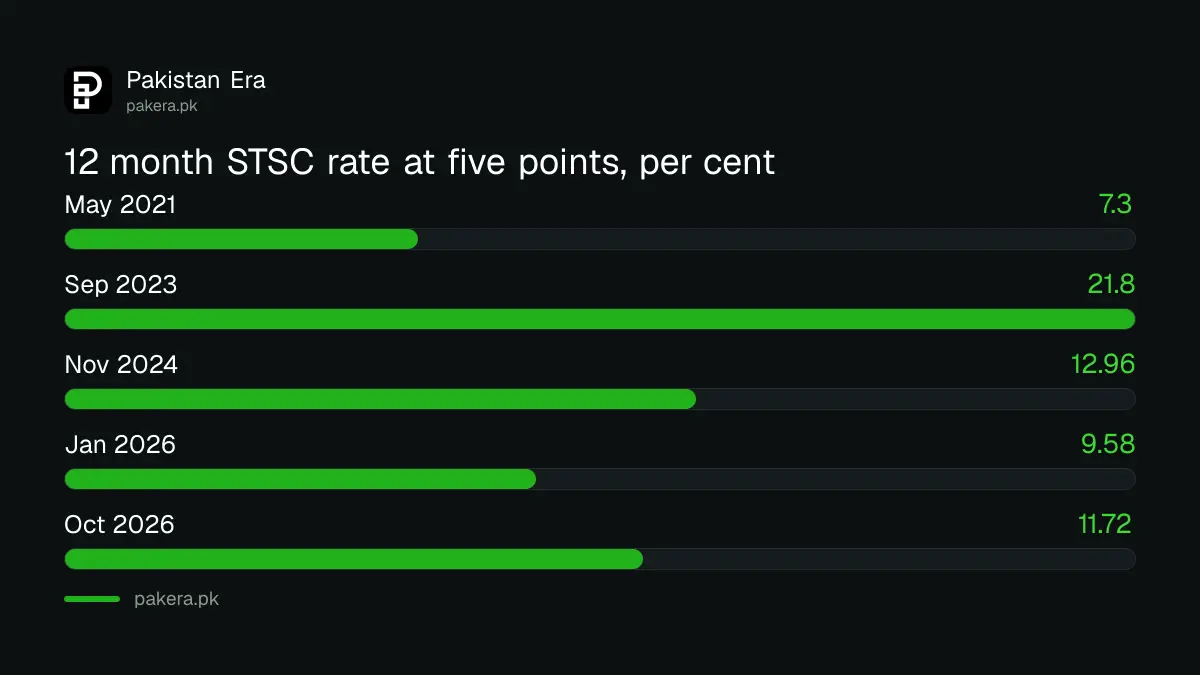
The file starts on 19 May 2021, when the rates were 6.96%, 7.14% and 7.30%. The highest 12 month rate was 21.80% (Rs 21,800), from 5 September to 29 October 2023. The 3 month rate peaked in the same period at 21.74%. The lowest was a 6.68% 3 month rate, from 13 August to 9 December 2021.
| Moment | 3 months | 6 months | 12 months |
|---|---|---|---|
| May to June 2021 (start of the file) | 6.96% | 7.14% | 7.30% |
| August to December 2021 (lowest) | 6.68% | 7.12% | 7.30% |
| 5 September to 29 October 2023 (highest) | 21.74% | 21.72% | 21.80% |
| 23 January to 25 May 2026 (2026 low) | 9.64% | 9.58% | 9.58% |
| From 21 October 2026 | 11.12% | 11.50% | 11.72% |
Short term rates move closely with the State Bank's policy rate and Treasury bill yields, because the government borrows for the same short periods. The policy rate history shows the same 2023 peak.
What the changes mean for Rs 10 lakh
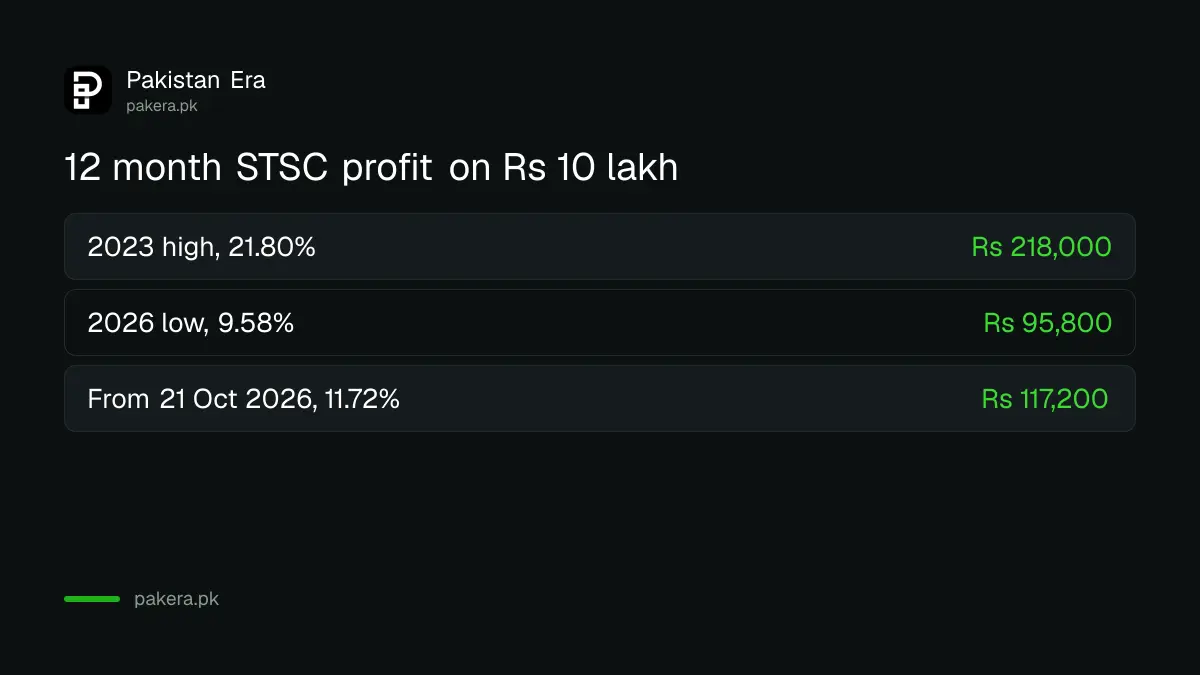
Multiply the Rs 100,000 figure by ten. Rs 1,000,000 in a 12 month certificate bought from 21 October 2026 earns Rs 117,200 at maturity, before tax. Bought at the 2026 low, it earned Rs 95,800. Bought at the 2023 high, it earned Rs 218,000.
On a 3 month certificate, the same Rs 10 lakh now earns Rs 27,800 a quarter. Rolling it over four times a year only matches the 12 month return if the rate does not fall in between.
Tax comes off the profit. National Savings' STSC page says withholding tax is 15% for people on the Active Taxpayer List and 30% for others. Unlike most schemes, STSC investments are exempt from Zakat, according to the same page. On Rs 117,200 of profit, a filer keeps Rs 99,620.
How to check the STSC rate yourself
National Savings publishes the current rate card and the full history file on one page. Both are free.
- Open the National Savings latest profit rates page.
- Find the Short-Term Savings Certificates box on the rate card.
- Open the STSC historical profit rates PDF on the same page.
- Find the row whose dates cover the day you bought your certificate.
- Read the rupee profit for your term and multiply it by your amount in lakh.
How to buy one, the Rs 10,000 minimum and the forms are in buying Short Term Savings Certificates. To compare it with a Treasury bill, see investing in Treasury bills.
Common questions
What is the Short Term Savings Certificate rate today?
From 21 October 2026: 11.12% for 3 months (Rs 2,780 per Rs 100,000), 11.50% for 6 months (Rs 5,750) and 11.72% for 12 months (Rs 11,720).
How many times did STSC rates change in 2026?
Eight times: 5 January, 23 January, 26 May, 10 June, 18 July, 4 September, 1 October and 21 October 2026.
What was the highest STSC rate?
21.80% for 12 months, from 5 September to 29 October 2023. Rs 100,000 earned Rs 21,800 in a year.
Is Zakat deducted from Short Term Savings Certificates?
No. National Savings' STSC page says these investments are exempt from Zakat. Withholding tax still applies.
Can I cash an STSC before it matures?
National Savings says a certificate cannot be cashed earlier than one month from issue, and profit is due only on completing the full term.
What is the minimum amount for an STSC?
Rs 10,000, with no upper limit, according to the National Savings STSC page.
How we verified this
What we checked, where we read it, and what we could not confirm.
Last checked 12 November 2026. Every rate, period and profit comes from National Savings' STSC history file (STSC_21Oct2026.pdf) and its rate card dated 21 October 2026, both on savings.gov.pk. Encashment, Zakat and tax rules come from the National Savings STSC page, read the same day. The Rs 10 lakh and after-tax figures are our arithmetic. The link to Treasury bills is general background; National Savings does not explain its changes.
About the author

Senior Writer, Public Services and Technology
Shahid joined us in 2024 as an author. He is a senior contributor to Pakistan's leading technology websites. He writes detailed articles, mostly covering his expertise in the latest tech, mobiles, apps, gadgets, and step-by-step guides. His ideology is to help people understand the latest trends and explain complex methods through very easy-to-understand guides.