Sindh Sales Tax on Services Rates 2026-27: 15% Standard, 19.5% Telecom and Every Reduced Rate
Sindh sales tax on services rates for 2026-27: 15% standard, 19.5% telecom, every 8%, 5%, 3% and 2% service on the SRB list, and the 2026 Finance Act changes.
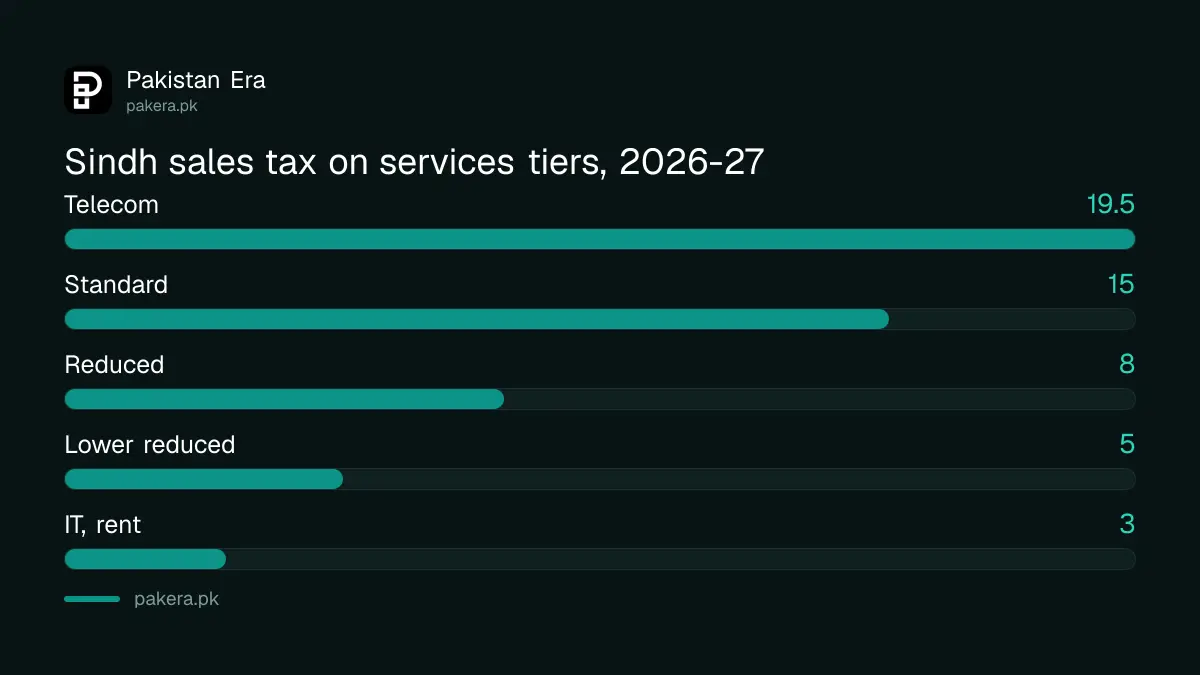
Sindh charges 15% sales tax on services in 2026-27. Telecom, internet and security tracking pay 19.5%. About 46 lines on the reduced list pay 8%, 5%, 3% or 2%, or a fixed amount. The Sindh Finance Act 2026 changed eight of them from 1 July 2026.
The Sindh Revenue Board (SRB) collects this tax under the Sindh Sales Tax on Services Act 2011. Section 8 sets the 15% standard rate. The Second Schedule has Part I for higher rates and Part II for lower rates. The First Schedule lists exempt services.
Sindh's standard rate is 15%, and telecom pays 19.5%
Every taxable service in Sindh pays 15% unless the Second Schedule names it. Part I lists five services at the higher 19.5% rate, all of them telecom, internet, hosting or security tracking. Part II lists the reduced rates.
| Part I service at 19.5% | Code |
|---|---|
| Hosting and IT infrastructure for collocation | 83159 |
| Telephony and other telecom services | 841 |
| Internet telecom services | 842 |
| Security systems, including vehicle tracking | 85230 |
| Installation of radio, TV and communications equipment by telephony, internet and security providers | 87340 |
Reduced rates in Sindh for 2026-27
Part II covers food, transport, real estate, IT, professional, personal and education services. The common reduced rates are 8%, 5% and 3%. No input tax can be claimed at these rates, except where a business chooses not to use the reduced rate.
| Service | Rate |
|---|---|
| Restaurants paid by card, wallet or QR | 8% |
| Rent-a-car, vehicle rental and coach charter | 8% |
| Road freight, except oil tankers | 8% |
| Real estate agents, on a fee or contract basis | 8% |
| Legal services, tax consultancy, insolvency | 8% |
| Security guards and armoured cars | 8% |
| Cleaning, photography, gyms and recreation | 8% |
| Beauty parlours and physical well-being | 8% |
| Repair services of other goods | 8% |
| Cab aggregator drivers, bus stations, parking, tolls | 5% |
| Third-party motor insurance, travel and tour operators | 5% |
| Laundries, dry cleaners, publishing and printing | 5% |
| Fashion designers, educational support services | 5% |
| IT, software, hosting and online content | 3% |
| Commercial rent of immovable property | 3% |
| Call centres, foreign exchange spread, truck addas | 3% |
| Doctors above Rs 3,000 a visit, hospital rooms above Rs 25,000 a day | 3% |
| Schools above Rs 500,000 a year, other training | 3% |
| Insurance brokers | 3% |
| Insurance agents, stand-alone cable TV operators | 2% |
Three lines use fixed amounts. Freight transport agencies pay Rs 1,000 per bill of lading or airway bill. Race club entry pays Rs 200 per person. Property developers pay Rs 100 per square yard of land and Rs 50 per square foot built. The cab aggregator rule is in Sindh sales tax for ride drivers.
What the Sindh Finance Act 2026 changed
The Sindh Finance Act 2026, assented on 30 June 2026, rewrote eight reduced rate lines. Builders moved to a fixed charge, insurance agents fell to 2%, accounting left the 8% line, and beauty parlours lost a 5% option.
| Line | Before 1 July 2026 | From 1 July 2026 |
|---|---|---|
| Construction services | 8% for all construction | 8% only for ready-mix concrete; dredging added at 8% |
| Property developers and promoters | Under construction at 8% | Rs 100 per sq yard of land and Rs 50 per sq ft built |
| Insurance brokerage and agency | 5% | 2% agents, 3% brokers |
| Legal and accounting services | 8% for both | 8% for legal, tax consultancy and insolvency |
| Freight transport agency | Rs 1,000 a bill, freight forwarders only | Rs 1,000 a bill, all such agencies |
| Repair services | Machinery and metal products | Repair of other goods |
| Education | 3% above Rs 500,000 a year, and training | Same 3%, plus educational support at 5% |
| Beauty and well-being | 8%, or 5% with SRB-linked POS | 8% only |
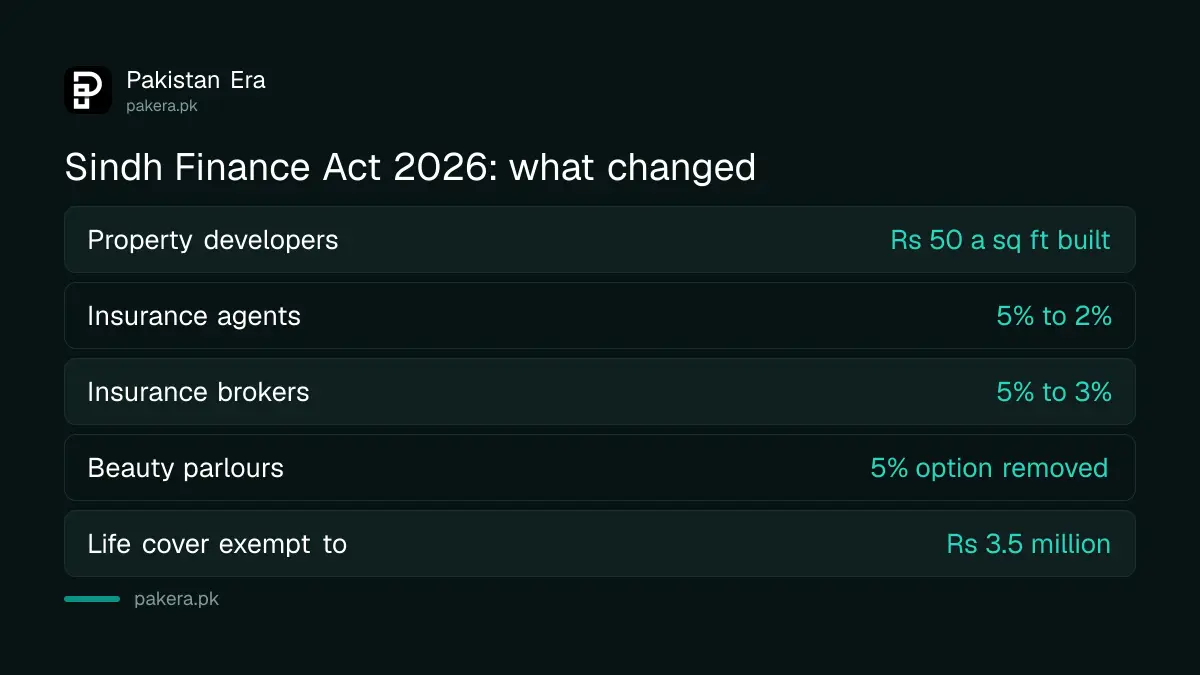
The exemption list changed too. Life insurance for individuals is now exempt up to Rs 3.5 million of cover, up from Rs 500,000. Reinsurance of crop and export marine insurance was exempted. Storage exemption now covers food grains and fresh fruit and vegetables.
Services that pay no Sindh sales tax
The First Schedule exempts some services in full or below a limit. Examples are schools charging up to Rs 500,000 a year, doctors charging up to Rs 3,000 a visit, residential rent, IT exports paid in foreign exchange, and small restaurants with turnover up to Rs 5 million.
- Building your own house up to 10,000 square feet of covered area
- Renting buildings used only as homes, or as hostels of recognised educational institutions
- IT, software, call centre and accounting services exported and paid in foreign exchange
- Small restaurants, beauty parlours, auto workshops and repair shops below their turnover limits
- Marriage halls and lawns on plots up to 800 square yards, if not air-conditioned and not part of a hotel or caterer
- Hajj and Umrah tour operators, and school trips
How a Sindh business uses the reduced rates
A reduced rate means you cannot claim input tax. For six lines, including ready-mix concrete, road freight, pipelines, IP licensing, IT services and call centres, you must e-file an option with SRB before you can charge the reduced rate.
- Find your service by its CPC code in Part I or Part II of the Second Schedule.
- If it is not listed, the rate is 15%.
- Check any condition, such as card payment, a fee limit or a turnover limit.
- For the six option lines, e-file the reduced rate option with SRB.
- Charge the rate on each invoice and file the monthly SST-03 return.
Monthly filing is explained in filing the SRB SST-03 return. To check that a supplier is registered before you pay their tax, use SRB's taxpayer search.
Common questions
What is the sales tax on services rate in Sindh for 2026-27?
The standard rate is 15%. Telecom, internet and security tracking pay 19.5%. Reduced rates of 8%, 5%, 3% and 2% apply to the services on Part II of the Second Schedule.
Did the Sindh standard rate change in 2026?
No. It stays at 15%, set in section 8 of the Act since the 2025 rewrite. The 2026 changes were to individual reduced rate lines and exemptions.
What do accountants pay in Sindh now?
The 2026 Act replaced "legal and accounting services" with legal services, tax consultancy and insolvency at 8%. Accounting is no longer on that line, so it falls to the 15% standard rate unless exported.
Do beauty parlours in Sindh still get 5%?
No. The 5% option for parlours with SRB-linked POS machines was removed. The rate is 8%, and small parlours with turnover up to Rs 2.5 million stay exempt if they meet the conditions.
Is sales tax charged on residential rent in Sindh?
No. Renting buildings used only as homes is exempt. Renting property for business use pays 3%.
Are IT exports from Sindh taxed?
IT, software and call centre services exported outside Pakistan and paid in foreign exchange through a business bank account are exempt. Local IT services pay 3%, as set out in registering an IT business with SRB.
How we verified this
What we checked and where we read it.
We read the consolidated Sindh Sales Tax on Services Act 2011 on 15 November 2026, the edition updated with the Sindh Finance Act 2026 (Act XX of 2026, assented 30 June 2026), from SRB's acts, rules and amendments page. We used section 8 for the standard rate, Second Schedule Parts I and II with their general conditions, and the First Schedule of exempt services. Each 2026 change is taken from the footnotes in that edition, which also print the old wording. The Sindh Finance Act 2026 PDF on the same page is a scanned image, so the consolidated Act was the working text.
About the author

Tax, Bills and Technology Writer
Ali Akhtar is a young and curious voice here at Pakistan Era. He is currently pursuing his A-Levels and has a growing interest in Pakistan’s changing industrial landscape and educational trends. Ali likes to write in a way that helps him explain and explore the world around him. His writing reflects the perspective of the new generation navigating the evolving trends of Pakistan where technology, youth innovation, and shifting opportunities are reshaping the country’s future.