Truck Axle Load Limits on Pakistan's Highways: 12, 22 and 31 Tons, and the Rs 5,000 Overloading Fine
Pakistan highways allow 12 tons on a single axle, 22 on a tandem and 31 on a tridem, with gross limits of 17.5 to 61.5 tons. See the 15 per cent overload fine.
Short answer: On Pakistan's national highways and motorways the legal axle load limits are 12 tons on a single axle, 22 tons on a tandem axle, 31 tons on a tridem axle and 5.5 tons on the front steering axle, under the Sixth Schedule of the National Highways Safety Ordinance 2000. A two axle truck is capped at 17.5 tons gross and the heaviest six axle articulated combination at 61.5 tons. Carrying 15 per cent or more above the limit is an offence with a fine of Rs 1,000 to 5,000 and up to a month in prison, and the Motorway Police can hold the vehicle until the excess is unloaded.
We read the National Highways Safety Ordinance 2000 in the copy the National Highways and Motorway Police publish on nhmp.gov.pk on 19 October 2026. Section 43 of the Ordinance sets the limits by reference to the Sixth Schedule, and section 75 sets the penalty. These are federal rules for the roads the NHMP patrols. Provincial highways and city roads have their own limits under provincial motor vehicle rules.
A single axle carries 12 tons and a tridem 31 tons
The Sixth Schedule fixes four axle limits. A single axle may carry 12 tons. A tandem axle, two axles close together, may carry 22 tons. A tridem axle group of three may carry 31 tons. The front steering axle is limited to 5.5 tons. Tyre pressure is capped at 120 psi on rear axles and 100 psi on the front.
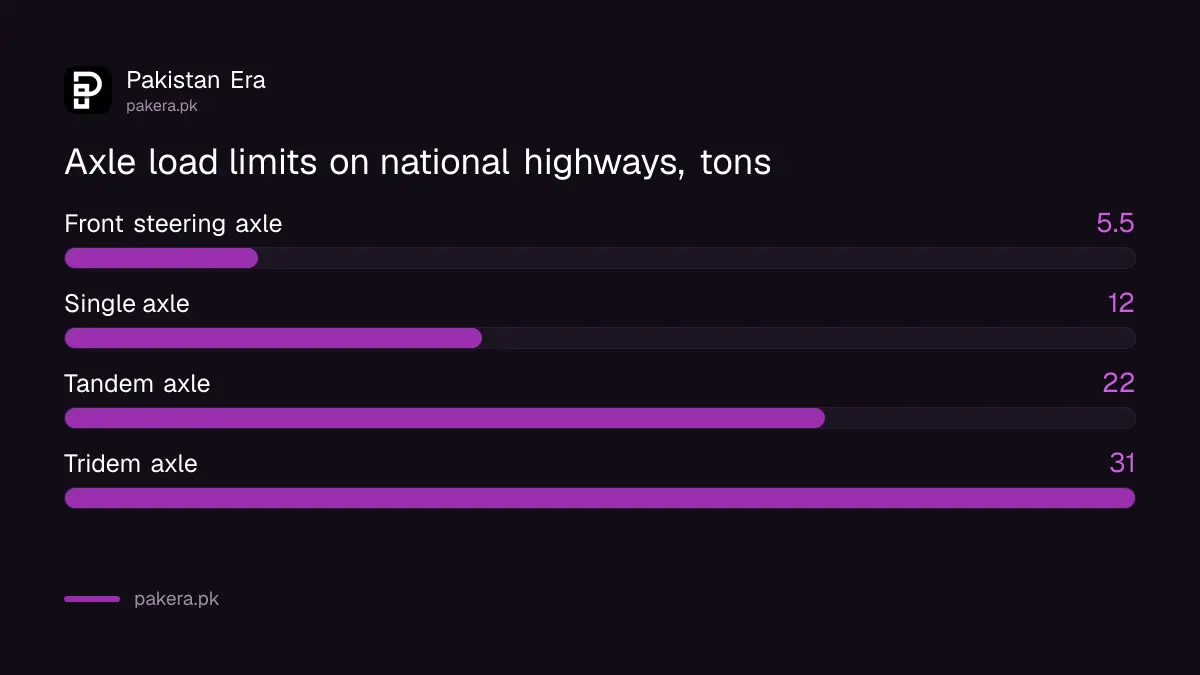
The axle limit matters more than the gross limit for enforcement, because a weighbridge reads each axle group. A truck under its gross limit can still be overloaded on one axle if the load sits too far back. That is why the schedule also lists tyre pressure: an overloaded axle on under-inflated tyres is what breaks up the road surface, and road damage is the reason the limits exist.
| Axle | Maximum load |
|---|---|
| Front steering axle | 5.5 tons |
| Single axle | 12 tons |
| Tandem axle | 22 tons |
| Tridem axle | 31 tons |
| Tyre pressure, rear | 120 psi |
| Tyre pressure, front | 100 psi |
Gross weight runs from 17.5 tons for a two axle truck to 61.5 tons
The schedule gives a gross vehicle weight for each truck configuration. A two axle rigid truck is limited to 17.5 tons. Three axle rigids are 27.5 or 29.5 tons depending on the axle layout. A four axle combination is 39.5 or 41.5 tons, five axles 48.5 to 51.5 tons, and the heaviest six axle articulated layouts 58.5 and 61.5 tons.
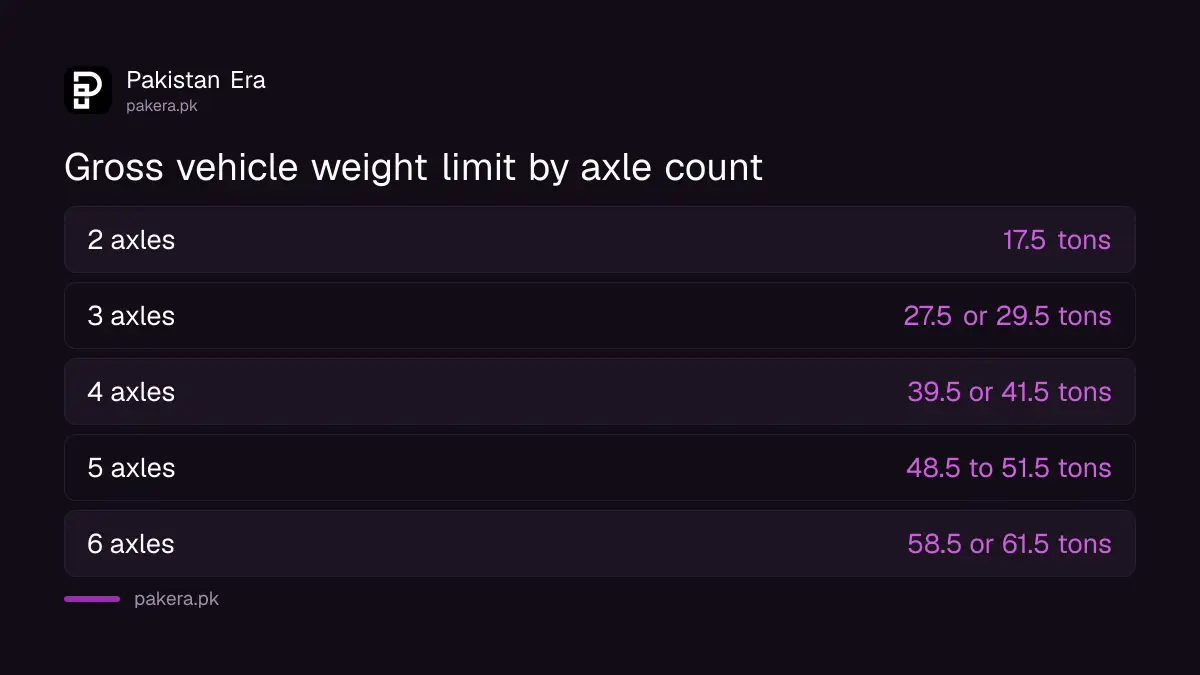
The published copy of the schedule draws each layout as a diagram with a code such as 1.22 or 1.2-22, where each digit is an axle and a dash marks the trailer, and some codes did not survive the scan. So the table below gives the gross figures by axle count. Where two layouts share a count, the figure depends on whether the axles sit on one rigid truck or are split between truck and trailer: a three axle rigid with a tandem rear is 27.5 tons, while a two axle truck pulling a single axle trailer is 29.5 tons.
| Axles on the vehicle or combination | Maximum gross weight |
|---|---|
| 2 axles | 17.5 tons |
| 3 axles | 27.5 or 29.5 tons |
| 4 axles | 39.5 or 41.5 tons |
| 5 axles | 48.5, 49.5 or 51.5 tons |
| 6 axles | 58.5 or 61.5 tons |
The gross figures are simply the axle limits added up. A six axle articulated truck with a 5.5 ton front axle, a 22 ton tandem drive and a 31 ton tridem trailer comes to exactly 58.5 tons, which is the schedule's figure for that layout. A truck that stays inside its axle limits is therefore inside its gross limit too. Length, width and height are a different schedule, covered in the dimension rules for goods vehicles on the motorways.
Overloading by 15 per cent costs Rs 1,000 to 5,000 and the vehicle is held
Section 75 of the Ordinance makes it an offence to drive a goods vehicle loaded 15 per cent or more above the Sixth Schedule limit. The penalty is imprisonment up to one month, or a fine of not less than Rs 1,000 and up to Rs 5,000, or both. The Tenth Schedule lists the same offence as a major violation with the Rs 1,000 to 5,000 fine.

The 15 per cent figure is a tolerance, not a target. A tridem trailer rated at 31 tons becomes an offence at 35.65 tons. Below that, the Twelfth Schedule still lists a standard penalty for carrying goods less than 15 per cent in excess, so even a small overload is a ticketable violation. Overloading by 30 per cent is also a 6 point entry on the driver's licence, counted toward the 20 point suspension line of the Ordinance's point system.
The fines in the 2000 text have been revised by notification since, and the revised amounts are not in the copy the NHMP publishes, so treat the Rs 1,000 to 5,000 as the floor set by the Ordinance rather than today's ticket price. The challan itself is checked and paid through the same channel as any Motorway Police challan.
Weighbridges read each axle, so load placement matters
The NHMP and the National Highway Authority weigh trucks at weigh stations on the motorways and at NHA axle load control points on the national highways. A reading over the limit on any one axle group is an overload even when the total is legal. Drivers who load a 20 ton consignment over the rear tandem of a three axle rigid can breach the 22 ton tandem limit with the front axle nearly empty.
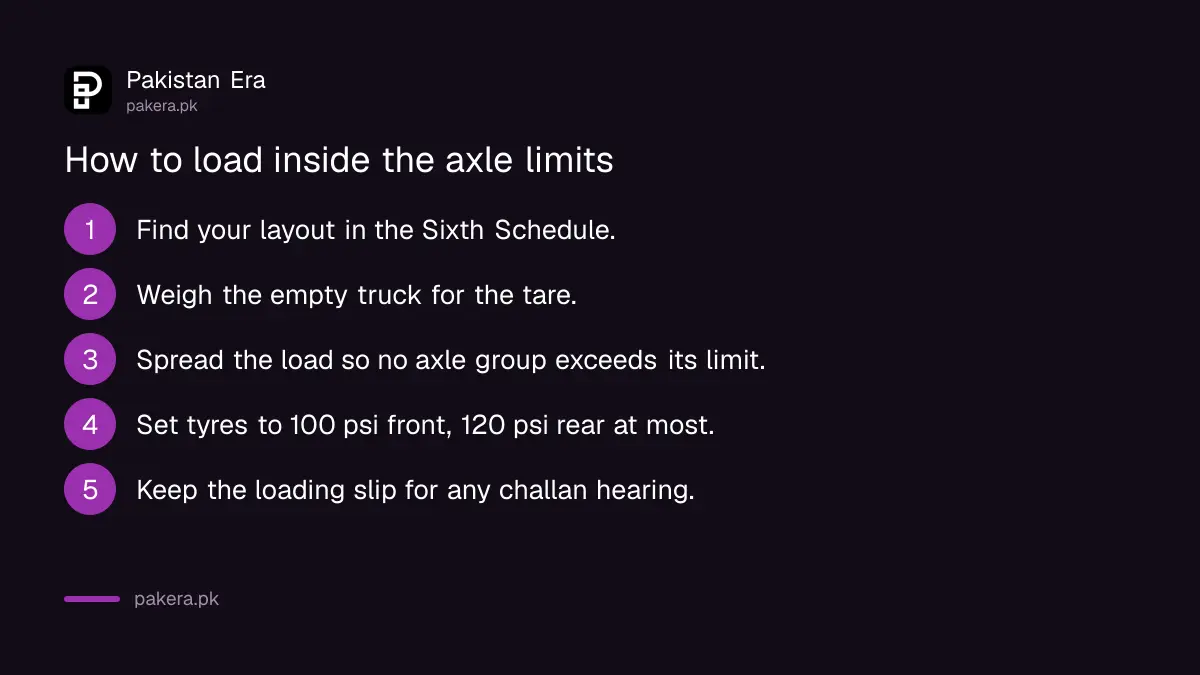
- Find your configuration in the Sixth Schedule and note both the axle limits and the gross limit for it.
- Weigh the empty vehicle. The tare weight is deducted from the gross limit to give your legal payload.
- Spread the load so the front axle carries close to its 5.5 tons and no rear group exceeds 12, 22 or 31 tons.
- Check tyre pressures: 100 psi front, 120 psi rear is the schedule's maximum.
- Keep the loading slip. If a weighbridge reading is disputed, the slip and the consignment note are what the challan hearing turns on.
Cement, sugar, steel and fertiliser loads are the usual offenders, because they are dense and fill the body long before the volume is used up. A 40 foot container on a tridem trailer is comfortably inside 31 tons unless the box itself was packed over its own rating.
The NHA runs its own axle load regime on top of the Ordinance
The National Highway Authority, which owns the roads, has for years notified an axle load management regime with its own enforcement at toll plazas and weigh stations, including turning overloaded trucks back and charging for the excess. That regime sits alongside the Ordinance rather than replacing it, and its current notified rates were not readable on the NHA site when we checked, so this page gives only the statutory limits.
For passenger vehicles the equivalent rule is seats rather than tons: carrying passengers 30 per cent above the permitted number is an offence under the same section, and the complaint route for an overloaded public van is the practical remedy for a passenger. If an overloaded truck is involved in a crash, the 24 hour accident reporting rule applies to the driver regardless of fault.
Common questions
What is the axle load limit on Pakistan's motorways?
12 tons on a single axle, 22 tons on a tandem, 31 tons on a tridem and 5.5 tons on the front steering axle, under the Sixth Schedule of the National Highways Safety Ordinance 2000.
What is the maximum gross weight for a truck in Pakistan?
17.5 tons for a two axle truck, up to 61.5 tons for the heaviest six axle articulated layout, with intermediate figures of 27.5 to 58.5 tons by configuration.
What is the fine for an overloaded truck on the motorway?
Under section 75 of the Ordinance, Rs 1,000 to 5,000 and up to one month in prison for a load 15 per cent or more over the limit. The amounts have been revised by notification since 2000, so the ticket may be higher.
Does a small overload count?
Yes. Carrying goods less than 15 per cent over the limit is listed as a standard penalty violation in the Twelfth Schedule, and 15 per cent or more becomes the major offence.
What tyre pressure does the schedule allow?
A maximum of 120 psi on rear axles and 100 psi on the front axle.
Do the same limits apply on provincial roads?
No. The Sixth Schedule applies on national highways and motorways. Provincial highways and city roads are governed by provincial motor vehicle rules.
How we verified this
What we checked, where we read it, and what we could not confirm.
We read the National Highways Safety Ordinance 2000 in the PDF published by the National Highways and Motorway Police at nhmp.gov.pk, linked from its traffic rules page, on 19 October 2026. The axle limits, tyre pressures, gross weights, section 43 and section 75 are all from that copy. The schedule's truck layout codes are drawn as diagrams that did not scan cleanly, so the gross weights are given by axle count with both values where two layouts share a count, and the pairing of each value to a layout is our reading. The example of a six axle truck adding to 58.5 tons is our arithmetic. We could not read the NHA's current axle load management notification on nha.gov.pk, which returned an access error, and the revised fine schedule reported since 2023 is not on the NHMP site, so neither is quoted.
About the author

Tax, Bills and Technology Writer
Ali Akhtar is a young and curious voice here at Pakistan Era. He is currently pursuing his A-Levels and has a growing interest in Pakistan’s changing industrial landscape and educational trends. Ali likes to write in a way that helps him explain and explore the world around him. His writing reflects the perspective of the new generation navigating the evolving trends of Pakistan where technology, youth innovation, and shifting opportunities are reshaping the country’s future.