How to Report an Overloaded Public Van or Bus in Pakistan
A 14 seat van packed with 22 people is a safety risk, not bad luck. See which number to call in your province, what a Motor Vehicle Examiner can do, and more.
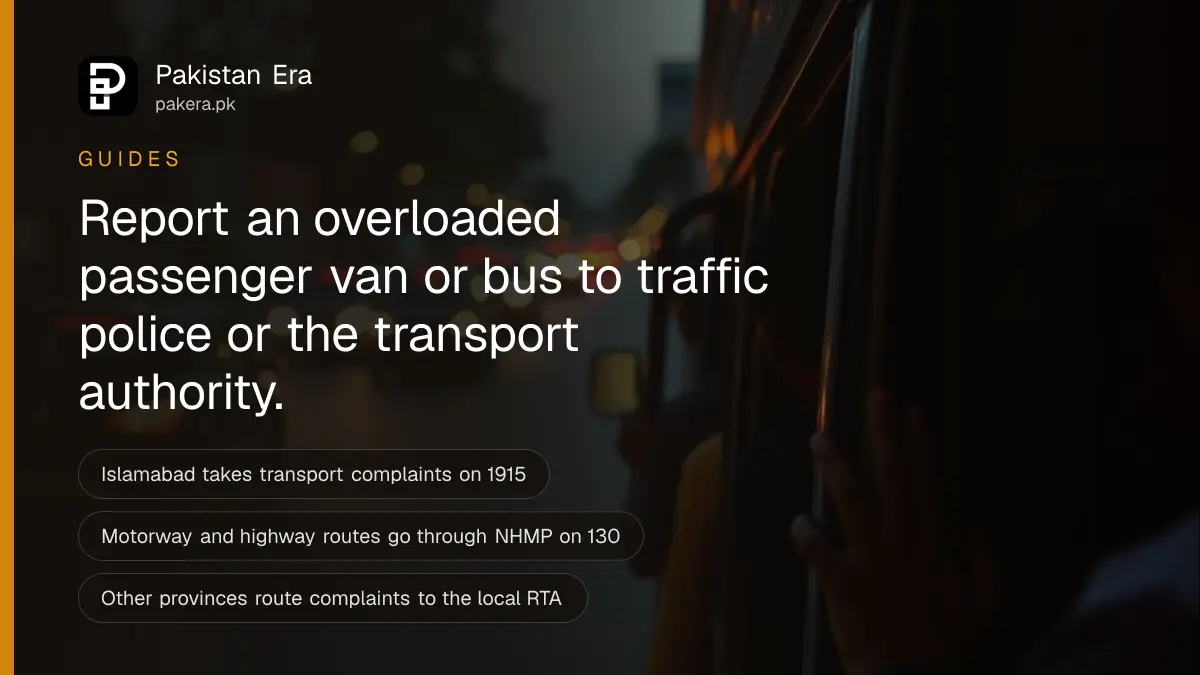
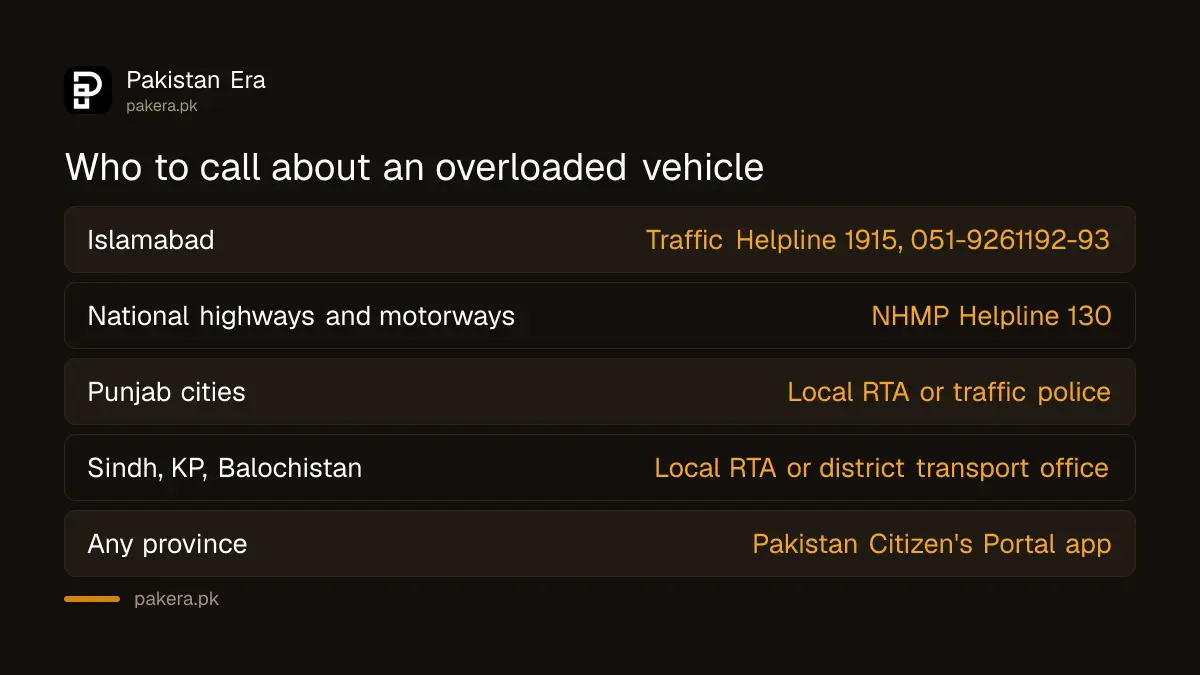
Call the traffic helpline for your city or route to report an overloaded van or bus. In Islamabad that is 1915, on national highways and motorways it is NHMP's 130, and in other cities it is your local Regional Transport Authority or traffic police, with the Pakistan Citizen's Portal app as a nationwide backup when there is no local number.
A 14 seat van with 22 people standing inside it is not a quirky local habit. It is a vehicle built for one load carrying half as many passengers again, with the same brakes, the same tyres and a driver who cannot see half his mirrors. Reporting an overloaded van or bus in Pakistan is the one lever an ordinary commuter actually has against that, short of refusing to board.
We read through Islamabad Police's own published numbers, the National Highways and Motorway Police's own site, and the Pakistan Citizen's Portal's own description of itself, to put together a route that works province by province. Where a province does not publish one clear number we could verify directly, we say so rather than inventing one.
| Where you see it | Call this |
|---|---|
| Islamabad | Traffic Helpline 1915, or 051-9261192-93 |
| National highways and motorways | NHMP Helpline 130 |
| Punjab, Sindh, KP, Balochistan cities | Local RTA or city traffic police |
| No local number answers | Pakistan Citizen's Portal app |
Call 1915 for an overloaded vehicle in Islamabad
Islamabad Police's own site lists a dedicated Traffic Helpline on 1915, alongside the emergency line 15 and a separate complaint cell. That is the number to use for an overloaded, overcharging or route skipping public service vehicle inside the capital.
The alternate number 051-9261192-93 reaches the same traffic desk when 1915 is busy. Keep both written down if you commute the same route often, because a repeated report from the same corridor carries more weight than a one off call.
Use NHMP's 130 for an overloaded coach or van on a highway or motorway
The National Highways and Motorway Police run a separate helpline, 130, which we confirmed directly on nhmp.gov.pk. That is the number for a packed coach or van you see on a motorway or national highway, where city traffic police do not have jurisdiction.
NHMP also links out to the Pakistan Citizen's Portal from its own site for complaints it cannot resolve on the spot, which is worth knowing if your first call does not lead anywhere. We cover how that portal works, start to finish, in the guide to the Pakistan Citizen's Portal complaint process.
Other provinces route the same complaint through a local transport authority
Punjab, Sindh, Khyber Pakhtunkhwa and Balochistan each run their own Regional or Provincial Transport Authority, and overloading complaints inside a city normally go through that body or the local traffic police, not a single nationwide number.
We could not confirm one uniform public hotline for every RTA across all four provinces at the time we checked, so the honest advice is to call your city's traffic police number first, and fall back on the Citizen's Portal if that does not move. A Motor Vehicle Examiner, the official who inspects a public service vehicle's fitness and seating capacity, sits inside the same transport department structure that issues the route permit for a bus or goods vehicle in the first place, which is the record enforcement checks a complaint against.
A report needs the registration number, not just a description
A complaint that says "a crowded van on the Ferozepur Road" goes nowhere. A complaint with a registration number, a route number and a time gives whoever picks it up something to actually act on.
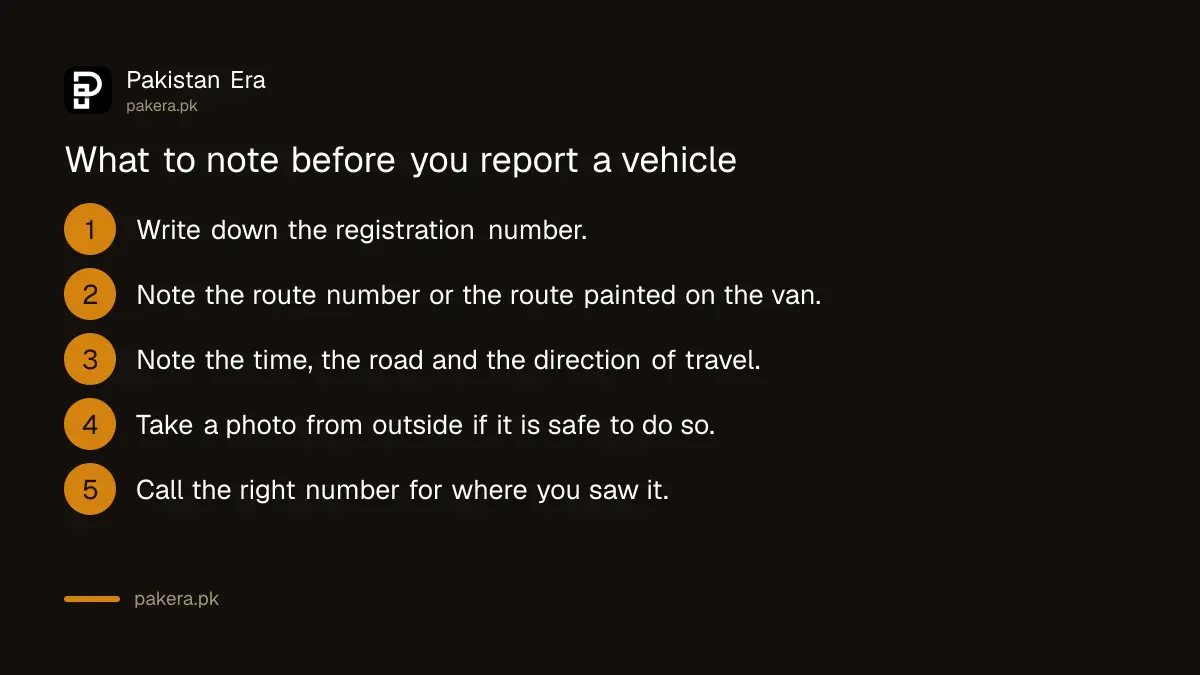
- Write down the vehicle's registration number as soon as you can read it.
- Note the route number, or the destination painted on the van's board.
- Record the time, the road name and which direction it was travelling.
- Take a photo from outside the vehicle if it is safe to do so, never while it is moving and never leaning out to get it.
- Call the number for where you saw it, or file through the Citizen's Portal if nothing local answers.
Hold onto that note even after you call. If the same vehicle or route comes up again, a second dated report from you turns one complaint into a pattern, and a pattern is what gets a route permit reviewed.
Repeat overloading puts a vehicle's fitness and route permit at risk
An overloaded public service vehicle is already failing the seating limit set when it was certified fit to carry passengers, a certificate we explain in full in the guide to the vehicle fitness certificate in Punjab. Enforcement against overloading and overcharging has been reported as leading to impounded vehicles and, after repeated warnings, cancelled route permits for the worst offenders.
We are reporting that enforcement pattern rather than stating it as settled policy everywhere, because the exact rule and fine figure differ by province and we could not read every province's own schedule directly. What is consistent is the principle: a van or bus runs on a permit tied to a seating number, and a transport authority can act on that permit when a vehicle is repeatedly found over it.
If you are inside an overloaded van right now, get out at the next stop
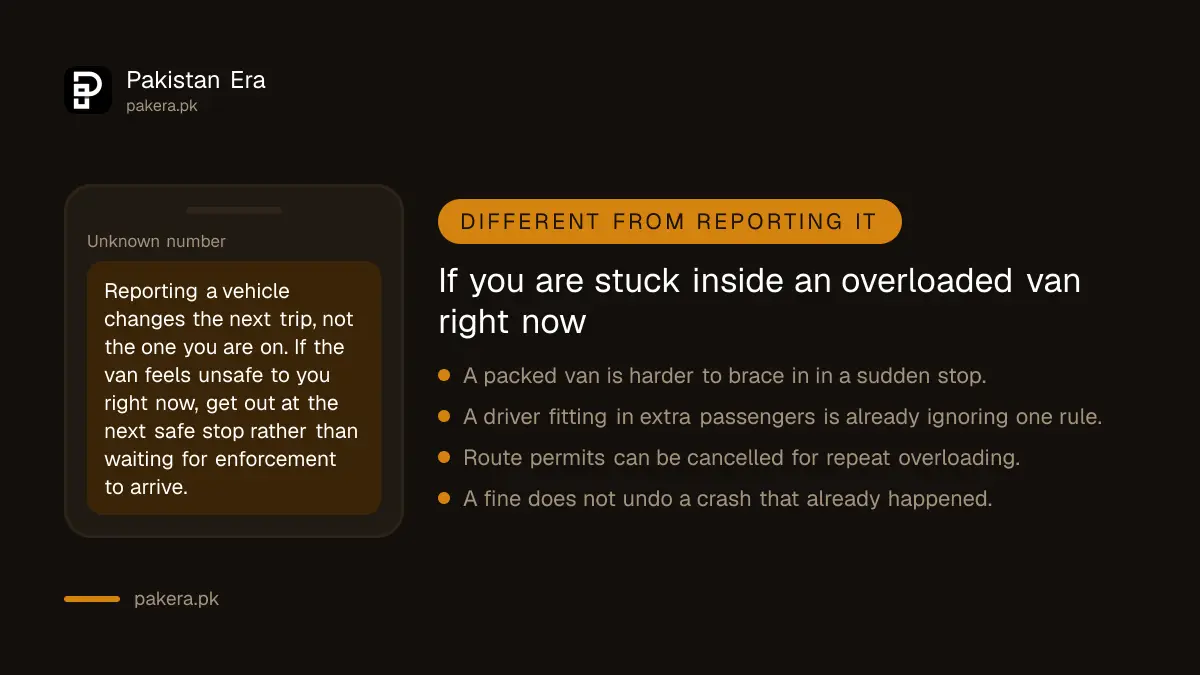
Reporting a vehicle protects the next trip on that route, not the one you are currently on. If a van already feels unsafe with you inside it, waiting for enforcement to arrive is not a plan, because nobody is coming in the next five minutes.
Get off at the next safe stop and take another vehicle, even if it costs you the fare twice. A packed van gives you far less to hold onto in a sudden stop, and a driver who has already ignored the seating limit has already shown you how he treats the other rules too.
Common questions
What number do I call to report an overloaded van in Pakistan?
It depends where you see it. Islamabad uses Traffic Helpline 1915, national highways and motorways use NHMP's 130, and other cities route the complaint through the local traffic police or Regional Transport Authority.
Is there one nationwide number for reporting an overloaded bus?
Not one confirmed single hotline for every province. The Pakistan Citizen's Portal app works nationwide as a fallback when a local number does not answer or does not exist for your area.
What should I record before reporting an overloaded vehicle?
The registration number, the route number or destination board, the time, the road, and a photo taken from outside if it is safe to take one.
Who inspects a public van's seating capacity?
A Motor Vehicle Examiner, working under the provincial transport department that also issues the vehicle's fitness certificate and route permit.
Can a van lose its route permit for overloading?
Repeated overloading has been reported as grounds for route permit review and cancellation after warnings, though the exact process differs by province and authority.
Should I stay in an overloaded van if I already paid the fare?
No. If it feels unsafe, get off at the next stop. A refunded or wasted fare is a smaller loss than staying in a vehicle that cannot brace you properly in a crash.
About the author

Senior Writer, Public Services and Technology
Shahid joined us in 2024 as an author. He is a senior contributor to Pakistan's leading technology websites. He writes detailed articles, mostly covering his expertise in the latest tech, mobiles, apps, gadgets, and step-by-step guides. His ideology is to help people understand the latest trends and explain complex methods through very easy-to-understand guides.