Using Pakistan's Flag, Quaid-e-Azam's Name or a Government Logo in Business: Permission, Rs 500 Fine and the 2026 Changes
Using Pakistan's flag, Quaid-e-Azam's name or a government logo in business needs written permission under the 1957 Act. See the 2026 changes and the fine.
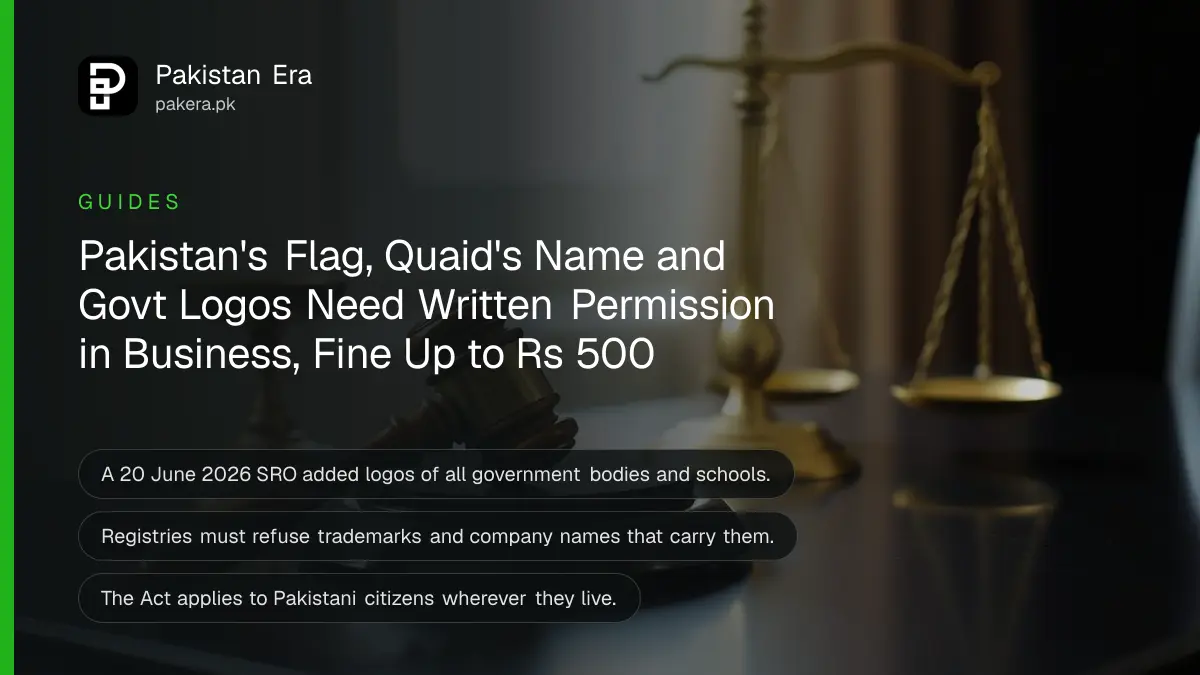
You need written permission from the Prime Minister, or an officer he authorises, before you use Pakistan's flag, Quaid-e-Azam's name or picture, or any government logo in a trademark, a business name or for "any other purpose", under the Pakistan Names and Emblems Act, 1957. Breaking the rule carries a fine of up to Rs 500, and registries must refuse such names and marks.
The law was widened in 2026. A notification of 20 June 2026 added the logos of every government department, state company, statutory body and government school or university, and the seals of public office holders. We read the Cabinet Division's updated text of the Act. Below is what it covers, who can refuse your registration, and how to stay on the right side of it before you print a logo or register a company.
The 1957 Act protects five kinds of name and emblem
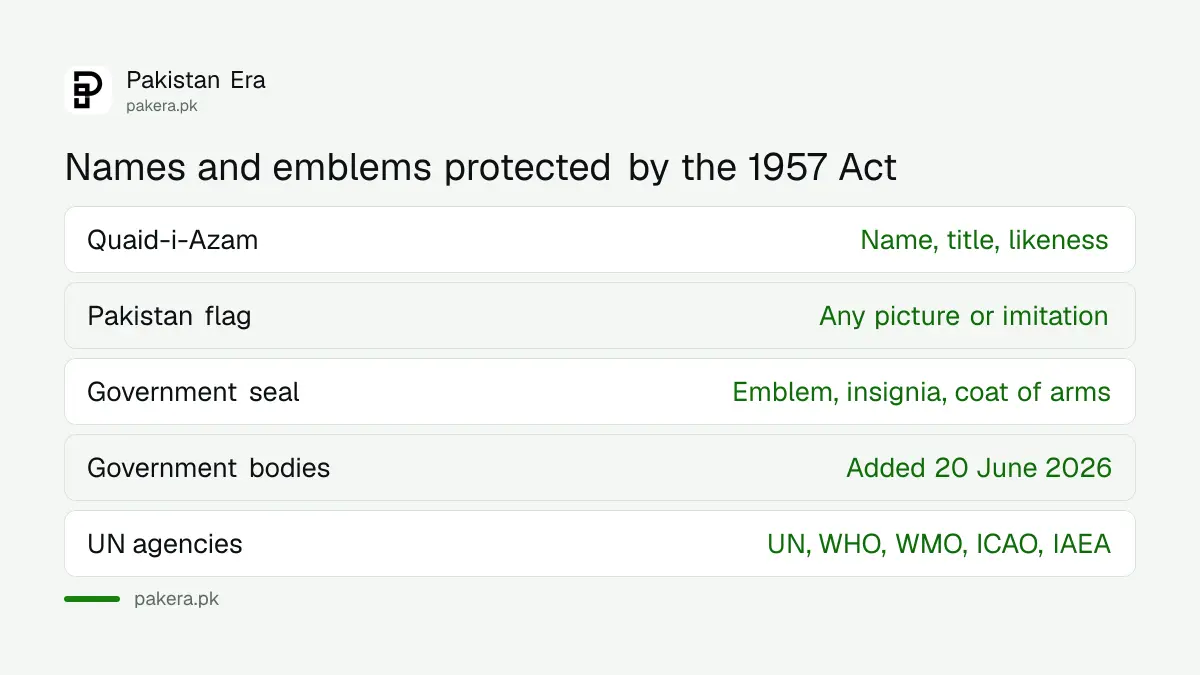
The Act's schedule lists five protected groups: Quaid-e-Azam's name, title or likeness; the Pakistan flag; the government's seal and emblem; logos of government bodies and public office holders; and the names and emblems of five UN agencies. A copy or imitation counts too.
| No. | Protected under the Schedule |
|---|---|
| 1 | The name, title or semblance of Quaid-i-Azam Mohammad Ali Jinnah, and any variation of it |
| 2 | The Pakistan flag |
| 3 | The official seal, emblem, insignia or coat of arms of the Government |
| 4 | The seal, emblem or insignia of any government department, statutory or autonomous body, state-owned enterprise, educational institution or other government entity, or of a public office holder |
| 5 | The name, emblem or seal of the United Nations, WHO, World Meteorological Organisation, ICAO and IAEA |
Two definitions make the net wider than it looks. A "name" includes any abbreviation of it. An "emblem" includes a picture, a drawing or a "colourable imitation", meaning something close enough to be mistaken for the real one. So a redrawn crescent and star in the flag's layout, or a near copy of a ministry crest, is still caught.
Government logos were added on 20 June 2026
Item 4 of the Schedule was replaced by S.R.O. No. 1038(I)/2026 of 20 June 2026. It now covers the logo of any government department, statutory or autonomous body, state-owned enterprise or government educational institution, and the seal of a public office holder.
That matters for printers, app makers and coaching centres. A tuition academy that copies a board's crest, a courier that borrows a state company's colours and logo, or a page that uses a ministry seal to look official all fall within item 4. The Act was also amended by Act No. XXVIII of 2026, which made the Prime Minister the authority for permission and for sanctioning prosecution.
Registries must refuse marks and companies that carry them
Section 4 tells every registering authority to refuse a trademark or design bearing a protected name or emblem, a company or firm whose name carries a protected name, and a patent whose title includes one. If there is doubt, the question goes to the Prime Minister, whose decision is final.
"Competent authority" in the Act means any body that grants patents or registers trademarks, designs, companies or firms. In practice that is the trademark registry, the company registrar and the provincial registrars of firms. If you are choosing a brand name, run this check before you pay any filing fee, alongside the steps in registering a trademark in Pakistan. If an older mark of yours already carries a protected element, sort out permission well before its trademark renewal falls due.
| Section | Rule |
|---|---|
| Section 1 | Applies to the whole of Pakistan and to Pakistani citizens wherever they are |
| Section 3(1) | No use without written permission of the Prime Minister or an authorised officer |
| Section 3(2) | Fine of up to Rs 500 |
| Section 4 | Registries must refuse marks, designs, companies and patents carrying protected names |
| Section 6 | No prosecution without prior sanction of the Prime Minister or an authorised officer |
| Section 8 | Rules under the Act can carry a fine of up to Rs 200 |
The fine is Rs 500, but refusal is the real cost
Section 3(2) sets the penalty at a fine of up to Rs 500. No prosecution can start without the prior sanction of the Prime Minister or an authorised officer. The larger risk for a business is a refused registration and having to rebrand.
The Rs 500 figure has not been raised in the text we read, so the money penalty is small. But a refused company name means refiling, and a refused trademark leaves your brand unprotected. Printing thousands of packets with a borrowed crest and then being told to stop costs far more than the fine.
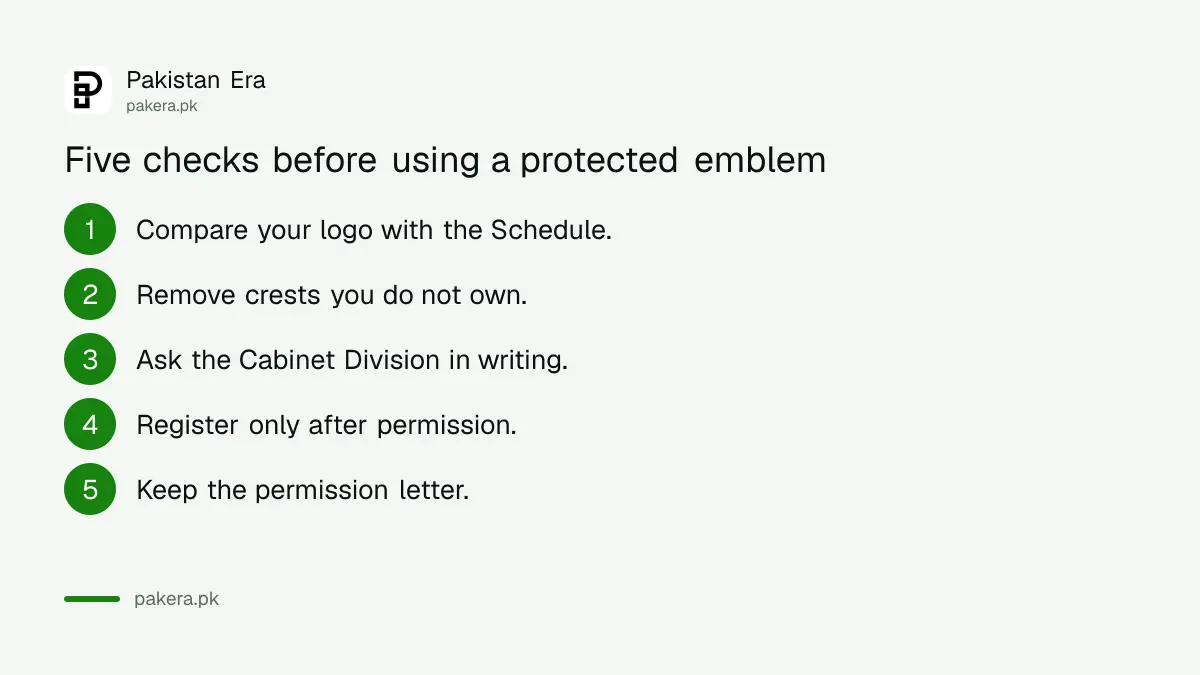
Check these five things before you use a protected name or logo
Before you print, register or publish, check whether your design uses anything on the Schedule, and if it does, change it or get written permission first. The Act does not name a single office for permission, so ask in writing and keep the reply.
- Compare your name and logo with the five groups in the Schedule, including abbreviations and look-alikes.
- Remove any government crest, seal, board logo or state company logo you do not own.
- If you still need a protected name or emblem, write to the Cabinet Division, which publishes the Act, and ask which officer can grant permission.
- Do not file a trademark, company or firm name with a protected element until you hold written permission.
- Keep the permission letter with your registration papers, since registries can refer doubtful cases to the Prime Minister.
The Act's words reach "any other purpose whatsoever", which is very broad. It does not say how that applies to ordinary patriotic display, such as flags at home on Independence Day, and we found no rule or notice on that point. Treat commercial use as the clear risk.
Common questions
Can I use Quaid-e-Azam's name in my business name?
Not without written permission. The Act protects his name, title or likeness and any variation, and registries must refuse a company or firm name that carries it.
What is the fine for using the Pakistan flag on a product?
Up to Rs 500 under section 3(2) of the 1957 Act, with prosecution only after sanction by the Prime Minister or an authorised officer.
Can a private school or academy use a board's logo?
Since 20 June 2026 the Schedule covers the emblems of government educational institutions and bodies. Using one needs written permission.
Who gives permission to use a protected emblem?
The Prime Minister or an officer he authorises. The Act does not name the office, so ask the Cabinet Division in writing.
Does the Act apply to Pakistanis abroad?
Yes. Section 1 says it applies to all citizens of Pakistan wherever they may be.
Are UN logos protected in Pakistan?
Yes. The names and emblems of the United Nations, WHO, WMO, ICAO and IAEA are on the Schedule.
How we verified this
What we checked, where we read it, and what we could not confirm.
Last checked 27 October 2026. Every section, the Rs 500 and Rs 200 fines, the definitions and the Schedule come from the Cabinet Division's text of the Pakistan Names and Emblems (Prevention of Unauthorised Use) Act, 1957, as on 20 June 2026, which we downloaded from the Cabinet Division website on 26 October 2026. The footnotes in that text cite S.R.O. No. 1038(I)/2026 of 20 June 2026 for item 4 and Act No. XXVIII of 2026 for the Prime Minister's role. We have not seen the S.R.O. or the 2026 Act themselves, or any rules made under section 8, and we did not apply for permission, so we cannot say how long a request takes.
About the author

Global Affairs & Political Economy Writer
Muhammad Hatim is a book lover who started writing because he enjoys it. At Pakistan Era he writes about international relations, geopolitics and the global economy, with a particular interest in South Asia and the forces behind current events.