How to Report a Tampered Scale or a Wrong Price Tag in Pakistan
A tampered scale and a wrong price tag go to different offices. Which provincial department to call in Punjab, Sindh, KP and Balochistan, and what to bring.
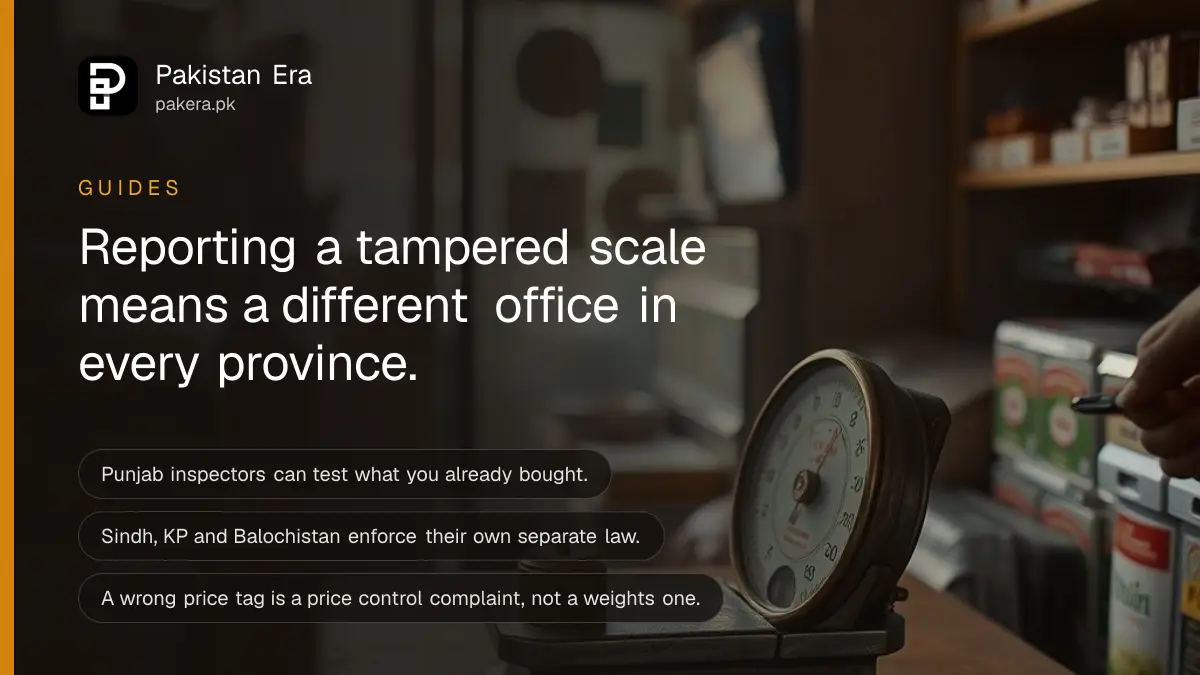
A tampered scale and a wrong price tag are two different complaints in Pakistan. A scale goes to your province's Weights and Measures office. A price tag goes to the price control office, and the phone number changes from province to province.
Most shoppers lump both under "the shop cheated me" and give up before filing anything. That is the wrong instinct. Each law gives an inspector real power, and most of that power sits unused because nobody asks for it.
We checked which law and which office actually handles a weights and measures complaint in Punjab, Sindh, Khyber Pakhtunkhwa and Balochistan, on 4 October 2026.
A tampered scale and a wrong price tag are not the same complaint
A scale, weight or sealed packet that shorts you falls under weights and measures law. A missing, wrong or unapproved price tag falls under price control law. Different office, different penalty, sometimes a different phone number entirely.
Weights and measures enforcement is provincial in Pakistan, not federal. There is no single national hotline for a bad scale. Each province runs its own Act, its own inspectorate, and in practice, its own level of how easy the complaint actually is to make.
| Province | Law in force | Who enforces it |
|---|---|---|
| Punjab | Punjab Weights and Measures (International System) Enforcement Act 1975 | Weights and Measures inspectorate, under the district administration |
| Sindh | Sindh Standard Weights and Measures Enforcement Act 1975 | Weights and Measures wing, Industries Department |
| Khyber Pakhtunkhwa | Khyber Pakhtunkhwa Standard Weights and Measures Enforcement Act, as amended in 2013 | Weights and Measures wing, Industries Department |
| Balochistan | Balochistan Weights and Measures (International System) Enforcement Ordinance 1977 | Controller Weights and Measures, Quetta |
All four laws follow roughly the same design, inherited from the same decade: an inspector can check a scale, enter a shop, and in Punjab's case, even test an item you already carried home. The figures and the fine print differ by province, and we have not read all four Acts cover to cover, so we only state what we actually verified below.
Punjab's inspectors can test what you already bought
Punjab's 1975 Act gives an inspector unusually wide powers: checking the scale itself, entering the shop, and verifying the weight of something already sold and carried out the door. A sealed packet can legally be opened and checked if the inspector has reason to believe it is short.
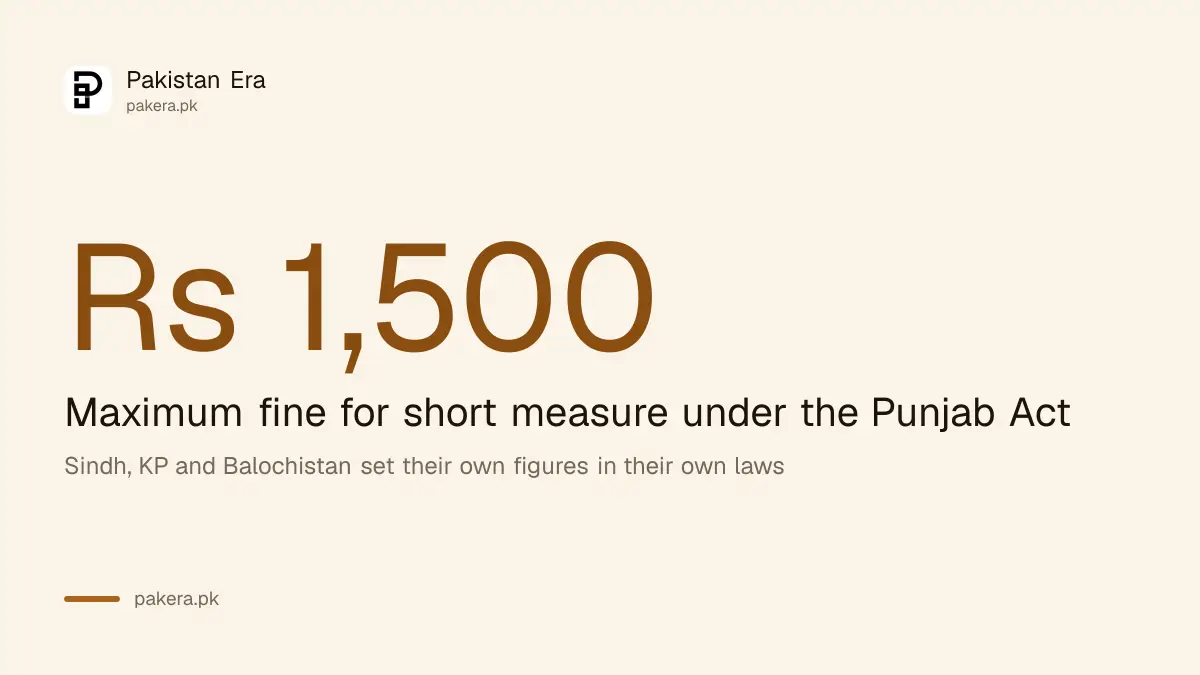
The maximum fine for short measure in Punjab is Rs 1,500, a figure that has not moved since the Act was written. We go through the full powers, the sealed packet rule and the appeal process in our guide to a short weight complaint in Punjab, so we are not repeating that section by section here.
What matters for a Punjab complaint in practice: it starts at the district administration the inspectorate sits under, not at a call centre. There is no dedicated weights and measures hotline the way there is for price control.
Sindh, Khyber Pakhtunkhwa and Balochistan each run their own law
Sindh enforces the Sindh Standard Weights and Measures Enforcement Act 1975 through a Weights and Measures wing inside the Industries Department. Khyber Pakhtunkhwa enforces its own Act, last amended in 2013. Balochistan enforces the Balochistan Weights and Measures (International System) Enforcement Ordinance 1977, through a Controller Weights and Measures based in Quetta.
We found the names and the responsible offices for all three, but we could not get a clean read of the full text of any of the three laws, and we are saying so rather than guessing at fine amounts. Unlike Punjab, none of the three publishes an easy, documented complaint number for a weights and measures issue specifically.
The practical route is the same in all three: take it to your district administration or the provincial Industries Department office nearest you, and ask them to route it to the Weights and Measures wing. It is slower than a hotline call, and that is the honest state of it right now.
A wrong price tag is a price control complaint, not a weights one
A missing price tag, an inflated price, or a price higher than the government notified rate is a different offence from a short scale. Punjab and Sindh both run live, working complaint routes for this specific problem.
Punjab's price control line is covered in our guide to reporting overcharging in Punjab, and Sindh's in our guide to reporting overcharging in Karachi and Sindh. Use those if the problem is the price on the tag, not what the scale actually reads.
A shop can fail both at once. A trader who prints a low price and then shorts the weight is running two separate offences, and naming both when you complain usually gets faster attention than naming either alone.
What to collect before you report it
An inspector moves faster with something concrete in hand. Gather this before you call or visit:
- The receipt, if one was given, showing the price and the stated weight.
- A photo of the price tag or the shelf label, taken before you paid.
- The purchased item itself, if it is something you can still produce.
- The shop's name and exact address, not just the market or bazaar name.
- The approximate time of the purchase, since an inspector may want to catch the same scale in use.
A receipt is often the only thing that survives once the dispute starts. Many small shops do not issue one unless asked, so ask.
What happens after you report it
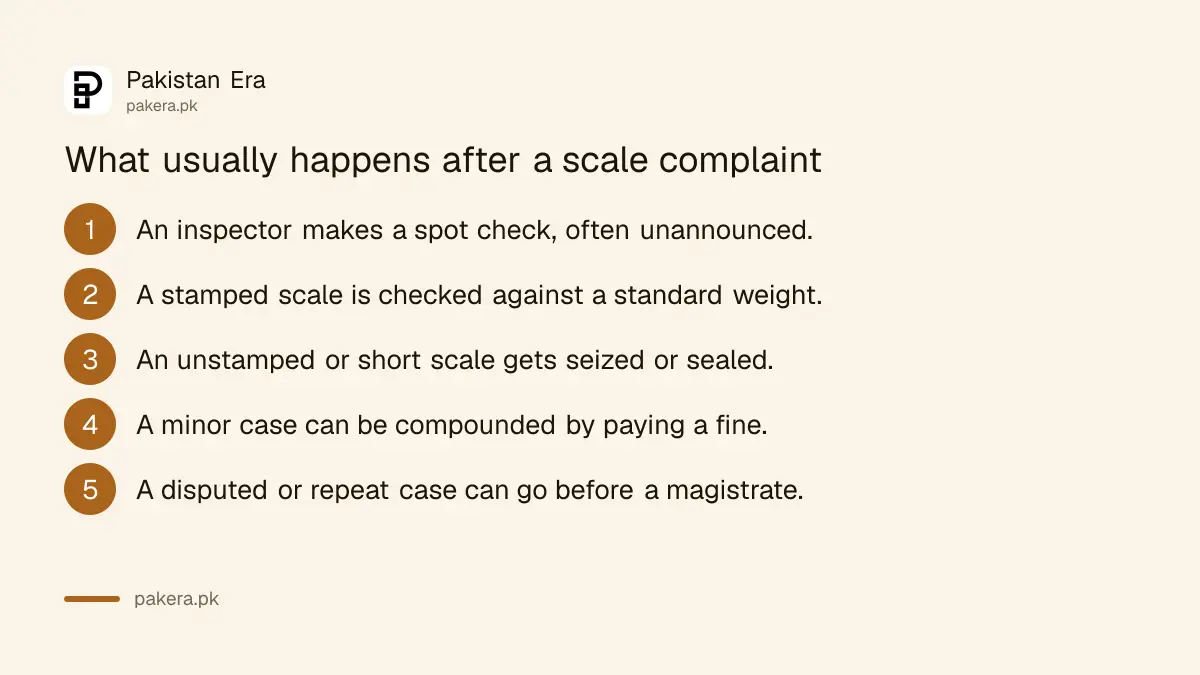
Across these provincial laws, the pattern repeats. An inspector makes a spot check, often without warning. A scale is weighed against a known standard weight. If it is unstamped or found short, it can be seized or sealed on the spot.
A first or minor offence is often settled by the trader paying a fine directly, called compounding the offence. A disputed case, or a repeat offender, goes to a magistrate instead. None of this happens if nobody reports it, and a surprising number of shops never get checked for exactly that reason.
Common questions
Is weights and measures a federal or provincial matter in Pakistan?
Provincial. Each province enforces its own Act or Ordinance, and there is no single national hotline for it.
Can an inspector check something I already bought and took home?
In Punjab, yes. The 1975 Act lets an inspector verify the weight of an item already sold or delivered, not just the scale itself.
What is the fine for a tampered or unstamped scale?
In Punjab, short measure carries a fine up to Rs 1,500, and an unstamped instrument carries up to six months or Rs 5,000, or both. We could not independently verify current fine figures for Sindh, Khyber Pakhtunkhwa or Balochistan.
Where do I report a wrong price tag instead of a scale problem?
Through price control, not weights and measures. Punjab and Sindh both run separate complaint routes for pricing, covered in our overcharging guides for each province.
Is there one number to call anywhere in Pakistan for a bad scale?
No. Each province routes it through its own district administration or Industries Department, and none publishes a dedicated weights and measures hotline the way Punjab does for price control.
Can a shop argue the scale belonged to an employee, not the owner?
Not in Punjab. Its Act presumes a scale used by an employee or agent was used by the trader, unless the trader proves otherwise.
How we verified this
What we checked, where we read it, and what we could not confirm.
Last checked 4 October 2026. Punjab figures and powers are drawn from our existing sourcing of the Punjab Weights and Measures (International System) Enforcement Act 1975, read at punjablaws.punjab.gov.pk and detailed fully in our Punjab short weight guide, and are cross-referenced here rather than re-verified as new research. We confirmed the existence and title of the Balochistan Weights and Measures (International System) Enforcement Ordinance 1977 by fetching it directly from balochistan.gov.pk, though the document's text did not extract cleanly for us, so we state only its name and the Quetta Controller's office, not its section numbers or fine amounts. The Sindh Standard Weights and Measures Enforcement Act 1975 and a Khyber Pakhtunkhwa Standard Weights and Measures Enforcement Act, amended in 2013, are named based on official legal-publication references we found, but we were not able to open and read either text directly, so no fine figures for Sindh or Khyber Pakhtunkhwa are stated anywhere in this article. Price control hotline details for Punjab and Sindh are not repeated here and are sourced in their own linked guides. Weights and measures enforcement is a provincial subject in Pakistan. Nothing here is legal advice.
About the author

Tax, Bills and Technology Writer
Ali Akhtar is a young and curious voice here at Pakistan Era. He is currently pursuing his A-Levels and has a growing interest in Pakistan’s changing industrial landscape and educational trends. Ali likes to write in a way that helps him explain and explore the world around him. His writing reflects the perspective of the new generation navigating the evolving trends of Pakistan where technology, youth innovation, and shifting opportunities are reshaping the country’s future.