How to Apply for a GP Fund Advance From AGPR: Refundable and Non-Refundable
Apply for a federal GP Fund advance through your DDO and AGPR. Refundable limits, the 45, 50 and 55 non-refundable rule, the papers and the common fixes.
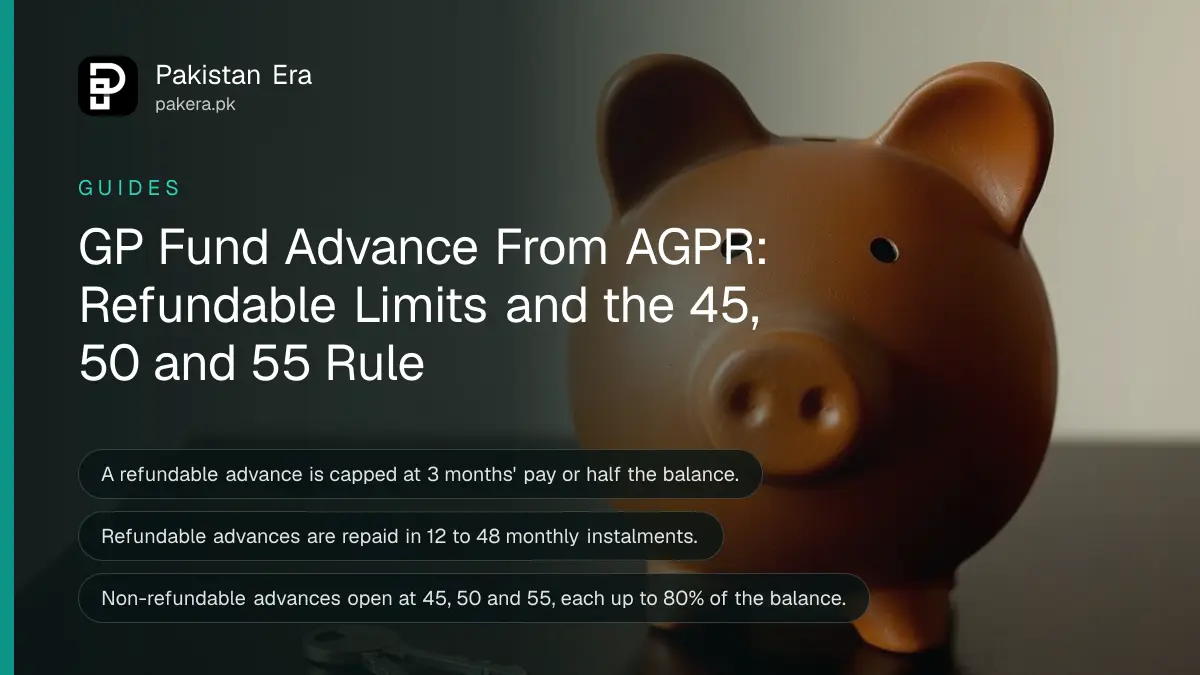
A federal employee applies for a GP Fund advance through the Drawing and Disbursing Officer (DDO), who sends the sanctioned case to AGPR. A refundable advance is capped at three months' pay or half your balance, whichever is less, and is repaid in 12 to 48 instalments. A non-refundable advance opens at age 45 and is never repaid.
The General Provident Fund is your own money, cut from your pay every month. You can borrow from it before retirement, or take part of it out for good after 45. The rules are old, but they are short, and most rejected files fail on one missing paper.
| Point | Refundable advance | Non-refundable advance |
|---|---|---|
| Who can apply | Any subscriber, any age | After age 45, 50 and 55, one each |
| Maximum | 3 months' pay or half the balance, whichever is less | 80% of the balance (100% once after 50) |
| Paid back? | Yes, 12 to 48 monthly instalments | No, deducted from the final payment |
| Reason needed | Yes, from the list in rule 15 | Yes at 45 to 50, no reason after 50 |
| Change form | FO-5 | FO-02 |
A refundable advance is a loan from your own GP Fund
A refundable GP Fund advance is a temporary loan from your own balance. Rule 15 of the General Provident Fund (Federal Services) Rules allows it for illness, overseas travel for health or education, funerals, religious ceremonies and family marriages. It is recovered from your pay.
The rule lists three groups of reasons. Pick the one that fits and say so plainly in the application.
- Expenses of a long illness of you, your spouse or a person who depends on you.
- Overseas travel for the health or education of you or a dependant.
- Obligatory expenses for a funeral or a religious ceremony, your own marriage, a family member's marriage, or the marriage of a dependent female relative.
A Finance Division decision also allows a refundable advance to pay deferred haq mehr (dower). You must show proof of payment within one month, and it is allowed only once. If you already took a marriage advance at the wedding, the dower advance is not open to you later.
The refundable limit is three months' pay or half the balance
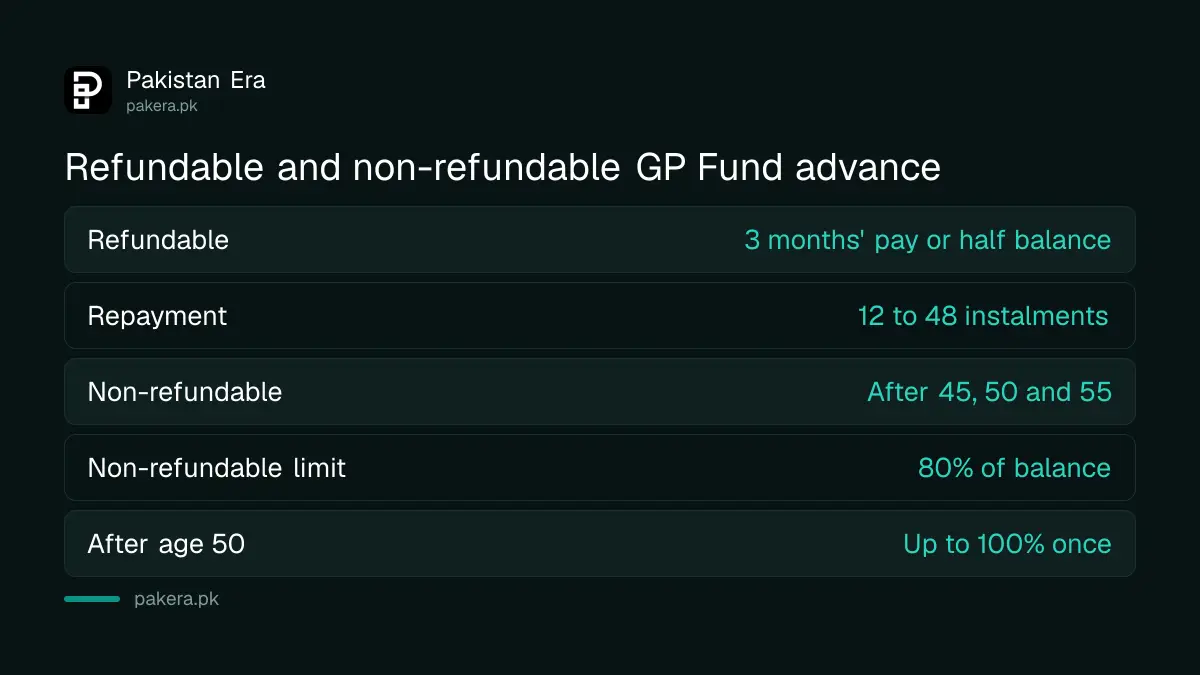
A refundable advance cannot be more than three months' pay or half of your GP Fund balance, whichever is smaller. A larger amount is possible only for special reasons, which you write in the application or explain to the sanctioning officer in person if they are private.
Take an example. Your monthly pay is Rs 80,000 and your balance is Rs 600,000. Three months' pay is Rs 240,000. Half the balance is Rs 300,000. Your normal limit is the smaller figure, Rs 240,000.
Recovery runs in equal monthly instalments. The sanctioning officer fixes the number, which cannot be fewer than 12 unless you ask for fewer, and never more than 48. Deduction starts from the first month you draw full pay after the advance. You can pay more than one instalment in a month if you want to finish early.
One advance at a time is the working rule. AGPR's revised procedure, in a circular of 24 April 2025, says a second refundable advance will not be entertained until the earlier one is fully recovered. The profit rate on your balance, and the mark-up on house and car advances, are set out with the GP Fund profit rate for 2025-26.
A non-refundable advance opens at 45, 50 and 55
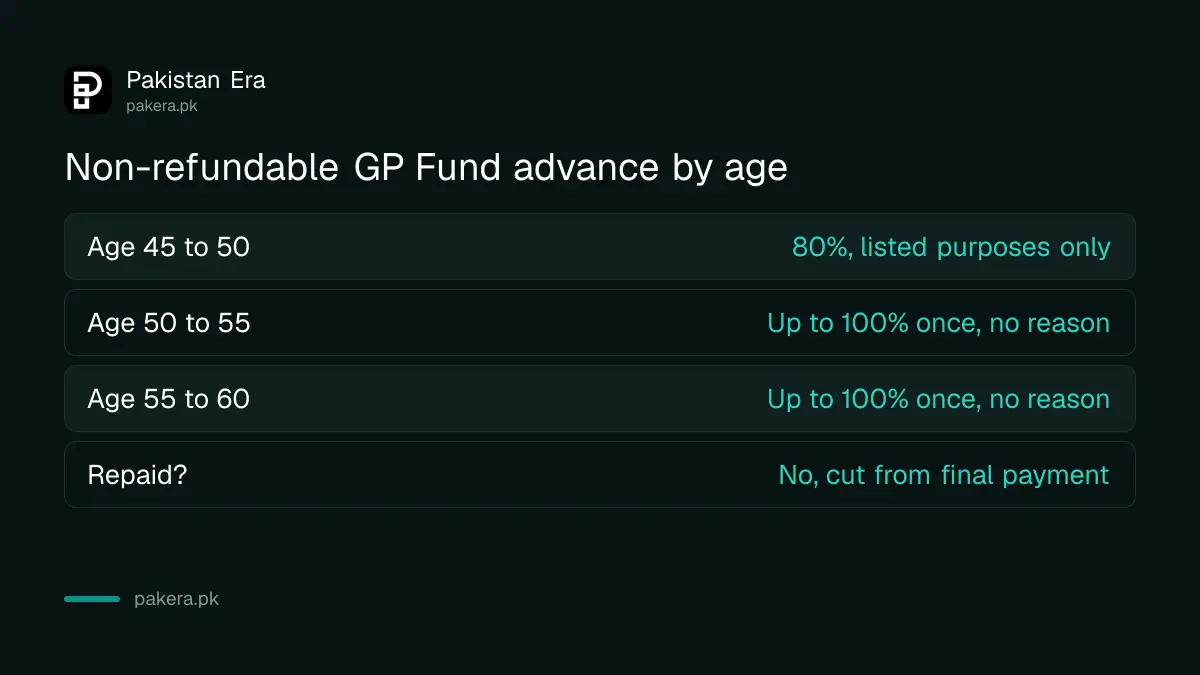
Rule 15-B allows three non-refundable advances, one after each of the ages 45, 50 and 55. Each can be up to 80 per cent of your balance on the date you apply. You never repay it; it is simply taken off your final GP Fund payment at retirement.
Between 45 and 50, the money must go to one of these purposes:
- Building a house on land owned by you, your wife or your children.
- Rebuilding, extending or renovating a house you or your family already own.
- Buying agricultural land.
- Buying a house to live in.
- Repaying a loan taken from a bank or other financial institution.
After 50, no reason is needed. A subscriber who has reached 50 may draw up to 100 per cent of the balance as a non-refundable advance. A Finance Division clarification adds that if you took 80 per cent at 50, you can still take the remaining 20 per cent. AGPR's own GP Fund page puts it the same way: 80 per cent between 45 and 50, and 100 per cent once in service between 50 and 60.
A refundable advance you are still repaying can be converted into a non-refundable one once you turn 45. Ask your DDO about it before you apply for anything new.
Apply through your DDO with five papers
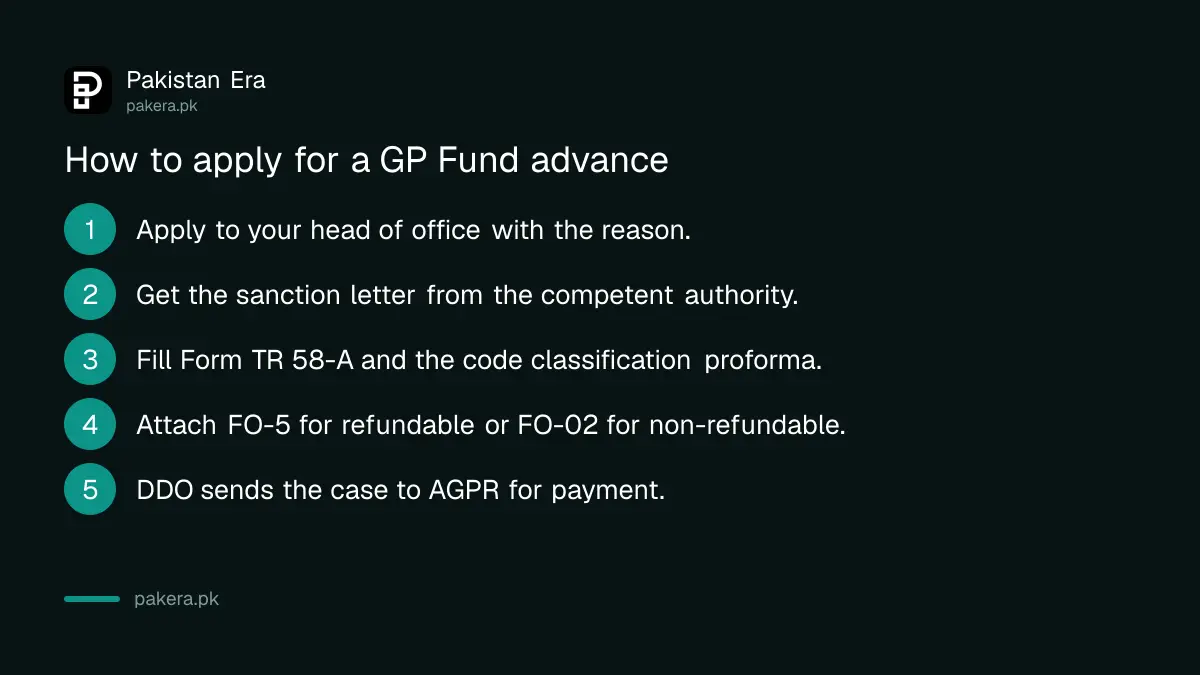
You do not apply to AGPR directly. You apply to your own office, the sanctioning authority approves it, and the DDO sends the case to AGPR with the sanction letter, Form T.R.58-A, a code classification proforma and the right computer change form.
- Write an application to your head of office stating the type of advance, the amount and the reason.
- Get your current GP Fund balance from your latest pay slip or GP Fund statement.
- Get the sanction letter from the competent authority in your ministry or department.
- Fill Form T.R.58-A and the code classification proforma, both on AGPR's GP Fund and forms pages.
- Attach form FO-5 for a refundable advance or FO-02 for a non-refundable one.
- Class-IV subscribers also attach a deduction statement with proof of GP Fund deductions.
- The DDO forwards the full case to AGPR, which pays it into your salary account.
For a house purchase under the non-refundable rule, spend the money within three months and show proof, or the whole amount must be paid back with interest. For a loan repayment, the proof is due within two weeks.
Most GP Fund advance cases stall on four problems
The common reasons a GP Fund advance is held up are an earlier advance still running, missing credits from a previous office, the wrong change form, and a balance that is lower than the amount asked for. Each has a direct fix.
| Problem | Fix |
|---|---|
| Earlier refundable advance not fully recovered | Finish the instalments or pay the rest in one go, then apply |
| Balance missing years from an earlier office | Ask that office to transfer the old GP Fund balance with interest to AGPR first |
| Repaid by challan but payroll still deducts | Send the challan copy and a change statement to AGPR |
| FO-5 sent for a non-refundable case | Replace it with FO-02, and the other way round |
| Amount above the limit | Cut it to 3 months' pay or half the balance, or state special reasons |
Keep a copy of every paper your DDO sends. If AGPR returns the case, the return note names the missing item, and a copy saves you a week. The monthly deduction itself, by pay scale, is listed in the GP Fund deduction rates for 2026.
Common questions
Can I take a GP Fund advance before age 45?
Yes, but only a refundable one. It must be for illness, travel for health or education, a funeral, a religious ceremony or a marriage, and you repay it from your pay.
How much refundable GP Fund advance can I get?
Three months' pay or half your balance, whichever is less. More is allowed only for special reasons that the sanctioning authority accepts.
Can I take a second refundable advance?
Only after the first is fully recovered. AGPR's revised procedure of April 2025 does not entertain a second refundable advance while the first has a balance.
Do I need a reason for a non-refundable advance after 50?
No. Rule 15-B says no reasons are required after 50, and you may draw up to 100 per cent of the balance once.
Does a non-refundable advance reduce my pension?
No. It reduces only your GP Fund final payment. Pension and gratuity are worked out separately, as the government pension case papers show.
Where does AGPR send the money?
To the bank account where your salary is credited, once the case is passed.
How we verified this
What we checked and where we read it.
Last checked 24 November 2026. We read the General Provident Fund (Federal Services) Rules published by the Finance Division (updated edition), rules 15, 15-B and 16 and the Sixth Schedule, with the Government decisions printed under them. We also read AGPR's GP Fund page, which lists the papers for refundable and non-refundable advances and the 80 and 100 per cent limits by age, AGPR's forms page, and the AGPR circular of 24 April 2025 on second refundable advances. The age bands on AGPR's page and the wording in the rules differ slightly: the rules allow 100 per cent after 50, and AGPR lists it as once in service between 50 and 60. Departments under AG offices in the provinces follow their own provincial GP Fund rules.
Free on WhatsApp
Get last dates and rule changes on WhatsApp
We post new last dates, fee changes and fixes for common problems, a few short posts a day.
Follow Pakera on WhatsAppOther followers cannot see your number.
Pakera Solves It
Which online process wasted your time this week?
A portal that will not load, a form nobody explains, a complaint that went nowhere. Tell us. Every week we pick one, solve it step by step and publish the answer.
About the author

Tax, Bills and Technology Writer
Ali Akhtar is a young and curious voice here at Pakistan Era. He is currently pursuing his A-Levels and has a growing interest in Pakistan’s changing industrial landscape and educational trends. Ali likes to write in a way that helps him explain and explore the world around him. His writing reflects the perspective of the new generation navigating the evolving trends of Pakistan where technology, youth innovation, and shifting opportunities are reshaping the country’s future.