Balochistan Bans Iranian Oil in Passenger Buses on the Makran Route: Gwadar, Kech and Panjgur
Balochistan has banned carrying Iranian oil in passenger buses on the Makran route. Buses and companies face legal action. What passengers should do now.
Short answer: The Balochistan government has put a complete ban on carrying Iranian oil in passenger buses on the Makran route, which serves Gwadar, Kech (Turbat) and Panjgur. Chief Minister Mir Sarfraz Bugti ordered immediate legal action against any bus or transport company that breaks it. The decision was taken at a meeting he chaired in Gwadar on Friday 27 November 2026.
For passengers, the practical meaning is simple. Fuel cans and drums should not be on your bus, in the cabin, in the luggage hold or on the roof. A bus caught carrying them faces action, and so does the company that runs it.
Passenger buses on the Makran route can no longer carry Iranian oil
The ban covers every passenger bus operating on the Makran route. The chief minister said passenger buses exist to give people safe travel and cannot be used to move oil illegally, and he told officials to act against violators without exception.
Makran Division is made up of three districts: Gwadar, Kech and Panjgur. All three border Iran or sit close to it, and fuel from across the border has long reached their towns by road. Some of it travels in the same buses that carry families between Turbat, Gwadar, Panjgur and Karachi.
| Point | What was decided |
|---|---|
| What is banned | Carrying Iranian oil in passenger buses |
| Where | The Makran route (Gwadar, Kech, Panjgur) |
| Who faces action | The bus and the transport company |
| Type of action | Immediate and strict legal action |
| Decided by | Meeting chaired by CM Mir Sarfraz Bugti |
| Where and when | Gwadar, Friday 27 November 2026 |
Fuel in a passenger bus is a fire risk for everyone on board
Petrol and diesel give off vapour that can catch fire from a spark, a cigarette or a hot engine. Stored in plastic cans inside a crowded bus, even a small leak puts every passenger at risk, which is why the government tied the ban to safe travel.
The Makran routes are long. A trip from Turbat or Panjgur to Karachi takes many hours, often at night, with few towns along the way. A fire far from a hospital or fire station is the worst case for passengers, and it is the case the ban is meant to prevent.
What passengers on Makran buses should do now
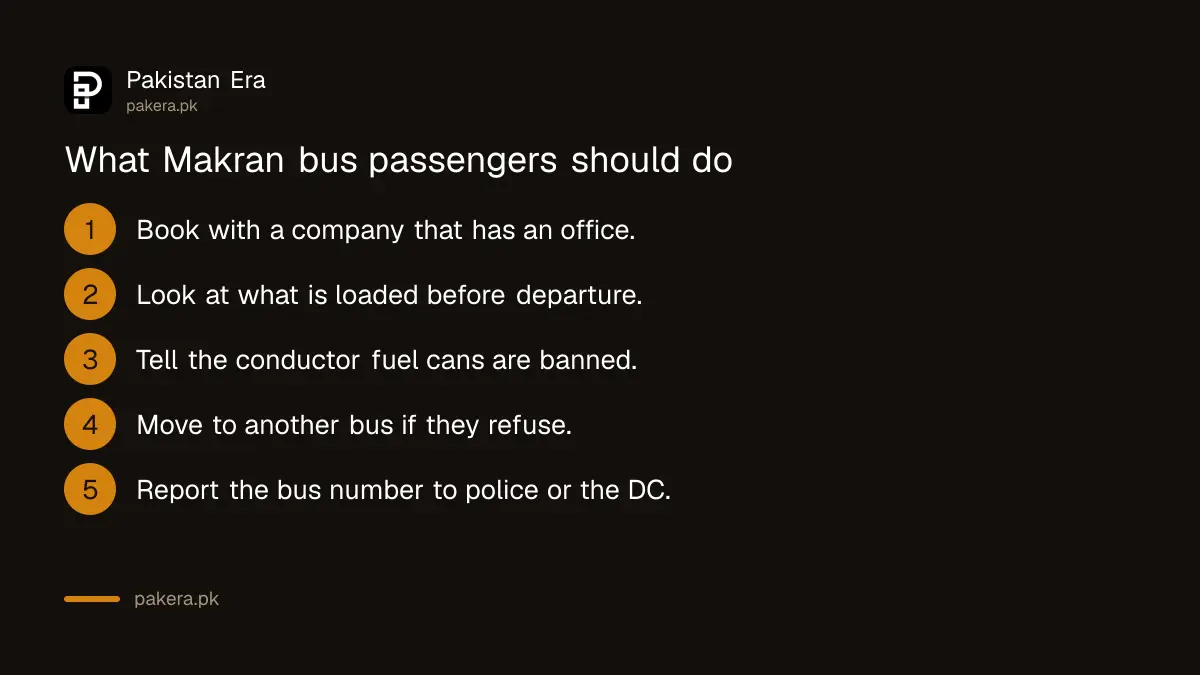
Check what goes into your bus before you board. If you see fuel cans or drums being loaded in the cabin, hold or roof, raise it with the conductor, choose another bus if you can, and report it to the local police or district administration.
- Book with a transport company that has a fixed office and ticket counter, so you know who runs the bus.
- Before departure, look at what is being loaded under the bus and on the roof.
- If you see fuel cans or drums, tell the conductor or driver that carrying them is now banned.
- If they refuse to remove them, ask for a seat on another bus or another company.
- Note the bus number, the company name and the time, and report it to the nearest police station or the deputy commissioner's office.
- Do not carry fuel in your own luggage. The ban is aimed at buses and companies, but a fuel can in your bag is the same danger.
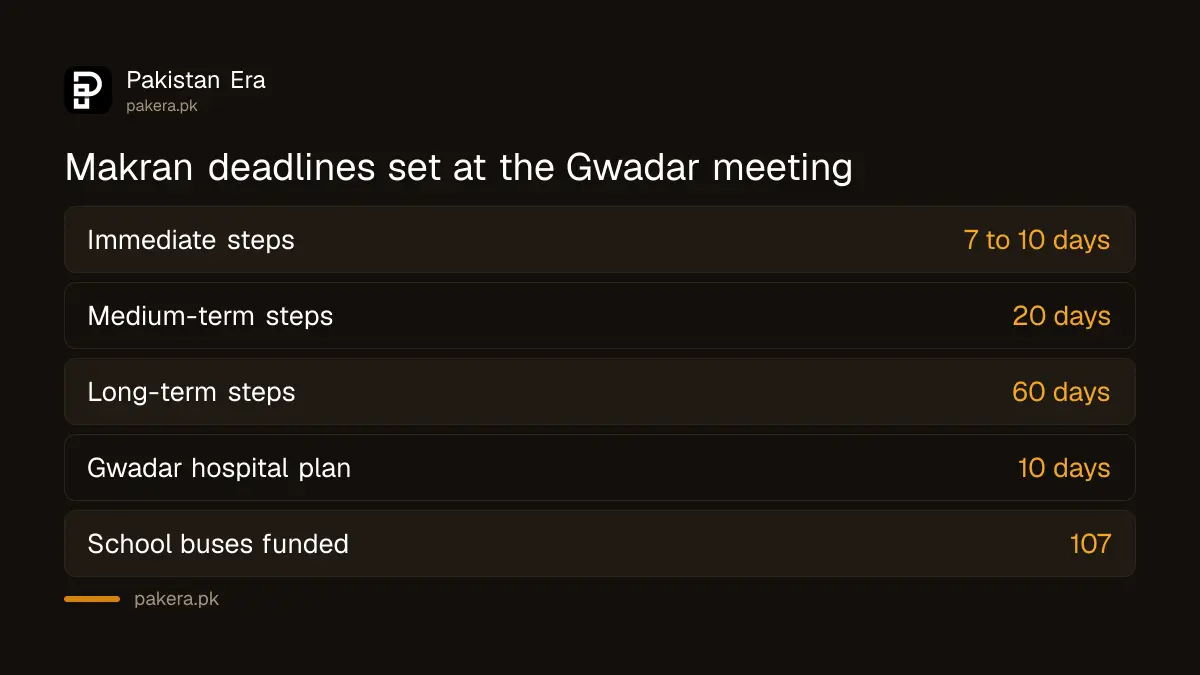
The Gwadar meeting also set 10, 20 and 60 day deadlines for Makran
The same meeting reviewed a report from the Secretaries Committee's visit to Gwadar, Kech and Panjgur, which held public hearings and inspected schools and hospitals. Complaints were split into three phases: immediate steps in 7 to 10 days, medium-term steps in 20 days and long-term steps in 60 days.
| Decision | Detail |
|---|---|
| Immediate measures | 7 to 10 days |
| Medium-term measures | 20 days |
| Long-term measures | 60 days |
| School buses | Funds for fuel and drivers to run 107 school buses |
| DHQ Hospital Gwadar and GDA Trauma Centre | Management plan due within 10 days |
Makran Division has 1,472 schools and 10,236 teaching and non-teaching staff, the meeting was told. The chief minister ordered teachers to be posted where they are needed, training for teachers, and better use of the digital monitoring system in schools.
The 107 school buses matter to parents in the division. The funds released are for fuel and drivers, so buses that were standing idle can start carrying children again.
Iranian fuel and the border trade in Balochistan
Fuel from Iran is part of daily life and trade in Balochistan's border districts. Crossings and border trade have been opened and shut several times this year, as in October when trade at Taftan and Gabd was suspended.
Supply from Iran also moves prices across the province. When the border closed in October, gas cylinders became costlier, as set out in the report on the LPG price surge after the Iran border closure. The bus ban does not close the border. It stops one way of moving the fuel, inside vehicles full of people.
For the wider picture of what is being built in the port city, the status of Gwadar's CPEC projects lists the airport, water and port works.
Common questions
Which buses does the Balochistan oil ban cover?
All passenger buses operating on the Makran route, which serves Gwadar, Kech (Turbat) and Panjgur.
Who is punished if a bus carries Iranian oil?
The chief minister ordered strict legal action against both the passenger bus and the transport company found breaking the ban.
When was the ban announced?
At a meeting chaired by Chief Minister Mir Sarfraz Bugti in Gwadar on Friday 27 November 2026.
Does the ban close the Pakistan-Iran border?
No. It is about carrying oil in passenger buses. Border crossings and trade are governed by separate decisions.
What should I do if my bus is carrying fuel cans?
Tell the conductor, ask to move to another bus if they refuse, and report the bus number and company to the local police or the deputy commissioner's office.
How we verified this
What we checked and where we read it.
The decision was announced after the chief minister's meeting in Gwadar on 27 November 2026 and was reported consistently on 27 and 29 November 2026, including the ban, the action against buses and companies, the 7 to 10, 20 and 60 day phases, the 1,472 schools and 10,236 staff, the 107 school buses and the 10 day plan for DHQ Hospital Gwadar. Statements of the Balochistan government are issued through its official website and the Directorate General of Public Relations. Checked on 29 November 2026.
Free on WhatsApp
Get the next change first on WhatsApp
Price changes, new rules and deadlines that affect your money, in a few short posts a day.
Follow Pakera on WhatsAppOther followers cannot see your number.
About the author

Senior Writer, Public Services and Technology
Shahid joined us in 2024 as an author. He is a senior contributor to Pakistan's leading technology websites. He writes detailed articles, mostly covering his expertise in the latest tech, mobiles, apps, gadgets, and step-by-step guides. His ideology is to help people understand the latest trends and explain complex methods through very easy-to-understand guides.