Biochar in Punjab: Turn Fruit and Vegetable Waste Into Fertiliser With 55% Organic Carbon
Punjab's soil lab made biochar from mandi waste with 55% organic carbon and 2.2% potassium, and says it lifted wheat and maize yields. See how it is made.
Biochar made from mandi fruit and vegetable waste carried 55 per cent organic carbon, 1.4 per cent nitrogen, 0.5 per cent phosphorus and 2.2 per cent potassium when Punjab's soil chemistry scientists tested it. The Punjab Agriculture Department says it raised wheat and maize yields in their trials and suits the province's high pH soils.
Every vegetable market in Punjab throws out peels, rotten fruit, leaves and pulp by the cartload each day. Every October, farmers burn rice straw and cotton sticks. The province's farm advisory for 16 to 31 October 2026 makes the case that both are wasted fertiliser. We read the Urdu original on 20 October 2026, along with the Sindh department's advice on cotton sticks, and set out what each says and where they stop.
Biochar is waste heated with little air, not burned
The department describes biochar as fruit and vegetable waste that is cleaned, sun-dried and then heated in a drum or oven with limited oxygen, in a unit called a pyrolyser. The result is cooled and stored in airtight containers so it does not soak up moisture.
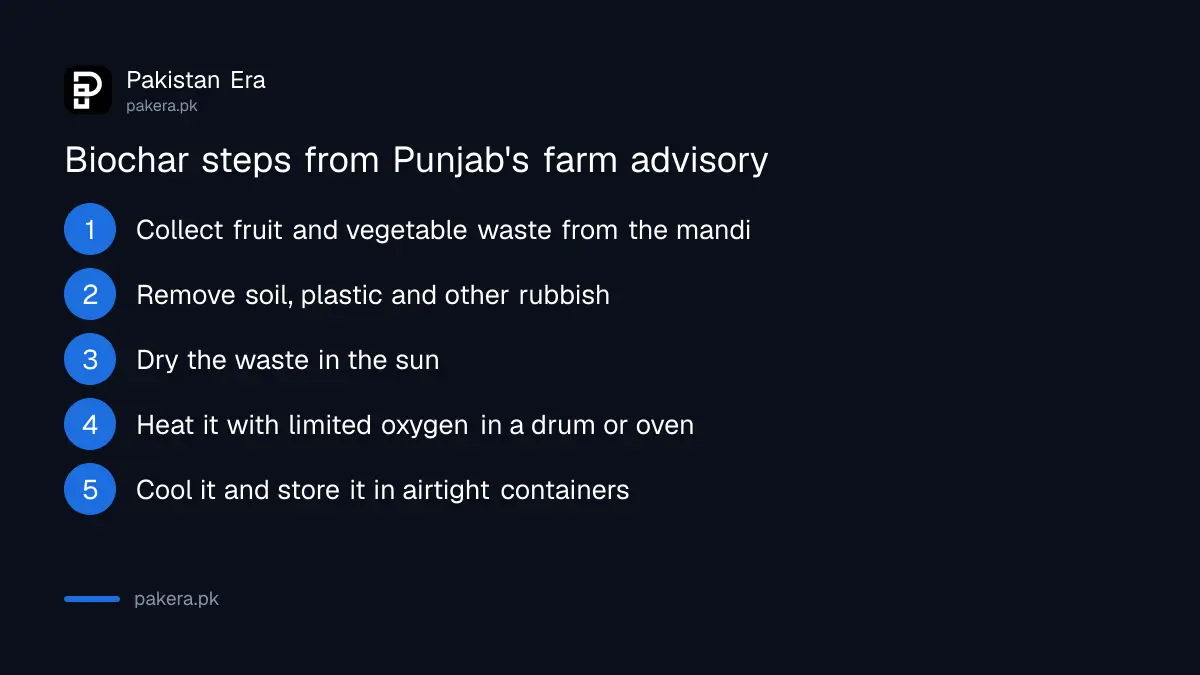
- Collect peels, rotten pieces, leaves and pulp from a fruit and vegetable market.
- Clean out soil, plastic and anything that is not plant waste.
- Dry the material in the sun until most of the moisture is gone.
- Heat it in a drum or oven with limited oxygen, the pyrolyser step.
- Cool the biochar and store it in airtight containers.
The key word is limited oxygen. Burning in open air turns waste into ash and smoke. Heating with little air leaves a black, carbon-rich solid that stays in the soil. The department's advisory says the raw material is free and the method is friendly to the environment.
Punjab's soil lab found 55 per cent organic carbon
The department's soil chemistry section made biochar from vegetable and fruit waste and tested it as an organic fertiliser. It found 55 per cent organic carbon, 1.4 per cent nitrogen, 0.5 per cent phosphorus and 2.2 per cent potassium.
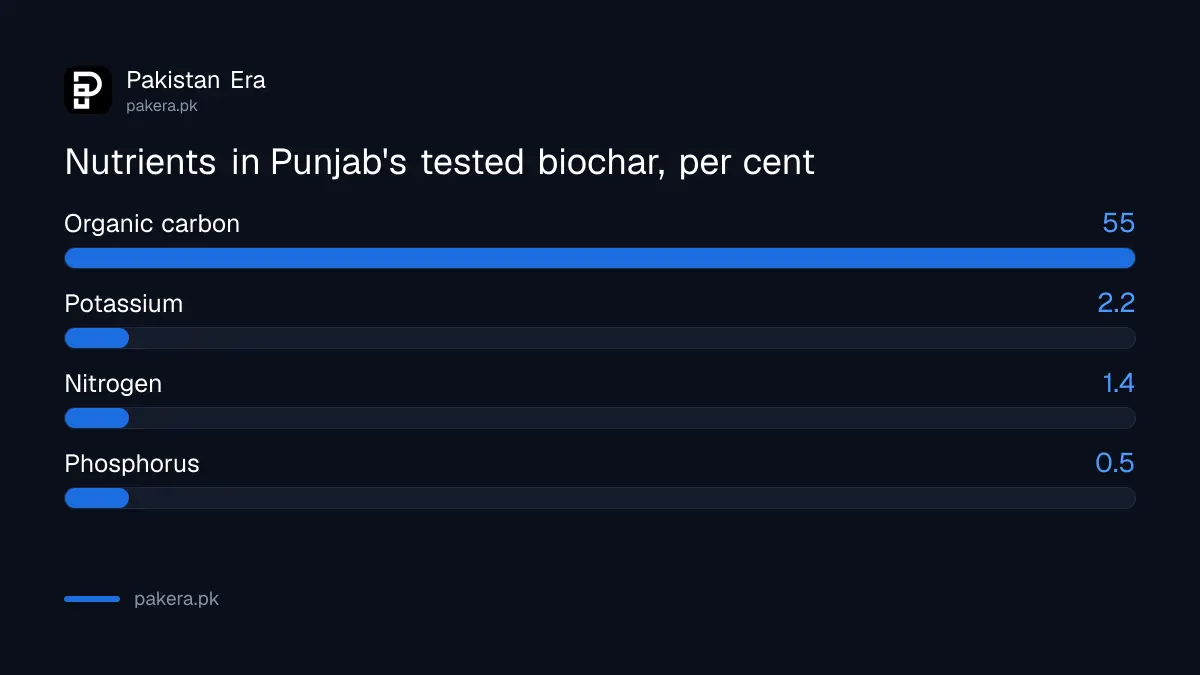
| Nutrient | Share in the biochar |
|---|---|
| Organic carbon | 55% |
| Potassium | 2.2% |
| Nitrogen | 1.4% |
| Phosphorus | 0.5% |
Put those numbers in perspective. Urea is 46 per cent nitrogen, so biochar is not a replacement for a bag of urea or DAP. Its value is the carbon, because organic carbon is what helps soil hold water and nutrients. That is the honest way to read the table: a soil builder, with a little potash on the side.
It suits Punjab's high pH soils
The advisory says biochar is a long-lasting organic fertiliser whose effect stays in the soil, including in Punjab's high pH soils. Biochar made at 300 to 400 degrees Celsius has a relatively low pH, and fruit and vegetable waste makes it lower still, because acids in the raw material remain.
pH is a measure of how acid or alkaline a soil is. High pH, or alkaline, soil locks up nutrients like phosphorus and zinc, so the plant cannot take them even when they are there. The department says fruit and vegetable biochar carries chemical groups, such as carboxyl and phenolic groups, that release hydrogen ions and stop the soil pH from rising.
Its conclusion, from trials in the soil chemistry section, is that biochar raises wheat and maize yields and the soil's productivity. The advisory does not give the size of the yield gain, the rate per acre or the cost of a pyrolyser. So treat it as a promising lead from a government lab, not a recipe with a price tag. If you want to know your own soil's pH first, Punjab's mobile soil and water lab covers 15 districts.
Chop rice straw into the field instead of burning it
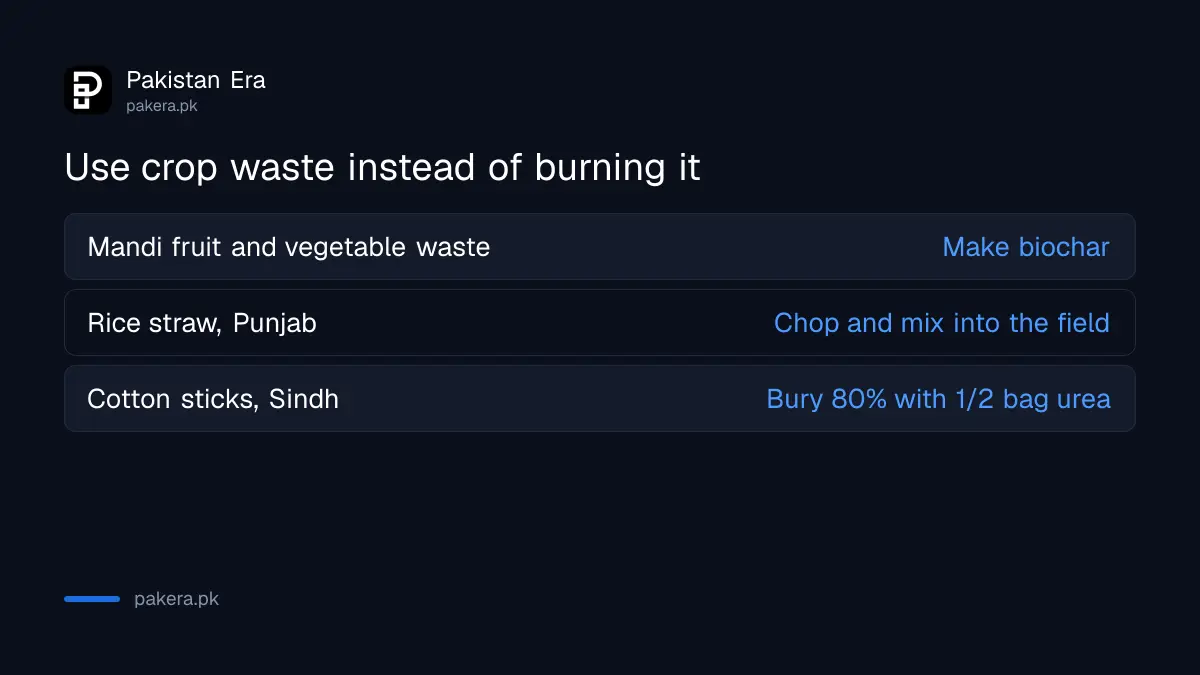
The same advisory tells rice growers not to burn crop residue. It says to cut the straw with a rice straw chopper and mix it into the field, which adds to soil fertility. Burning, it says, causes smog and air pollution.
That advice lands in the worst week for air. Readings this month show how bad it gets, with Kasur at 342 early on 20 October in our report on Punjab air quality. A machine is the usual barrier for a small farmer. Punjab rents out seeders that sow wheat straight into rice stubble, and the details are in the super seeder rental subsidy. The rules on burning sit inside the Punjab pre-smog action plan.
Sindh says bury cotton sticks with half a bag of urea
The Sindh Agriculture Department asks cotton growers to bury at least 80 per cent of their cotton sticks instead of burning them. It says half a bag of urea an acre, worked in after burial, speeds up rotting. It even calls for burial to be made compulsory.
The urea is there because rotting straw and sticks use up nitrogen from the soil for a few weeks. Adding a little at burial keeps the next crop from going hungry. At the week to 8 October 2026 national average of Rs 4,779.51 a bag for urea, half a bag costs about Rs 2,390 an acre, our arithmetic from the urea and DAP prices for that week.
Common questions
What is biochar?
A carbon-rich solid made by heating dried plant waste with little oxygen. Punjab's advisory describes making it from fruit and vegetable market waste.
How much nitrogen is in fruit and vegetable biochar?
1.4 per cent, in the Punjab soil chemistry section's test, with 55 per cent organic carbon and 2.2 per cent potassium.
Does biochar increase crop yield?
The Punjab Agriculture Department says its trials showed higher wheat and maize yields, but it does not give the size of the gain.
What should I do with rice straw instead of burning it?
Cut it with a rice straw chopper and mix it into the field, as Punjab's advisory says.
How should cotton sticks be handled in Sindh?
Bury at least 80 per cent of them in the soil and add half a bag of urea an acre to help them rot.
How we verified this
What we checked, where we read it, and what we could not confirm.
We read the biochar section and the rice residue advice in the Punjab Agriculture Department's farm advisory for 16 to 31 October 2026, listed on its crop advisory page, and the Sindh Agriculture Department's wheat crop page, on 20 October 2026. The Punjab text is a scanned Urdu page that begins partway through the biochar article, so we could not see its opening or its author. It gives no application rate, no yield figure and no equipment cost, and we did not test any biochar ourselves.
About the author

Senior Writer, Public Services and Technology
Shahid joined us in 2024 as an author. He is a senior contributor to Pakistan's leading technology websites. He writes detailed articles, mostly covering his expertise in the latest tech, mobiles, apps, gadgets, and step-by-step guides. His ideology is to help people understand the latest trends and explain complex methods through very easy-to-understand guides.