How to Check a College or University Closure Notice Is Real in Punjab
Real Punjab college and university closures are posted on the HED website with a signed notification. Use these checks before you forward or act on a notice.
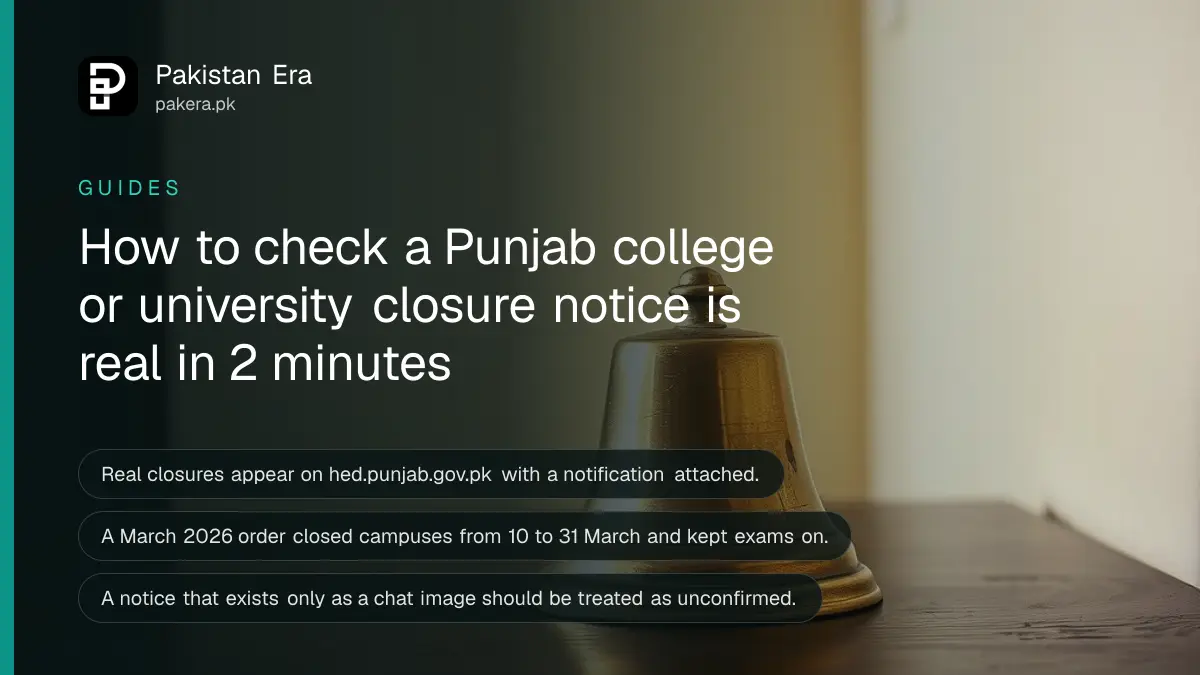
Short answer: A real closure of Punjab colleges and universities appears on the Higher Education Department (HED) website at hed.punjab.gov.pk, as a dated page that links the signed notification. If a notice is only an image in a WhatsApp group, treat it as unconfirmed and check the site before you skip class.
Last night a notice claiming all Punjab colleges and universities would close on Monday 12 October went round. The department is reported to have called it fake. Most students have no easy way to tell, so this guide gives a short routine you can use any time.
We opened the HED site on 12 October 2026 and read the way it posts a real closure. That page is our model for the checks below. The closure notice for 12 October was one such case, and we set out what happened there.
A real HED closure is a page with the signed notification attached
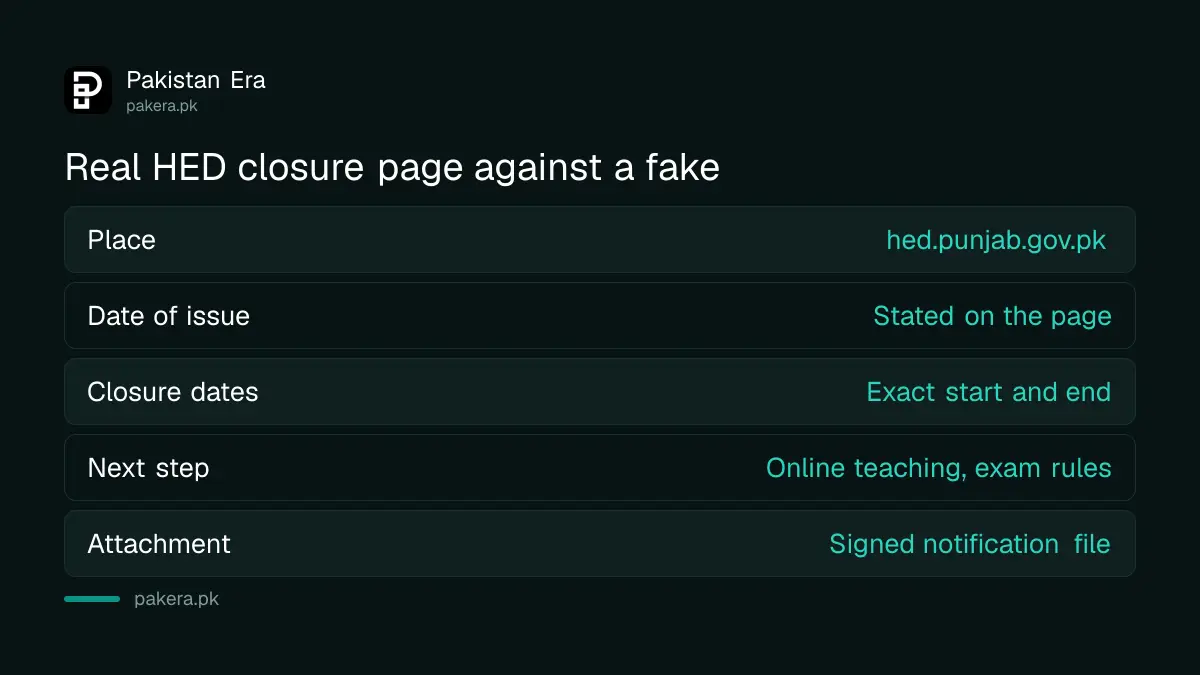
The department posts a closure as its own page with a date, the institutions covered, the dates of the closure and a link to the official notification. If you cannot find such a page or notification on the HED site, you do not have a confirmed closure.
Here is a real example from the site. A page dated 9 March 2026 says all public and private colleges and universities in Punjab would stay closed for on-campus activities from 10 to 31 March 2026. It tells institutions to move to online teaching and says scheduled exams continue as announced. It links the notification as a separate file.
| Part of the notice | The real March 2026 page | What a fake often lacks |
|---|---|---|
| Place | Posted on hed.punjab.gov.pk | Only an image in a chat group |
| Date of issue | 9 March 2026 | No date, or only a date in the picture |
| Dates of closure | 10 to 31 March 2026 | Vague, or one day only |
| What happens next | Online teaching, exams as announced | No instruction at all |
| Attachment | Official notification file linked | No file, no number |
Check who is allowed to order the closure
The closing body depends on the institution. The Higher Education Department covers public and private colleges and universities in Punjab. The School Education Department covers schools. A notice that mixes both, or that comes from nobody you can name, is a warning sign.
Smog closures are a separate chain. In our earlier check, a school closure for smog started with an order from the Environmental Protection Agency, and the School Education Department then issued its own notification. We trace that chain in the order for a smog school closure in Punjab. Boards also announce changes to papers on their own sites.
Use a short routine before you act
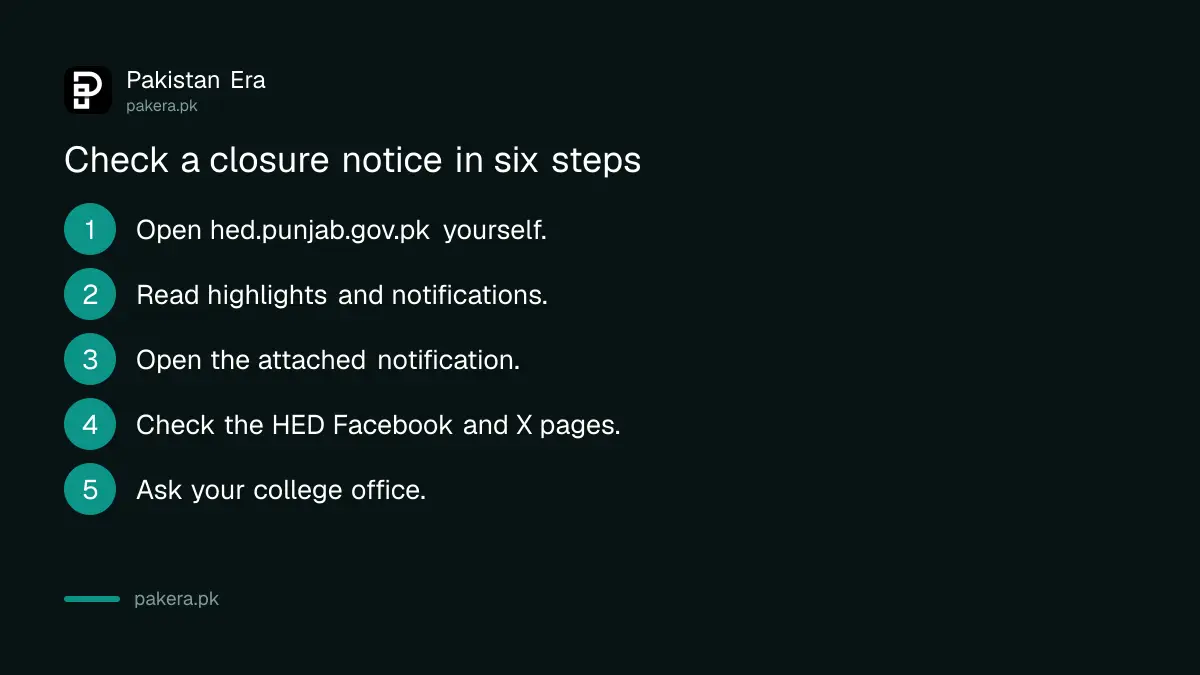
Open the official website, find the notification, read the dates and then ask your college. It takes about two minutes. Do this before you forward anything, because a forwarded fake is what makes it travel.
- Open hed.punjab.gov.pk on your phone yourself. Do not tap the link in the message.
- Look at the highlights and the notifications page for a dated closure.
- Open the attached notification and read the dates and the institutions named.
- Check the department's Facebook page, HEDPunjabOfficial, and its X account, PunjabHed.
- Ask your own college office or head of department.
- If you still doubt it, go to class or sit the paper.
Know the signs of a fake notice
A fake notice is often a plain image with a letterhead copied from a real one. It may name a reason such as law and order, weather or an event, and it may give a date for tomorrow. It rarely has a page on the official site.
Look for these signs. There is no link to the department site. The notice names every college in the province in one line. It was first seen in a forwarded message. The text has spelling mistakes. It tells you to share it with as many people as you can. A real order does not ask for that.
The helpline is reported, so confirm it before you rely on it
The department is reported to run a verification line at 042-99210039-42 for people who want to confirm a notification. We did not find that number on the HED pages we opened, so use the website as your main check and the number only as a second step.
If you call, ask for the notification number and date, not just a yes or no. Then write both down. A genuine order will have them.
Common questions
Where does the Punjab Higher Education Department post closures?
It posts them on hed.punjab.gov.pk as a dated page with the official notification attached. Its social media pages also repeat them.
Can a college close on its own?
Yes, for its own reasons, such as a local event, but it should tell students through its own website or notice board. A single college cannot close the whole province.
Does a closure stop exams?
Not always. The March 2026 notice said scheduled exams would continue as announced. Read the notification for what applies to exams.
Who orders school closures for smog?
In our earlier check, the Environmental Protection Agency issued the order and the School Education Department then issued a notification. Colleges are a different department.
What should I do if I already shared a fake notice?
Delete your forward and post a short correction in the same group. Say that the department did not issue the notice and point people to its website.
Is a screenshot of a notification enough proof?
No. A screenshot can be edited. Open the department site and find the same notification there.
How we verified this
What we checked, where we read it, and what we could not confirm.
We read the Higher Education Department homepage, notifications page and March 2026 closure page at hed.punjab.gov.pk on 12 October 2026. The helpline number is reported and is not confirmed on an HED page that we opened. Site layouts and numbers change, so confirm on the day.
About the author

Public Services and Education Journalist
Fajr Riaz is a journalist and content writer at Pakistan Era, based in Lahore. She covers the questions people meet in everyday life in Pakistan: how a public service works, what a change in the rules means, and where to find a reliable answer.