Check Your Electricity Company Score in Pakistan: NEPRA Rates It A to D
NEPRA's 2026 rules make every electricity company publish a quarterly score out of 100, down to sub-division. See the marks, the A to D bands and where to look.
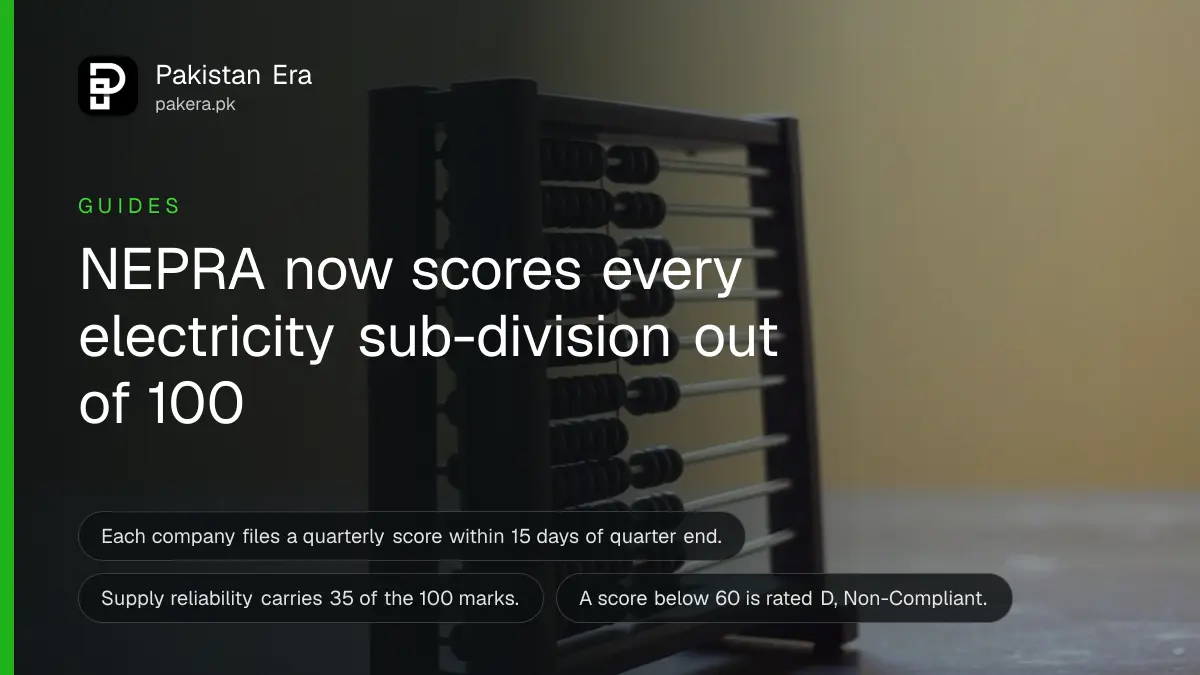
Short answer: NEPRA's 2026 rules make every electricity company score itself out of 100 each quarter. The score is split by sub-division, division, circle and company, and it must be published on the company's website and app. A score below 60 is rated D, Non-Compliant.
Your bill comes from a company. Your cuts, voltage and complaints come from one small office under it. Until now, you had no number that told you whether that office was any good.
We downloaded and read the Performance Standards (Distribution) Regulations 2026 from nepra.org.pk on 14 October 2026. They were notified as SRO 1430(I)/2026 on 25 August 2026. We did not look for a published scorecard on any company website yet, so we cannot tell you what any company scored.
The scorecard turns service into one number
Schedule VIII of the regulations creates a quarterly scorecard out of 100. It rolls up how well a company restores power, answers complaints, keeps voltage steady and treats consumers. Each score is worked out for your sub-division, then added up to division, circle and company level.
The company must send the finished scorecard to NEPRA within 15 days of the end of each quarter. It must also publish it on its website and on its consumer app. That second part is the useful one for you.
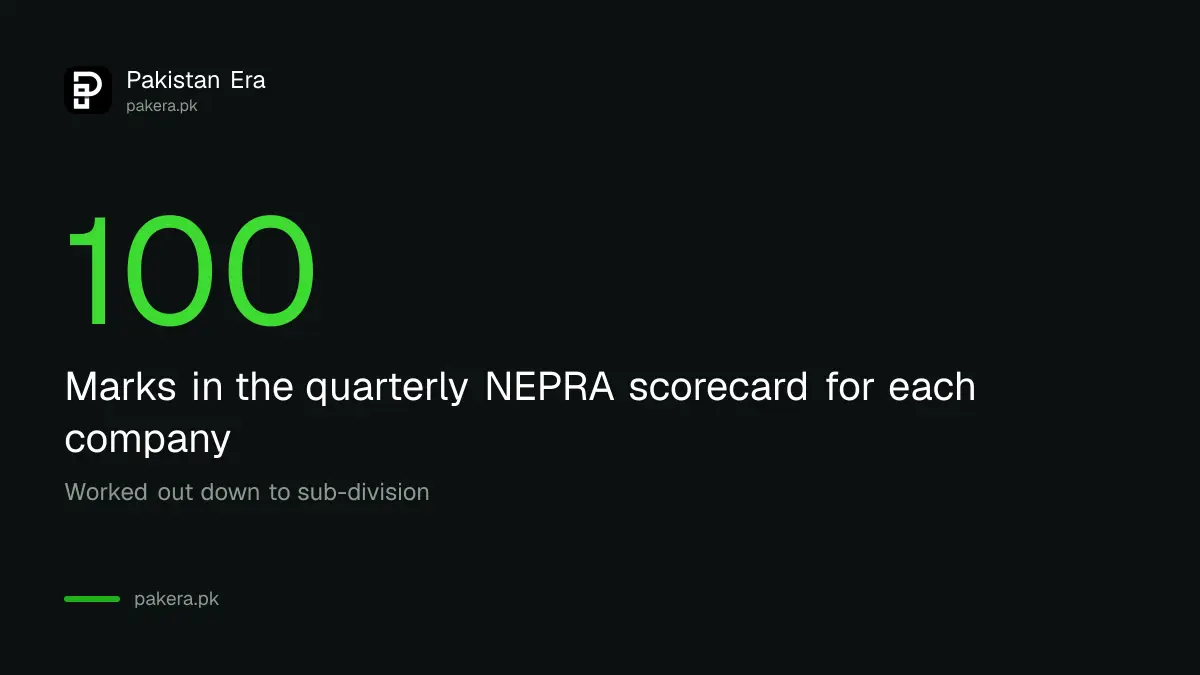
Supply reliability carries the most marks
Out of 100 marks, 35 go to supply reliability, 30 to consumer service, 20 to technical quality, 10 to smart meter performance and 5 to solar, EV and transparency. So power cuts and complaint handling decide most of the score.
| Part of the score | Marks | What it measures |
|---|---|---|
| Supply reliability | 35 | Faults fixed on time, yearly cut limits, planned cuts |
| Consumer service | 30 | Complaints settled on time, consumer satisfaction |
| Technical quality | 20 | Voltage within 5 per cent, power factor |
| Smart meter performance | 10 | Meter data and billing accuracy (not counted in year one) |
| Solar, EV and transparency | 5 | Solar connections, EV charger rules |
The smart meter part is reported in the first year but left out of the total score until the second year. For what those meters change, see what smart electricity meters change in Pakistan.
The rating bands run from A to D
A score of 90 to 100 is A, Excellent. A score of 75 to 89 is B, Satisfactory. A score of 60 to 74 is C, Needs Improvement. Anything below 60 is D, Non-Compliant and the company must explain itself to NEPRA.
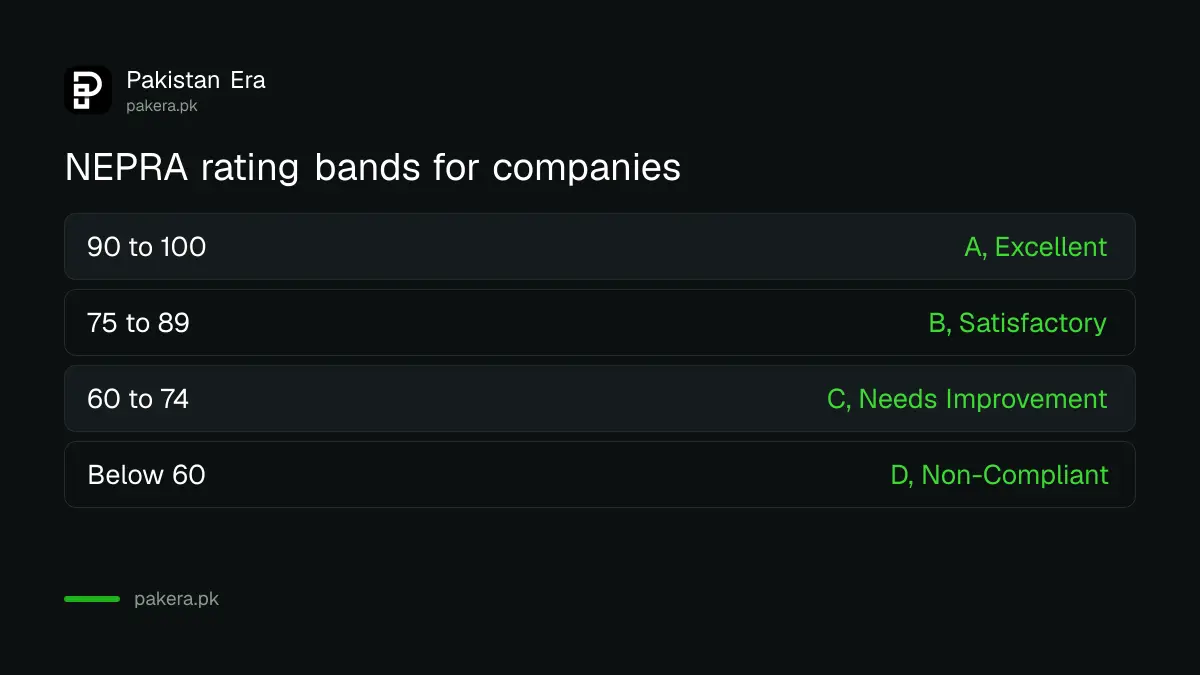
A C rating means management must give an improvement plan within 30 days. A D rating means officers must explain within 15 days and also give a plan. If the supply reliability part falls under half its marks in any quarter, NEPRA must issue a show cause notice, whatever the total score is.
There is a catch. The rating consequences do not apply until the fifth quarter after the rules, so the first few scorecards are practice rounds.
How to find and use your sub-division score
Look on your company's website and app for the quarterly performance scorecard, then find your sub-division. Compare its reliability and complaint marks with the company total. A weak local office is the case to take to your complaint centre.
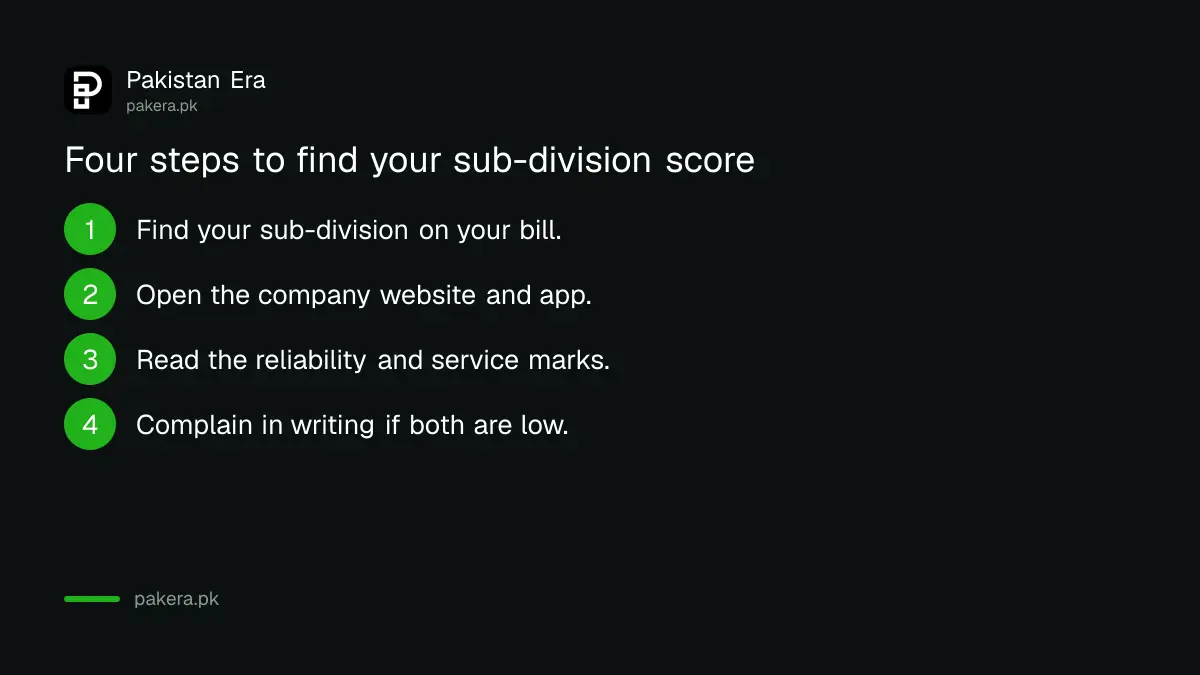
- Find your sub-division name and code on your electricity bill.
- Open your company's website and its consumer app and look for performance reports and the quarterly scorecard.
- Read the supply reliability and consumer service marks for your sub-division.
- If both are low, lodge a written complaint and mention the score. Keep the complaint number.
Our report on 7.4 million electricity company complaints shows why the complaint marks matter. For where to file when the office does not act, see how to complain to NEPRA.
Why a score helps ordinary consumers
A single number lets you compare offices and see which one is slipping. It also gives a complaint more weight, because you can point to the company's own filed figures instead of an opinion. The score is a tool for you and for NEPRA alike.
Be careful with early numbers. The rules give companies time to build their data, and a few quarters will pass before bad ratings carry penalties. Look at the trend over several quarters rather than a single result.
Also compare your office with its own division and circle. A sub-division far below its neighbours is the clearest case for a written complaint, and an officer is less likely to wave it away.
Common questions
How often is the scorecard published?
Every quarter. The company must send it to NEPRA within 15 days of the quarter end and publish it on its website and consumer app.
What is a good score?
A score of 90 or more is rated A, Excellent. A score of 75 to 89 is rated B, Satisfactory.
What happens to a company that scores below 60?
It is rated D, Non-Compliant. Officers must explain within 15 days and give an improvement plan. NEPRA can also fine a company that breaks the standards.
Can I see the score for my own area?
Yes, in principle. The score is worked out for each sub-division, and the regulations say it must be published. We have not confirmed that any company has posted one yet.
Do the ratings have any effect now?
Not yet. The rating consequences start from the fifth quarter. NEPRA can also change the band limits before then.
How we verified this
What we checked, where we read it, and what we could not confirm.
Last checked on 14 October 2026, Pakistan time. We read NEPRA's Performance Standards (Distribution) Regulations 2026, Schedule VIII. We did not find or check any published company scorecard, and we could not confirm when the first one is due.
About the author

Tax, Bills and Technology Writer
Ali Akhtar is a young and curious voice here at Pakistan Era. He is currently pursuing his A-Levels and has a growing interest in Pakistan’s changing industrial landscape and educational trends. Ali likes to write in a way that helps him explain and explore the world around him. His writing reflects the perspective of the new generation navigating the evolving trends of Pakistan where technology, youth innovation, and shifting opportunities are reshaping the country’s future.