How to Check an FBR SRO or Notification Is Genuine in Pakistan
Check an FBR SRO on the FBR website: pick the department list, match number and year, read the signed page and watch for list dates that differ by a day.
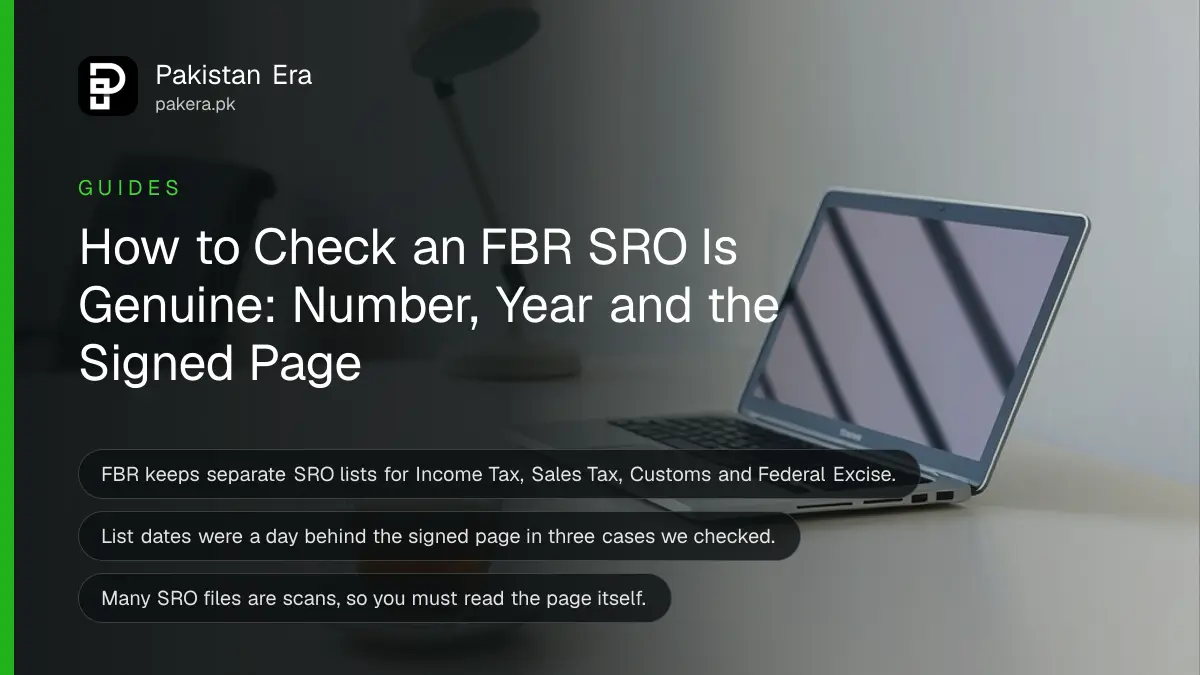
Short answer: To check an SRO, open the Federal Board of Revenue (FBR) website, choose the SRO list for the right department (Income Tax, Sales Tax, Customs or Federal Excise), find the number and year, and open the PDF. Then compare the date, the subject and the legal power on the signed page with what you were told. Do not rely on a forwarded image.
An SRO is a Statutory Regulatory Order, the legal notice through which the government changes a rate, a rule or an exemption. We opened the FBR lists for Income Tax, Sales Tax and Customs while writing this week's notes, and read the PDFs. The lists are useful, but they have habits that can trip you up.
Each tax has its own SRO list on the FBR website
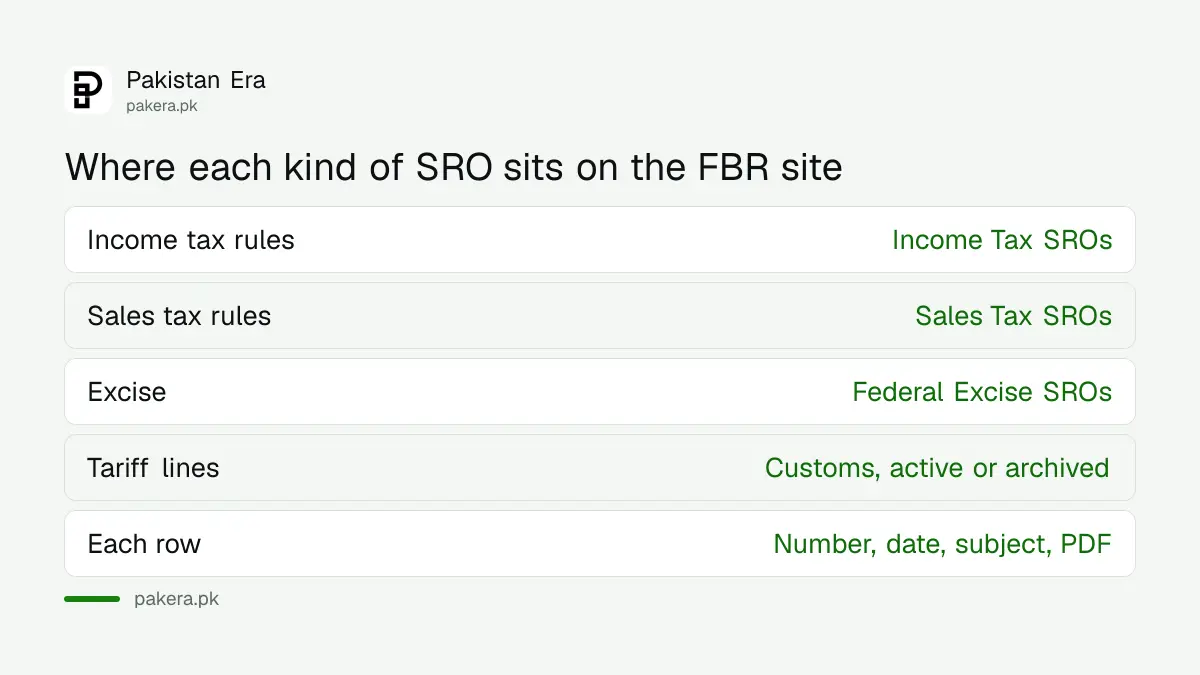
The FBR SRO page splits notifications by department. The groups we saw are Inland Revenue (Income Tax, Sales Tax, Federal Excise) and Customs (active import, active export, and amending or archived). A rule on sales tax will not show on the Income Tax list.
Each row shows the SRO number, a date, a subject line and a link to the PDF. The list for each department shows the newest items first. Draft rules are also listed, and they are marked as drafts.
The number, year and department must all match
An SRO number such as 1889(I)/2026 has three parts: the serial number, the series letter in brackets and the year. The same number can exist in other years, so the year matters. The customs list described the notification amended by S.R.O. 1888 as S.R.O. 693(I)/2026, while the signed page says S.R.O. 693(I)/2006, dated 1 July 2006. We used the signed page.
If a message gives no year, ask for it. Then check that the department fits the subject. A change to a customs tariff line belongs on the Customs list. For an example of a customs notification read through, see our note on S.R.O. 1888 and the new tariff lines.
| What to compare | Where on the signed page |
|---|---|
| Number and year | After "S.R.O." in the first line of the text |
| Date | Top right, under the department name |
| Legal power | The section "in exercise of the powers conferred by" |
| Draft or final | Drafts say "the following draft" and invite objections |
| Signature | Bottom right, with the officer's post |
The date on the list can differ from the date on the page
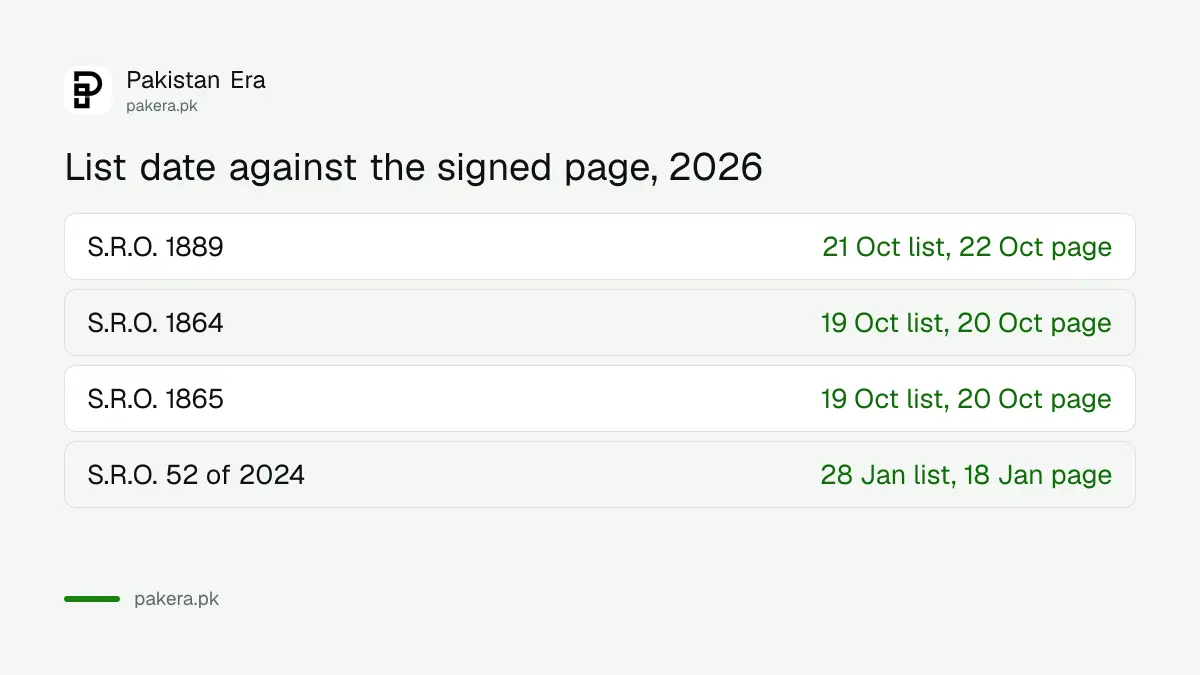
This is the trap we hit most. FBR's Sales Tax list showed S.R.O. 1889(I)/2026 under 21 October 2026, but the signed page is dated 22 October. The Customs list showed S.R.O. 1864 and 1865 under 19 October, and the signed pages say 20 October.
We cannot tell why the listed dates run a day early. If a deadline or a start date depends on the day, use the date on the signed page. A notification that states its own start date, such as the faceless audit rule in force from 15 October, is easier to rely on.
Many SRO files are scans and some hold more than one document
Most of the PDFs we opened were scanned images with no text layer. You cannot search them, and a copy-paste tool will return nothing. Open the PDF and read the page. Some files also contain other papers. The file for S.R.O. 1888 held a website request form and a separate federal excise order for hatcheries.
Another file, for S.R.O. 1829, carried the title "Revised SRO 1829 of 2026". So a "revised" version can replace an earlier one under the same number. If two copies of an SRO differ, ask which was uploaded last and look for the later date on the list.
A draft is not law until it is notified
Draft rules say "the following draft" and give seven days from publication in the official Gazette for objections or suggestions. We saw this wording on the income tax drafts of 6 October 2026. A draft on the FBR list can still change or never be notified. Our note on the draft rule 38B shows how a draft reads.
When a viral message calls a draft a new law, check the opening lines of the page. And check whether a final notification has followed. For a guide to the law text itself, see how to find the latest text of a federal law.
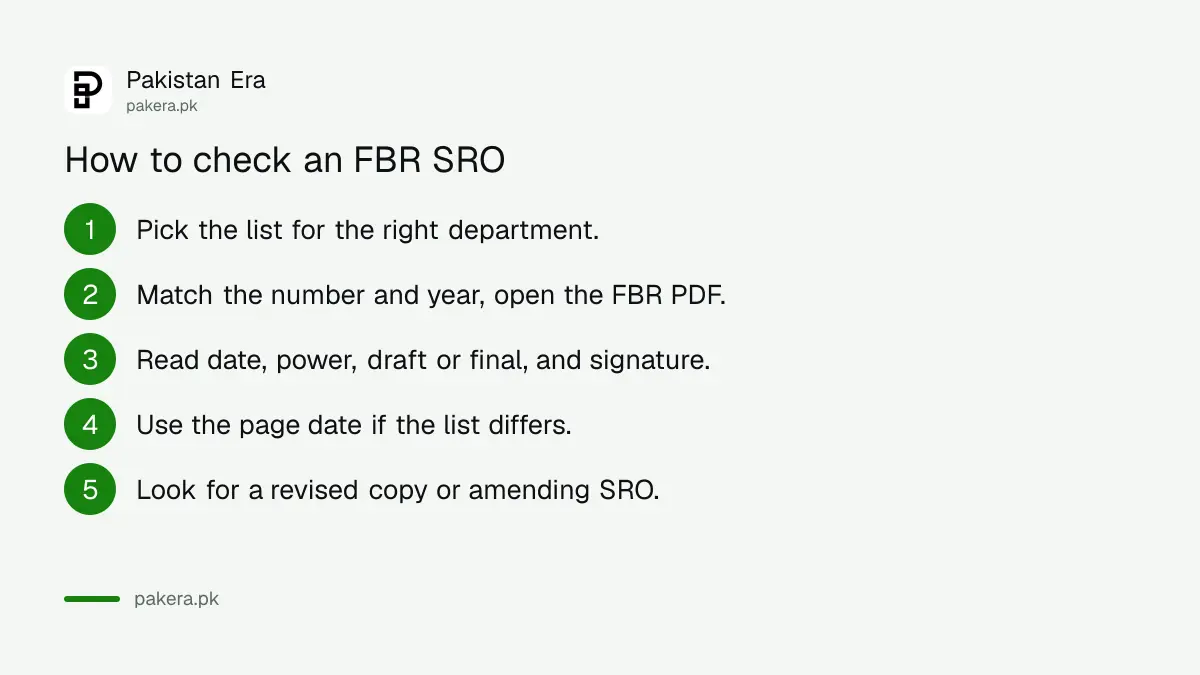
- Pick the department list that fits the subject.
- Find the number and year, and open the PDF from the FBR site only.
- Read the signed page: date, power, draft or final, and signature.
- If the list date and the page date differ, use the page date.
- Check for a later "revised" copy or an amending SRO.
- If you cannot find it, do not act on it. Ask an FBR office or your tax adviser.
Beware of images forwarded on messaging apps. A fake notice can copy FBR's look. Our guide on checking a viral government notice lists what to look for. Use only the FBR domain, fbr.gov.pk, and its download site for the PDFs.
Common questions
Where do I find an FBR SRO?
On the SRO pages of the FBR website, in the list for the right department: Income Tax, Sales Tax, Federal Excise or Customs.
What does the number mean?
It is the serial number, the series letter in brackets and the year, for example 1889(I)/2026. Always quote all three parts.
Why does the list show a different date?
We saw lists run one day behind the signed page in several cases. Use the date printed on the signed page.
Can I search the text of an SRO?
Often not. Many files are scanned images with no text layer, so you must read the page.
How do I know if an SRO is a draft?
The text says "the following draft" and invites objections within seven days of Gazette publication. A final notification says the Board "is pleased to" make or direct the change.
Does a listing on the FBR site mean it is in force?
Not by itself. Check whether it is final, and whether the text gives a start date. Some pages give none.
How we verified this
What we checked, where we read it, and what we could not confirm.
Last checked 23 October 2026. We opened the Income Tax, Sales Tax and Customs lists on the FBR SRO pages through a page reader, and read the signed PDFs of S.R.O. 1689, 1691, 1692, 1751, 1825, 1864, 1865, 1888 and 1889 of 2026. We did not check the Gazette, the Federal Excise list or the archived customs list, and we cannot say that the date gap is the rule everywhere.
About the author

Tax, Bills and Technology Writer
Ali Akhtar is a young and curious voice here at Pakistan Era. He is currently pursuing his A-Levels and has a growing interest in Pakistan’s changing industrial landscape and educational trends. Ali likes to write in a way that helps him explain and explore the world around him. His writing reflects the perspective of the new generation navigating the evolving trends of Pakistan where technology, youth innovation, and shifting opportunities are reshaping the country’s future.