FBR Drafts Rule 38B: IRIS Would Flag Tax Return Errors Before Any Penalty
FBR's draft rule 38B would flag errors in your tax return on IRIS and give you at least seven days to reply before any penalty. See what the draft says.
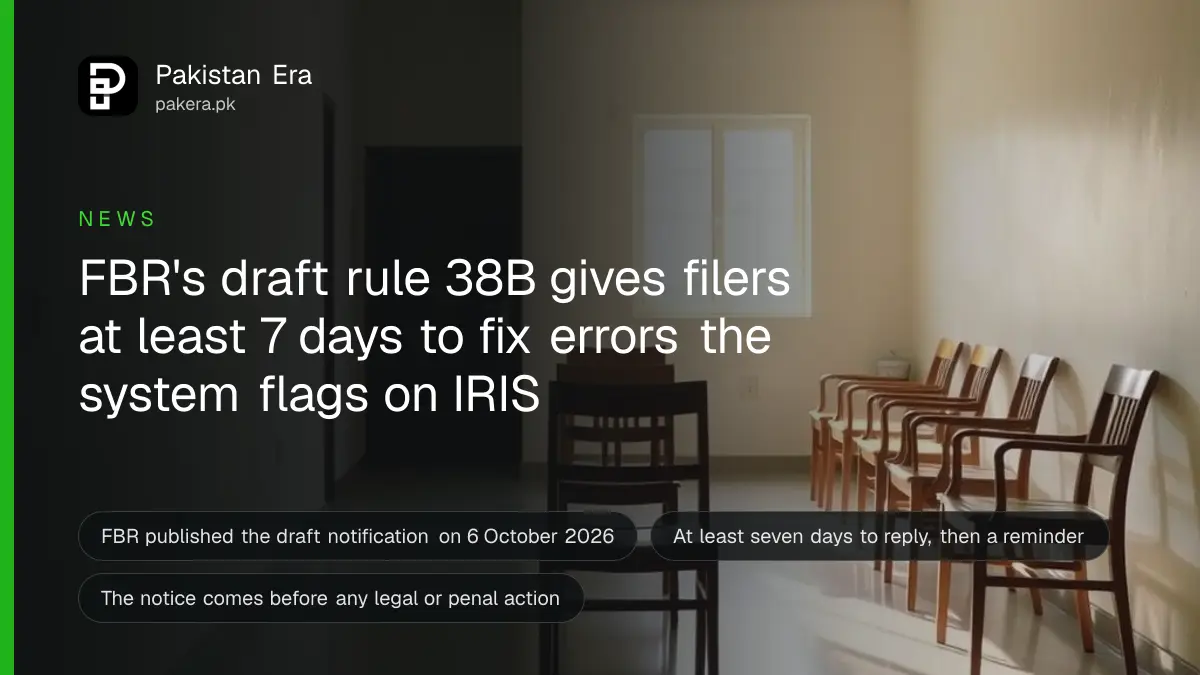
FBR has published a draft rule, number 38B, that would make its computer system flag errors in your income tax return and tell you on IRIS before any penalty or legal step starts. The notice must give you at least seven days to reply. It is a draft, not law yet.
Most filers meet FBR at the end of a long chain: a mismatch is found, an officer is assigned, and a notice arrives with a deadline. This draft tries to move the first contact earlier and make it automatic. It matters most to anyone who files by the new 15 October 2026 date and then forgets about the return.
We read the draft notification, S.R.O. 1690(I)/2026, on FBR's own website on 8 October 2026. This is what it says, what it does not say and what you can do now.
The draft is dated 6 October 2026 and is not yet in force
FBR published the draft on 6 October 2026 as S.R.O. 1690(I)/2026. It proposes to insert a new rule 38B in the Income Tax Rules, 2002, after rule 38A. The title is "Procedure for electronic scrutiny and intimation of issues detected by the automated system".
It is a draft under section 237 of the Income Tax Ordinance, 2001. That means FBR invites objections and suggestions first. The notification gives three days from its publication in the official Gazette. We did not find a Gazette date, so we cannot say when that window closes.
Until FBR notifies the final rule, nothing here binds you. The text can also change after objections.
The system would warn you on IRIS before any legal action
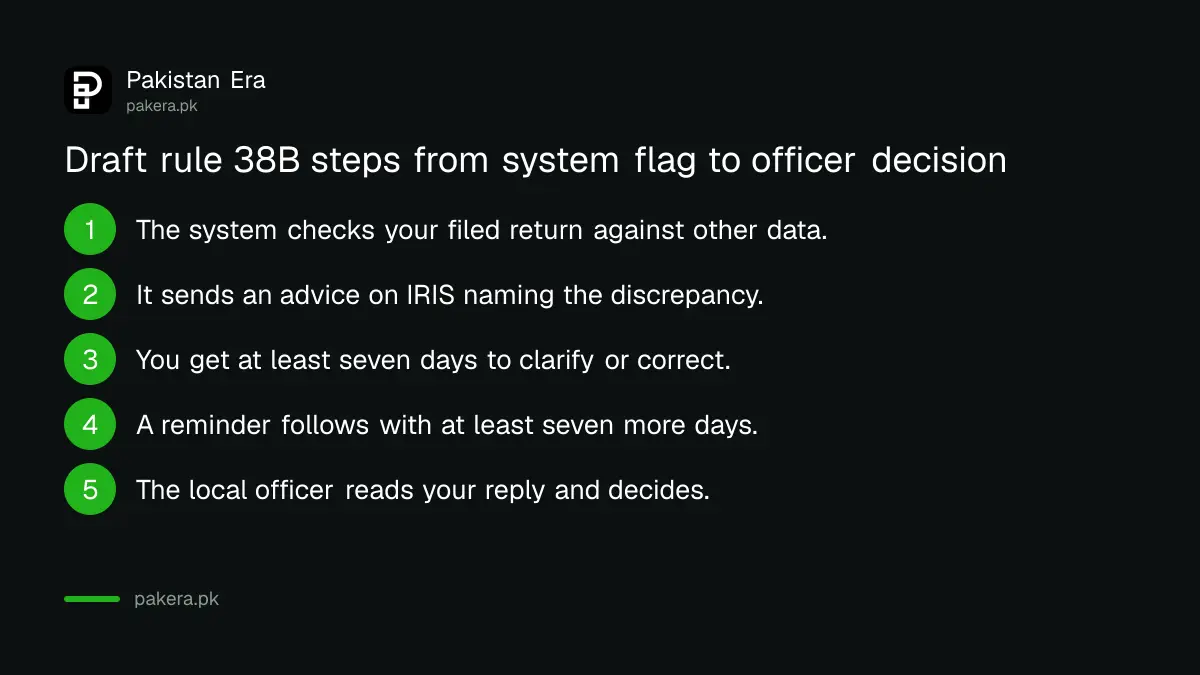
Under draft sub-rule (2), the automated system may send an online advice or advance intimation through IRIS. It would point out factual or legal mistakes or discrepancies in your return.
The stated aim is to let you clarify the issue, correct the error or take other corrective action before any legal or penal action starts. That order is the useful part. Today a mismatch can reach you as a formal notice. Under the draft it would reach you as a warning first.
The rule rests on section 120(2A) of the Ordinance, which already lets FBR process returns through an automated system. The draft sets the procedure for that system.
You would get at least seven days to reply, and a reminder
Two time limits are in the draft, both in plain numbers. The table lists the draft sub-rules that matter to a filer.
| Draft sub-rule | What it says |
|---|---|
| (2) | The system may send an advice or advance intimation on IRIS about errors or discrepancies |
| (3) | The Officer of Inland Revenue with jurisdiction can also send the same system-generated intimation |
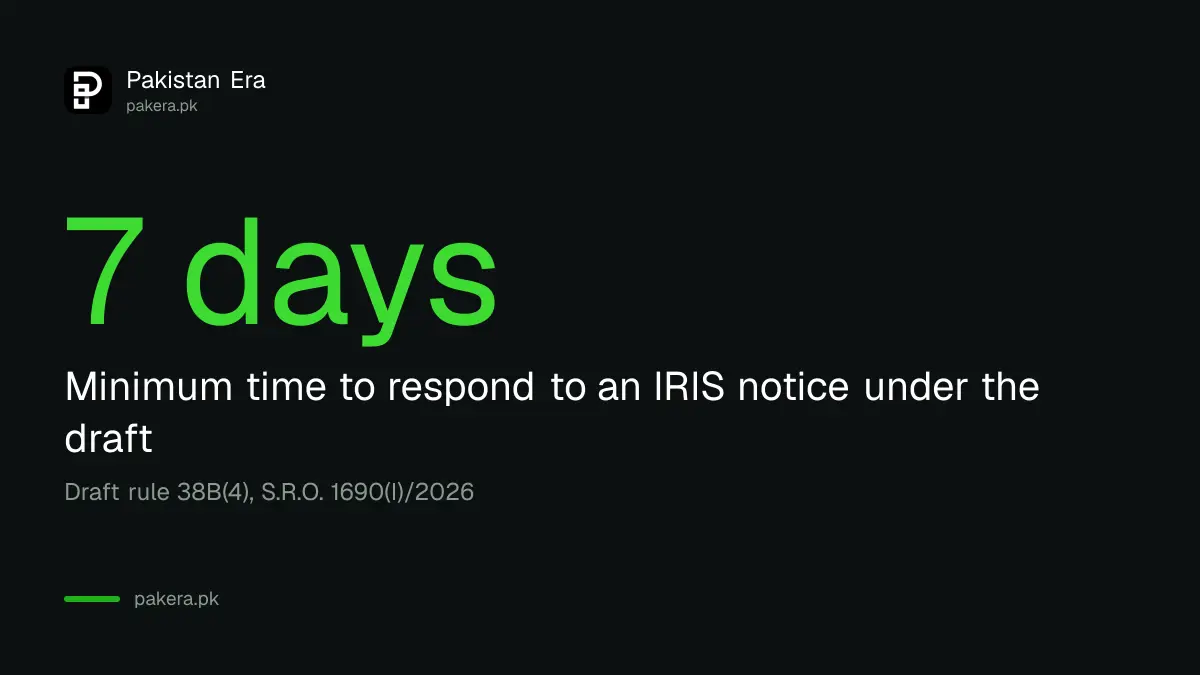
| (4) | The intimation sets a response period of not less than seven days |
| (5) | If you do not respond in time, a reminder follows, again not less than seven days |
| (6) and (7) | The issue, the intimation and your response are recorded, passed to the officer and logged on a dashboard |
| (9) | The officer reads your response and takes action under the Ordinance if needed |
So the minimum is seven days to reply and then another seven days after a reminder. Both are minimums. The notice itself will state the actual period, and it could be longer.
A flag is not an assessment or an audit
The draft does not say a flagged issue becomes a penalty. It says the intimation comes before "any legal or penal action". After your response, the local officer analyses it, or the lack of one, and decides whether to act under the Ordinance.
That is different from a full audit. FBR's new faceless audit centre handles selected audits through computer-picked cases, as we explained in the report on FBR's National Faceless Centre for tax audits. Rule 38B is about the earlier step, a system check of the return.
One point the draft leaves open. Section 120(2A) of the Ordinance has its own safeguard: a system-generated notice naming the adjustments, and thirty days to respond before adjustments are made. It also says the sub-section applies from a date FBR notifies in the Gazette. The draft does not explain how its seven day minimum fits with those thirty days. We did not find a notification of that date either, so treat both as unclear for now.
A filer can prepare now by keeping the return clean
You cannot reply to a notice that does not exist yet. But a few habits will make any future flag easy to answer.
- Make sure FBR can reach you. A notice on IRIS only helps if you log in. Check your registered mobile number and email on the IRIS profile.
- Keep your paperwork for the year. Bank statements, salary slips, tax deduction certificates and property papers are what answer a mismatch.
- Match the return to what FBR already holds. The Summary of Economic Transactions in your return shows tax already recorded against your CNIC. Differences are what a system would catch.
- Fix a mistake yourself if you find one. The steps to revise an income tax return under section 114(6) are open to you before anyone asks.
- Check your return went through. Confirm that the return and wealth statement show as completed, as in the steps to check an income tax return was filed on IRIS.
If you have not filed for tax year 2026, the date is 15 October 2026 under the circular covered in the report on the extension of the tax return deadline. A return filed on time is also the first thing any system looks for.
Common questions
Is rule 38B in force?
No. S.R.O. 1690(I)/2026 is a draft published on 6 October 2026. FBR must consider objections and notify a final version first.
How long will I have to reply to an IRIS notice?
The draft says not less than seven days, and the notice will state the exact period. If you do not reply, a reminder follows with at least seven more days.
Will I get a penalty if the system flags my return?
The draft says the flag comes before any legal or penal action. It does not say a flag leads to a penalty. The local officer decides after reading your reply.
Who can send the intimation?
The automated system, and also the Officer of Inland Revenue who has jurisdiction over you, under draft sub-rule (3).
Will I get the notice by post?
The draft names IRIS as the channel. It does not mention post, SMS or email, so keep your IRIS account reachable.
Does this replace the faceless audit?
No. The draft covers system checks of returns and advance intimation. Audits and assessments fall under section 122E and the National Faceless Centre.
How we verified this
What we checked, where we read it, and what we could not confirm.
Last checked on 8 October 2026. We read the draft notification S.R.O. 1690(I)/2026, dated 6 October 2026, from FBR's SRO page, where it is listed with the other draft Income Tax Rules published that day. We also read sections 120 and 237 of the Income Tax Ordinance, 2001 in FBR's consolidated copy, amended up to 30 June 2026. We could not find the Gazette publication date, so the closing date for objections is not known. Nothing here is tax advice.
About the author

Tax, Bills and Technology Writer
Ali Akhtar is a young and curious voice here at Pakistan Era. He is currently pursuing his A-Levels and has a growing interest in Pakistan’s changing industrial landscape and educational trends. Ali likes to write in a way that helps him explain and explore the world around him. His writing reflects the perspective of the new generation navigating the evolving trends of Pakistan where technology, youth innovation, and shifting opportunities are reshaping the country’s future.