Check Domestic Worker Rights in Islamabad: Leave, Maternity Benefit and Notice Under the 2022 Act
Islamabad domestic workers get a written letter, a weekly rest day, 8 sick days, 10 festival days, 6 weeks maternity leave and a month notice under 2022 Act.
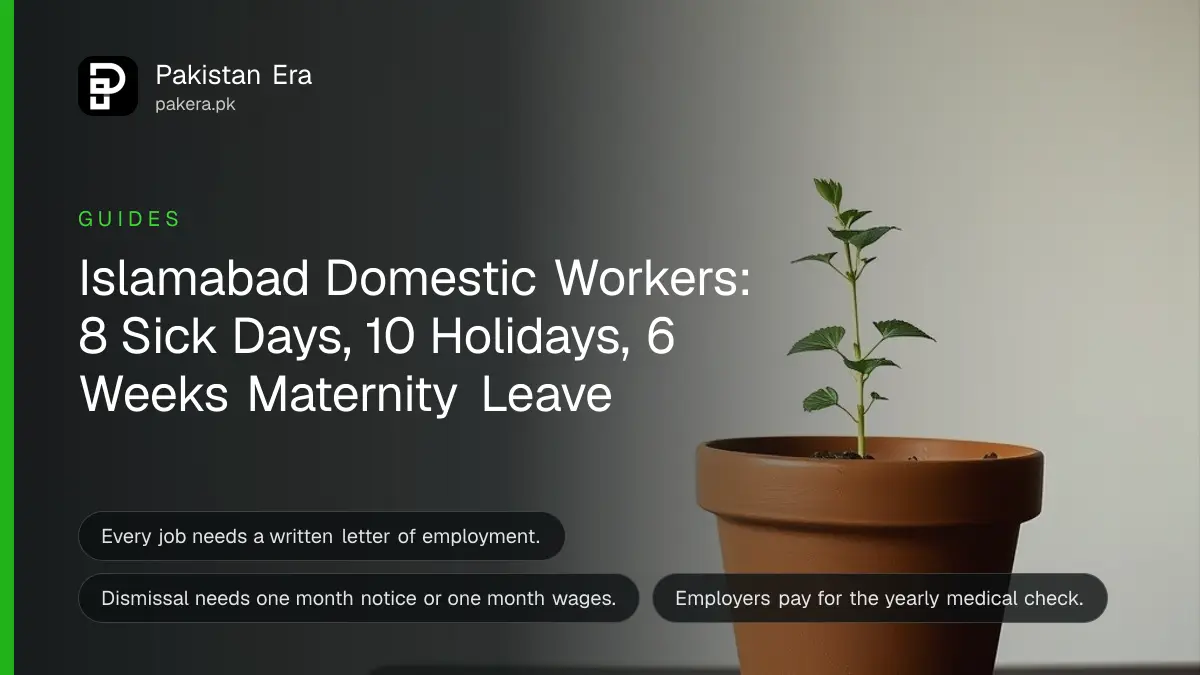
Under the Islamabad Capital Territory Domestic Workers Act 2022, a domestic worker is entitled to a written letter of employment, one rest day a week, 8 days of paid sick leave, 10 festival holidays, 6 weeks of maternity leave and one month's notice before dismissal. The Act applies only inside Islamabad. It came into force at once on 21 October 2022.
Maids, cooks, drivers and carers in Islamabad homes often work without a contract or a day off. We read the Act as published in the Gazette of Pakistan (Extraordinary) of 25 October 2022 on 21 October 2026. This guide lists what the employer owes. If wages or documents are the problem, use our guide to the 30 day dispute route in Islamabad.
Every domestic worker must get a written letter of employment
Section 5 says every job must start with a letter of employment in the prescribed form. It states the nature of work and the wage. The employer must send a copy to the Commissioner's office in Islamabad. The worker cannot be made to do work outside the job description in that letter.
Employers had 60 days from the start of the Act to issue letters to staff already working. The employer may keep a copy of the worker's identity documents during the job, never the originals. We could not find the prescribed form in the Act itself, so ask the Islamabad administration for it.
Live-in workers get 12 hours free of duty and one full rest day a week
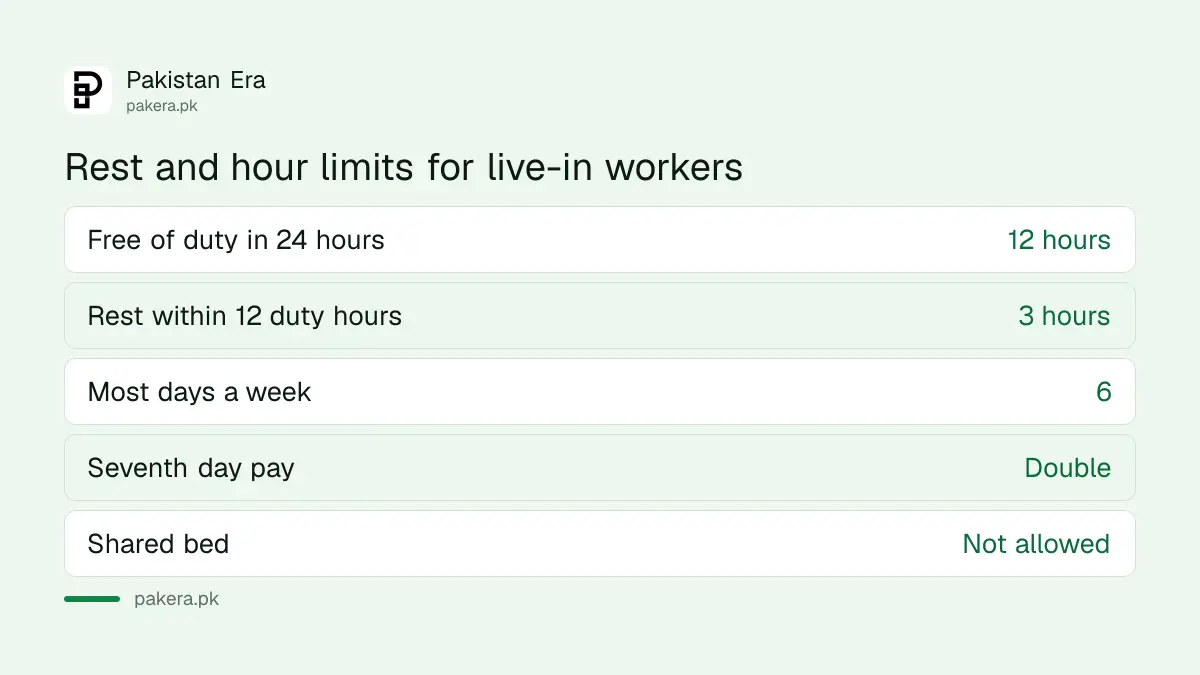
Section 5(5) gives a full time or live-in worker at least 12 hours free of duty in every 24 hours. In the 12 hours of duty, at least 3 hours must be rest or break time. No worker can be made to work more than six days a week.
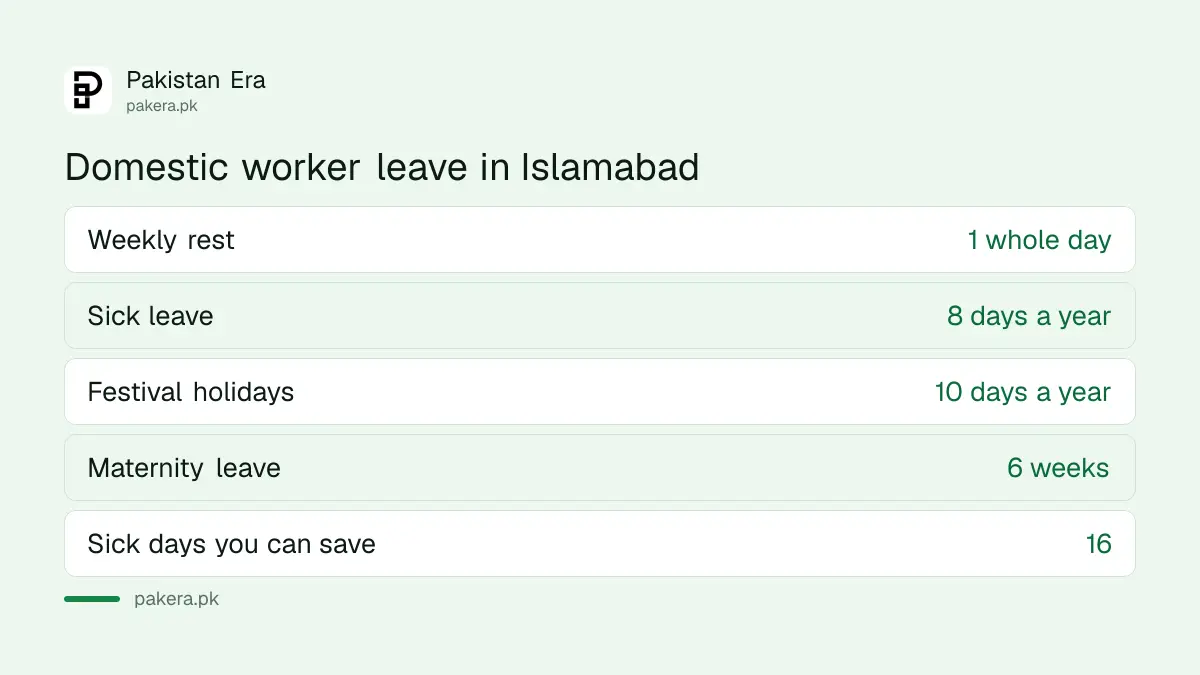
A seventh day is possible only if both sides agree, and it is paid at double the usual rate. Section 6(1) also gives every domestic worker at least one whole day off each week. A worker may be employed for seven days in a row only if the total hours do not pass 30 and no day passes six hours.
Sick leave is 8 paid days and festival holidays are 10 paid days
Section 6 gives 8 days of sick leave on full wages each year. Unused days carry forward, up to 16 days at one time. A domestic worker also gets 10 festival holidays on full wages, with dates agreed with the employer at the start of the calendar year.
| Entitlement | What the Act says | Section |
|---|---|---|
| Weekly rest | At least one whole day a week | 6(1) |
| Sick leave | 8 days a year on full wages, up to 16 saved | 6(2) |
| Festival holidays | 10 days a year on full wages | 6(3) |
| Maternity leave | 6 weeks for a female worker | 6(4), 9 |
| Notice of dismissal | One month in writing, or one month's wages | 13 |
| Yearly medical check | At the employer's cost | 11 |
Pay for leave is the daily average of what the worker earned in the three months before. A worker on sick leave of four days or more must be paid before the leave begins. Any promise to give up these rights is void under section 15.
A female domestic worker gets six weeks of maternity leave and benefit
Sections 6(4) and 9 give a female domestic worker six weeks of maternity leave. The maternity benefit must be at least six weeks of wages, and never less than the minimum wage the Government notifies. The Act says the manner of payment will be prescribed in rules.
We did not find rules under the Act. So the amount is clear but the payment process is not. Ask for the benefit in writing before leave starts and keep a copy. For the wage floor, see the guide to the Islamabad minimum wage and shortfall claims.
Employers must give decent accommodation, a yearly check-up and one month's notice
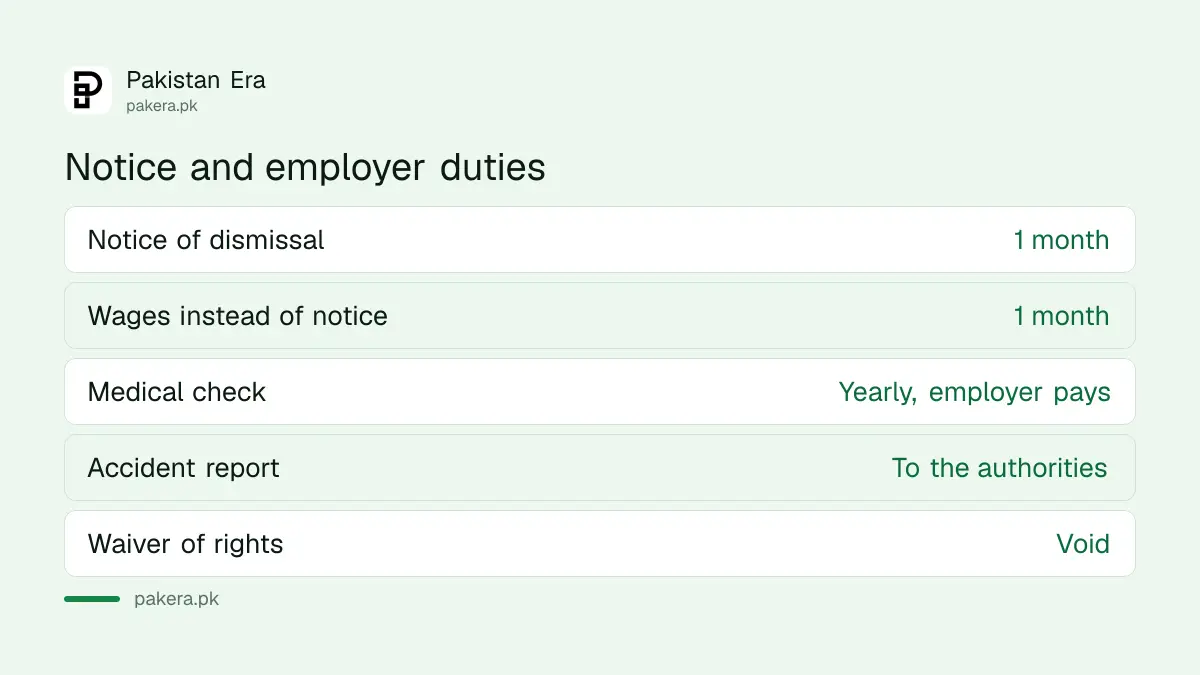
Section 10 says a live-in worker must have decent living conditions and cannot be made to share a bed. Section 11 requires a yearly medical examination by a registered doctor, and vaccination, at the employer's cost. Section 13 requires one month's written notice from either side.
If the employer ends the job without notice, one month's wages must be paid instead, worked out from the average of the last three months. Section 12 also requires the employer to report a serious accident at home that keeps a worker off work for 48 hours.
- Ask for the letter of employment in writing and keep a copy.
- Agree the weekly rest day and the 10 festival days at the start of the year.
- Note every sick day and every day worked beyond the agreed hours.
- Keep messages about wages, notice and any request to sign away leave.
- If a right is refused, raise a dispute within 30 days.
Common questions about Islamabad domestic worker rights
Does the Act apply in Rawalpindi or Lahore?
No. It extends only to the Islamabad Capital Territory. Other provinces have their own laws. See our guide to domestic worker rights across provinces.
Can an employer dismiss me without notice?
Not without paying one month's wages instead, under section 13. Either side can give one month's written notice.
How many sick days do I get?
Eight days a year on full wages, and unused days carry forward up to 16 days.
Can I give up my weekly day off for extra money?
Section 15 makes any waiver of a right under the Act void. A seventh working day is possible by mutual agreement at double pay, but the weekly rest day itself is a right.
Must the employer pay for my medical check?
Yes. Section 11 makes the yearly check and vaccinations the employer's expense.
Do I need to register my worker with the police?
That is a separate step under Islamabad police rules. See our guide on how to register a domestic worker with the police.
How we verified this
What we checked, where we read it, and what we could not confirm.
Last checked 21 October 2026. We read sections 1 to 19 of the Islamabad Capital Territory Domestic Workers Act 2022, assented on 21 October 2022 and published in the Gazette of Pakistan (Extraordinary) on 25 October 2022, from a copy of the Gazette text. The statute is listed on Pakistan Code. We did not find rules under the Act, the prescribed letter form or the current notified domestic worker wage, so confirm them with the Islamabad administration. The overtime rate is not stated clearly in our copy, so we leave it out.
About the author

Tax, Bills and Technology Writer
Ali Akhtar is a young and curious voice here at Pakistan Era. He is currently pursuing his A-Levels and has a growing interest in Pakistan’s changing industrial landscape and educational trends. Ali likes to write in a way that helps him explain and explore the world around him. His writing reflects the perspective of the new generation navigating the evolving trends of Pakistan where technology, youth innovation, and shifting opportunities are reshaping the country’s future.