Check Any Medicine Against the WADA 2026 Prohibited List Before You Compete in Pakistan
Check every medicine against the WADA 2026 Prohibited List before you compete. See which groups are banned always or only in competition, and the steps to take.
Short answer: Before you compete in Pakistan or abroad, check every medicine against the WADA Prohibited List that is in force, which on 21 October 2026 is the 2026 List, effective from 1 January 2026. If a substance is not listed, or you are unsure, ask your anti-doping organisation before you take it. In Pakistan that is the Anti-Doping Organization of Pakistan.
A cough syrup, an inhaler or an injection from a clinic can end a season. The athlete is responsible for what is in the body, whoever prescribed it. This guide shows how to read the list, which groups are banned only on match day and which always, and what to do first. We read the World Anti-Doping Agency (WADA) page on 21 October 2026.
The 2026 List is in force and a new list is published each October
The 2026 List of Prohibited Substances and Methods went into effect on 1 January 2026. WADA says the list is updated at least once a year, with the new version published in October and taking effect on 1 January. The page we read did not yet show a 2027 list.
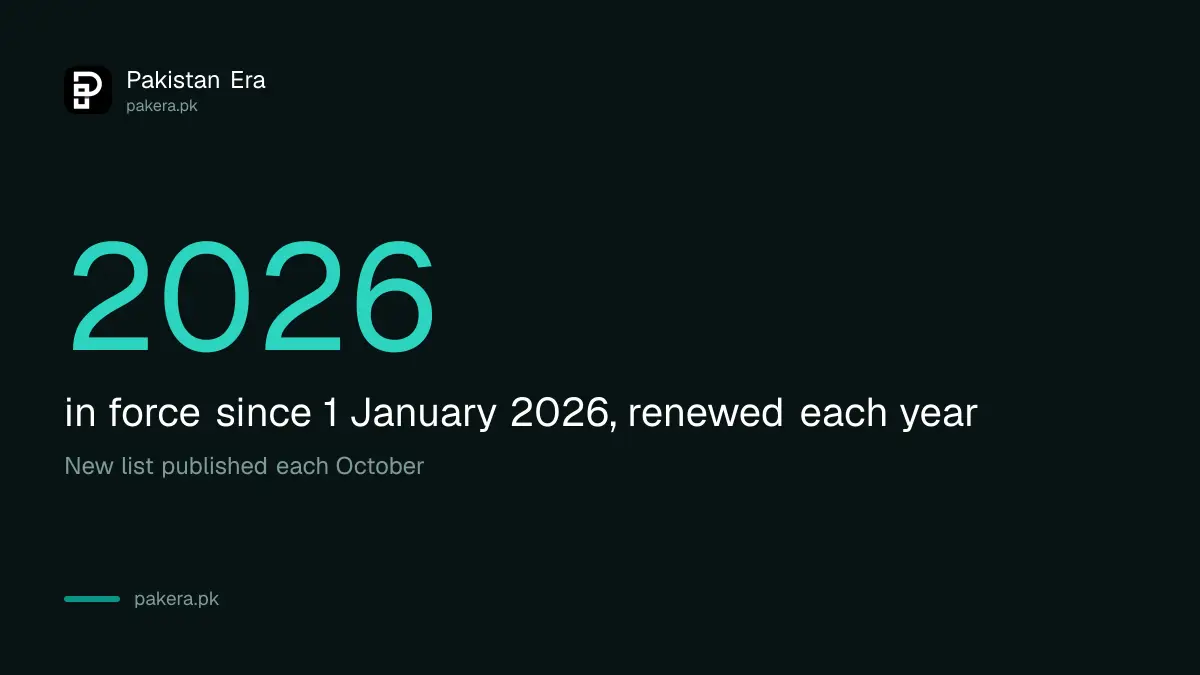
So an athlete who plans a medicine in November or December should recheck after the new list appears. A medicine that is allowed today can be banned from 1 January.
Some groups are banned always and some only in competition
The list has groups with codes. S0 to S5 and M1 to M3 are banned at all times. S6 stimulants, S7 narcotics, S8 cannabinoids and S9 glucocorticoids are banned in competition. P1, beta-blockers, applies only in particular sports.
| Code | Group | When banned |
|---|---|---|
| S0 | Non-approved substances | At all times |
| S1 | Anabolic agents | At all times |
| S2 | Peptide hormones and growth factors | At all times |
| S3 | Beta-2 agonists | At all times |
| S4 | Hormone and metabolic modulators | At all times |
| S5 | Diuretics and masking agents | At all times |
| S6 | Stimulants | In competition |
| S7 | Narcotics | In competition |
| S8 | Cannabinoids | In competition |
| S9 | Glucocorticoids | In competition |
| P1 | Beta-blockers | In particular sports |
| M1 to M3 | Blood, chemical and gene manipulation | At all times |
"In competition" has its own definition in the rules, and we did not open it. Do not assume the ban stops when the match ends.
Check the medicine before you take it, in six steps
The safe order is to check first, then take. Write down the name of the active ingredient, not just the brand name, because pharmacies in Pakistan sell one ingredient under many brands.
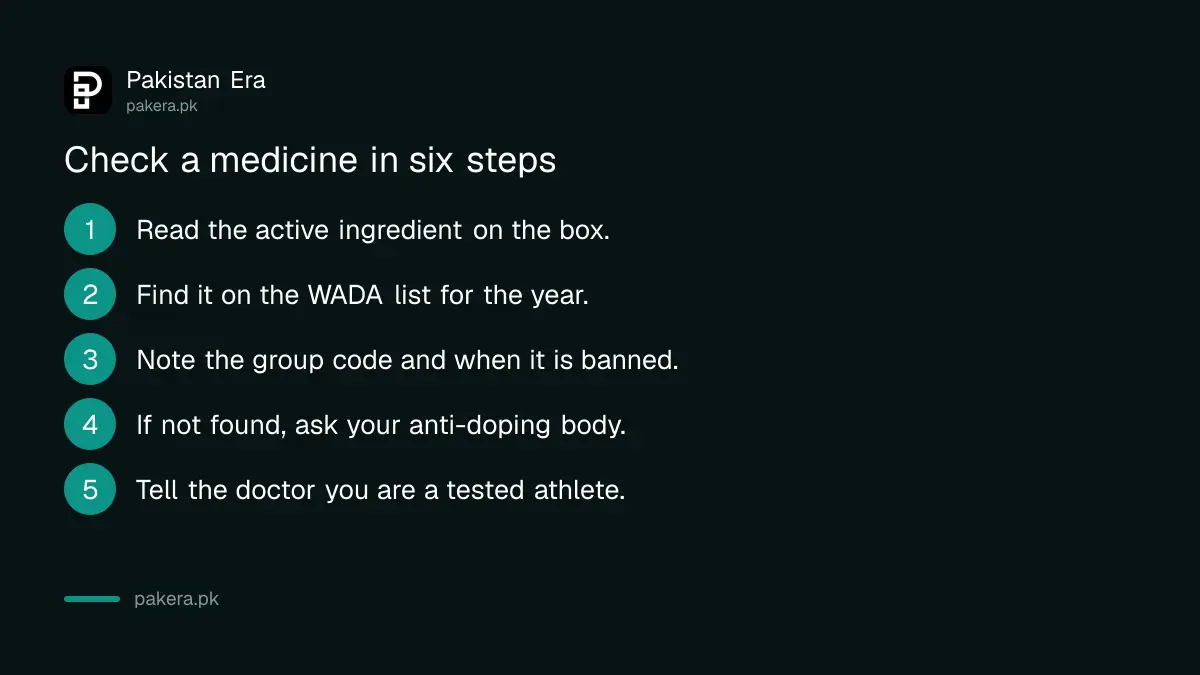
- Read the active ingredient on the strip or box.
- Look for that ingredient on the WADA list for the year you will compete.
- Note the group code and whether it is banned at all times or in competition.
- If you cannot find it, ask your anti-doping organisation. WADA's own page says to do this.
- Tell the doctor you are a tested athlete before any prescription.
- Keep the prescription and the box, with dates, in case of a test.
A banned medicine may need an exemption before you compete
If an athlete has a real medical need for a listed substance, the route is a Therapeutic Use Exemption, usually called a TUE. WADA publishes guidelines for glucocorticoids and TUEs. The exemption has to come before competing, in the normal case, and the national or international body decides.
For the details of who approves a TUE in Pakistan, and the forms, we could not open the national anti-doping organisation's site on 21 October 2026. So we do not state the steps. Contact the Anti-Doping Organization of Pakistan or your federation first, and do not take a banned medicine while you wait.
The same applies to a team going abroad. A federation that sends a squad needs the right paperwork, and the guide to getting a PSB NOC to send a team abroad covers that side. The money side is in the report on PSB grants to sports federations.
Where cricket, hockey and club players fit
The WADA list applies to sports that follow the World Anti-Doping Code. Whether a particular club league tests is a question for its organiser. If you play at a level where you could be tested, assume the list applies.
Beta-blockers, group P1, are a good example of a rule that depends on the sport. A medicine for blood pressure can be fine in one sport and banned in another. So the sport you play decides the answer, not only the medicine.
Common questions
Which WADA list applies in October 2026?
The 2026 List, in force since 1 January 2026. WADA says a new list is published each October and takes effect on 1 January.
Are all banned substances banned at all times?
No. Groups S6 to S9 are banned only in competition, and P1 only in particular sports. S0 to S5 and M1 to M3 are banned at all times.
What if my medicine is not on the list?
Ask your anti-doping organisation before you take it. WADA's page says to verify with your Anti-Doping Organization.
What is a TUE?
A Therapeutic Use Exemption lets an athlete use a banned medicine for a real medical need. It has to be approved by the right body.
Does a doctor's prescription protect me?
No. The athlete is responsible for what is in the body. Tell the doctor you are a tested athlete before you accept a prescription.
Who runs anti-doping in Pakistan?
The Anti-Doping Organization of Pakistan. We could not open its site, so check its current contact details yourself.
How we verified this
What we checked, where we read it, and what we could not confirm.
Last checked 21 October 2026. We read the WADA Prohibited List page on 21 October 2026 for the 2026 effective date, the group codes and the advice to check with your anti-doping organisation. We did not read the list itself, the definition of "in competition", the TUE rules, or any page of the Anti-Doping Organization of Pakistan, because they did not load for us. We therefore give no Pakistani TUE procedure. The point that an athlete answers for what is in the body is the standard rule of the Code, which we did not re-read.
About the author

Tax, Bills and Technology Writer
Ali Akhtar is a young and curious voice here at Pakistan Era. He is currently pursuing his A-Levels and has a growing interest in Pakistan’s changing industrial landscape and educational trends. Ali likes to write in a way that helps him explain and explore the world around him. His writing reflects the perspective of the new generation navigating the evolving trends of Pakistan where technology, youth innovation, and shifting opportunities are reshaping the country’s future.