Civil Servants (Amendment) Act 2026: 5 Changes for Federal Employees in Pakistan
The Civil Servants (Amendment) Act 2026 changed 5 sections for federal staff in Pakistan: surplus absorption, compassionate allowance, transfers and conduct.
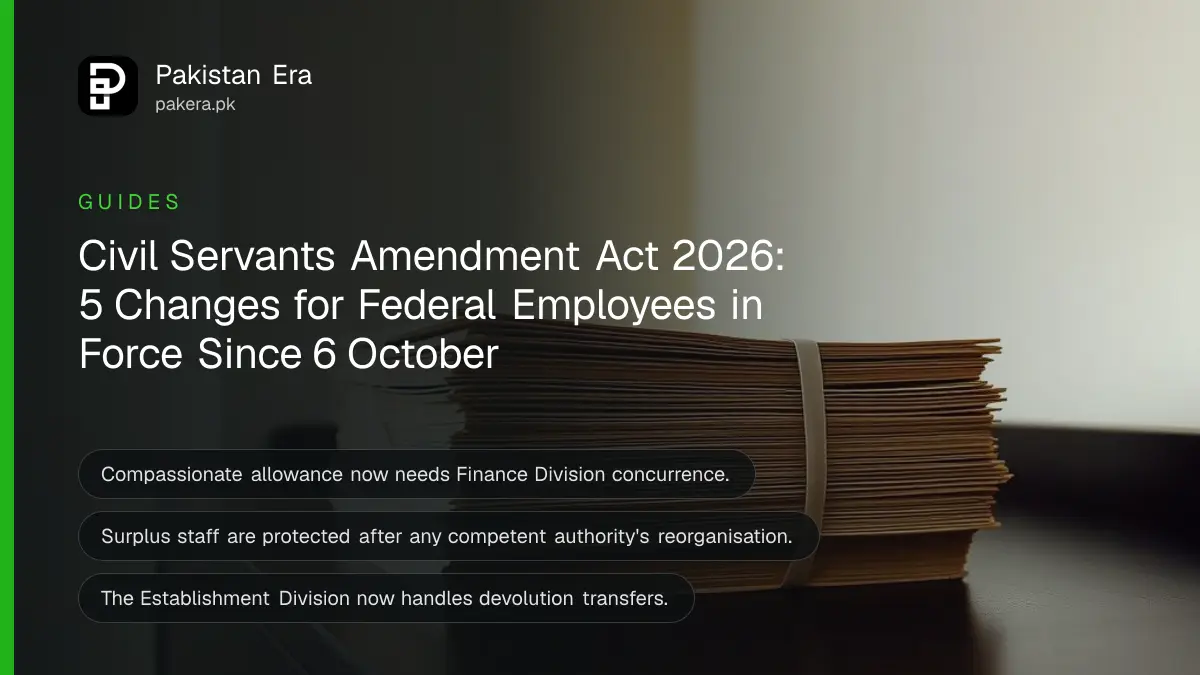
Short answer: The Civil Servants (Amendment) Act, 2026 made five changes to Pakistan's Civil Servants Act, 1973, in force since 6 October 2026. The biggest for federal employees: a compassionate allowance for a dismissed civil servant is now sanctioned by the appointing authority with the Finance Division's concurrence, and the surplus absorption rule now covers reorganisations decided by any competent authority, not only the government. Devolution transfers now sit with the Establishment Division.
The Civil Servants Act, 1973 is the basic law for federal government employees. It sets out appointment, transfer, termination, conduct, pay, pension and appeals. The 2026 amendment is short, but two of its changes touch money and jobs directly. Here is each change, with the old and new wording side by side.
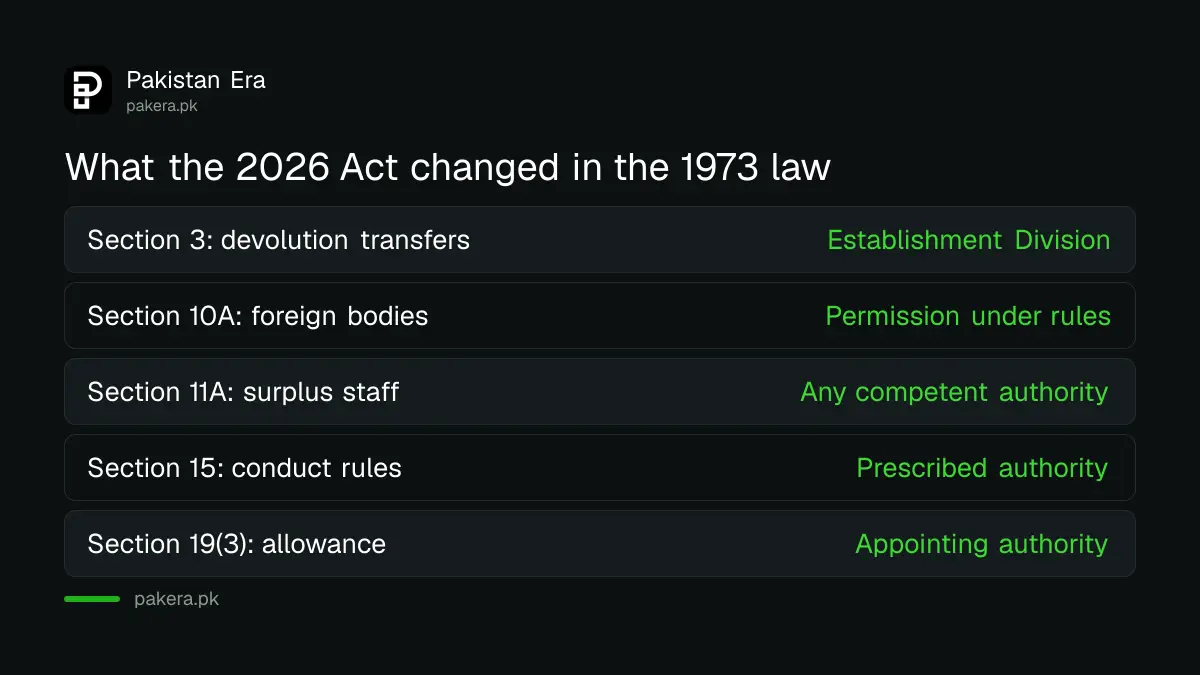
The 2026 Act changed five sections of the Civil Servants Act
The amendment was passed by Parliament and received the President's assent on 6 October 2026. It was published in the Gazette on 12 October 2026 and came into force at once. It changes sections 3, 10A, 11A, 15 and 19 of the 1973 Act.
| Section | Before | After the 2026 Act |
|---|---|---|
| 3(3) and 3(4): transfers after devolution | The Federal Government may transfer | The Establishment Division may transfer |
| 10A(2): work in international bodies | Prior permission of the Federal Government under rules laid before Parliament | Prior permission in accordance with the rules |
| 11A: absorption of surplus staff | Surplus because of a Government decision | Surplus because of a Government decision or a decision of any other competent authority |
| 15: conduct | Rules or instructions issued by Government or a prescribed authority | Rules or instructions issued by a prescribed authority |
| 19(3): compassionate allowance | Government may sanction | The appointing authority, with Finance Division concurrence, may sanction |
Compassionate allowance now needs the appointing authority and Finance Division
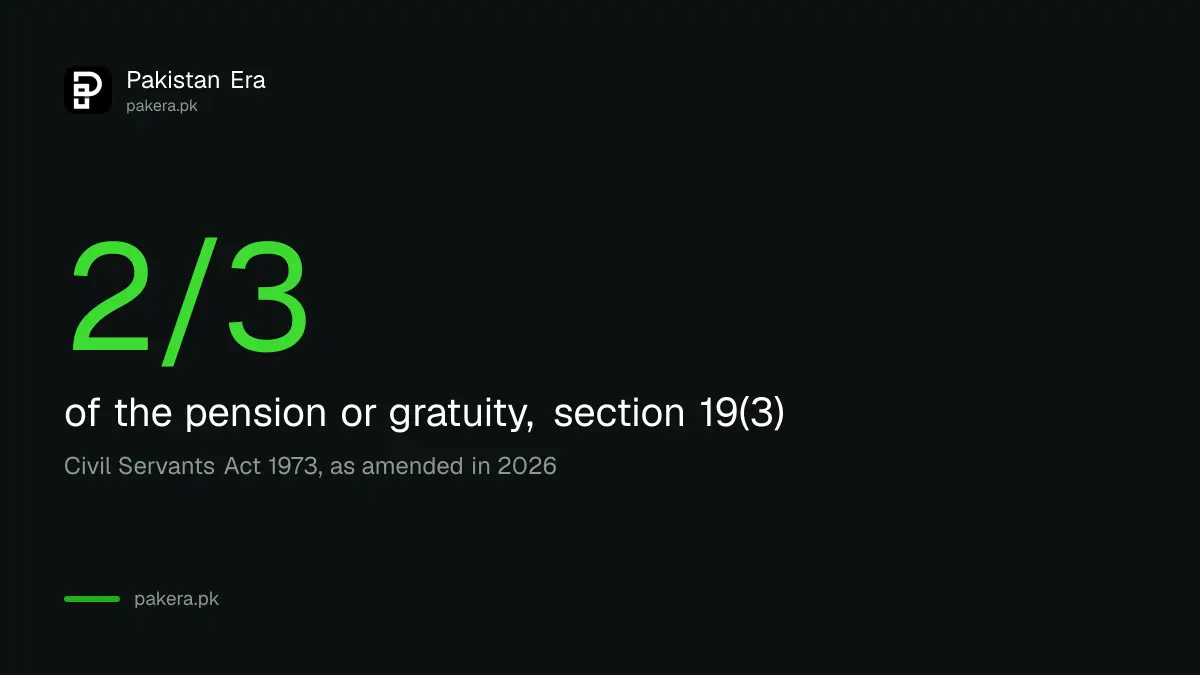
Section 19(3) says a civil servant dismissed or removed from service for discipline gets no pension. But a compassionate allowance may be sanctioned. It can be up to two thirds of the pension or gratuity he would have got if invalided out on the date of dismissal. The 2026 Act changed who sanctions it.
The decision now rests with the appointing authority, with the concurrence of the Finance Division. For a family, that means the request goes to the authority that appointed the employee, which then needs the Finance Division to agree. The two thirds ceiling has not changed.
- Write to the appointing authority asking for a compassionate allowance under section 19(3).
- Attach the dismissal or removal order and a statement of the employee's qualifying service.
- Explain the family's circumstances: dependants, illness or lack of other income.
- Keep a receiving copy. The appointing authority then seeks the Finance Division's concurrence.
- If the decision is an order on terms of service, an appeal or review under section 22 must be filed within 30 days unless the rules say otherwise.
Surplus staff keep their right to an equal post after any reorganisation
Section 11A protects a civil servant made surplus when a Division, department or office is reorganised or abolished, or a post is abolished. He may be appointed to a post in the same basic pay scale if he has the qualifications for it. If no equal post exists, he may be offered a lower post, and his previous pay stays protected.
Before 2026, the section spoke of surplus staff "in pursuance of any Government decision". The amendment adds "or decision of any other competent authority". So a reorganisation ordered by another competent body, not just the federal government itself, now brings the same protection. Whenever federal offices are merged or closed, this line decides who is protected.
Pay protection on a lower post is the key line for families. If you are moved down a grade as a surplus employee, check that your pay slip still shows the pay you drew in the higher post. If it does not, raise it in writing with your accounts office.
Devolution transfers and conduct rules moved to named authorities
Sections 3(3) and 3(4) deal with staff of Ministries abolished or devolved after the Eighteenth Amendment of 2010. The power to transfer such staff to a province, or to another Ministry in Islamabad, now belongs to the Establishment Division. The transfer is still on the same terms and conditions as before.
Section 15 now says a civil servant's conduct is regulated by rules or instructions issued by a prescribed authority. The words "Government or" were removed. Conduct rules already in place are not cancelled by this change. It only fixes who can issue them from now on.
Working for an international organisation still needs permission
Section 10A bars a civil servant from serving in any international organisation, international NGO, international financial institution or foreign donor agency during service. The exception is a posting or deputation on behalf of Pakistan, or with prior permission under the rules.
The 2026 Act removed the reference to the Federal Government and the line saying those rules must be laid before both Houses of Parliament. The ban and the permission requirement remain. If you are offered a job with a UN agency or a donor project, get written permission first, or you breach section 10A.
Other rules for federal employees did not change with this Act. The leave rules, set out in our page on federal employee leave rules, and the benefit fund covered in FEB&GIF retirement benefits stand as they were.
Common questions
When did the Civil Servants (Amendment) Act 2026 come into force?
At once, on the President's assent on 6 October 2026. The Gazette copy is dated 12 October 2026.
Can a dismissed federal employee get any pension?
No pension, but a compassionate allowance of up to two thirds of the pension or gratuity may be sanctioned under section 19(3).
Who sanctions the compassionate allowance now?
The appointing authority, with the concurrence of the Finance Division.
What happens to my pay if I am made surplus and given a lower post?
Section 11A protects the pay you were drawing in the higher post.
Who transfers devolved Ministry staff now?
The Establishment Division, under sections 3(3) and 3(4).
Can a civil servant work for a UN agency?
Only if posted or deputed on behalf of Pakistan, or with prior permission under the rules.
How we verified this
What we checked and where we read it.
We checked the text of the Civil Servants (Amendment) Act, 2026 (Act No. LIII of 2026) on 15 November 2026, from the National Assembly's list of Acts. The Gazette of Pakistan copy is dated 12 October 2026 and records the President's assent on 6 October 2026. We compared each change with the consolidated Civil Servants Act, 1973 on the Pakistan Code, which shows amendments up to 2025. The "before" wording in our table is from that copy. The appeal time in section 22 is from the same copy. The compassionate allowance steps are our practical advice, not words of the Act.
About the author

Global Affairs & Political Economy Writer
Muhammad Hatim is a book lover who started writing because he enjoys it. At Pakistan Era he writes about international relations, geopolitics and the global economy, with a particular interest in South Asia and the forces behind current events.