Company Tax Return Last Date 2026 in Pakistan: 31 December for June Year-Ends, Late Penalty, ATL Surcharge and FBR's New E-Format Draft
Companies with a June year-end must file the tax year 2026 return by 31 December 2026 under section 118. See the late penalty, ATL surcharge and new draft.

The last date for a company's income tax return for tax year 2026 in Pakistan is 31 December 2026, if the company's year ends between 1 January and 30 June. Companies with other year-ends filed by 30 September. That date comes from section 118(2) of the Income Tax Ordinance. Every company must file, even with no income.
The 31 October deadline that dominated the news covered returns first due on 30 September, mainly individuals and associations, not companies with a June year-end. We read sections 114, 118, 182 and 182A in FBR's copy of the Ordinance, amended up to 30 June 2026, and a draft rule FBR published on 27 October 2026, on 1 November 2026. Here is what a company owner or accountant needs to know.
Section 118(2) sets two dates for companies
Section 118(2) splits companies by their year-end. A company whose tax year ends between 1 January and 30 June files by 31 December following that year-end. Any other company files by 30 September following its year-end. Most companies close on 30 June.
| Company's year-end | Return due (section 118(2)) | Example for tax year 2026 |
|---|---|---|
| Between 1 January and 30 June | 31 December after the year-end | Year ended 30 June 2026: due 31 December 2026 |
| Any other date (special tax year) | 30 September after the year-end | Already due in 2026 |
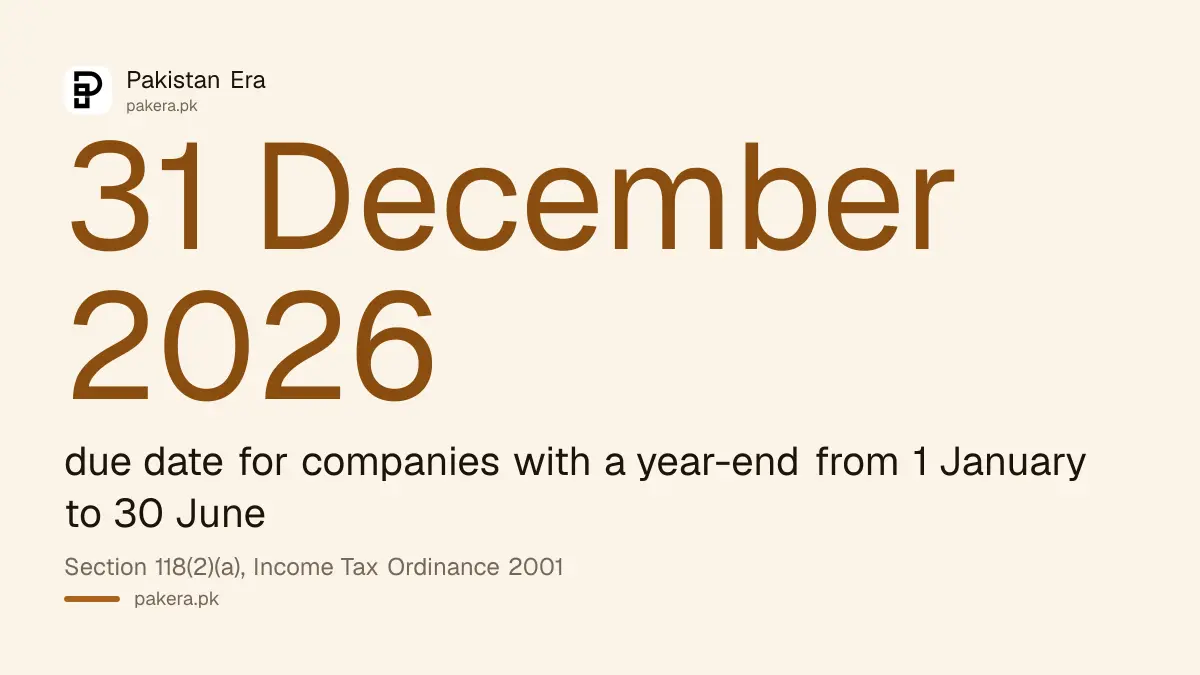
By our count, 31 December 2026 is a Thursday. Plan to file a few days earlier, since a last-day upload leaves no room for a portal problem. A 30 June year-end company has had six months to close its accounts, so there is little reason to leave it to the last day.
Every company must file, with or without income
Section 114(1)(a) lists "every company" among persons who must file a return for each tax year. Unlike individuals, there is no income threshold. A dormant or loss-making company still files, and a missing return brings the same penalty and Active Taxpayers List consequences.
This catches out small private companies set up for a project that never started. If the company exists on SECP's register, FBR expects a return. The yearly return to SECP is a separate duty, covered in filing a company's annual return with SECP. Filing one does not replace the other. A company that has no NTN yet needs one first, as set out in getting an NTN for a company or AOP.
FBR has proposed machine-readable financial statements from tax year 2026
FBR's draft SRO 1912(I)/2026, dated 27 October 2026, proposes a new rule 73(2F). It would require companies to submit the financial statements attached to the return for tax year 2026 onwards only through IRIS, in an electronically readable file format. It is not yet final.
The draft says the statements must follow the data scheme, taxonomy, file structure, field mapping and validation rules that FBR will publish on IRIS. FBR may set different schemes for different classes of company. A second change would let a return be verified by digital signature or another secure electronic method, with IRIS issuing an acknowledgement number that counts as proof of filing.
| Draft change in rule 73 | What it would mean |
|---|---|
| New sub-rule (2F) | Company accounts filed only in IRIS, in a readable file format |
| Data scheme and taxonomy | Fields and validation set by FBR |
| Different schemes allowed | Rules can differ by class of company |
| Substituted sub-rule (3) | Digital signature or secure electronic verification |
| Electronic acknowledgement | Unique reference number as proof of filing |
FBR invited objections within seven days of the draft's publication in the Gazette. If the rule is made final before December, accountants may need to prepare accounts in FBR's format rather than attach a scanned PDF. Watch FBR's SRO list in November.
Filing late brings a penalty of at least Rs 50,000
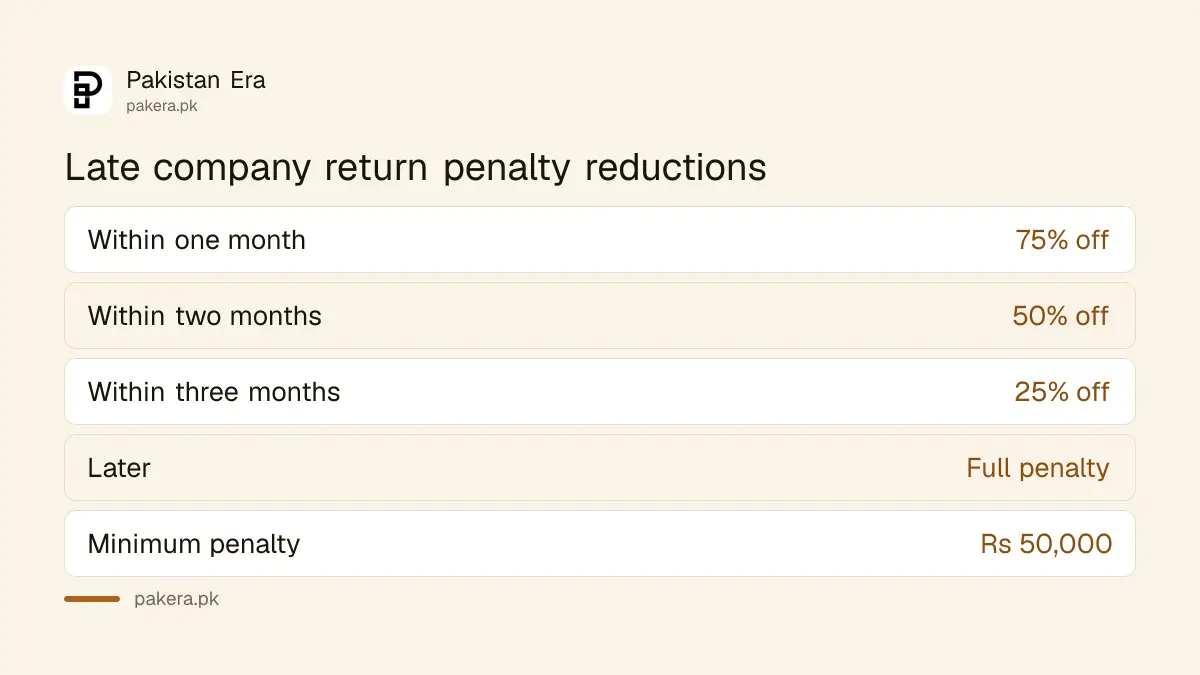
Under section 182, a company that files late pays the higher of 0.1 per cent of tax payable for each day, or Rs 1,000 a day. The minimum is Rs 50,000 and the maximum 200 per cent of tax payable. Filing soon after cuts it.
The penalty is cut by 75 per cent if the return is filed within one month after the due date, by 50 per cent within two months, and by 25 per cent within three months. After that, the full amount applies. The same rules for individuals are covered in the late return penalty after 31 October.
| Filed after 31 December 2026 | Penalty reduction |
|---|---|
| Within one month | 75% |
| Within two months | 50% |
| Within three months | 25% |
| Later than three months | None |
A late company also drops off the Active Taxpayers List
Section 182A keeps a late filer off the Active Taxpayers List for that year. To get back on, a company pays a Rs 100,000 surcharge. Off the list, it gets no refunds. It also cannot carry forward that year's loss.
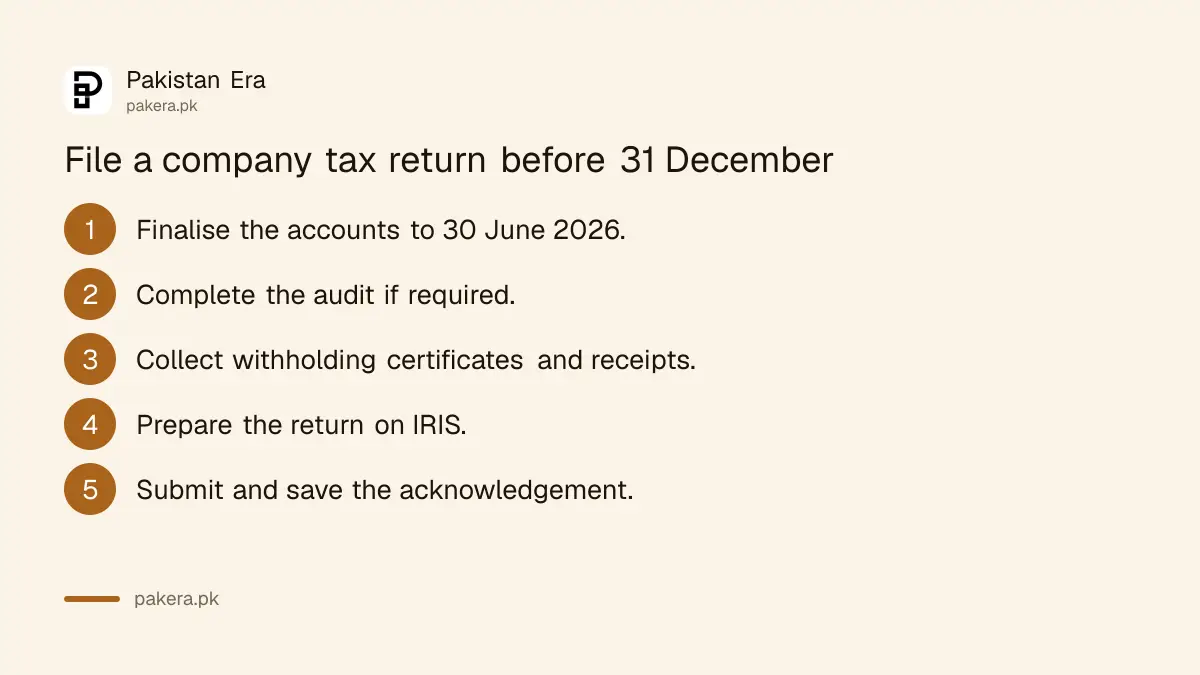
Being off the list also means higher withholding rates on many transactions, which suppliers and banks apply automatically. For a trading company, that cost can exceed the penalty. Here is a short checklist to file on time.
- Close and finalise the accounts for the year ended 30 June 2026.
- Get the audit done if the company is required to have one.
- Collect withholding tax certificates and payment receipts for the year.
- Prepare the return on IRIS and attach the financial statements.
- Submit before 31 December 2026 and save the acknowledgement.
For every other date between now and July 2027, see the full list of FBR tax deadlines after 31 October.
Common questions
What is the last date for a company tax return in 2026?
31 December 2026 for a company whose tax year ended between 1 January and 30 June 2026, under section 118(2)(a).
Did the 31 October extension apply to companies?
The 31 October extension covered returns first due on 30 September. Companies with a June year-end were never due then; their date is 31 December.
Does a company with no business have to file?
Yes. Section 114(1)(a) requires every company to file a return for each tax year, with no income threshold.
What is the penalty for a late company return?
The higher of 0.1 per cent of tax payable per day or Rs 1,000 per day, with a minimum of Rs 50,000 and a maximum of 200 per cent of tax payable.
How much is the ATL surcharge for a company?
Rs 100,000 under section 182A, as raised by the Finance Act 2026.
Is the new e-format for company accounts final?
No. Draft SRO 1912(I)/2026 of 27 October 2026 proposes it, with objections invited within seven days of Gazette publication.
How we verified this
What we checked, where we read it, and what we could not confirm.
Last checked 1 November 2026. We read sections 114, 118, 182 and 182A in FBR's Income Tax Ordinance amended up to 30 June 2026 and FBR's draft SRO 1912(I)/2026 on rule 73, on 1 November 2026. The weekday of 31 December is our count. FBR can extend the company deadline under section 214A; none had been issued when we checked.
About the author

Global Affairs & Political Economy Writer
Muhammad Hatim is a book lover who started writing because he enjoys it. At Pakistan Era he writes about international relations, geopolitics and the global economy, with a particular interest in South Asia and the forces behind current events.