Late Tax Return Penalty in Pakistan After 31 October 2026: Every Case Worked Out
Late tax return penalty in Pakistan after 31 October 2026: Rs 1,000 a day or 0.1% of tax, 75% off within a month, plus the Rs 25,000 ATL surcharge. Worked out.
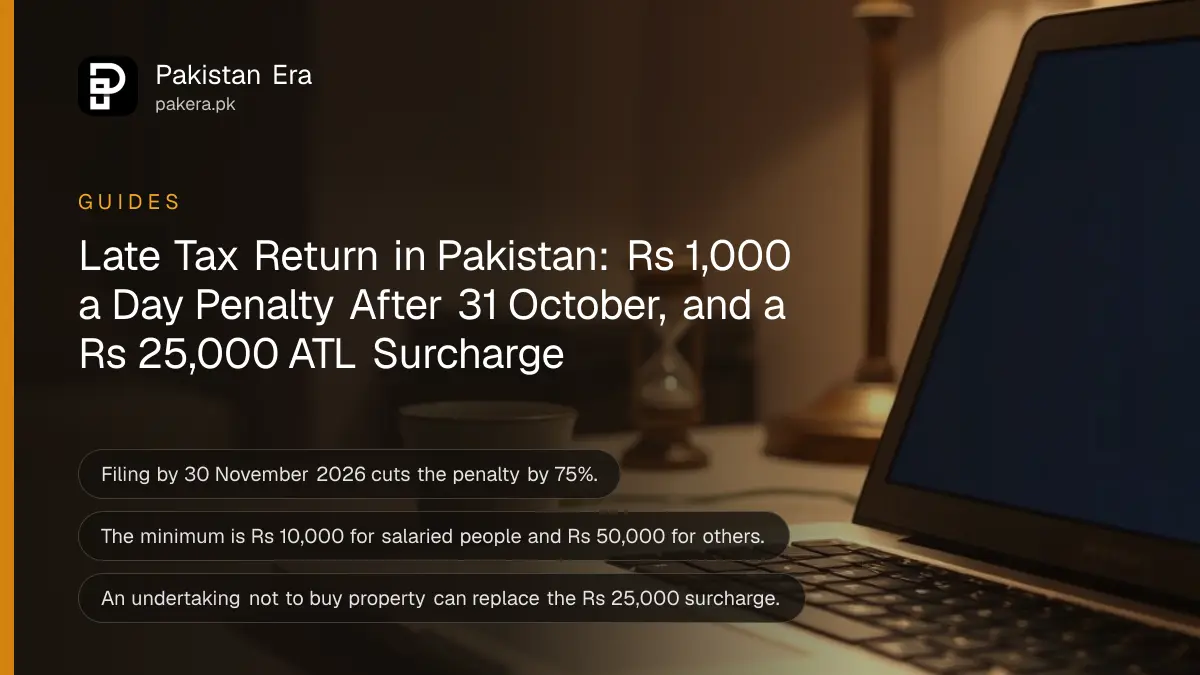
If you file your 2026 income tax return after 31 October 2026, the penalty under section 182 is Rs 1,000 a day or 0.1% of your tax a day, whichever is higher, with a minimum of Rs 10,000 for a salaried person and Rs 50,000 for everyone else. File within a month and the penalty is cut by 75%.
That is only half the bill. A late filer also drops off the Active Taxpayers List (ATL) and needs a Rs 25,000 surcharge to get back on. We read both sections in FBR's own copy of the Income Tax Ordinance on 28 October 2026, and worked out what three typical late filers would pay.
The deadline for tax year 2026 is 31 October 2026
FBR Circular No. 04 of 2026-27, dated 15 October 2026, extended the return deadline for tax year 2026 to 31 October 2026 for everyone who was due by 30 September. It was the second extension. As of 28 October, FBR had published no further extension on its website.
The circular says the extension was given after requests from trade bodies and tax bar associations. If you are still waiting for a third one, the 31 October extension notice explains what FBR has actually said. Plan as if midnight on 31 October is final.
The penalty is Rs 1,000 a day or 0.1% of tax a day
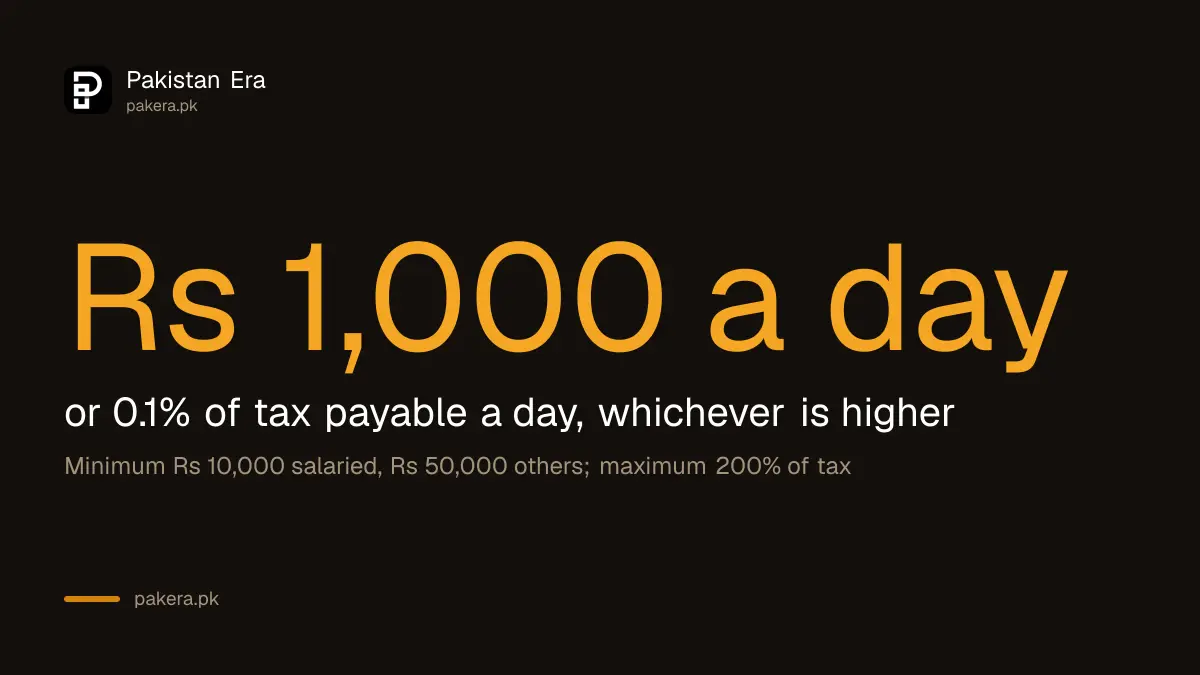
Section 182, entry 1 of the table, charges the higher of 0.1% of tax payable for each day late or Rs 1,000 for each day late. The minimum is Rs 10,000 for an individual with 75% or more of income from salary, and Rs 50,000 in all other cases. The maximum is 200% of tax payable.
"Tax payable" has a special meaning here. It is the higher of the tax on your assessed income for the year or the tax payable for the previous year in which you filed on time. So a low figure this year does not help if last year's tax was higher.
For most people Rs 1,000 a day is the bigger number. The 0.1% only takes over once your tax payable is above Rs 1 million.
Filing within one month cuts the penalty by 75%
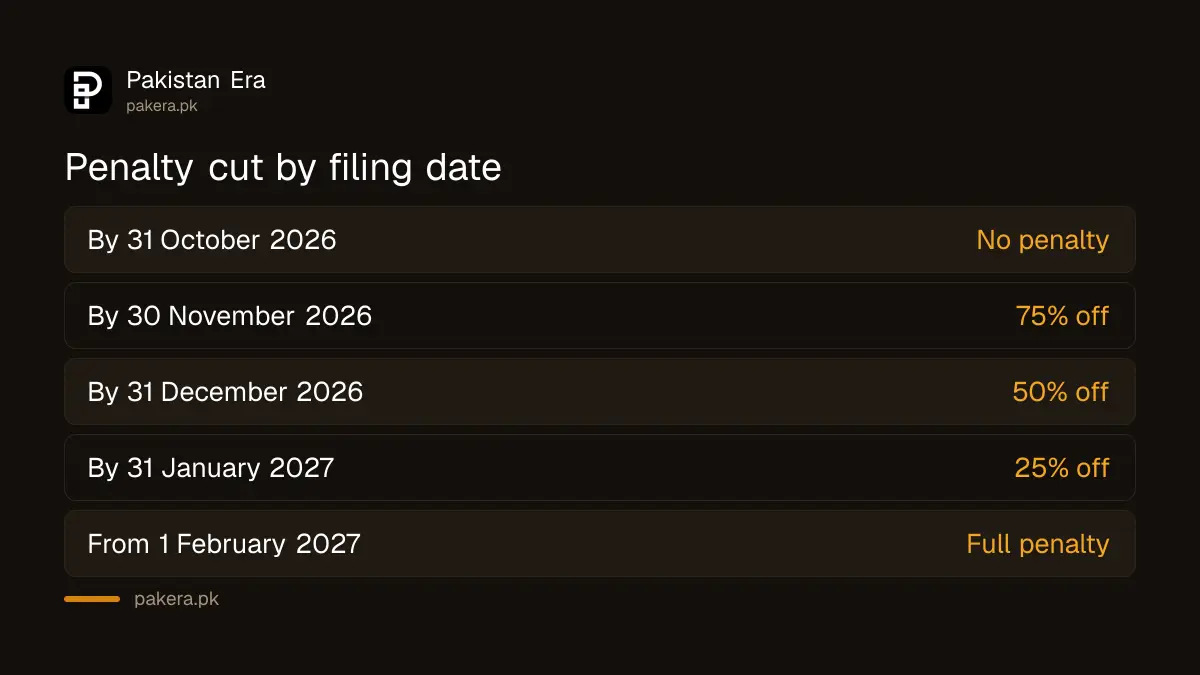
The law reduces the penalty by 75% if you file within one month after the due date, by 50% within two months and by 25% within three months. With a 31 October due date, those windows close on 30 November 2026, 31 December 2026 and 31 January 2027.
| You file | Penalty cut | You pay |
|---|---|---|
| By 31 October 2026 | No penalty | Nothing |
| 1 November to 30 November 2026 | 75% | 25% of the penalty |
| 1 December to 31 December 2026 | 50% | 50% of the penalty |
| 1 January to 31 January 2027 | 25% | 75% of the penalty |
| From 1 February 2027 | None | The full penalty |
The Ordinance does not say clearly whether the minimum of Rs 10,000 or Rs 50,000 applies before or after the cut. So in the examples below we show both readings. Your tax office decides in your case.
Three late filers, worked out
These examples use the section 182 formula exactly as written. Each assumes the same tax payable as the previous year and no reasonable excuse accepted by FBR.
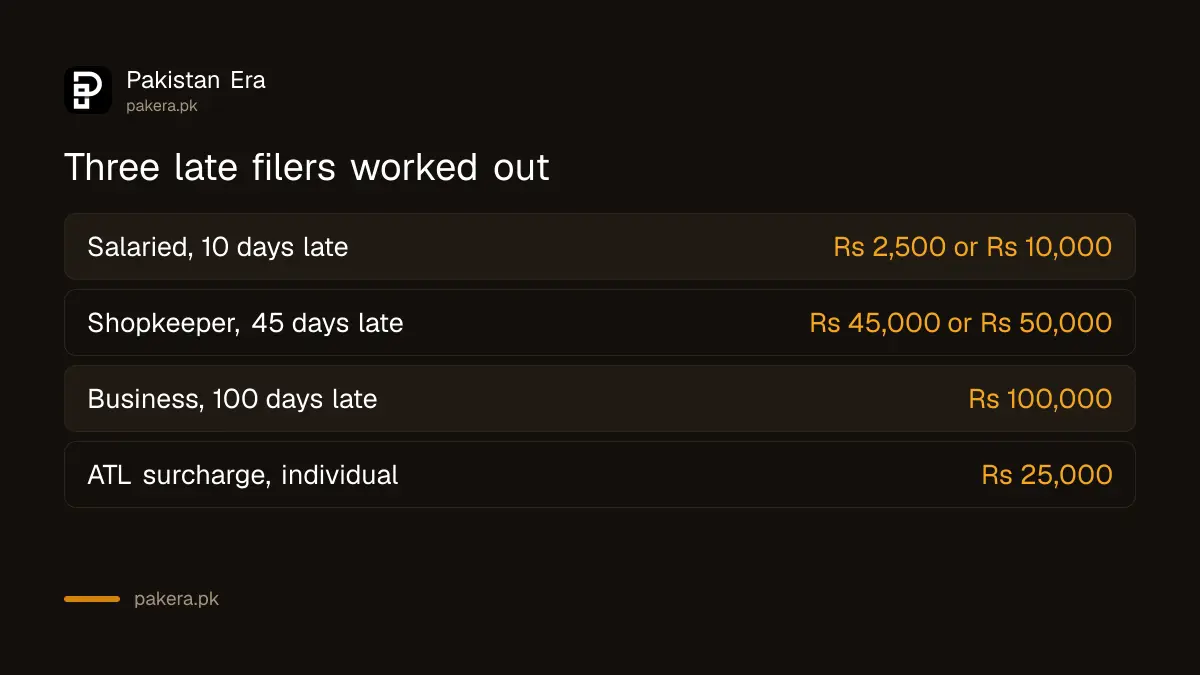
| Case | Penalty before cut | After cut |
|---|---|---|
| Salaried, tax Rs 60,000, files 10 November (10 days late) | Rs 10,000 (10 days x Rs 1,000, equal to the minimum) | Rs 2,500 if the 75% cut applies to the minimum, or Rs 10,000 if the minimum still applies |
| Shopkeeper, tax Rs 2,000,000, files 15 December (45 days late) | Rs 90,000 (45 days x Rs 2,000) | Rs 45,000 after the 50% cut, or Rs 50,000 if the minimum applies after the cut |
| Business, tax Rs 500,000, files 8 February 2027 (100 days late) | Rs 100,000 (100 days x Rs 1,000) | Rs 100,000, no cut after three months |
The cap is 200% of tax payable, so on Rs 60,000 of tax the penalty can never go above Rs 120,000. On Rs 500,000 it stops at Rs 1 million.
A nil return is the awkward case. With tax payable at zero, the 200% cap is zero while the minimum is Rs 10,000 or Rs 50,000. The law does not say which wins, and we found no FBR guidance on it. A student or housewife with no taxable income should simply file a nil return before the deadline and avoid the question.
Late filers also lose their place on the Active Taxpayers List
Section 182A says a person who misses the due date is not included in the ATL for that year. To be added after filing late, an individual pays a surcharge of Rs 25,000, an association of persons Rs 50,000 and a company Rs 100,000. Finance Act 2026 raised these from Rs 1,000, Rs 10,000 and Rs 20,000.
Staying off the ATL is expensive in its own right. Non-filers pay 40% tax on bank profit instead of 20%, and 11.5% instead of 2.75% when they sell property, on FBR's 2026-27 rate card. The surcharge is often cheaper than a year of non-filer rates.
Section 182A also says a late filer cannot carry forward a business loss for that year, gets no refund while off the ATL, and gets no extra payment for a delayed refund for that period.
An undertaking can replace the Rs 25,000 surcharge
Section 182A(3) lets an individual skip the surcharge by giving the Commissioner an undertaking not to buy or acquire any property for six months from the date of the undertaking, in a form FBR prescribes. It applies to individuals only, not companies or associations.
FBR published a draft of that form, called ATL-U, earlier in October. The draft ATL-U form is what we have seen; we could not confirm on 28 October that the final form has been notified. Until it is, ask your tax office how to submit the undertaking.
What to do if you will miss 31 October
Every day costs at least Rs 1,000, so filing late is still far better than not filing. The steps below keep the bill as small as the law allows. If IRIS is slow on the last night, the IRIS deadline-day fixes are worth trying before you give up.
- Try to file by midnight on 31 October 2026 on IRIS, even with a simple return you revise later.
- If you miss it, file before 30 November 2026 to get the 75% cut.
- Pay the Rs 25,000 ATL surcharge with a PSID, or ask about the property undertaking.
- Keep the IRIS acknowledgement and the surcharge receipt together.
- If FBR later sends a penalty order, reply with your filing date and any reasonable excuse, such as illness.
If you have already received a notice to file, follow the section 114(4) notice steps rather than waiting. The late filing process on IRIS is the same as on time, only the penalty differs.
Common questions
What is the last date to file the income tax return for tax year 2026?
31 October 2026, under FBR Circular No. 04 of 2026-27, for everyone who was originally due by 30 September 2026.
What is the minimum penalty for a late tax return in Pakistan?
Rs 10,000 for an individual with at least 75% of income from salary, and Rs 50,000 for everyone else, under section 182.
How much is the ATL surcharge for an individual?
Rs 25,000 under section 182A, raised from Rs 1,000 by Finance Act 2026.
Can I avoid the Rs 25,000 surcharge?
An individual can give an undertaking not to buy property for six months instead, under section 182A(3), in the form FBR prescribes.
Is there a penalty if I file on 1 November 2026?
Yes. One day late counts, but filing in November cuts the penalty by 75%.
Will FBR extend the deadline again?
FBR had not announced another extension when we checked on 28 October 2026. Do not plan on one.
How we verified this
What we checked, where we read it, and what we could not confirm.
We read sections 182 and 182A in FBR's consolidated Income Tax Ordinance, 2001 (amended up to Finance Act 2026) and FBR Circular No. 04 of 2026-27 on 28 October 2026. The worked examples are our own arithmetic. We could not confirm whether the minimum penalty applies before or after the time-based cut, how a nil return is treated against the 200% cap, or whether Form ATL-U has been notified.
About the author

Tax, Bills and Technology Writer
Ali Akhtar is a young and curious voice here at Pakistan Era. He is currently pursuing his A-Levels and has a growing interest in Pakistan’s changing industrial landscape and educational trends. Ali likes to write in a way that helps him explain and explore the world around him. His writing reflects the perspective of the new generation navigating the evolving trends of Pakistan where technology, youth innovation, and shifting opportunities are reshaping the country’s future.