File Your Tax Return After the 15 October Deadline in Pakistan
Missed 15 October? You can still file your 2026 tax return on IRIS. See the section 182 penalty, the Rs 25,000 ATL surcharge and how to cut both of them.
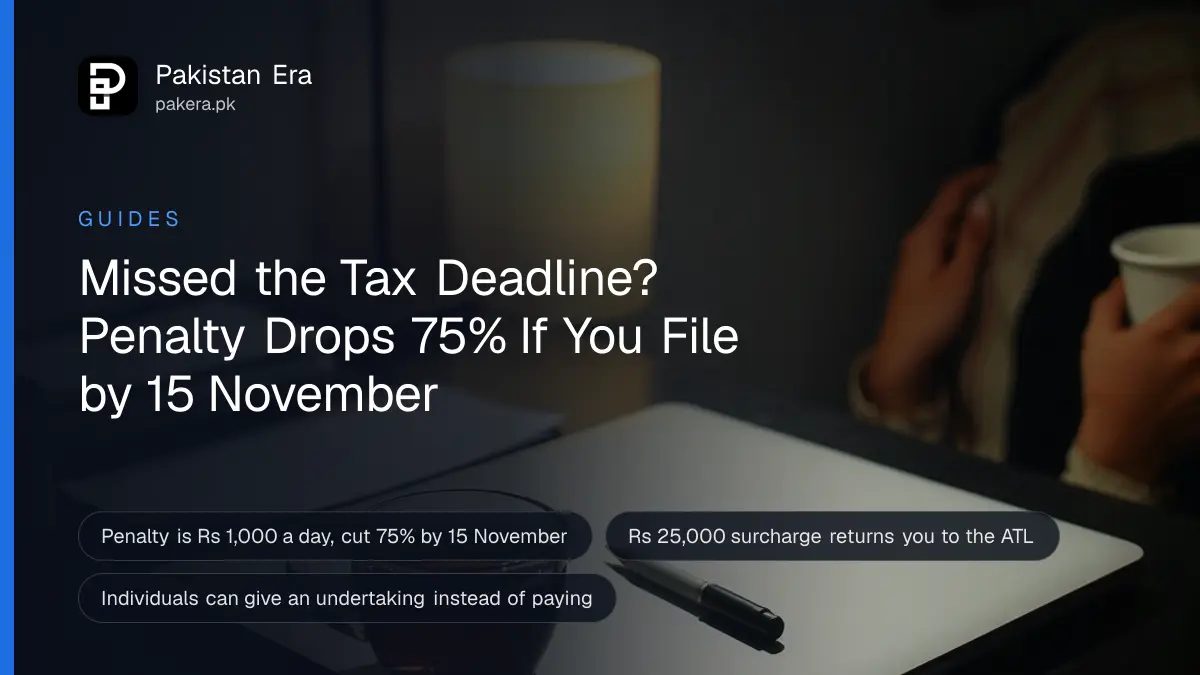
Yes, you can still file your tax year 2026 return after 15 October 2026. Log in to IRIS and file it the same way. A late return brings a section 182 penalty from 16 October, and a Rs 25,000 surcharge to get back on the Active Taxpayers List. File by 15 November and the penalty is cut by 75%.
FBR moved the due date from 30 September to 15 October 2026 by Circular No. 3 of 2026-27, issued under section 214A. So for most people, 15 October is now the date that counts. Every day after it has a price.
The portal does not lock you out after the deadline. The law rewards filing late over not filing at all. What changes is the cost, and the cost grows every day you wait. We read every rule below in FBR's own copy of the Income Tax Ordinance 2001, amended up to 30 June 2026, and we read the circular itself on FBR's site on 2 October 2026.
The extended due date for tax year 2026 is 15 October
FBR's Circular No. 3 of 2026-27, dated 30 September 2026, extends the return date for tax year 2026 to 15 October 2026. It covers everyone who had to file by 30 September. Late filing rules apply only after the extended date ends.
This matters for three reasons. Section 182 counts the penalty reductions from the "due date or extended due date". Section 182A keeps you off the Active Taxpayers List only if you miss the date "as extended by the Board under section 214A". And section 119 lets you ask for more time only up to the due date, which is now 15 October.
The circular does not cover anyone whose return was due on a different date, such as a company with a special tax year. If that is you, check your own due date first. The full background is in the report on how FBR extended the deadline to 15 October.
You can still file a late return on IRIS
Filing after 15 October works exactly like filing before it. You log in to IRIS or the Tax Asaan app, open the tax year 2026 return, fill it in and submit. The law then attaches a penalty and a surcharge to that late return.
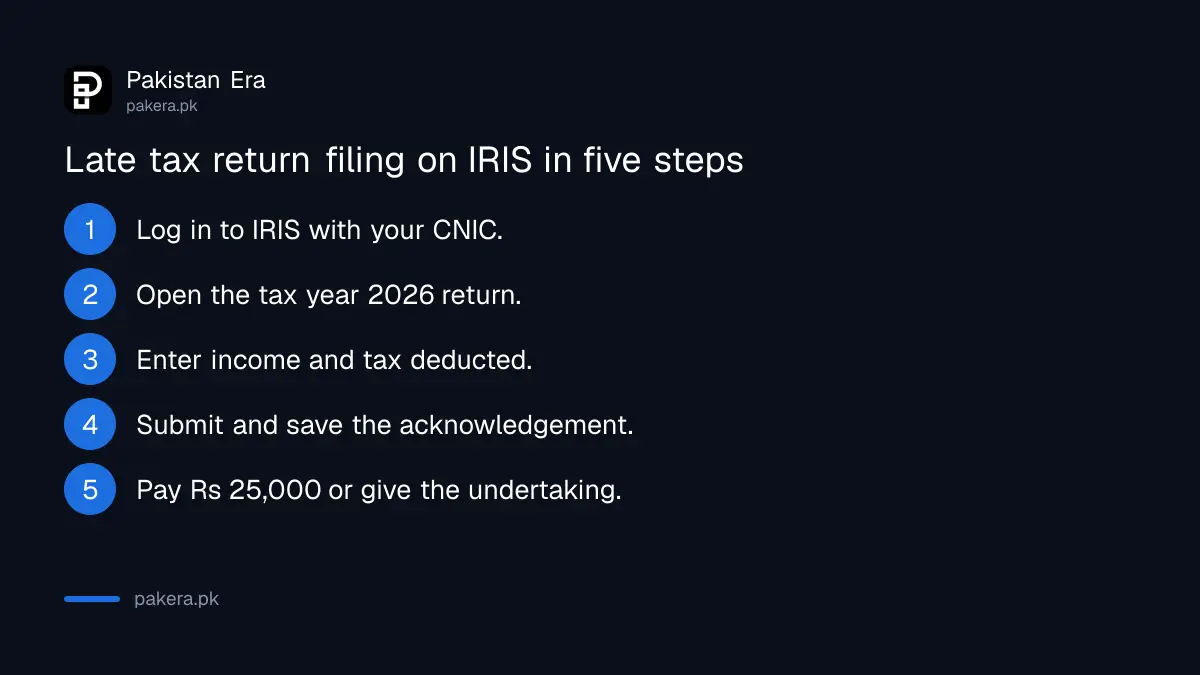
- Log in to iris.fbr.gov.pk with your CNIC and password. If you have never registered, register first with your CNIC.
- Open the return for tax year 2026, which covers 1 July 2025 to 30 June 2026. Check the year twice.
- Enter your income and the tax already deducted from your salary, bank profit and bills.
- Complete the wealth statement, then submit and save the acknowledgement.
- Pay the Rs 25,000 surcharge with a PSID, or give the undertaking explained below, to get back on the Active Taxpayers List.
The screens inside the form are the same ones you use to file your income tax return on time. If IRIS will not let you in, the IRIS login errors most people hit have known fixes. Don't let a password reset cost you another week.
The late filing penalty is Rs 1,000 a day for most people
Section 182 charges the higher of Rs 1,000 a day or 0.1% of your tax payable a day. For anyone whose yearly tax is below Rs 1 million, Rs 1,000 a day is the higher figure. The law cuts the penalty by 75%, 50% or 25% if you file within one, two or three months.
The minimum penalty is Rs 10,000 if at least 75% of your income is salary. For everyone else, including shopkeepers, freelancers and landlords, the minimum is Rs 50,000. The maximum is 200% of your tax payable for the year. "Tax payable" means the higher of this year's assessed tax or last year's tax payable.
| You file by | Days late | Rs 1,000 a day comes to | Cut in the law | After the cut |
|---|---|---|---|---|
| 15 November 2026 | 31 | Rs 31,000 | 75% | Rs 7,750 |
| 15 December 2026 | 61 | Rs 61,000 | 50% | Rs 30,500 |
| 15 January 2027 | 92 | Rs 92,000 | 25% | Rs 69,000 |
| After 15 January 2027 | 93 or more | Rs 1,000 a day | None | Full amount |
One gap in the law matters here. Section 182 does not say whether the Rs 10,000 or Rs 50,000 minimum applies before or after the cut. So if you file in the first month, budget for the minimum, not the smaller figure in the table. We would rather you overestimate by a few thousand rupees than be surprised by a notice.
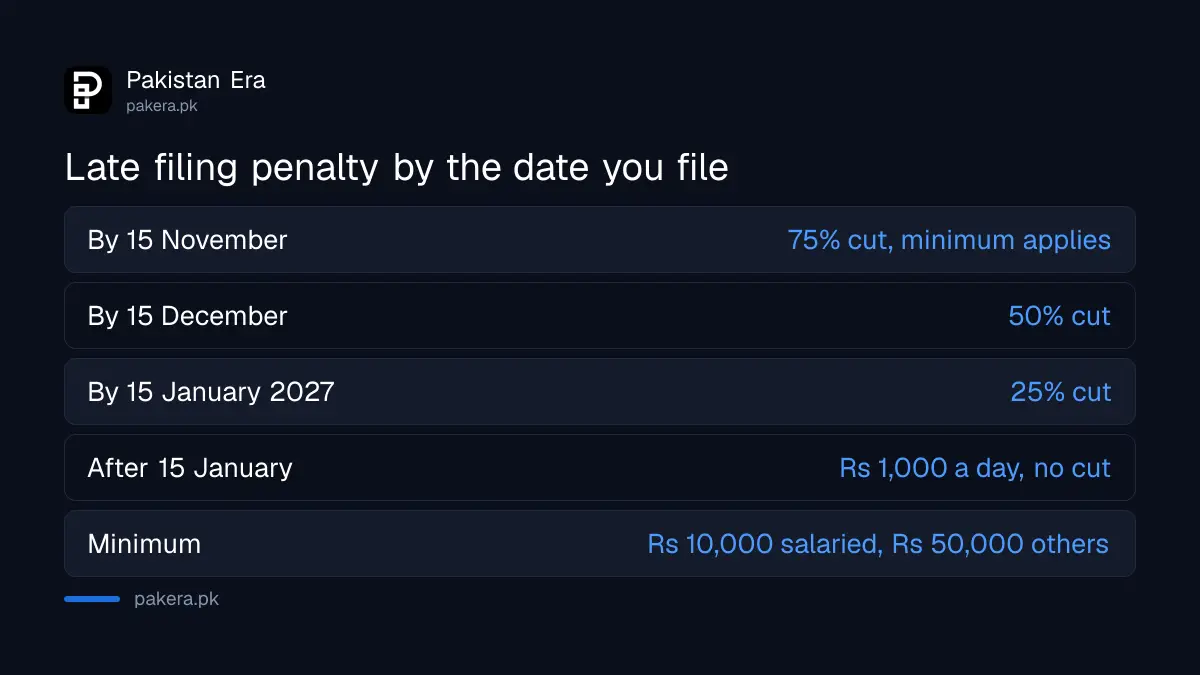
The table makes the choice plain. A return filed by 15 November costs a fraction of one filed in January. Waiting for "a better time" is the most expensive option on the list.
The Rs 25,000 surcharge puts you back on the Active Taxpayers List
A late return does not put you on the Active Taxpayers List for that year by itself. Under section 182A, an individual must also pay a surcharge of Rs 25,000. An association of persons pays Rs 50,000 and a company pays Rs 100,000.
The Finance Act 2026 raised these amounts from Rs 1,000, Rs 10,000 and Rs 20,000. The full story of that rise is in our report on the ATL surcharge for late filers. You pay it through a PSID, a payment slip ID made on IRIS, and it is a separate PSID from any income tax you owe.
The surcharge is separate from the penalty. You can owe both. While you stay off the list, section 182A also says three more things happen:
- FBR issues no tax refund to you.
- You cannot carry forward a business loss for that year.
- The time you spend off the list does not count towards extra payment for a delayed refund.
Salaried people who are owed a refund feel the first point most. The refund simply waits until you are back on the list.
An undertaking can replace the surcharge for individuals
Section 182A(3) lets an individual skip the Rs 25,000 surcharge by giving an undertaking before the Commissioner. You promise not to buy, acquire or take ownership of any property for six months from the date you give it. The undertaking must be in the prescribed form.
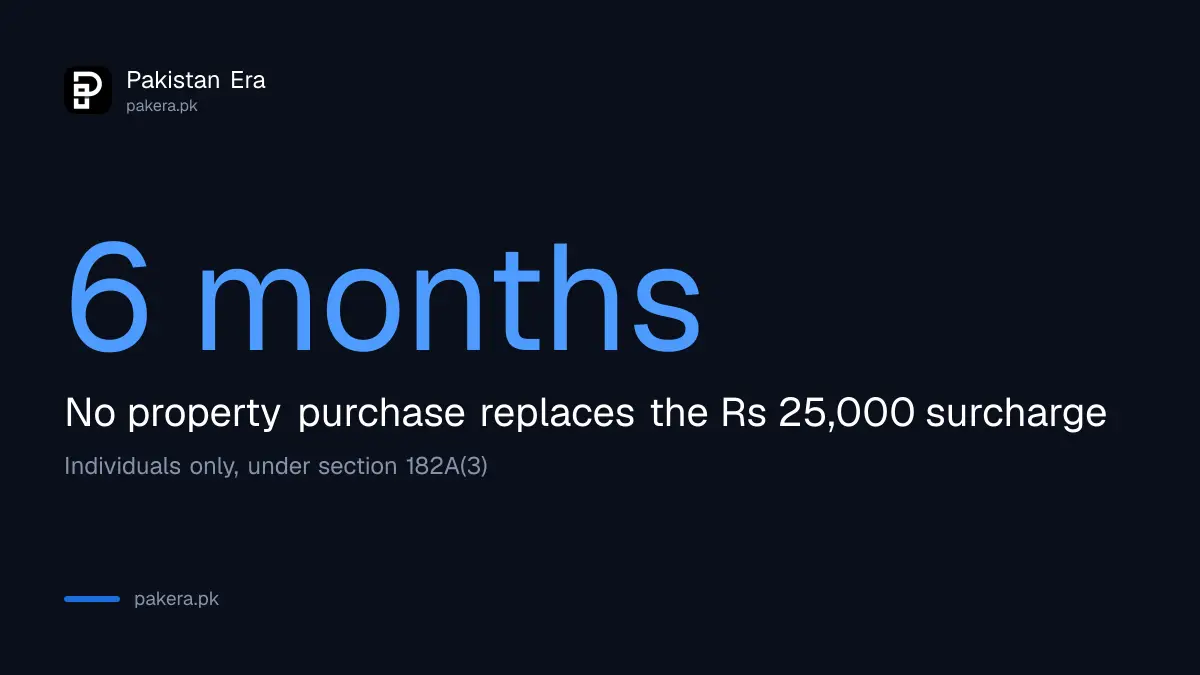
This is a real choice, not a trick. If you have no plan to buy a plot, a house or a car in the next six months, the undertaking costs you nothing. If you are in the middle of a purchase, paying Rs 25,000 is likely cheaper than freezing it.
The law says "any property" and does not define it further in that subsection. We would treat it broadly and avoid any large purchase in those six months. Ask your Regional Tax Office for the prescribed form, because we could not find it published on FBR's site.
A section 119 extension must be asked for by 15 October
Section 119 lets you ask your Commissioner in writing for up to 15 more days, but only if you apply by the due date. With the due date now 15 October, that is your last day to ask. After it, only the Board can relax the date, under section 214A.
The grounds in section 119 are absence from Pakistan, sickness or another misfortune, or any other reasonable cause. The Chief Commissioner can grant a further extension if the Commissioner does not. Keep a copy of your application and any reply.
Section 214A is different. It lets the Board allow any act to be done late, before or after the time limit ends, for one person or a whole class of people. Circular No. 3 is that power in use. A second general extension is possible but never promised, so do not wait on one. File first.
Staying a non-filer costs far more than filing late
The penalty and the surcharge have a ceiling you can see. Non-filer rates do not. People off the Active Taxpayers List pay much higher withholding tax when they buy property, register a car, earn bank profit or withdraw cash.
| Transaction | Filer pays | Non-filer pays |
|---|---|---|
| Buy a property worth Rs 10 million | Rs 125,000 (1.25%) | Rs 1,050,000 (10.5%) |
| Sell a property for Rs 10 million | Rs 275,000 (2.75%) | Rs 1,150,000 (11.5%) |
| Register a 1,300cc car worth Rs 4.5 million | Rs 67,500 (1.5%) | Rs 202,500 (4.5%) |
| Earn Rs 100,000 bank profit | Rs 20,000 (20%) | Rs 40,000 (40%) |
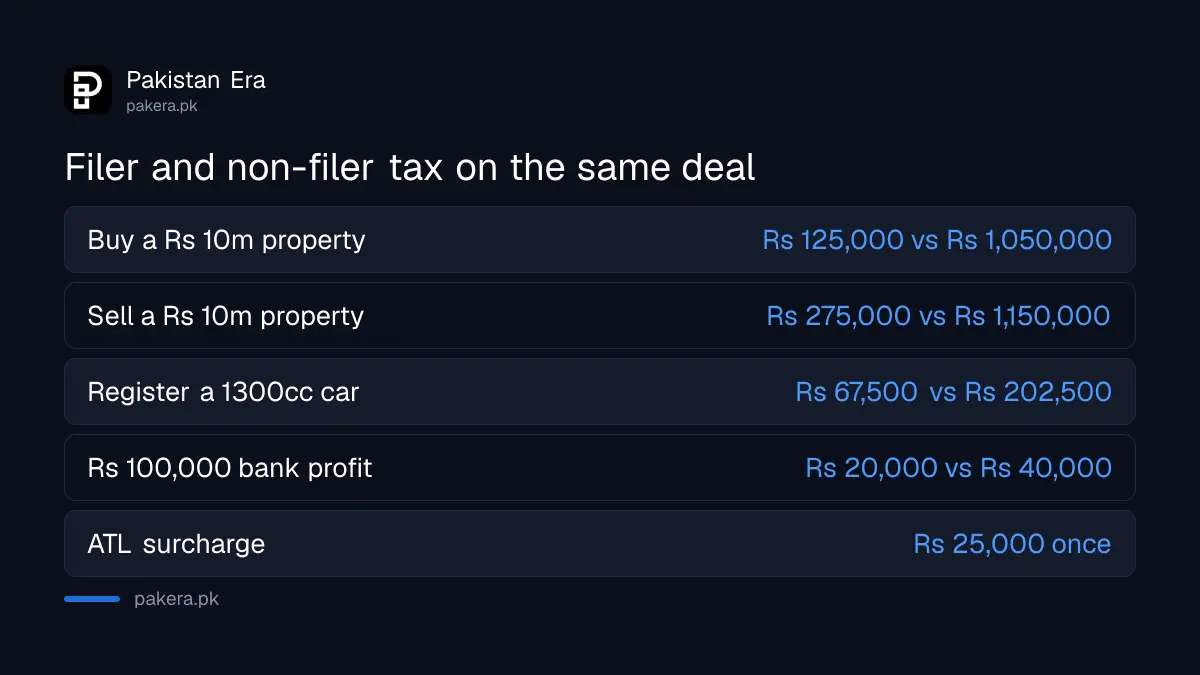
These are the rates in force from 1 July 2026, from the First and Tenth Schedules of the Ordinance. On one Rs 10 million plot, the gap is Rs 925,000. That is 37 times the surcharge. Cash is hit too: a non-filer loses 0.8% on bank cash withdrawals above Rs 50,000 a day.
After you file and pay, make sure your name is back. You can check your filer status with one SMS to 9966, and confirm the return itself went through by checking that your return was filed on IRIS.
Common questions
Can I file my tax return after 15 October 2026?
Yes. IRIS accepts late returns for tax year 2026. You file the same way, then pay the Rs 25,000 surcharge or give the undertaking to get back on the Active Taxpayers List.
What is the penalty for a late tax return in Pakistan?
The higher of Rs 1,000 a day or 0.1% of tax payable a day. The minimum is Rs 10,000 for mainly salaried people and Rs 50,000 for others. It is cut by 75%, 50% or 25% if you file within one, two or three months of 15 October.
Does the late penalty count from 30 September or 15 October?
From 15 October for anyone the circular covers. Sections 182 and 182A both refer to the date as extended by the Board, and Circular No. 3 extended it to 15 October 2026.
Can I avoid the Rs 25,000 ATL surcharge?
An individual can, by giving an undertaking before the Commissioner not to buy or acquire any property for six months. Associations of persons and companies cannot use this route.
Can I still ask for a section 119 extension?
Only if you apply by 15 October. Section 119 requires the application by the due date. After that, only FBR can relax the date, under section 214A.
Will I get my tax refund if I file late?
Not while you are off the Active Taxpayers List. Once you are back on it, the refund can be processed, but the time off the list does not earn extra payment for delay.
How we verified this
What we checked, where we read it, and what we could not confirm.
Last checked on 2 October 2026. The 15 October 2026 date is from FBR's Circular No. 3 of 2026-27, dated 30 September 2026, issued under section 214A for persons required to file by 30 September 2026. Every other rule here is read in FBR's consolidated Income Tax Ordinance 2001, amended up to 30 June 2026. The penalty of the higher of 0.1% of tax payable or Rs 1,000 a day, the Rs 10,000 and Rs 50,000 minimums, the 200% maximum and the 75%, 50% and 25% reductions after the "due date or extended due date" are from entry 1 of the table in section 182. The exclusion from the Active Taxpayers List for missing the date "as extended by the Board under section 214A", the Rs 25,000, Rs 50,000 and Rs 100,000 surcharge as amended by the Finance Act 2026, the bar on refunds and loss carry forward, and the six month property undertaking are from section 182A. The 15 day extension and its "by the due date" condition are from section 119, and the Board's power to allow a late act is from section 214A. The filer and non-filer rates are from the First and Tenth Schedules and FBR's withholding rate card as updated to 30 June 2026. The penalty table is our own arithmetic, counted from 15 October 2026. We could not find the prescribed undertaking form on FBR's site. Nothing here is tax advice for your own circumstances.
About the author

Tax, Bills and Technology Writer
Ali Akhtar is a young and curious voice here at Pakistan Era. He is currently pursuing his A-Levels and has a growing interest in Pakistan’s changing industrial landscape and educational trends. Ali likes to write in a way that helps him explain and explore the world around him. His writing reflects the perspective of the new generation navigating the evolving trends of Pakistan where technology, youth innovation, and shifting opportunities are reshaping the country’s future.