How to Complain to the Press Council of Pakistan About a Newspaper: Rs 1,000 Fee, 15 Day Notice and a 30 Day Decision
How to complain to the Press Council of Pakistan about a newspaper story: notice the editor within 15 days, pay Rs 1,000, and get a decision within 30 days.
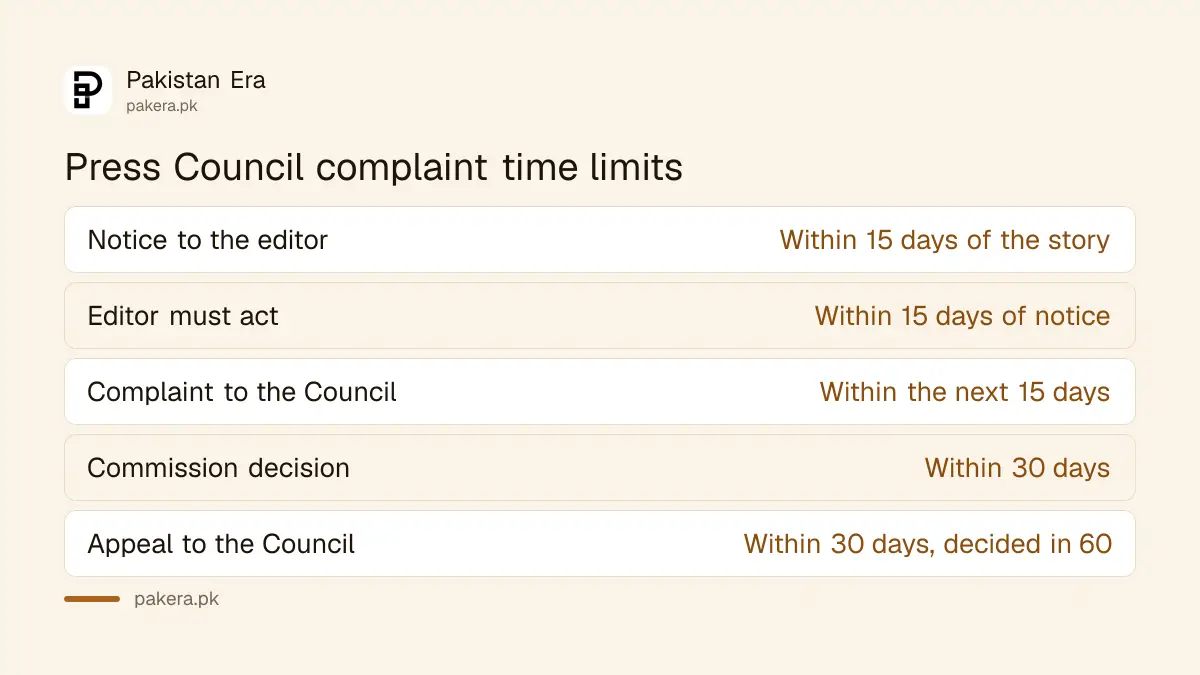
Short answer: To complain about a newspaper story in Pakistan, first send a written notice to the editor or publisher within 15 days of publication. The paper then has 15 days to act. If it does not, file a complaint with the Press Council of Pakistan within the next 15 days, with a Rs 1,000 bank draft (Rs 5,000 for an institution) in the name of "Press Council of Pakistan". An Inquiry Commission must decide within 30 days.
These steps come from Sections 10 to 13 of the Press Council of Pakistan Ordinance 2002. On 13 November 2026 a cabinet committee deferred a new Press Council of Pakistan Act 2026 for more consultation, as covered in our cabinet committee decisions of 13 November. So the 2002 Ordinance is still the law you use.
The Press Council handles complaints about newspapers and news agencies
The Press Council of Pakistan hears complaints that a newspaper, news agency, editor or journalist broke its Ethical Code of Practice. The Code is a schedule to the 2002 Ordinance. TV channels and cable are not covered. Those complaints go to PEMRA.
The Ordinance defines a newspaper as any daily or periodical work with public news or comment on it. A news agency is a service that supplies news to print and electronic media. If your complaint is about a TV channel, use the steps in our guide to complaining to PEMRA.
The Council can also act the other way. Under Section 8(2), a newspaper or journalist can complain to it about interference in the free working of the press by a government or political party.
What counts as a breach of the Ethical Code
The Ethical Code of Practice has 17 rules. A complaint must say which rule the story broke and how. These are the rules readers use most often.
- Accuracy: information, including pictures, must be true and accurate (rule 6), and facts must be fair and accurate (rule 2).
- No conjecture as fact: the press must avoid biased reporting and unverified material (rule 3).
- Privacy: no intrusion into private or family life and home (rule 4).
- Corrections: harmful mistakes must be fixed promptly, with due prominence, and people criticised get a right of reply where the issue is important (rule 11).
- Court reporting: an accused person must not be shown as guilty before judgment (rule 13).
- Victims: names and identifying photos of victims of sexual offences and serious crimes against children, juveniles and women must not be published (rule 14).
- Hate: no material that incites hatred on grounds of race, religion, sect, gender, disability or similar (rule 7).
Defamation for money damages is a separate matter for the courts. The Council cannot hear a matter already before a court, and you must declare that no court case is pending.
How to complain to the Press Council of Pakistan, step by step
The process has three stages: a notice to the paper, a complaint to the Council, and a hearing before an Inquiry Commission. Each stage has a 15-day or 30-day clock, so date everything you send.
- Write to the editor or publisher within 15 days of the day the story was published. Say what is wrong and what you want, such as a correction, a clarification or an apology. Keep a copy and proof of delivery.
- Wait 15 days for action. Under Section 10(2), the editor or publisher must act on your notice within 15 days of receiving it.
- File your complaint within the next 15 days if you get no reply or are not satisfied. Address it to the Registrar of the Press Council of Pakistan. The head office is in Islamabad, and the Ordinance allows a sub-office in each provincial capital.
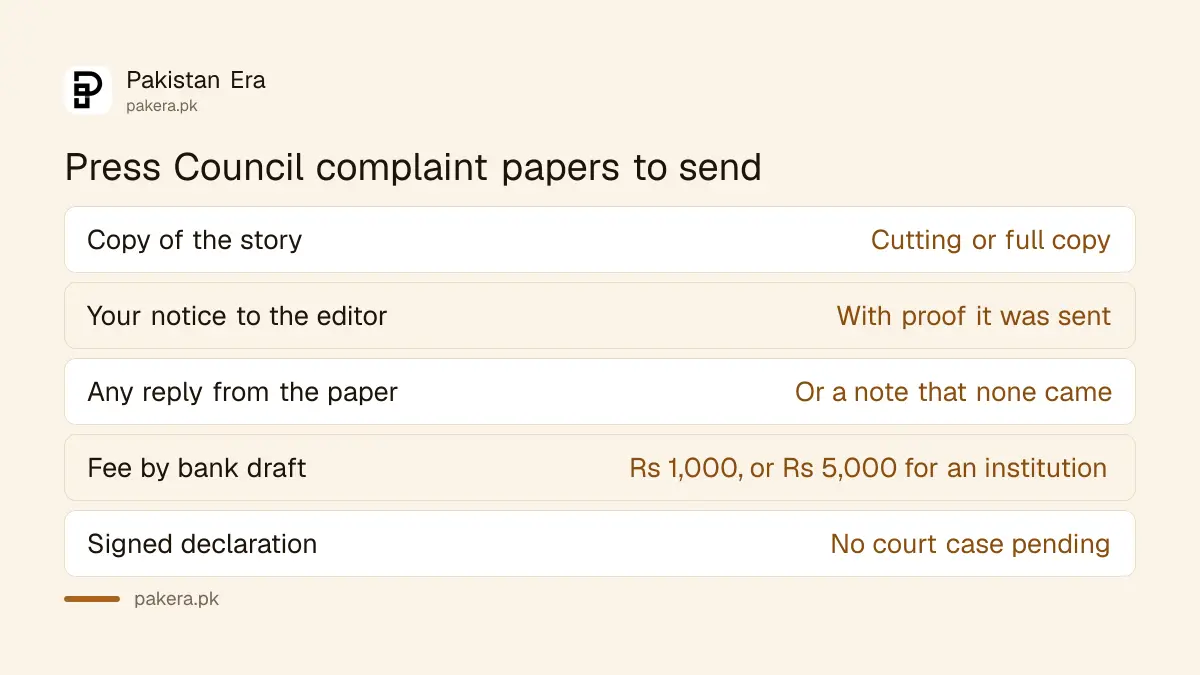
- Attach the evidence: the cutting or copy of the story, your notice, proof it was sent, and any reply from the paper.
- Explain the breach. State how the story violates the Ethical Code, and name the rule. If the complaint is about a story the paper refused to publish, explain how that refusal broke the Code.
- Add the fee: a bank draft of Rs 1,000 for an individual or Rs 5,000 for an institution, made out to "Press Council of Pakistan".
- Sign the declaration that you have given all relevant facts and that no court case is pending on the same matter, and that you will tell the Council if one starts.
How to write the complaint so it is not returned
Section 13 sets the format. A complaint that does not follow it can be sent back by the Registrar to be fixed and filed again within a set time. Getting it right the first time saves weeks.
| Rule in Section 13 | What to do |
|---|---|
| Short statement of facts | Keep it concise and stick to the material you rely on |
| Numbered paragraphs | Number every paragraph in order |
| Figures | Write dates, sums and numbers in figures, such as 12 November 2026 and Rs 5,000 |
| Fraud or bad intent | If you allege misrepresentation, blackmail, fraud or malice, say so clearly with dates |
| Signature | Sign it yourself, or give someone written authority to sign |
| No new grounds later | Put every ground in the first complaint; new claims come only by amendment |
What the Inquiry Commission can order
An Inquiry Commission has three members: a retired High Court judge or someone qualified to be one as chair, a nominee of the All Pakistan Newspapers Society (APNS) and a nominee of the Council of Pakistan Newspaper Editors (CPNE). It must dispose of a complaint within 30 days.
Both sides can bring evidence and be heard in person or through someone they authorise in writing. The Commission can summon witnesses. It cannot force a journalist to reveal a source. If you win, it can:
- order the paper to publish a contradiction or clarification, in a set manner and time;
- order the paper to publish an apology, and warn or reprimand the journalist, editor and publisher;
- give any other direction that fits the case.
If a paper ignores the decision, Section 15 lets the Council ask other papers to publish it. It can also recommend suspending the paper for up to seven issues, or cancelling its declaration after repeated refusal.
How to appeal a Commission decision
Either side can appeal to the Press Council within 30 days of the Commission's decision. A committee of five Council members hears the appeal, and the Council must decide it within 60 days. No member linked to either party may sit on the case.
For a case about government interference in a story, or a story about a federal department, other routes may also help. A federal service complaint can go to the Wafaqi Mohtasib, as set out in our Wafaqi Mohtasib complaint guide.
Common questions
How much does a Press Council of Pakistan complaint cost?
Rs 1,000 for an individual and Rs 5,000 for an institution, paid by bank draft in the name of "Press Council of Pakistan", under Section 10(5).
Can I complain straight to the Press Council?
No. You must first give notice to the editor or publisher within 15 days of publication. The Council will not take the complaint otherwise.
How long does the Press Council take to decide?
The Inquiry Commission must dispose of a complaint within 30 days. An appeal to the Council must be decided within 60 days.
Can the Press Council make a newspaper apologise?
Yes. A Commission can order a published apology, a contradiction or a clarification, and can warn or reprimand the people responsible.
Does the Press Council cover TV channels?
No. It covers newspapers and news agencies. Complaints about TV channels and cable go to PEMRA.
Has the Press Council of Pakistan Act 2026 replaced the 2002 Ordinance?
No. A cabinet committee deferred the draft Act on 13 November 2026 for further consultation. The 2002 Ordinance still applies.
How we verified this
What we checked and where we read it.
We checked every step on 14 November 2026 in the text of the Press Council of Pakistan Ordinance 2002 (Ordinance XCVII of 2002, with the 2023 amendment) on Pakistan Code: Sections 2, 3, 8, 9, 10, 11, 12, 13, 14, 15 and 19, and the Ethical Code of Practice in the Schedule. The deferral of the 2026 draft Act is from the Press Information Department release of 13 November 2026 on the Cabinet Committee for Disposal of Legislative Cases.
About the author

Global Affairs & Political Economy Writer
Muhammad Hatim is a book lover who started writing because he enjoys it. At Pakistan Era he writes about international relations, geopolitics and the global economy, with a particular interest in South Asia and the forces behind current events.