Blood Sugar Level Chart in Pakistan: Normal, Prediabetes and Diabetes Values in mg/dl (WHO)
WHO blood sugar chart in mg/dl: fasting below 110 is normal, 110 to 125 is prediabetes, 126 or above is diabetes. Plus 2 hour test, HbA1c and random values.
یہ صفحہ اردو میں پڑھیں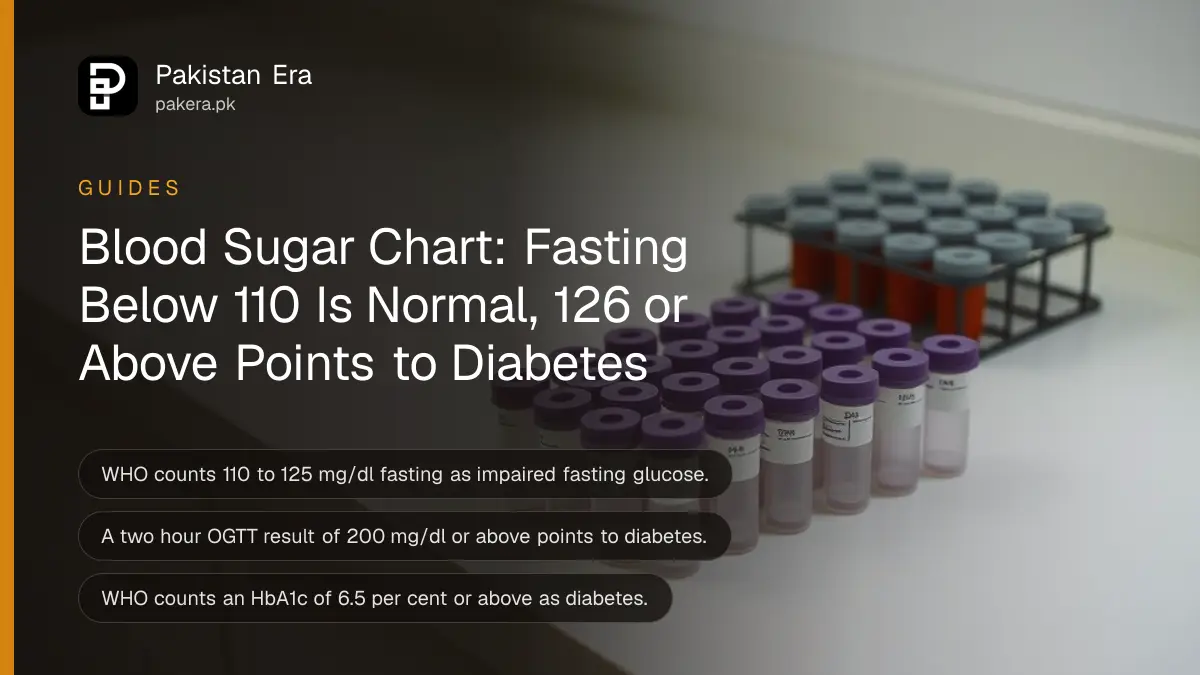
Short answer: By World Health Organization (WHO) criteria, a fasting blood sugar below 110 mg/dl is normal, 110 to 125 mg/dl is impaired fasting glucose (often called prediabetes), and 126 mg/dl or above points to diabetes. A two hour glucose test of 200 mg/dl or above, or an HbA1c of 6.5 per cent or above, also points to diabetes. A doctor confirms it with a second test.
Pakistani labs print results in mg/dl, while many WHO and foreign charts use mmol/L. The chart below gives both, so you can read any report. It is a guide for reading a result, not a way to diagnose yourself. World Diabetes Day falls on 14 November, and the President's message for 2026 says 34.5 million Pakistani adults had diabetes in 2024, more than a quarter of them undiagnosed.
Blood sugar level chart by WHO criteria
WHO uses three bands for fasting blood sugar: normal below 110 mg/dl, impaired fasting glucose from 110 to 125 mg/dl, and diabetes at 126 mg/dl or above. The two hour test after a glucose drink has its own bands, shown in the same table.
| Test | Normal | Prediabetes (WHO term) | Diabetes |
|---|---|---|---|
| Fasting blood sugar | Below 110 mg/dl (6.1 mmol/L) | 110 to 125 mg/dl (6.1 to 6.9 mmol/L), impaired fasting glucose | 126 mg/dl (7.0 mmol/L) or above |
| 2 hours after 75 g glucose drink (OGTT) | Below 140 mg/dl (7.8 mmol/L) | 140 to 199 mg/dl (7.8 to 11.0 mmol/L), impaired glucose tolerance | 200 mg/dl (11.1 mmol/L) or above |
| HbA1c | WHO sets no separate band | 6.5 per cent (48 mmol/mol) or above | |
| Random blood sugar, with symptoms | Not used for these bands | 200 mg/dl (11.1 mmol/L) or above | |
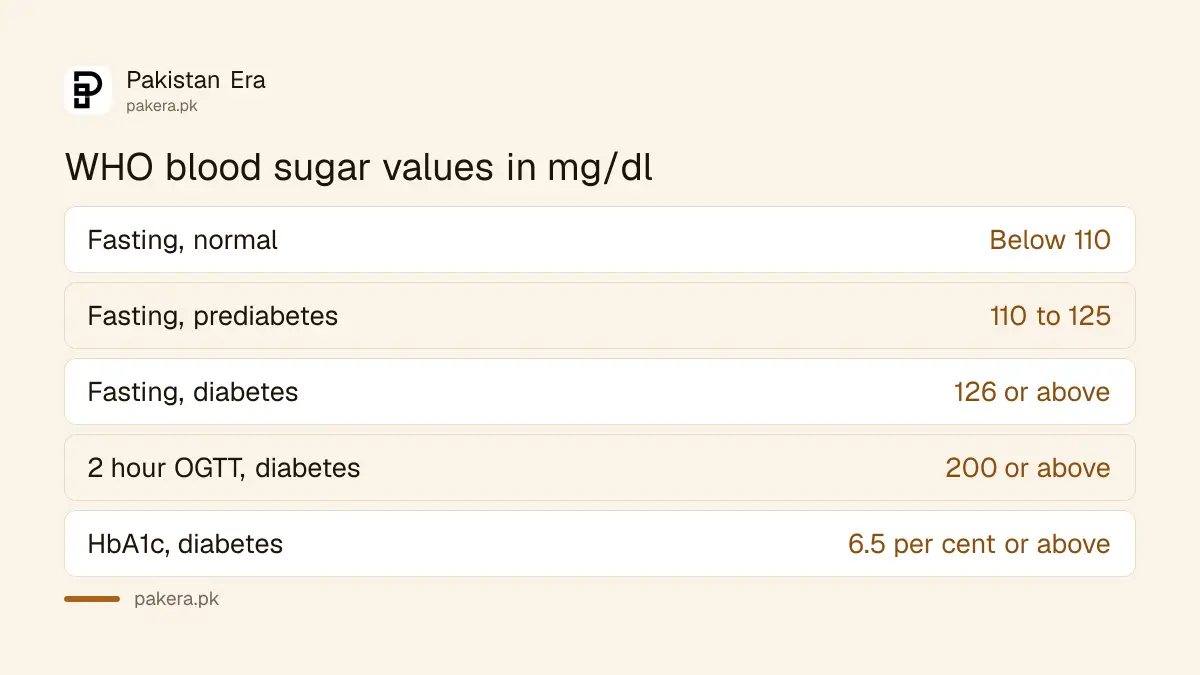
To change mmol/L to mg/dl, multiply by 18. So 7.0 mmol/L is 126 mg/dl, and 11.1 mmol/L is 200 mg/dl. Pakistani lab reports almost always use mg/dl.
Fasting sugar is the most common first test
A fasting test measures blood sugar after at least eight hours without food, usually first thing in the morning. Water is allowed. It is cheap, offered by every lab, and it is the number most doctors ask for first when they suspect diabetes.
If your fasting result is between 110 and 125 mg/dl, WHO recommends a glucose tolerance test, called an OGTT, to see how your body handles sugar. WHO says a fasting test alone misses about 30 per cent of undiagnosed diabetes cases, which is why the two hour test still matters.
Some labs print 100 mg/dl as the upper limit of normal fasting sugar. That lower line comes from the American Diabetes Association, which cut its threshold from 110 to 100 mg/dl in 2003. WHO kept 110. A result of 100 to 109 is worth raising with your doctor, but it is not diabetes.
The two hour test shows how your body handles sugar
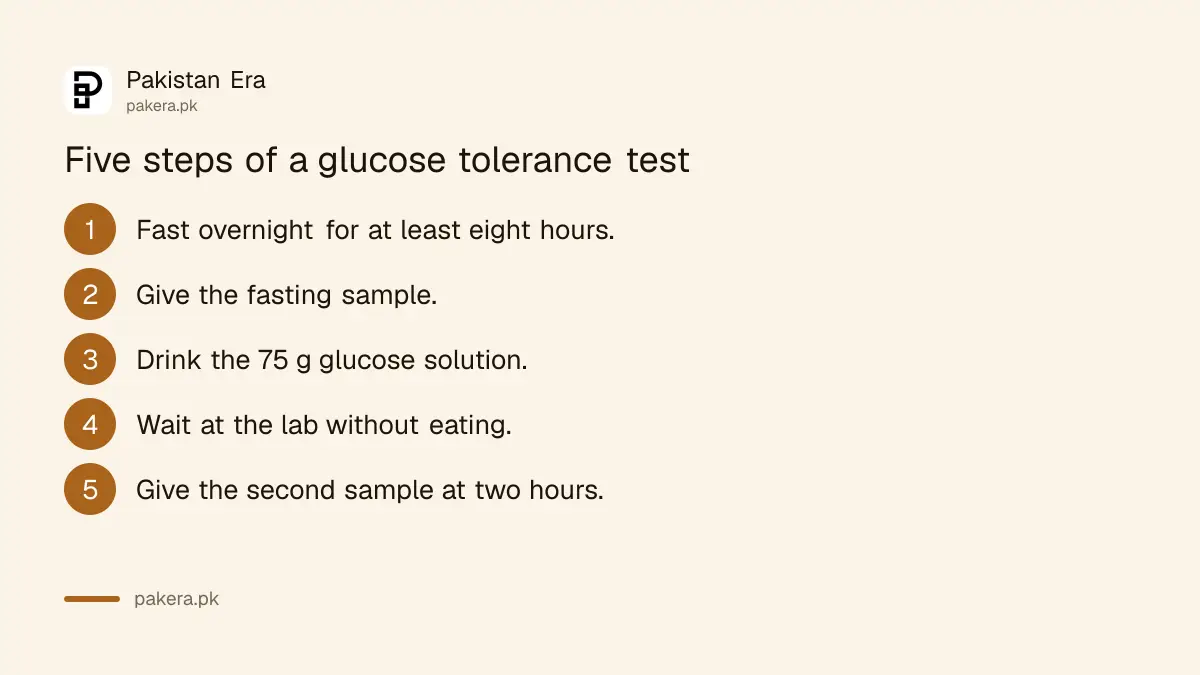
In an oral glucose tolerance test (OGTT), you give a fasting sample, drink 75 g of glucose dissolved in water, and give another sample two hours later. A two hour result of 200 mg/dl or above points to diabetes, and 140 to 199 mg/dl is impaired glucose tolerance.
The test takes most of a morning, so plan for it. Ask the lab for its own instructions when you book, and follow your doctor's advice about any medicines you take.
- Fast overnight for at least eight hours. Drink only water.
- Give the fasting sample at the lab in the morning.
- Drink the 75 g glucose solution the lab gives you.
- Stay at the lab and do not eat during the wait.
- Give the second sample at two hours. WHO asks labs to take it within five minutes of the two hour mark.
HbA1c shows your average sugar over about three months
HbA1c measures how much sugar is stuck to your red blood cells, which reflects the average level over roughly the last two to three months. WHO counts an HbA1c of 6.5 per cent or above as a sign of diabetes. You do not need to fast for it.
WHO added HbA1c to its list of diagnostic tests in its 2019 classification. Its older 2006 report had said HbA1c was not suitable for diagnosis. Doctors also use HbA1c to see how well treatment is working in people already diagnosed, which is why diabetics are often asked for it every few months.
WHO gives one HbA1c cut-off only. If your result is below 6.5 per cent but higher than your lab's normal range, ask your doctor what it means for you.
A random reading of 200 or above needs symptoms to count
A random blood sugar is taken at any time, whatever you last ate. WHO counts a random result of 200 mg/dl or above as diabetes only when the person also has signs such as thirst, passing urine often, blurred vision or weight loss.
Sugar after a meal naturally rises, so a single high random reading in someone who feels well is not enough. WHO says that when a high value is found in a person without symptoms, the test should be repeated on another day, preferably the same type of test, before calling it diabetes.
The common warning signs are set out in our guide to spotting type 2 diabetes early.
Lab tests beat home meters for a diagnosis
A home glucose meter, using a finger prick, is useful for people already being treated to track their sugar day to day. For a first diagnosis, use a lab test on a blood sample from a vein, which is the method WHO uses as the standard.
WHO says fasting values from a finger prick and from a vein are the same, but values after a glucose drink differ between the two. Home meters also vary by brand and by how strips are stored. If your meter shows a high number, book a lab test rather than starting medicine on your own.
Test rates differ by lab and city. See the Dow lab test rates for one public sector price list, and free diabetes care in Punjab for government clinics that test and treat without charge.
Common questions
What is a normal fasting blood sugar level?
By WHO criteria, a fasting blood sugar below 110 mg/dl (6.1 mmol/L) is normal. Some labs use 100 mg/dl, following the American Diabetes Association.
Is 120 fasting sugar diabetes?
No. A fasting result of 120 mg/dl falls in WHO's impaired fasting glucose band of 110 to 125 mg/dl. WHO advises a glucose tolerance test to check further.
What HbA1c level means diabetes?
WHO counts an HbA1c of 6.5 per cent (48 mmol/mol) or above as diabetes, confirmed by a doctor.
What sugar level is diabetes after eating?
WHO uses the two hour glucose tolerance test, not an ordinary meal. A two hour result of 200 mg/dl or above points to diabetes. A random reading of 200 or above counts only with symptoms.
Do I need to repeat a high result?
Yes, if you have no symptoms. WHO advises repeating the test on another day, preferably the same test, to confirm the diagnosis.
How do I convert mmol/L to mg/dl?
Multiply by 18. For example, 7.0 mmol/L is 126 mg/dl.
How we verified this
What we checked and where we read it.
Checked on 14 November 2026 against two World Health Organization documents: Classification of Diabetes Mellitus 2019, for the diabetes thresholds, HbA1c and the repeat test rule, and the 2006 WHO and IDF report Definition and Diagnosis of Diabetes Mellitus and Intermediate Hyperglycaemia, for impaired fasting glucose, impaired glucose tolerance and the 30 per cent figure. The 34.5 million figure is from the President's World Diabetes Day message of 14 November 2026.
About the author

Public Services and Education Journalist
Fajr Riaz is a journalist and content writer at Pakistan Era, based in Lahore. She covers the questions people meet in everyday life in Pakistan: how a public service works, what a change in the rules means, and where to find a reliable answer.