Constitutional Amendment in Pakistan: 224 National Assembly Votes and 64 Senate Votes Under Article 239
A constitutional amendment in Pakistan needs 224 of 336 National Assembly votes and 64 of 96 in the Senate. How Article 239 works step by step, and recent ones.
A constitutional amendment in Pakistan needs two-thirds of the total membership of each House: at least 224 of the National Assembly's 336 seats and 64 of the Senate's 96. The bill can start in either House. If it changes a province's boundaries, that province's assembly must also pass it by two-thirds. The rules are in Articles 238 and 239.
Two-thirds of the total membership is a high bar. Absent members and vacant seats count against the bill, because the Constitution counts all seats, not the members present. That is why amendments usually pass only with a broad coalition behind them.
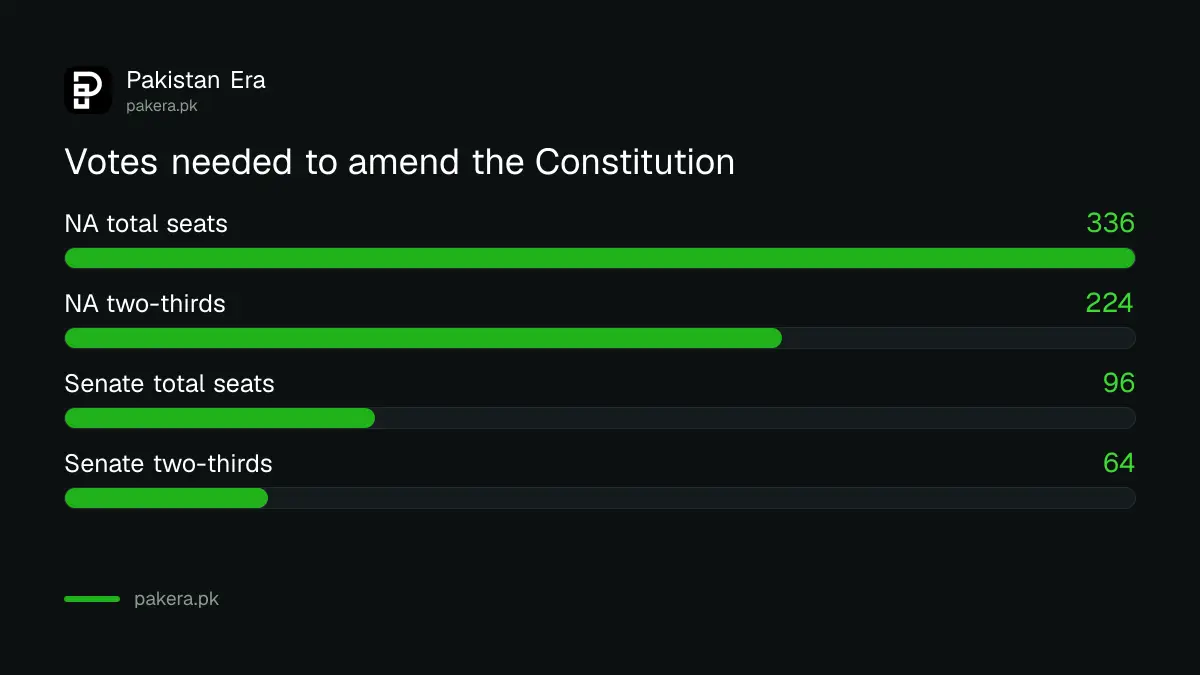
The votes needed in each House
Article 239 requires the votes of not less than two-thirds of the total membership in each House. With 336 seats in the National Assembly and 96 in the Senate, a constitutional amendment needs 224 and 64 votes. Members present do not lower those numbers.
| House | Total seats | Two-thirds needed | Source of seat number |
|---|---|---|---|
| National Assembly | 336 | 224 | Article 51 |
| Senate | 96 | 64 | Article 59 |
| Punjab Assembly (boundary changes only) | 371 | 248 | Article 106 |
| Sindh Assembly (boundary changes only) | 168 | 112 | Article 106 |
| Khyber Pakhtunkhwa Assembly (boundary changes only) | 145 | 97 | Article 106 |
| Balochistan Assembly (boundary changes only) | 65 | 44 | Article 106 |
The two-thirds figures are our arithmetic from the seat numbers. Where two-thirds is not a whole number, as for Khyber Pakhtunkhwa (96.67) and Balochistan (43.33), we rounded up, because "not less than" two-thirds means the next whole member.
How an amendment bill passes, step by step
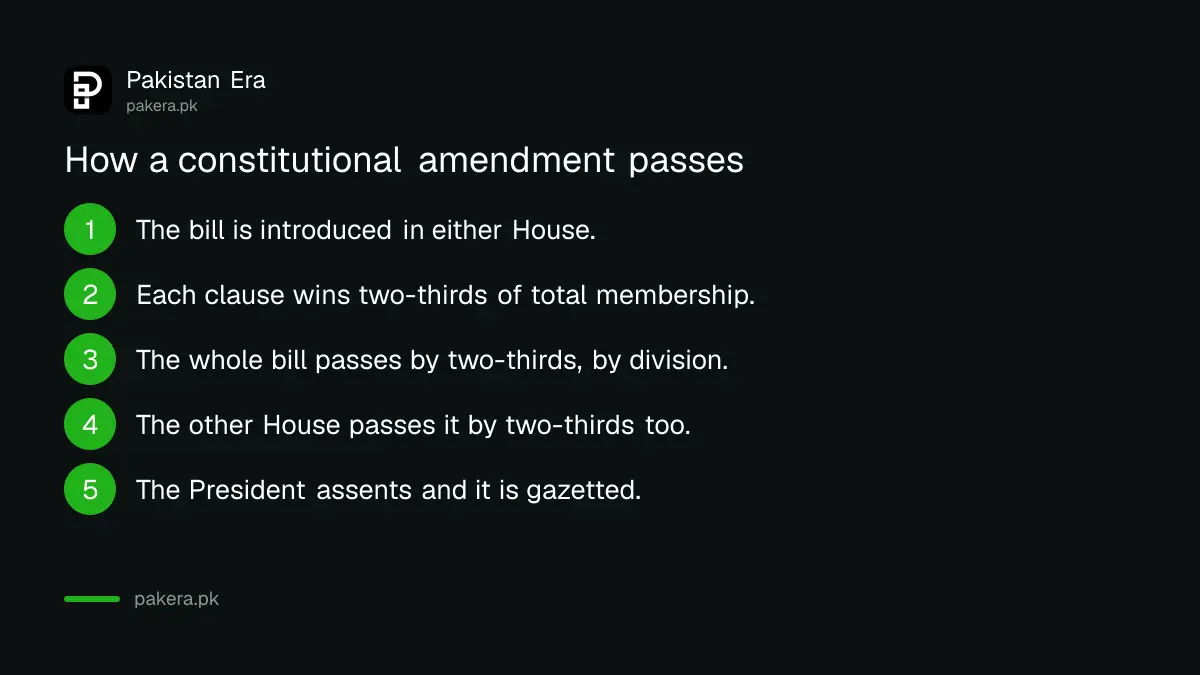
The bill is introduced in either House. Each clause is voted on separately and must get two-thirds of the total membership. The whole bill then passes by a recorded division. The other House repeats the process, and the bill goes to the President for assent.
- Introduction. A Constitution (Amendment) Bill is introduced in the Senate or the National Assembly (Article 239(1)).
- Clause by clause vote. In the National Assembly, each clause and schedule is put to the vote separately and needs two-thirds of the total membership. Members vote by rising in their seats (Rule 156(2)).
- Changes to clauses. Amendments to a clause need only a simple majority of members present and voting (Rule 156(3)).
- Final passage. The motion that the bill be passed needs two-thirds of the total membership, by division. The Speaker announces it was carried by not less than two-thirds (Rule 156(5) and (6)).
- The other House. The bill goes to the second House, which must also pass it by two-thirds (Article 239(2)).
- If the second House changes it. The first House must pass the changed bill again by two-thirds (Article 239(3)).
- Province's consent, if boundaries change. The provincial assembly concerned must pass it by two-thirds before it goes to the President (Article 239(4)).
- Assent and Gazette. The President assents, and it is published in the Gazette as an Act (Rule 156(10)).
Courts cannot question an amendment
Article 239(5) says no court can question any amendment to the Constitution on any ground, despite anything in any judgment. Article 239(6) adds that there is no limit at all on Parliament's power to amend any provision of the Constitution.
So once an amendment is passed and assented to, it becomes part of the Constitution. A citizen who disagrees with it cannot use a court petition to have it struck down under this text.
Members who vote against their party
Article 63A treats a vote against the party's direction on a Constitution (Amendment) Bill as a ground for defection. The party head can declare the member a defector after a show-cause chance. The Election Commission decides within 30 days, and the member can lose the seat.
The same rule covers votes on the election of the Prime Minister, confidence and no-confidence votes, and money bills. An appeal against the Election Commission's decision goes to the Federal Constitutional Court within 30 days.
Recent constitutional amendments
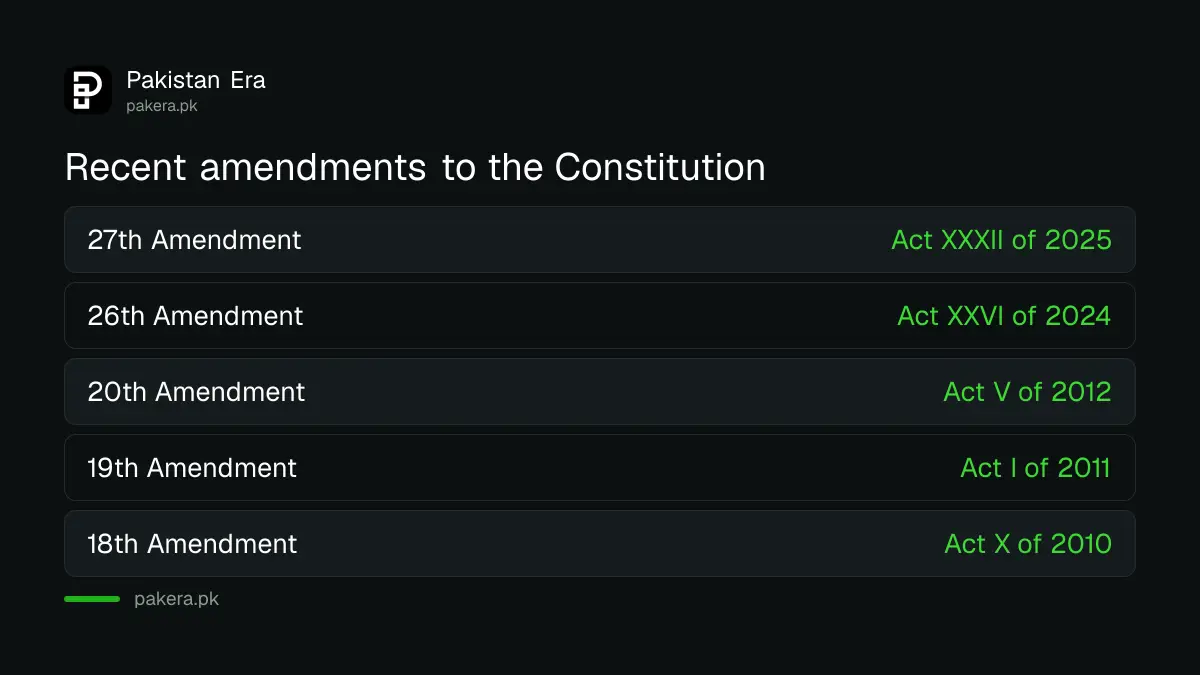
The National Assembly's Acts of Parliament list shows the Twenty-seventh Amendment under 13 November 2025, as Act XXXII of 2025, and the Twenty-sixth under 21 October 2024, as Act XXVI of 2024. The Constitution on Pakistan Code now carries footnotes for both.
| Amendment | Act number | Date |
|---|---|---|
| Twenty-seventh Amendment | Act XXXII of 2025 | 13 November 2025, on the NA Acts list |
| Twenty-sixth Amendment | Act XXVI of 2024 | 21 October 2024, on the NA Acts list |
| Twentieth Amendment | Act V of 2012 | Assented 28 February 2012 |
| Nineteenth Amendment | Act I of 2011 | Assented 1 January 2011 |
| Eighteenth Amendment | Act X of 2010 | Assented 19 April 2010 |
Among its changes, the Twenty-seventh Amendment brought in the Federal Constitutional Court, which now hears matters such as defection appeals. It also raised the number of Advisers the President can appoint on the Prime Minister's advice from five to seven, under Article 93. The court's first year is covered in the Federal Constitutional Court's 9,000 decided cases.
Amendment bill compared with an ordinary bill
An ordinary bill passes by a majority of members present and voting, and a deadlock can go to a joint sitting. A constitutional amendment needs two-thirds of all seats in each House separately, and there is no joint sitting route to rescue it.
For the ordinary route, read how a bill becomes law in Pakistan. To see the current Senate seats by province and party, see the Senate of Pakistan members list.
Common questions about constitutional amendments in Pakistan
How many votes are needed to amend Pakistan's Constitution?
At least 224 of 336 in the National Assembly and 64 of 96 in the Senate, which is two-thirds of each House's total membership.
Can a constitutional amendment start in the Senate?
Yes. Article 239(1) says a Bill to amend the Constitution may originate in either House.
Can the Supreme Court or any court strike down an amendment?
Article 239(5) says no court has jurisdiction to question any amendment to the Constitution on any ground.
Do provinces vote on constitutional amendments?
Only when the amendment would alter a province's limits. Then that province's assembly must pass it by two-thirds of its total membership.
What was the latest amendment to Pakistan's Constitution?
The Twenty-seventh Amendment, Act XXXII of 2025. The Constitution on Pakistan Code shows no later amendment as of 15 November 2026.
How we verified this
What we checked and where we read it.
Last checked 15 November 2026. Articles 51, 59, 63A, 93, 106, 238 and 239 are from the Constitution on Pakistan Code, which includes Twenty-seventh Amendment footnotes. Rule 156 is from the National Assembly Rules of Procedure, 2007, as modified up to 18 August 2026. The 26th and 27th Amendment entries are from the National Assembly's Acts of Parliament page; the 18th to 20th assent dates are from the preface of the National Assembly's 2012 edition of the Constitution. That list gives one date per Act without naming whether it is the date of passage or assent.
About the author

Global Affairs & Political Economy Writer
Muhammad Hatim is a book lover who started writing because he enjoys it. At Pakistan Era he writes about international relations, geopolitics and the global economy, with a particular interest in South Asia and the forces behind current events.