How to Convert a Partnership Firm or Private Company Into an LLP in Pakistan
Convert a firm or private company into an LLP with SECP in Pakistan: who qualifies, the three documents to file, what moves across and the 12-month notice.
A partnership firm or a private limited company in Pakistan can convert into an LLP by filing three things with the SECP registrar: a statement signed by all partners or all shareholders, a new LLP incorporation document, and a compliance statement. The LLP's partners must be exactly the old partners or shareholders. Once SECP registers it, the old firm or company is dissolved and everything it owned moves to the LLP.
Many family businesses start as a partnership firm and later want limited liability without becoming a full company. Others set up a private company and find the AGMs and board paperwork too heavy. The Limited Liability Partnership Act, 2017 gives both a direct route: the Second Schedule for firms and the Third Schedule for private companies.
| Firm to LLP | Private company to LLP | |
|---|---|---|
| Who signs the statement | All partners of the firm | All shareholders |
| Who the LLP partners must be | All firm partners, nobody else | All shareholders, nobody else |
| Extra condition | All creditors agree to the conversion | No charge or other security on its assets |
| What happens to the old entity | Firm dissolved, removed from the firms register | Company dissolved, removed from the companies register |
| Old name on letters | 12 months | 12 months |
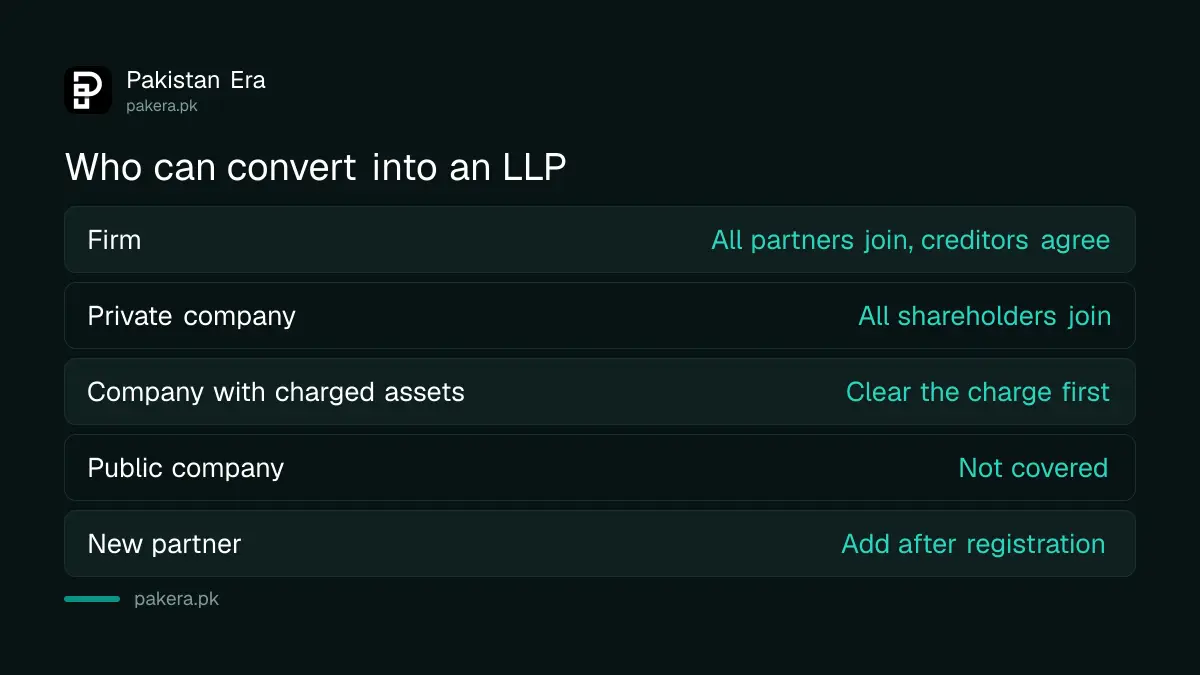
Only a firm or company whose owners all move across can convert
The LLP's partners must be every partner of the firm, or every shareholder of the company, and no one else. A partner cannot be dropped and a new one cannot join during the conversion. Make those changes before you apply, or after the LLP is registered.
A firm also has to show two things in its statement: it can pay its debts as they fall due, and all its creditors have agreed to the conversion. Get that consent in writing from the bank, suppliers and landlord first. A private company can convert only if no charge or other security interest is still in force on its assets. If a bank loan is secured on company property, clear it and record the satisfaction with SECP before applying.
File three documents with the SECP registrar to convert
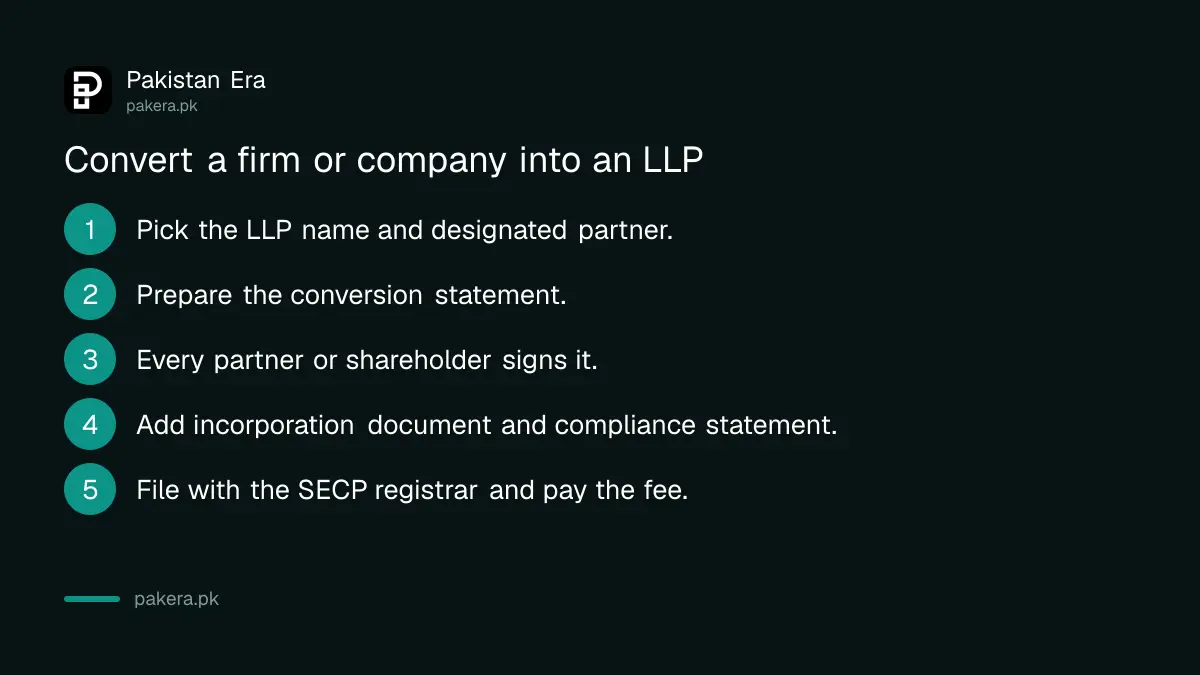
The conversion filing has three parts: a conversion statement signed by all owners, the LLP incorporation document, and the compliance statement that every new LLP needs. SECP sets the form and fee. The registrar may ask for the papers to be verified before registering the LLP.
- Agree the LLP name, ending in "LLP", and choose at least one designated partner who has lived in Pakistan six months in the past year.
- Prepare the conversion statement. A firm gives its name, its registration number and date under the Partnership Act 1932, that it can pay its debts, and that all creditors agree. A company gives its name, registration number and date of incorporation.
- Have every partner or every shareholder sign that statement.
- Prepare the LLP incorporation document and the compliance statement from an advocate, a chartered or cost accountant, or a partner.
- File all three with the SECP registrar and pay the fee, then wait for the certificate of registration.
The full list of what the incorporation document must say, and the rules on partners and names, are in the guide to register an LLP with SECP.
On registration, property, contracts and staff move to the LLP automatically
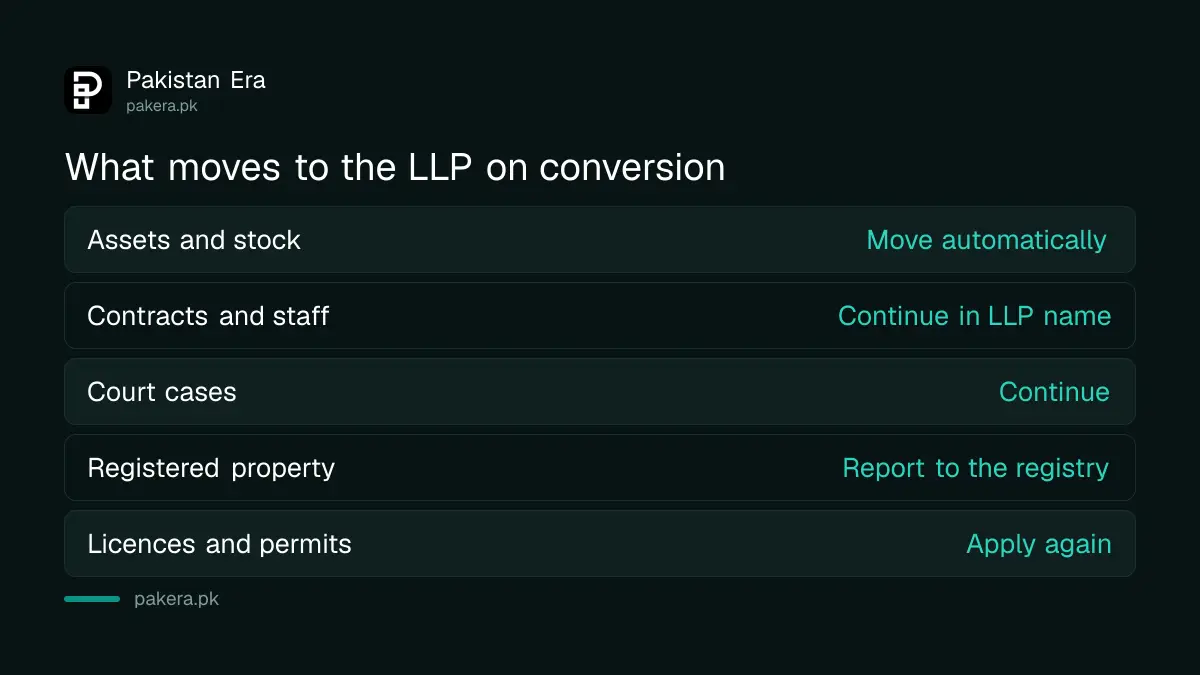
From the date on the certificate, all the firm's or company's property, rights, debts and business pass to the LLP with no separate transfer deed. Contracts, employment contracts, court cases and appointments continue in the LLP's name as if it had always been the party.
Two things do not carry over on their own. Licences, permits and approvals issued to the firm or company under any law are excluded from the automatic transfer, so apply to each regulator in the LLP's name. Property registered with an authority, such as land or vehicles, must be reported to that authority as soon as practicable.
| Item | Moves to the LLP automatically? | What to do |
|---|---|---|
| Cash, stock, machinery | Yes | Update your books |
| Contracts and staff contracts | Yes | Tell clients and staff of the new name |
| Court cases | Yes, they continue | Inform your lawyer |
| Land, vehicles, registered property | Yes, but must be reported | Notify the land, excise or other registry |
| Licences and permits | No | Apply again in the LLP's name |
Old firm partners stay liable for debts from before the conversion
Converting does not wipe out personal liability for the past. A firm's partners remain personally liable, along with the LLP, for debts and contracts made before the conversion. If a partner pays such a debt, the LLP must repay that partner unless the partners agreed otherwise.
This rule is in paragraph 15 of the Second Schedule. Only debts taken on after the conversion get the LLP's limited liability. Agree in writing how old firm debts will be handled before you file. The Third Schedule for companies has no such paragraph, because shareholders were already protected by limited liability.
Show the old name on every letter for 12 months
For 12 months, starting no later than 14 days after registration, all official correspondence must state that the LLP was converted from the firm or company and give its old name and registration number. Missing this carries a fine of up to Rs 1 million, plus up to Rs 10,000 a day.
Update letterheads, invoices, email footers and the business signboard at the same time. The LLP's own name must also be shown outside every office. FBR needs to know about the new entity too; the steps for a tax number are in getting an NTN for a partnership or company. A company that wants to close instead of converting can use SECP's route to close a company through Easy Exit.
Common questions
Does an unregistered partnership firm qualify for conversion?
The Second Schedule asks for the firm's registration number and date "if applicable", so the wording allows for a firm with no registration. Registering it first, for example to register a partnership firm in Punjab, gives you a clear record to file.
Can a public company convert into an LLP?
No. The Third Schedule covers only private companies. A public company would first need to become a private company under the Companies Act 2017.
Can we add a new partner during the conversion?
No. The LLP's partners must be exactly the firm's partners or the company's shareholders. Add the new partner after registration and file the notice within 15 days.
Does the company need a separate winding up?
No. Paragraph 6 of the Third Schedule says the company is treated as dissolved and removed from the register of companies from the registration date.
Will our bank loan stop a company from converting?
Yes, if the loan is secured by a charge on company assets. The Third Schedule allows conversion only when no security interest is in force on the assets.
How we verified this
What we checked and where we read it.
We checked this guide on 25 November 2026 against the Second and Third Schedules and sections 5, 25 and 26 of the Limited Liability Partnership Act, 2017 on the Pakistan Code, the Ministry of Law and Justice's statute portal, in the version updated to 15 October 2021. The Third Schedule still refers to companies under the Companies Ordinance, 1984, which the Companies Act, 2017 replaced.
Free on WhatsApp
Get last dates and rule changes on WhatsApp
We post new last dates, fee changes and fixes for common problems, a few short posts a day.
Follow Pakera on WhatsAppOther followers cannot see your number.
Pakera Solves It
Which online process wasted your time this week?
A portal that will not load, a form nobody explains, a complaint that went nowhere. Tell us. Every week we pick one, solve it step by step and publish the answer.
About the author

Tax, Bills and Technology Writer
Ali Akhtar is a young and curious voice here at Pakistan Era. He is currently pursuing his A-Levels and has a growing interest in Pakistan’s changing industrial landscape and educational trends. Ali likes to write in a way that helps him explain and explore the world around him. His writing reflects the perspective of the new generation navigating the evolving trends of Pakistan where technology, youth innovation, and shifting opportunities are reshaping the country’s future.