How to Close a Company With SECP in Pakistan: Easy Exit Strike Off, 4 Forms and Rs 5,000
Close an unwanted company in Pakistan with SECP Easy Exit: check who is eligible, file Forms EE-I to EE-IV and pay Rs 5,000 online or Rs 10,000 on paper.
Short answer: A private or unlisted public company in Pakistan with no debts and no disputes can ask SECP to strike its name off through the Easy Exit route. You file four forms, EE-I to EE-IV, and pay Rs 5,000 online or Rs 10,000 on paper. Housing and real estate companies cannot use it.
Many owners register a company, never use it and then forget it. The company still has to file returns, and missed filings can bring penalties. Closing it properly ends those duties. SECP, the Securities and Exchange Commission of Pakistan, has a short route for companies that qualify.
We read SECP's Company Easy Exit page, which shows a last updated date of 7 October 2026, on 14 October 2026. We did not file a strike off ourselves.
Who can use SECP's Easy Exit route
SECP says all private and public unlisted companies can apply, as can not-for-profit associations licensed under section 42 of the old Companies Ordinance, 1984. Many other kinds of company are excluded. If you are on the excluded list, you need a different closing route.
| Cannot use Easy Exit | What the page says |
|---|---|
| Subsidiaries of listed companies | Excluded |
| Foreign companies | Excluded |
| Trade organisations | Those under the Trade Organizations Act, 2013 |
| Companies with dues | Unpaid amounts to banks, financial institutions, taxes, utilities or government departments |
| Companies under action | Investigation, inspection, prosecution or court proceedings |
| Companies in disputes | Management or shareholding disputes |
| Companies with illegal activity | Illegalities or fraudulent activities |
| Housing and real estate | Development or marketing companies |
| Deposit takers | Companies that took public deposits and have not repaid or delivered |
The money rule is the one that stops most small companies. If the company owes tax, a bank or a utility, clear the debt first. A company that fails any listed test is not eligible, so check the whole list before you pay for the forms.
The four forms SECP asks for
The file has four parts. Form EE-I is the application to strike off the company's name. Form EE-II is the members' resolution. Form EE-III is a declaration and indemnity. Form EE-IV is an auditors' certificate. All four go to SECP together.
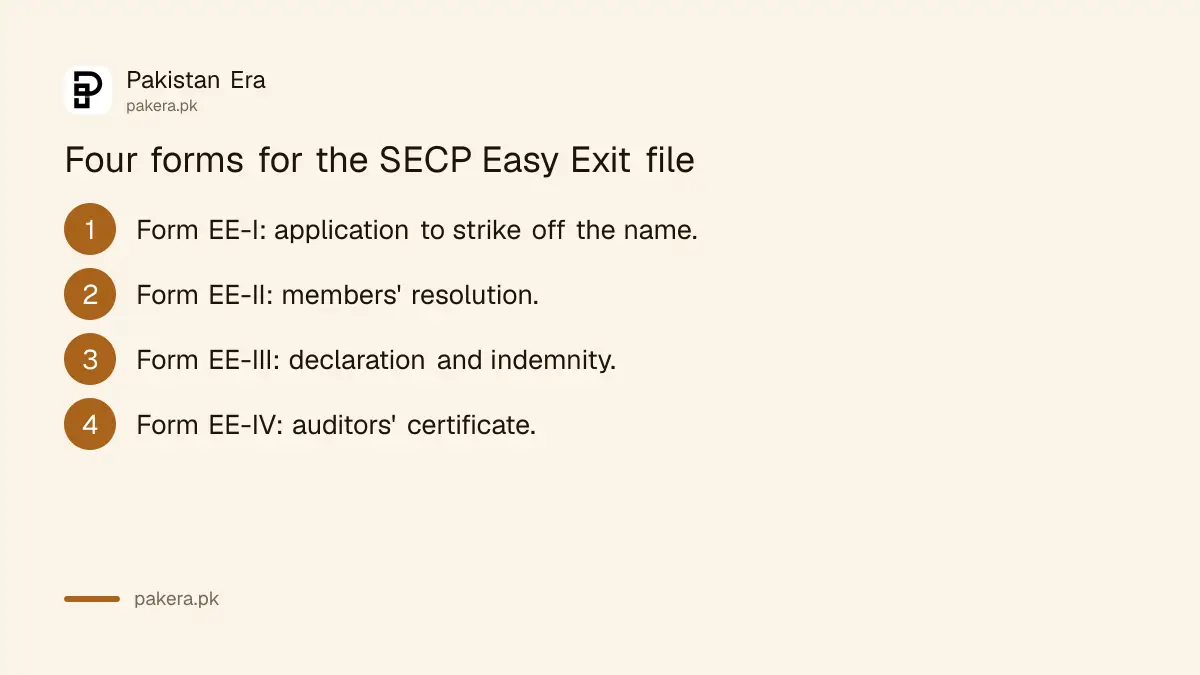
The resolution records that the members agree to close the company. The declaration and indemnity is a promise by the signers about the company's affairs. The auditors' certificate needs a practising auditor, so ask for the fee in advance. SECP's page does not publish the form wording on the page we read, so download the current forms from SECP before you fill anything in.
- Check every ineligible category above against your company.
- Clear all dues to banks, tax offices and utilities.
- Hold a members' meeting and pass the resolution for Form EE-II.
- Ask an auditor for the certificate on Form EE-IV.
- Complete Form EE-I and the declaration on Form EE-III.
- File the set with SECP and pay the fee.
What the application costs
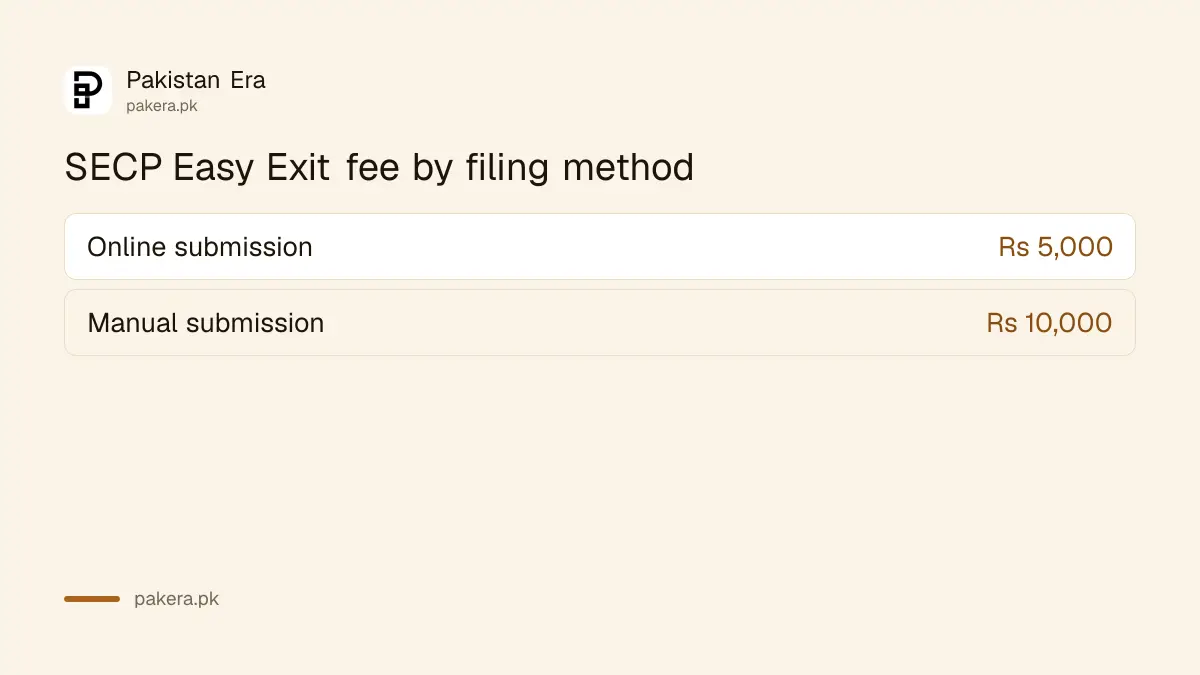
SECP's page gives two fees. An online submission costs Rs 5,000. A manual submission costs Rs 10,000. SECP adds that the electronic fee applies only where the Commission provides an electronic facility, so check whether this filing can be made on eZfile.
The auditor's fee and any lawyer's fee are extra and are set by them. Compare quotes from at least two. The strike off fee is the smaller part of the bill for most small companies.
What the page does not tell you
The page does not state a waiting period, a public notice period or what happens after you file. We could not find those details on the page we read. Ask SECP's registrar office in writing how long the process takes and how you will be told the name is struck off.
Keep your filings current until SECP confirms the strike off. A company that stops filing during the process may face penalties. See how to file your company's annual return with SECP and how to report a director change on Form 29. If your company has a beneficial owner record, check the Form 19 beneficial owner declaration as well.
Closing is different from starting a new one
Closing a company ends its legal existence. Do not use Easy Exit if you only want a new name. For a fresh start, read how to register a private limited company with SECP. Close the bank account after the strike off is confirmed.
Think about the tax side too. Easy Exit is an SECP process. The page we read does not describe how to close your FBR registration, so talk to your tax adviser about the final return. Do not assume that striking off the company closes your tax file.
If the company holds a contract, a lease or a licence, end each of them in writing first. Keep copies of the company records. The page does not say how long to keep them, so ask your auditor.
Common questions
What is SECP Easy Exit?
It is a route for eligible unlisted companies to ask SECP to strike their name off the register using four forms.
How much does it cost?
SECP lists Rs 5,000 for an online submission and Rs 10,000 for a manual one.
Can a company with unpaid tax use it?
No. Companies with outstanding dues to banks, tax offices, utilities or government departments are excluded.
Can a real estate company use it?
No. SECP excludes housing and real estate development or marketing companies.
Is a sole proprietorship closed this way?
No. A sole proprietor is not an SECP company. Easy Exit covers companies and certain licensed associations only.
How we verified this
What we checked, where we read it, and what we could not confirm.
Last checked on 14 October 2026, Pakistan time. We read SECP's Company Easy Exit Regulations page, which shows Last Updated 7 October 2026. The page names the regulations without a year in the text we saw. SECP's own closing a company page blocked us, so other closing routes are not covered. We did not file an application. Confirm with the registrar before you pay.
About the author

Tax, Bills and Technology Writer
Ali Akhtar is a young and curious voice here at Pakistan Era. He is currently pursuing his A-Levels and has a growing interest in Pakistan’s changing industrial landscape and educational trends. Ali likes to write in a way that helps him explain and explore the world around him. His writing reflects the perspective of the new generation navigating the evolving trends of Pakistan where technology, youth innovation, and shifting opportunities are reshaping the country’s future.