How to Register a Limited Liability Partnership (LLP) With SECP in Pakistan
Register an LLP with SECP in Pakistan: two partners, one designated partner resident here, a name ending in LLP, the 8-part incorporation document, deadlines.

To register a limited liability partnership (LLP) in Pakistan, you need at least two partners, one designated partner who lives in Pakistan, and a name ending in "LLP". File the incorporation document with the SECP registrar, with a compliance statement signed by an advocate, a chartered or cost accountant, or a partner. SECP then issues a registration certificate.
An LLP sits between a partnership firm and a company. The partners run it like a firm, but the LLP is a separate legal person, so a partner's own house and savings are not on the line for its debts. The Limited Liability Partnership Act, 2017 sets the rules, and SECP is the registrar.
| Rule | What the LLP Act 2017 says |
|---|---|
| Partners | At least 2, individuals or companies (section 9) |
| Designated partner | At least 1 individual resident in Pakistan (section 10) |
| Name | Must end with "LLP" (section 6) |
| Registered office | Required; any change reported within 15 days (section 5) |
| Late filing | Default fee of Rs 5,000 for every day of delay (section 36) |
An LLP needs two partners and one designated partner living in Pakistan
Every LLP must have at least two partners. A partner can be a person or a company. At least one partner must be a designated partner: an individual who has stayed in Pakistan for six months or more in the year before. Designated partners are responsible for the LLP's filings.
If every partner is a company, or partners are a mix of people and companies, at least two individuals must act as designated partners, and one of them must be resident in Pakistan. A person who is an undischarged insolvent, or who a court has found of unsound mind, cannot be a partner.
If the partners drop below two and the LLP keeps trading for more than six months, the remaining partner becomes personally liable for debts taken on after that point. That rule is in section 9(2).
The incorporation document must carry eight details
The incorporation document is the LLP's founding paper, signed by everyone who will be a partner on day one. Section 5 lists what it must contain. Gather these before you start, because the registrar can refuse an incomplete or badly signed document under section 23.
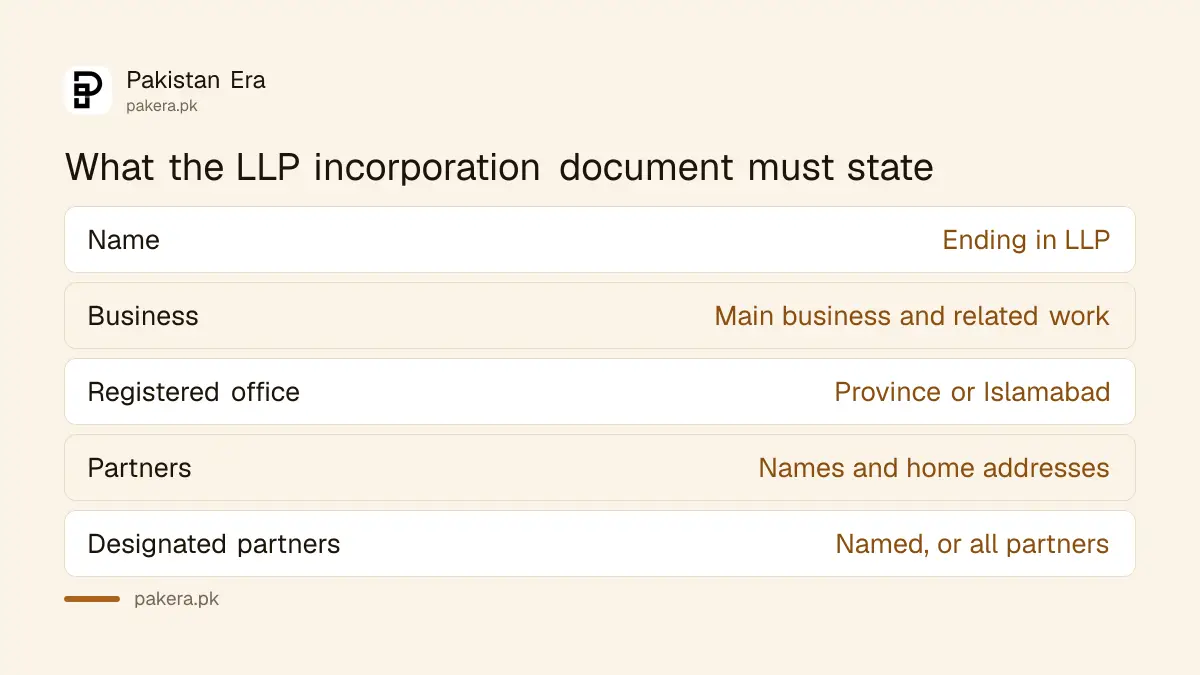
- The LLP's name, ending in "LLP".
- The main business it will carry on, plus related activities.
- The province, or Islamabad, where the registered office will be.
- The name and home address of each partner.
- Which partners are designated partners, or a statement that all partners are.
- A statement that the partners' liability is limited.
- Any other details SECP's LLP regulations ask for.
- A compliance statement from an advocate, a member of ICAP or ICMAP, or a subscribing partner.
Register the LLP with SECP in five steps
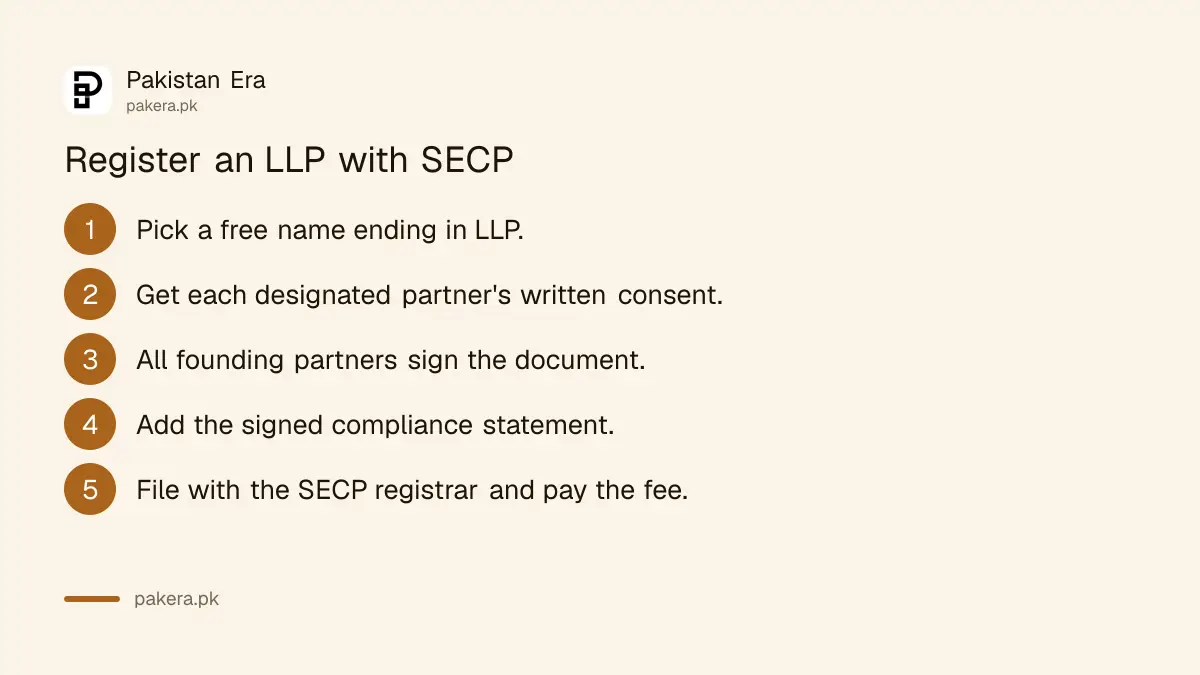
Choose a name, get each designated partner's written consent, sign the incorporation document, add the compliance statement, and file it with the SECP registrar with the fee. Once the registrar is satisfied, SECP issues a certificate that the LLP is registered under the name you chose.
- Pick a name ending in "LLP" that is not the same as, or close to, an existing company or LLP. The SECP company name check shows names already taken.
- Get written consent from each designated partner. Section 10(5) bars anyone from becoming a designated partner without prior consent.
- Have all founding partners sign the incorporation document.
- Get the compliance statement signed by your advocate, accountant or a partner.
- File both with the SECP registrar and pay the fee. Section 35 allows SECP to accept LLP filings online.
The certificate is conclusive proof that the LLP is registered under that name. After that, file the LLP agreement between the partners with the registrar too. Section 12(2) requires it, along with any later change to it.
Some names need SECP approval, and some will be refused
The registrar refuses a name that is undesirable, deceptive, offensive to religious feeling, or the same as an existing LLP or company. Words linking the LLP to the federal or a provincial government, a head of state, a state corporation or a foreign government need SECP's written approval first.
The registrar can also refuse the whole registration if the business looks unlawful, deceptive or against national security. Keep the business description plain and accurate.
Once registered, the name must be painted or fixed outside every office in English or Urdu. Not doing so carries a fine of up to Rs 10,000 for each day under section 6(6).
After registration, four deadlines keep the LLP in good standing
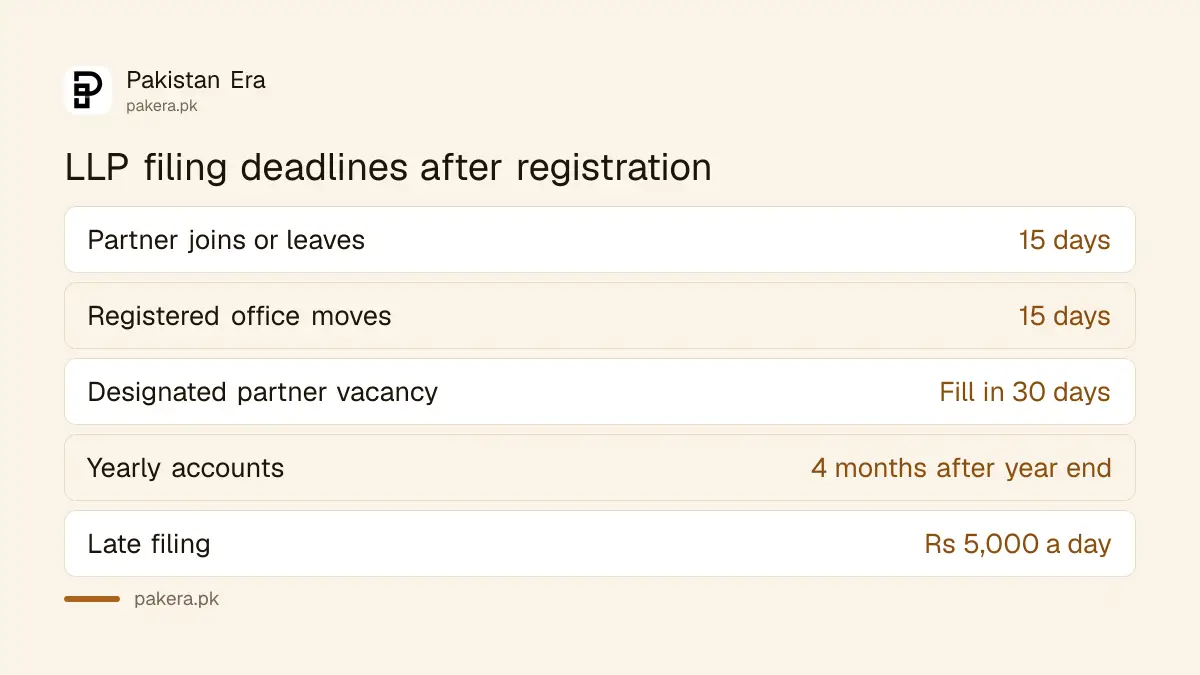
Most LLP filings run on 15 or 30 day clocks. Miss one, and section 36 adds a default fee of Rs 5,000 for every day of delay on top of the normal filing fee. Put these dates in a shared calendar from the day the certificate arrives.
| Event | Deadline | Section |
|---|---|---|
| Partner joins or leaves | Notice within 15 days | 14 |
| Registered office moves | Notice within 15 days | 5 |
| Designated partner post falls vacant | Appoint within 30 days | 10(4) |
| New designated partner's details and consent | File within 30 days | 10(6) |
| Yearly statement of accounts | Within 4 months of year end | 20(2) |
The LLP must keep double entry books on an accrual basis at its registered office. Only a chartered accountant can audit an LLP. The LLP must also record the ultimate beneficial owner of each partner, meaning the person who controls it or takes at least a quarter of its profit.
Choose an LLP over a firm or a company when liability is the worry
A partnership firm leaves partners personally liable for its debts. A private limited company limits liability but brings directors, shareholders, annual returns and AGMs. An LLP limits liability while letting partners run things through their own agreement.
| Partnership firm | LLP | Private limited company | |
|---|---|---|---|
| Registered with | Provincial registrar of firms | SECP | SECP |
| Separate legal person | No | Yes | Yes |
| Partners' or owners' liability | Unlimited | Limited | Limited |
| Minimum people | 2 partners | 2 partners | 2 members, or 1 for an SMC |
For the other routes, see how to register a partnership firm in Punjab and how to register a private limited company with SECP. Whatever you pick, the business still needs its own tax number; the FBR steps are in getting an NTN for a partnership or company.
Common questions
Can one person register an LLP in Pakistan?
No. Section 9 requires at least two partners. One person who wants limited liability can form a single member company with SECP instead.
Can a foreigner be a partner in a Pakistani LLP?
Yes, the Act lets any individual or company be a partner. But at least one designated partner must be resident in Pakistan, meaning six months or more in Pakistan in the past year.
Is an LLP the same as a partnership firm under the 1932 Act?
No. Section 32 says the Partnership Act 1932 does not apply to an LLP. An existing firm can convert into an LLP under the Second Schedule of the LLP Act.
What happens if we file a partner change late?
The registrar can still accept it, but section 36 charges a default fee of Rs 5,000 for every day of delay. Section 14 also allows a fine of up to Rs 1 million.
Does an LLP have to get its accounts audited?
Section 20 says LLP accounts are audited under SECP's regulations, and SECP can exempt some classes of LLP. The auditor must be a chartered accountant.
How we verified this
What we checked and where we read it.
We checked this guide on 25 November 2026 against the Limited Liability Partnership Act, 2017 on the Pakistan Code, the Ministry of Law and Justice's statute portal, in the version updated to 15 October 2021, including sections 5 to 14, 20, 23, 32, 35 and 36 and the Second Schedule.
Free on WhatsApp
Get last dates and rule changes on WhatsApp
We post new last dates, fee changes and fixes for common problems, a few short posts a day.
Follow Pakera on WhatsAppOther followers cannot see your number.
Pakera Solves It
Which online process wasted your time this week?
A portal that will not load, a form nobody explains, a complaint that went nowhere. Tell us. Every week we pick one, solve it step by step and publish the answer.
About the author

Tax, Bills and Technology Writer
Ali Akhtar is a young and curious voice here at Pakistan Era. He is currently pursuing his A-Levels and has a growing interest in Pakistan’s changing industrial landscape and educational trends. Ali likes to write in a way that helps him explain and explore the world around him. His writing reflects the perspective of the new generation navigating the evolving trends of Pakistan where technology, youth innovation, and shifting opportunities are reshaping the country’s future.