Daal Prices in Pakistan: Chana Daal Up Rs 11 a Kilo in a Week to Rs 286
Chana daal rose 3.99% to Rs 286 a kilo in Pakistan in the week to 8 October 2026. See masoor, moong and mash prices in 17 PBS cities and what changed this year.
Gram pulse, the chana daal on most kitchen shelves, rose to an average of Rs 286.06 a kilo across Pakistan in the week ended 8 October 2026. That is Rs 11 more than a week earlier, a rise of 3.99%, according to the Pakistan Bureau of Statistics (PBS). Only flour and chicken rose faster that week.
The other three pulses PBS tracks barely moved. Masoor went up 1.29%, mash 0.91%, and moong was flat. Three of the four are still cheaper than a year ago. Mash is the exception.
We read the PBS city annex for 8 October and the one for 1 October, and compared the four pulses across all 17 cities. Every price below is a PBS weekly average, not a price fixed by the government.
Chana daal rose Rs 11 a kilo in one week
The national average for gram pulse went from Rs 275.08 on 1 October to Rs 286.06 on 8 October. Four weeks earlier, on 10 September, it was Rs 268.49. So it has added about Rs 17.60 a kilo in a month, or 6.5%, on our arithmetic.
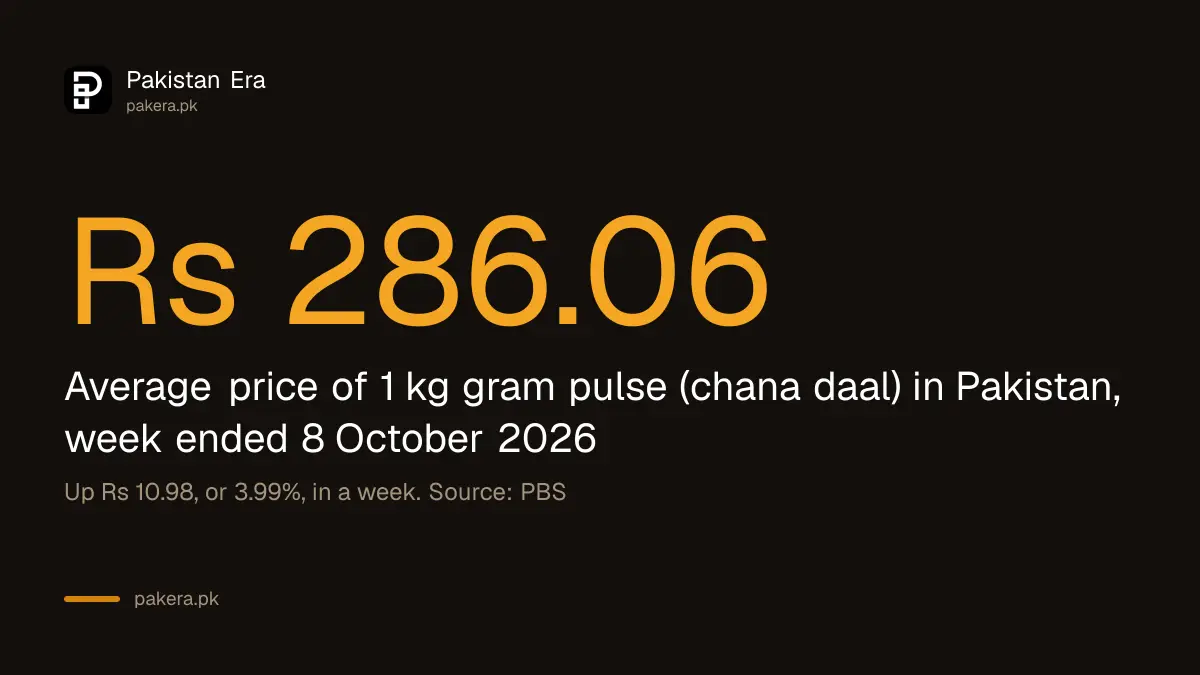
Even after the rise, chana daal is 5.97% cheaper than a year ago, when it averaged Rs 304.23. The jump this week is a reversal of a long fall rather than a new high.
Eleven of the 17 cities saw it go up. The biggest rises were in Gujranwala, Sargodha and Multan, each over Rs 23 a kilo.
| City | 1 October | 8 October | Change |
|---|---|---|---|
| Peshawar | Rs 320.00 | Rs 336.63 | Up Rs 16.63 |
| Quetta | Rs 299.93 | Rs 319.93 | Up Rs 20.00 |
| Islamabad | Rs 311.30 | Rs 316.35 | Up Rs 5.05 |
| Rawalpindi | Rs 295.91 | Rs 303.92 | Up Rs 8.01 |
| Multan | Rs 276.59 | Rs 299.78 | Up Rs 23.19 |
| Gujranwala | Rs 270.00 | Rs 296.63 | Up Rs 26.63 |
| Karachi | Rs 267.65 | Rs 287.98 | Up Rs 20.33 |
| Hyderabad | Rs 267.40 | Rs 284.78 | Up Rs 17.38 |
| Sargodha | Rs 253.29 | Rs 276.63 | Up Rs 23.34 |
| Lahore | Rs 253.06 | Rs 253.06 | No change |
| Faisalabad | Rs 226.62 | Rs 226.62 | No change |
Sialkot rose Rs 20 to Rs 280 and Bannu Rs 10 to Rs 300. Bahawalpur, Sukkur, Larkana and Khuzdar did not change. The gap is wide: chana daal costs about Rs 110 a kilo more in Peshawar than in Faisalabad.
Masoor, moong and mash prices this week
Masoor rose a little, mash rose a little, and moong held. All three moves were under Rs 5 a kilo on the national average.
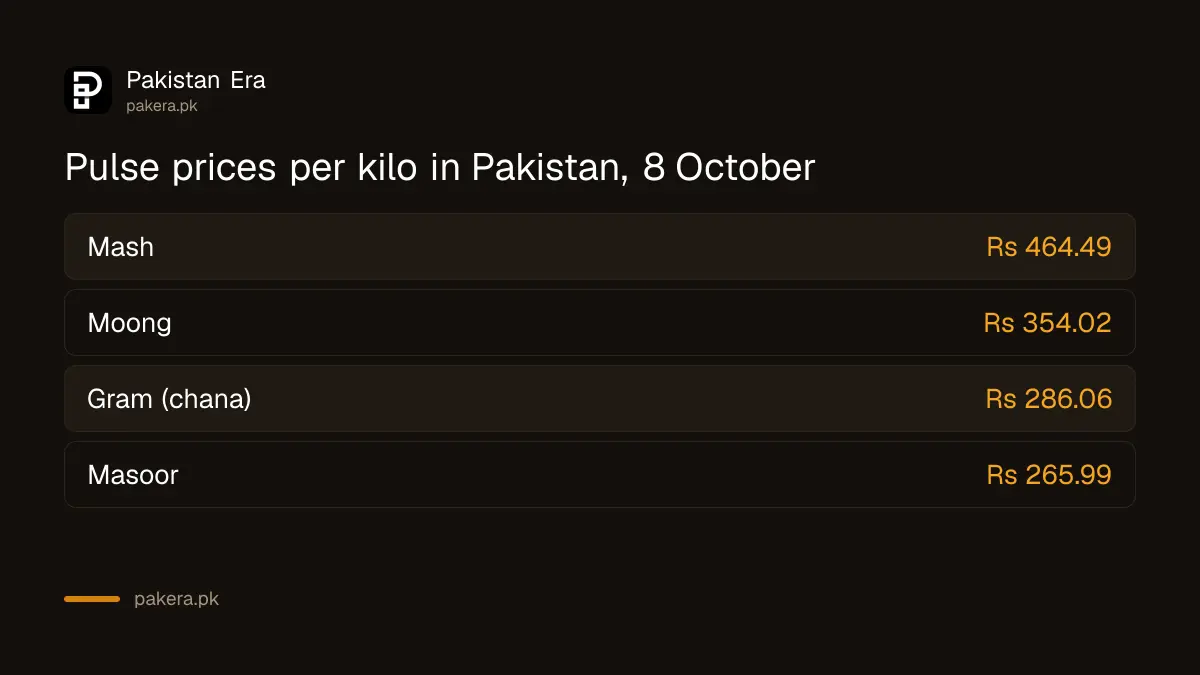
| Pulse (washed) | 8 October | Week change | Year change |
|---|---|---|---|
| Gram (chana) | Rs 286.06 | Up 3.99% | Down 5.97% |
| Masoor | Rs 265.99 | Up 1.29% | Down 9.79% |
| Moong | Rs 354.02 | Down 0.03% | Down 8.37% |
| Mash | Rs 464.49 | Up 0.91% | Up 3.67% |
The masoor rise came from Balochistan and southern Khyber Pakhtunkhwa only. Bannu, Quetta and Khuzdar each went up Rs 20 a kilo, and every other city stayed where it was. Islamabad is the dearest for masoor at Rs 308.94. Gujranwala, Sialkot and Sukkur are the cheapest at Rs 240.
Moong fell Rs 30 in Quetta but rose Rs 13.55 in Larkana, which is now the dearest city at Rs 433.23. Gujranwala is the cheapest at Rs 280.
Mash is the costliest pulse by far. Islamabad averages Rs 514.68 a kilo and Bahawalpur Rs 386.12.
Mash is the only pulse dearer than last year
A year ago, in the week ended 9 October 2025, mash averaged Rs 448.04 a kilo. It is Rs 16.45 higher now. Every other pulse has fallen over the year. Moong fell the most in rupees, about Rs 32 a kilo, and masoor the most in percentage terms, 9.79%.
That matters for the cheapest meal in most homes. A plate of cooked daal at an average hotel now costs Rs 177.75, up 0.98% in a week and 6.14% in a year, PBS says. Restaurant prices follow wages, gas and rent as well as the pulse itself, so they rarely fall when pulses do.
For a family that buys 2 kilos of chana daal and 2 kilos of masoor a month, this week's rise adds about Rs 29, on our arithmetic. Compared with a year ago, the same four kilos still cost about Rs 94 less.
PBS gives no reason for the chana daal rise
PBS records prices. It does not explain them. The federal food ministry's news page had no notice on pulse prices when we checked it on 9 October.
We could not find an official statement explaining this week's rise, so we are not guessing at a cause. A one-week jump can also reverse quickly, as moong did in Quetta.
The same PBS release showed flour rising even faster, by 5.69% in a week. The overcharging complaint route in Punjab covers pulses as well as flour where a district has notified a rate.
How to check a fair daal price in your city
The PBS average is not a legal price. It is a useful yardstick for spotting a shop that is far out of line.
- Open the latest PBS weekly SPI release and download the city annex.
- Find Pulse Gram, Pulse Masoor (Washed), Pulse Moong (Washed) or Pulse Mash (Washed).
- Read your city's minimum, average and maximum price.
- Ask whether your district has a notified rate list. Where it does, that list is the legal ceiling.
- Keep the receipt or note the shop and price, then complain to the district price control magistrate.
Loose daal sold by weight must be weighed on a stamped scale. If the weight looks wrong, the process for reporting a tampered scale applies.
Common questions
What is the daal price in Pakistan today?
In the week ended 8 October 2026, PBS averages were Rs 286.06 a kilo for gram (chana), Rs 265.99 for masoor, Rs 354.02 for moong and Rs 464.49 for mash.
How much did chana daal go up this week?
It rose Rs 10.98 a kilo, or 3.99%, from Rs 275.08 on 1 October. It was the third biggest weekly rise among the 51 items PBS checks.
Which city has the cheapest chana daal?
Faisalabad, at Rs 226.62 a kilo, followed by Bahawalpur at Rs 249.87 and Lahore at Rs 253.06.
Which daal is the cheapest right now?
Masoor, at Rs 265.99 a kilo on the national average. Chana daal is about Rs 20 dearer.
Are pulses cheaper than last year?
Three of four are. Masoor is down 9.79%, moong 8.37% and gram 5.97%. Mash is up 3.67%.
How we verified this
What we checked, where we read it, and what we could not confirm.
We read these PBS documents on 9 October 2026.
- PBS, SPI for the week ended 8 October 2026
- PBS city annex, 8 October 2026
- PBS city annex, 1 October 2026
Monthly changes, household costs and city gaps are our own arithmetic on PBS figures.
About the author

Tax, Bills and Technology Writer
Ali Akhtar is a young and curious voice here at Pakistan Era. He is currently pursuing his A-Levels and has a growing interest in Pakistan’s changing industrial landscape and educational trends. Ali likes to write in a way that helps him explain and explore the world around him. His writing reflects the perspective of the new generation navigating the evolving trends of Pakistan where technology, youth innovation, and shifting opportunities are reshaping the country’s future.