Duty Drawback Rates 2026 in Pakistan: FBR's New Schedules for Textile, Leather, Engineering and Other Exports (SRO 1908 to 1911)
FBR's SRO 1908 to 1911 of 2026 set new duty drawback rates for textile, leather, engineering and other exports from 27 October. See key rates and claim rules.
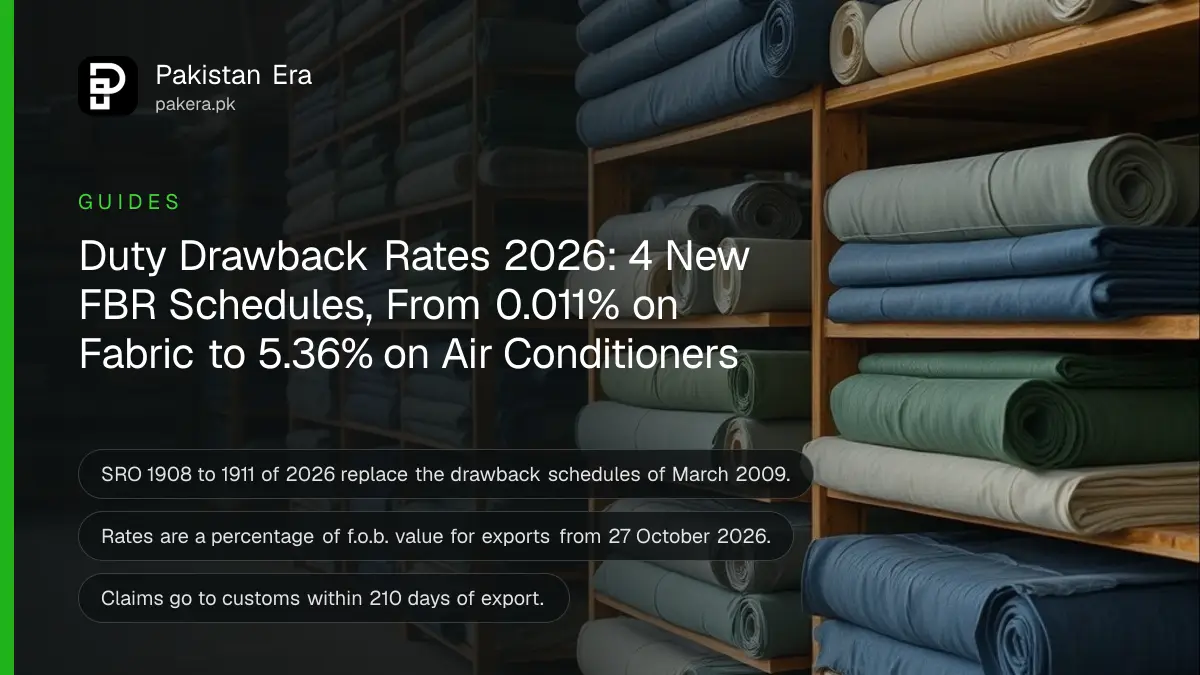
FBR has issued new duty drawback rates for exporters, the first full replacement of the 2009 schedules. Four notifications, SRO 1908 to SRO 1911 of 2026, set rates as a percentage of f.o.b. value for exports from 27 October 2026, and you must claim within 210 days of export. They cover textiles, leather, engineering goods and miscellaneous products.
Duty drawback is a refund of the customs duty you paid on imported raw materials that went into goods you exported. We read all four notifications on FBR's website on 1 November 2026. The rates for some common products, the claim conditions and a worked example follow.
Four SROs replace the 2009 drawback schedules
FBR issued the four notifications under section 21(c) of the Customs Act 1969. Each one supersedes its matching 2009 notification, SRO 209 to SRO 212 of 5 March 2009. The new rates apply to goods exported from 27 October 2026 onwards.
| Notification | Products | Replaces | Pages |
|---|---|---|---|
| SRO 1908(I)/2026 | Textile and allied products | SRO 209(I)/2009 | 63 |
| SRO 1909(I)/2026 | Leather and allied products | SRO 210(I)/2009 | 29 |
| SRO 1910(I)/2026 | Engineering and allied products | SRO 211(I)/2009 | 48 |
| SRO 1911(I)/2026 | Miscellaneous products | SRO 212(I)/2009 | 108 |
SROs 1909, 1910 and 1911 are dated 27 October 2026. The date on the scanned copy of SRO 1908 is partly unreadable, but its schedules also run from 27 October 2026. FBR uploaded all four on 29 October.
Rates are a percentage of the f.o.b. value of the export
Each schedule lists the imported raw materials, the finished goods with their H.S. codes, the start date and the repayment rate. The rate is a percentage of the free on board (f.o.b.) value of the goods you export, not of the duty you paid.
Rates vary widely. Basic grey cotton fabric earns very little. Air conditioners earn far more. Here are some lines we read in the schedules.
| Exported product | Notification | Drawback (% of f.o.b.) |
|---|---|---|
| Grey fabric, 100% cotton | SRO 1908 | 0.011% |
| Grey ready-made garments, 100% cotton | SRO 1908 | 0.272% |
| Grey made-ups (bed wear, curtains), 100% cotton | SRO 1908 | 0.497% |
| Dyed or printed cotton fabric | SRO 1908 | 0.450% |
| Footballs and similar balls | SRO 1909 | 0.031% |
| Split air conditioners | SRO 1910 | 5.36% |
| Self-contained package air conditioners | SRO 1910 | 5.42% |
| Tyres for trucks, buses, cars and jeeps | SRO 1911 | 0.38% |
| Motorcycle, scooter and rickshaw tyres | SRO 1911 | 1.45% |
| Bicycle tyres | SRO 1911 | 0.87% |
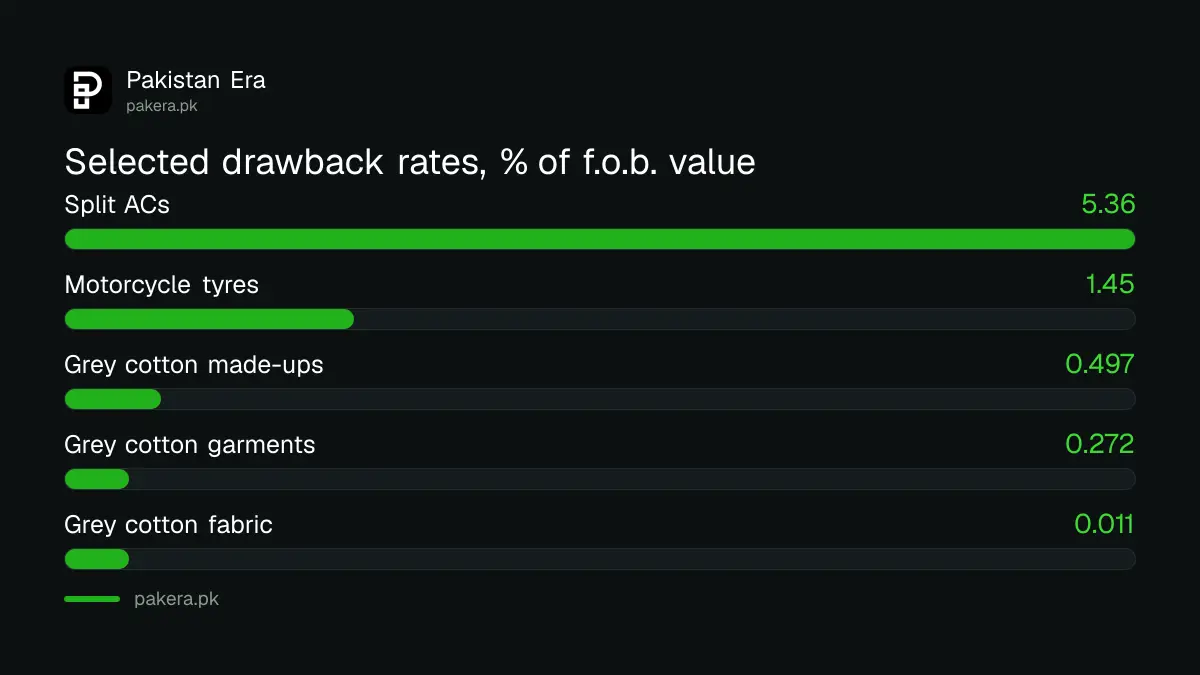
The schedules are scanned images, so check your own line against the PDF before you file. Match your product by H.S. code, not by name. The PCT code finder on TIPP helps confirm the code.
You must claim within 210 days of export
Every notification sets the same two conditions. You apply to the proper customs officer within 210 days of export, or within 180 days of the foreign exchange arriving as shown on the bank credit advice. And you must declare the claim on the goods declaration.
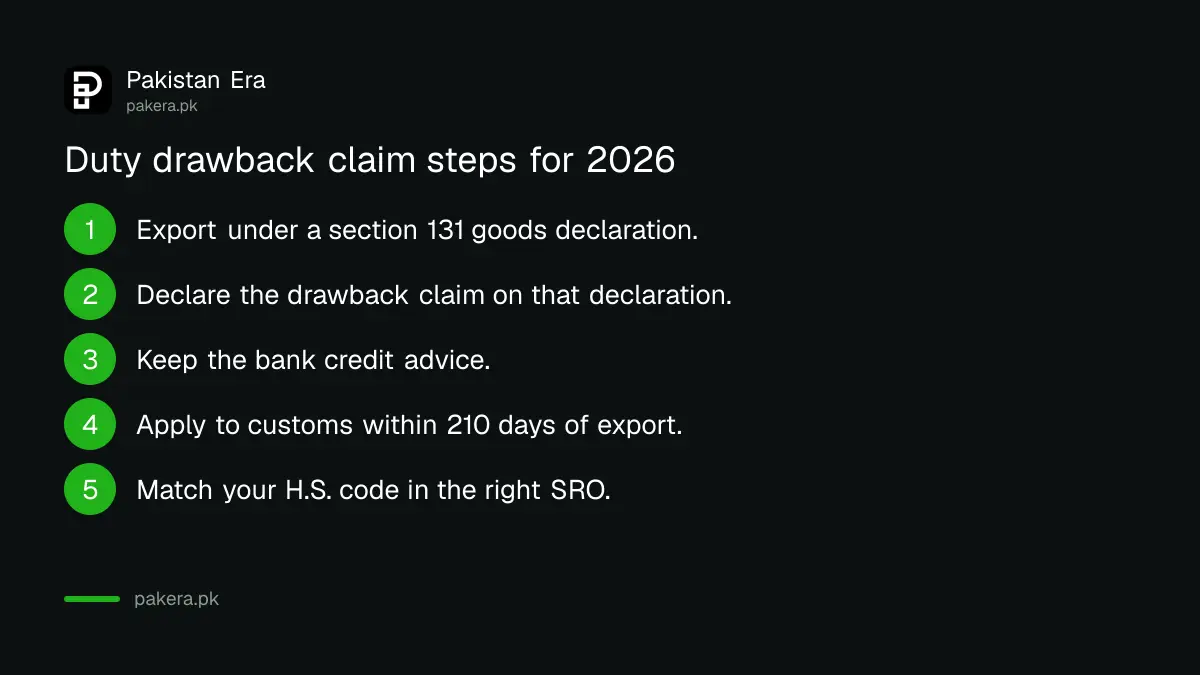
- Export the goods under a goods declaration filed under section 131 of the Customs Act.
- Declare on that goods declaration and your export papers that you claim drawback.
- Collect the bank credit advice when the export money arrives.
- Apply to the proper customs officer within 210 days of export, or 180 days of realisation.
- Check your product's rate and H.S. code in the matching SRO.
Missing the declaration on the goods declaration is the mistake to avoid. The condition asks for it at the time of export, so it cannot be added after the goods have left. Exporters filing on WeBOC can confirm their setup through WeBOC export registration.
A worked example shows how far the rates differ
The amount is simply the rate times the f.o.b. value. An export of split air conditioners worth Rs 10 million f.o.b. earns Rs 536,000 at 5.36 per cent. The same value of grey cotton fabric earns Rs 1,100 at 0.011 per cent.
| Export worth Rs 10 million f.o.b. | Rate | Drawback |
|---|---|---|
| Split air conditioners | 5.36% | Rs 536,000 |
| Motorcycle tyres | 1.45% | Rs 145,000 |
| Grey cotton made-ups | 0.497% | Rs 49,700 |
| Grey cotton garments | 0.272% | Rs 27,200 |
| Grey cotton fabric | 0.011% | Rs 1,100 |
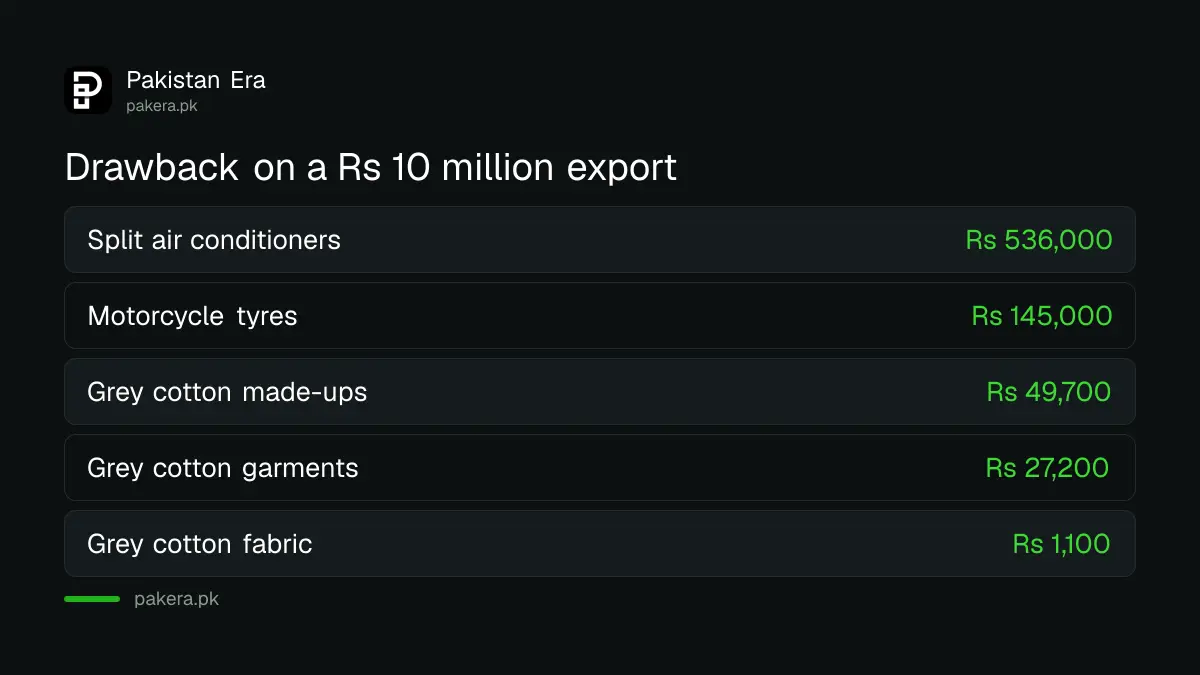
These are our own calculations from the published rates. For exporters with small drawback rates, the paperwork may cost more than the refund. That is when importing inputs duty free makes more sense.
Drawback is one of three ways to recover import duty
Drawback refunds duty after export. The Export Facilitation Scheme lets approved exporters import inputs without paying duty in the first place. An incremental export rebate is a separate cash support. Most exporters use one route per input, so pick the one that suits your volumes.
The duty-free route needs approval in advance, explained in getting EFS authorisation for duty-free raw materials. The rebate is covered in claiming the export rebate on incremental exports. Drawback stays the simplest choice for exporters who import inputs normally and pay the duty.
Common questions
What are the new duty drawback rates?
They are set out in SRO 1908 to SRO 1911 of 2026, as a percentage of f.o.b. value, for exports from 27 October 2026. Rates range from 0.011 per cent for grey cotton fabric to above 5 per cent for air conditioners.
Which old notifications do they replace?
SRO 209, 210, 211 and 212 of 5 March 2009, one for each product group.
What is the deadline to claim drawback?
210 days from export, or 180 days from the date the foreign exchange is realised as shown on the bank credit advice.
Do the new rates apply to goods exported before 27 October 2026?
The schedules give 27 October 2026 onwards as the period. Earlier exports are not covered by the new rates.
Is drawback paid on the duty I paid or on the export value?
On the f.o.b. value of the export, at the percentage in the schedule.
Can I claim drawback and use EFS for the same input?
Drawback repays duty that was paid. Inputs imported duty free under EFS carry no duty to repay, so the two do not stack on the same input.
How we verified this
What we checked, where we read it, and what we could not confirm.
Last checked 1 November 2026. We read SRO 1908(I)/2026, SRO 1909, SRO 1910 and SRO 1911(I)/2026 on FBR's website on 1 November 2026. The notifications are scanned, so we read them through text extraction and quote only lines that were clear. The Rs 10 million examples are our arithmetic. We did not read every product line, and the answer on EFS stacking is our reading of how drawback works, not a line in the SROs.
About the author

Global Affairs & Political Economy Writer
Muhammad Hatim is a book lover who started writing because he enjoys it. At Pakistan Era he writes about international relations, geopolitics and the global economy, with a particular interest in South Asia and the forces behind current events.