How to Get EFS Authorization for Duty-Free Raw Material in Pakistan: Papers, Security and Time Limits
Exporters can import inputs without customs duty or sales tax under EFS. See who qualifies, the five categories, papers, security and 2 to 5 year limits.
The Export Facilitation Scheme (EFS) lets an exporter bring in raw material without customs duty, sales tax, excise duty or withholding tax, if the goods go into products that are exported. You apply online to your Regulatory Collector in WeBOC or PSW. Authorization lasts two to five years, depending on your category.
We read the rules themselves: Chapter XL of the Customs Rules, 2001, in the consolidated text that FBR posted on 17 June 2026. It runs to 45 pages and has been amended many times, so we quote only what is clear in it. Where the text shows an old figure struck out and a new one beside it, we say so.
EFS suits exporters who add at least 10 per cent value
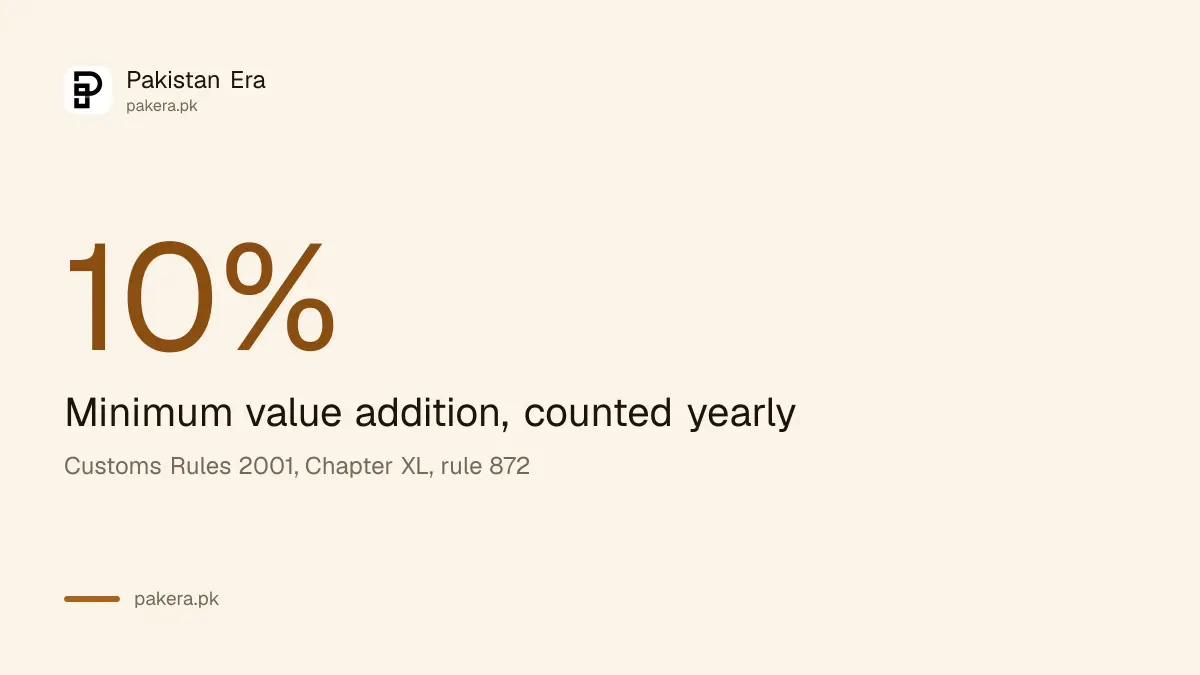
EFS is open to sales tax registered manufacturer-cum-exporters, indirect exporters, commercial exporters, toll manufacturers and Common Export Houses. A manufacturer-cum-exporter must add at least 10 per cent value, counted yearly in US dollars for imported goods and in rupees for local goods.
An indirect exporter is a factory that makes goods for another exporter on a firm order. A commercial exporter buys finished goods and exports them in the same state. Both need a sales tax registration, and the rules say you must also be registered in the WeBOC or PSW system.
Two limits matter. Raw cotton, cotton yarn and grey cloth are outside the scheme, and so is iron and steel scrap, apart from copper content in compressor and motor scrap. If your product is banned or restricted for export, you need separate permission from the Ministry of Commerce. Look this up first, by checking whether your goods are banned for export.
Your category sets the security and the authorization period
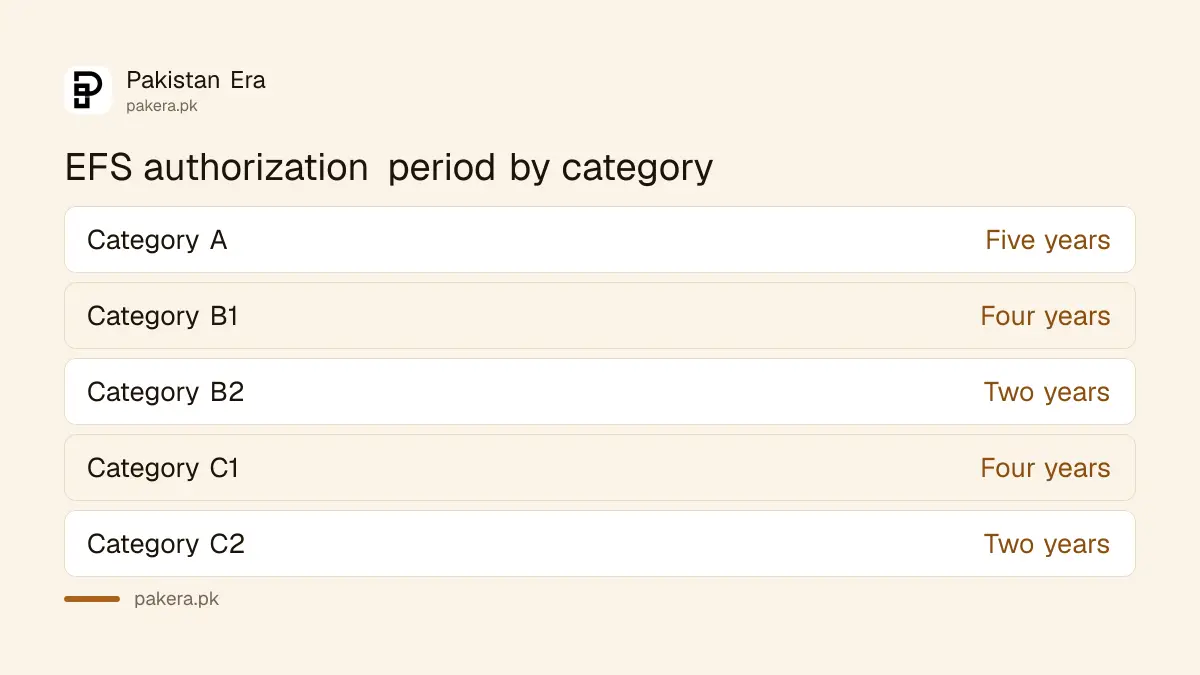
The rules sort exporters into Category A, B1, B2, C1 and C2. Category A gets five years. B1 and C1 get four years. B2 and C2, the newer exporters with under three years of history, get two years and must lodge a bank or insurance guarantee for their yearly need.
| Category | Who it covers | Authorization period |
|---|---|---|
| A | Manufacturer-cum-exporters exporting 60% or more of output, or at least USD 20 million, in the last two years | Five years |
| B1 | Other manufacturer-cum-exporters with more than 3 years of export history | Four years |
| B2 | Other manufacturer-cum-exporters with under 3 years of history | Two years |
| C1 | Indirect exporters, commercial exporters and toll manufacturers with more than 3 years of history | Four years |
| C2 | The same group with under 3 years of history | Two years |
The authorization value is uploaded year by year, based on the yearly need that the Input Output Coefficient Organization (IOCO) sets. The next year's value is released only if no action is pending against you and your reconciliation statements are filed.
On security, Category A exporters with USD 20 million or more in exports give an indemnity bond and post-dated cheque. Smaller ones add a bank guarantee, revolving bank guarantee or insurance guarantee for the extra duty and taxes. An exporter with no history can apply on a firm contract. Contracts above USD 1 million need the Chief Collector's approval, unless you show a bank proof of advance payment.
You apply online with a fixed set of papers
Apply online to the Regulatory Collector, meaning the Collector of Customs where your registered factory or office sits. Use the format in Appendix I of the rules. You can apply on export performance, on a firm contract, or on both at once, and one consolidated approval can cover several contracts.
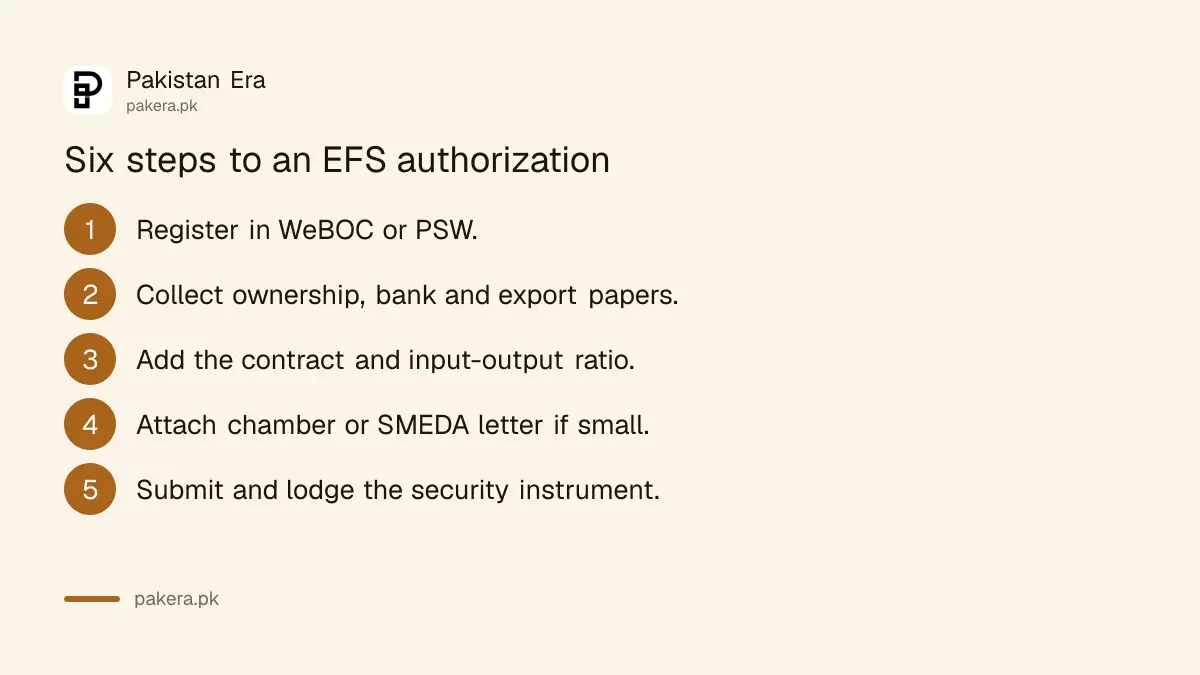
- Register your business in WeBOC or PSW and keep your sales tax registration current.
- Collect the papers: ownership documents or a lease covering the whole utilization period, bank statements for two years, export performance, a list of plant and machinery, and your vendor list.
- Add the contract or supply order if you apply on a contract, and your input-output ratio for one unit of product.
- For a small or medium exporter, attach the recommendation of your chamber of commerce, trade association or SMEDA.
- Submit the application with the approximate value of the input goods and lodge your security instrument.
- Wait for the IOCO to fix your capacity and input-output ratios, then use the authorization number on every import Goods Declaration.
If you are not yet a registered trader, start with the 19 items FBR lists for a WeBOC user ID. A first-time exporter also has to register as an exporter on WeBOC and TDAP.
IOCO has 60 days, and a late IOCO still lets you start
The rules give the Customs Input Output Coefficient Organization 60 days to fix your production capacity and input-output ratios. If it misses that date, you may acquire 25 per cent of the declared input value against a bank guarantee. That permission is provisional until IOCO finishes.
No application can be rejected without a hearing. If you disagree with IOCO's ratios, you can file a review before the Director General IOCO, or before the Chief Collector if the Regulatory Collector processed your case. The review is to be decided within 15 days. An order of the Regulatory Collector can be appealed to the Chief Collector within 30 days, and the appeal is to be decided in 30 days.
Your authorization can also be suspended. The Regulatory Collector may suspend it while deciding whether to cancel, and a suspension that is not decided within 30 days lapses. If goods are removed illegally or not used in time, the collector can encash your guarantee or cheque.
Use the goods in time and keep clean records
Inputs must be used in export products within the utilization period. The consolidated text shows nine months replaced by eighteen months from 7 March 2025, with up to six more months by committee approval in exceptional cases. Keep stock records, because officers can count your inputs at any time.
You must upload local acquisitions to the system within the time the rules set, keep records of applications, acquisitions, exports and disposals, and file the reconciliation statement in Appendix IV. If you fail to file, the system blocks further imports. Audit is yearly, and a proven fiscal fraud can lead to blacklisting of the CNIC of the owner, partners or directors.
Plant and machinery imported under EFS must stay for five years. Selling it earlier means full duty and taxes in the first three years, 75 per cent in year four and 50 per cent in year five. Selling output or leftover inputs inside Pakistan follows its own limits and surcharge. If you also need export credit cover, look at EXIM Bank's export credit insurance.
Common questions about EFS authorization
Who can apply for EFS in Pakistan?
Sales tax registered manufacturer-cum-exporters, indirect exporters, commercial exporters, toll manufacturers and Common Export Houses can apply. They must be registered in WeBOC or PSW, and manufacturers must add at least 10 per cent value.
Do I need export history to get EFS?
No. A new exporter can apply on a firm export contract. The Regulatory Collector scrutinises finances, capacity and local supply history, and contracts above USD 1 million need Chief Collector approval unless you show a bank proof of advance payment.
How long does EFS authorization last?
It lasts five years for Category A, four years for B1 and C1, and two years for B2 and C2. The value of inputs is uploaded for each year, based on your yearly need.
Can I import raw cotton or yarn under EFS?
No. The rules exclude raw cotton, cotton yarn and grey cloth from the scheme. Iron and steel scrap is also excluded, except the copper content of compressor and motor scrap.
What happens if the collector rejects my application?
You must first get a hearing. You can then ask for a review, decided within 15 days. Orders of the Regulatory Collector can be appealed to the Chief Collector within 30 days.
How we verified this
What we checked, where we read it, and what we could not confirm.
Last checked 14 October 2026. Everything above comes from Chapter XL, Export Facilitation Scheme 2021, of the Customs Rules, 2001, in the consolidated text posted on the FBR website as of 17 June 2026. The text carries tracked changes, so check the latest SRO before you rely on a time limit. We have not applied under the scheme ourselves, and IOCO processing times in practice may differ from the 60 days in the rules. Start from fbr.gov.pk for any new notification.
About the author

Global Affairs & Political Economy Writer
Muhammad Hatim is a book lover who started writing because he enjoys it. At Pakistan Era he writes about international relations, geopolitics and the global economy, with a particular interest in South Asia and the forces behind current events.