How to Sell EFS Goods or Leftover Inputs in Pakistan: The 20% Cap, 5% Rejects and KIBOR Plus 3% Surcharge
EFS users may sell 20% of output and 5% rejects in Pakistan on duty and taxes. See the KIBOR plus 3% surcharge, wastage rules and options for unused inputs.
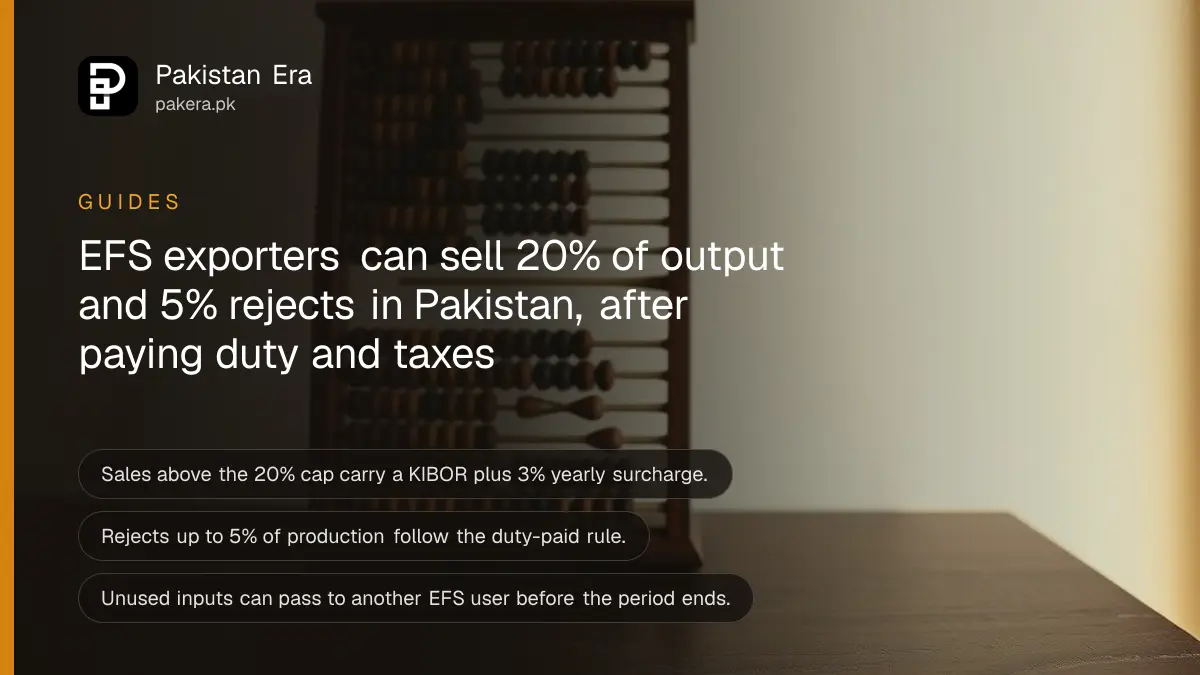
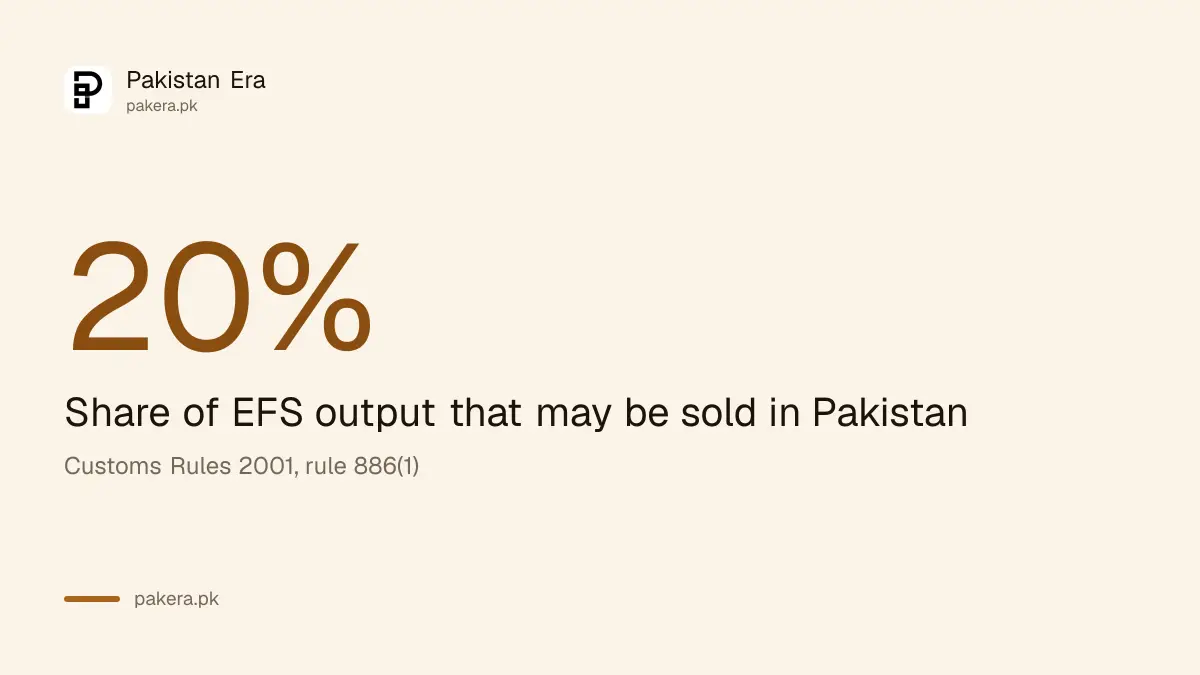
An exporter on the Export Facilitation Scheme (EFS) may sell up to 20 per cent of its output in Pakistan, if it pays the duty and taxes as if the goods were imported. Rejects up to 5 per cent of production follow the same payment rule. Anything above the limits, and unused inputs sold after the utilization period, carry an extra surcharge of KIBOR plus 3 per cent a year.
KIBOR is the Karachi Interbank Offered Rate, a benchmark bank lending rate that changes with the market. The rules are in rules 886 to 888 of Chapter XL of the Customs Rules, 2001, which we read in the consolidated text FBR posted on 17 June 2026. Each sale needs a Goods Declaration and the satisfaction of your Regulatory Collector.
You can sell up to 20 per cent of EFS output at home
A user may sell up to 20 per cent of the output goods made from duty-free inputs in the Pakistani market. The sale is made on a Goods Declaration, assessed as if the goods were imported in that condition. The Regulatory Collector must accept your reasons for selling at home.
The 20 per cent is a ceiling, not a right. The collector decides whether your reason is acceptable, so keep your export contract and any proof of why the export did not happen. The duty and taxes are paid at the rate for the finished goods, not for the raw material you used.
If you cannot export the rest and want to sell more than 20 per cent, the same route is open. The extra cost is a surcharge of KIBOR plus 3 per cent a year on the value of the input goods used in the output you sell, again with the collector's agreement.
Rejects have their own 5 per cent allowance
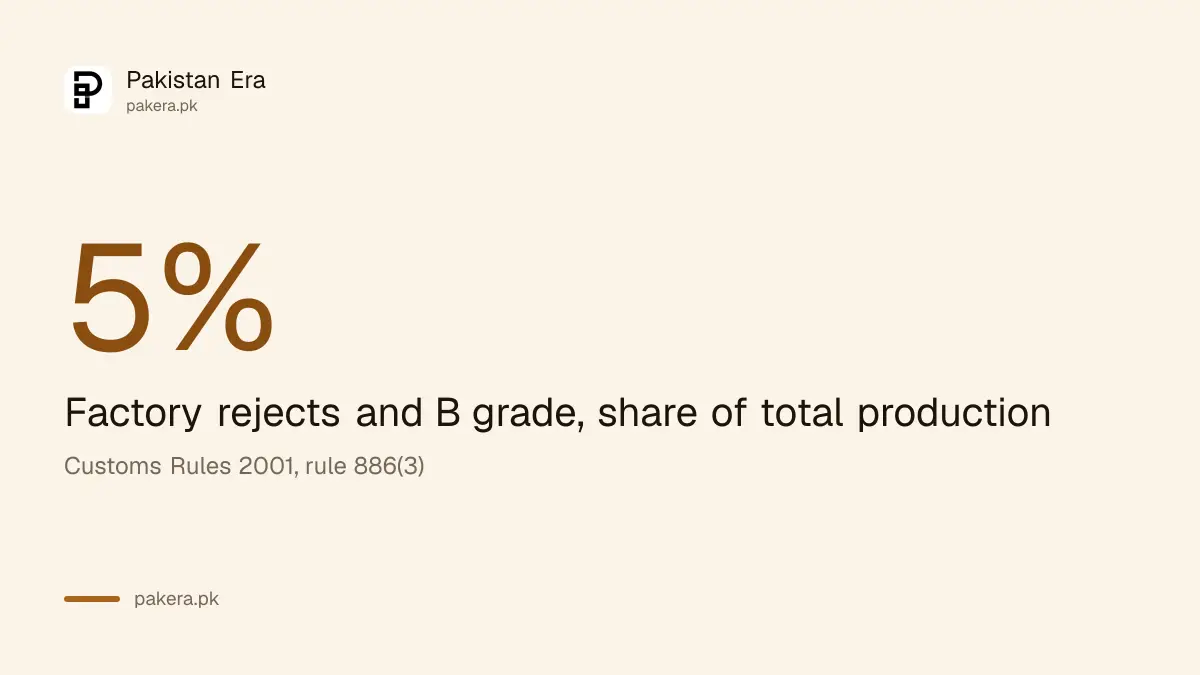
Factory rejects or B grade goods, up to 5 per cent of total production, may be sold in Pakistan on payment of the leviable duty and taxes, on a Goods Declaration. If they exceed 5 per cent, the goods are assessed as if they were imported in standard condition, which costs more.
| What you sell at home | Limit | What you pay |
|---|---|---|
| Output goods | Up to 20% of output | Duty and taxes as if imported |
| Output goods above the limit | With collector's satisfaction | Duty and taxes plus KIBOR + 3% a year on the input value |
| Rejects and B grade | Up to 5% of production | Duty and taxes as if imported |
| Rejects above 5% | Over the allowance | Assessed as standard goods |
| Excess wastage | Above the analysis certificate | Duty and taxes on inputs plus KIBOR + 3% |
If the product is banned under the import policy order, a domestic sale needs approval from the Ministry of Commerce. Check the export policy for your goods early, because it also governs what you may export.
Wastage is free of duty only within the analysis certificate
Each user has an analysis certificate that sets the input-output ratio and allowed wastage. Wastage within that limit carries no duty if you destroy it before an officer of at least Assistant Collector rank, or if you pay excise duty and sales tax before it leaves your premises.
You may also hand permissible wastage to another EFS user. If your wastage is higher than the certificate allows, you can sell it in Pakistan only after paying duties on the input goods and the KIBOR plus 3 per cent surcharge. The system records each such step, so the numbers should match your stock book.
Unused inputs can move on, be sold or be destroyed
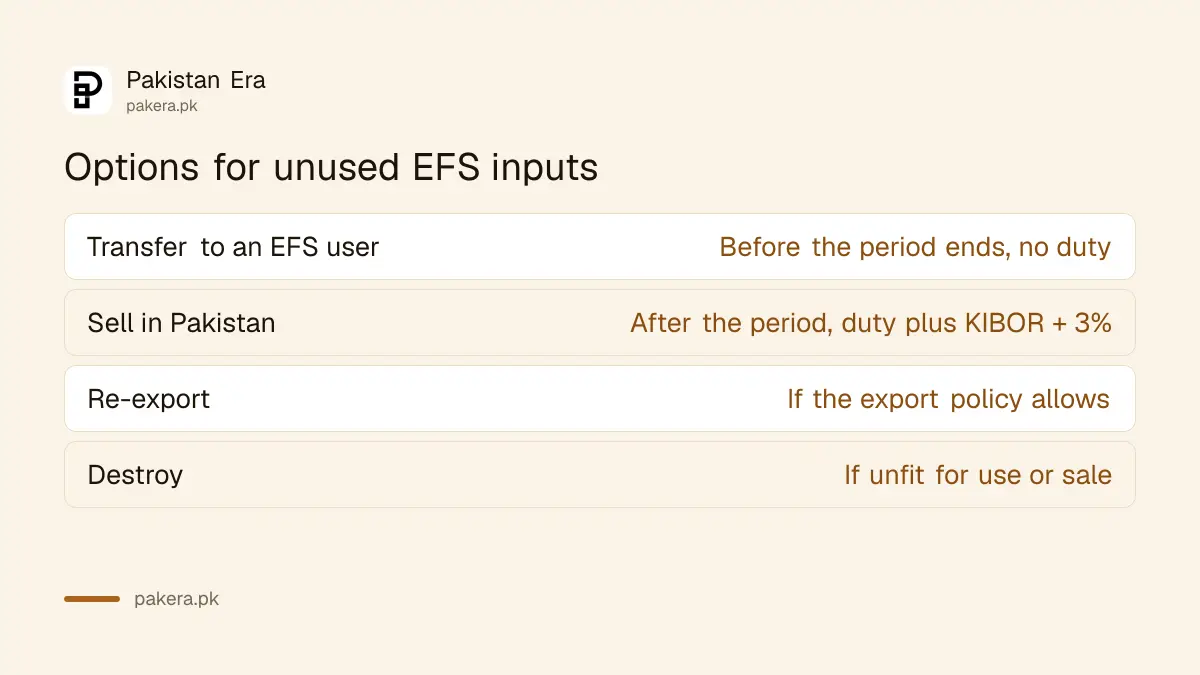
With the collector's approval, you can pass unused inputs to another authorized user before the utilization period ends, without duty. After the period ends, you can sell them in Pakistan on payment of duties and the surcharge. You can also re-export them if the export policy allows, or destroy goods unfit for use.
- Write to the Regulatory Collector and say which option you want.
- Wait for approval before you move, sell or destroy anything.
- File the Goods Declaration for a domestic sale and pay the duties and any surcharge.
- For a transfer, give the other user the details and keep the paperwork.
- The collector cuts your authorized value in the system within seven days.
Finished goods that you cannot export follow a shorter list: transfer to another EFS user, or destroy goods that are unfit. A domestic sale of such goods falls under the 20 per cent rule above. Goods lost in a fire or flood may qualify for remission of duty and tax if the collector is satisfied, but not where insurance covers the risk.
Refunds and drawback sit on the other side
EFS users can claim a sales tax refund on tax-paid inputs, including electricity, gas and services used for export products, as the Sales Tax Act allows. Duty drawback on duty-paid inputs can be claimed only after you have discharged your EFS obligations. See how to claim a sales tax refund from FBR.
Before you sell anything at home, make sure your authorization is not suspended, because a poor compliance record can lead to suspension. If you are still applying, start with how to get an EFS authorization. To estimate the duty you would pay, find the customs duty on a product by PCT code.
Common questions about selling EFS goods in Pakistan
How much of my EFS output can I sell in Pakistan?
Up to 20 per cent of output, on payment of duty and taxes as if the goods were imported. You can sell more with the collector's agreement, but a KIBOR plus 3 per cent surcharge applies.
Can I sell rejects from an EFS factory locally?
Yes, up to 5 per cent of total production, on payment of duty and taxes. Above 5 per cent, the goods are assessed as if they were imported in standard condition.
What is the KIBOR plus 3 per cent surcharge?
It is a yearly charge on the value of input goods used in goods sold at home beyond the limits. KIBOR is the interbank benchmark rate, so the surcharge moves with the market.
Do I pay duty on wastage?
Not on wastage within the analysis certificate, if you destroy it before an officer of Assistant Collector rank or pay excise duty and sales tax before removal.
Can I transfer unused inputs to another exporter?
Yes, with approval from the Regulatory Collector and before your utilization period ends, to another authorized EFS user, without duty. The collector adjusts both authorizations within seven days.
How we verified this
What we checked, where we read it, and what we could not confirm.
Last checked 14 October 2026. All limits and surcharges come from rules 886 to 890 and 895 of the Export Facilitation Scheme in the consolidated text posted on the FBR website as of 17 June 2026. We did not see the current KIBOR figure on an official page, so we give no rate. We have not made a domestic sale under the scheme ourselves, and a later SRO may have changed the text. Check fbr.gov.pk before you act.
About the author

Global Affairs & Political Economy Writer
Muhammad Hatim is a book lover who started writing because he enjoys it. At Pakistan Era he writes about international relations, geopolitics and the global economy, with a particular interest in South Asia and the forces behind current events.